A high-speed magnetic levitation (maglev) test sled travels along a straight, horizontal track.
How is the velocity of the maglev sled different from its speed?
The sled's linear induction propulsion system exerts a backward electromagnetic force on the track's stators to propel the sled forward. Explain how Newton's third law of motion applies to this interaction.
The distance-time graph below shows the movement of the maglev sled during a test run:
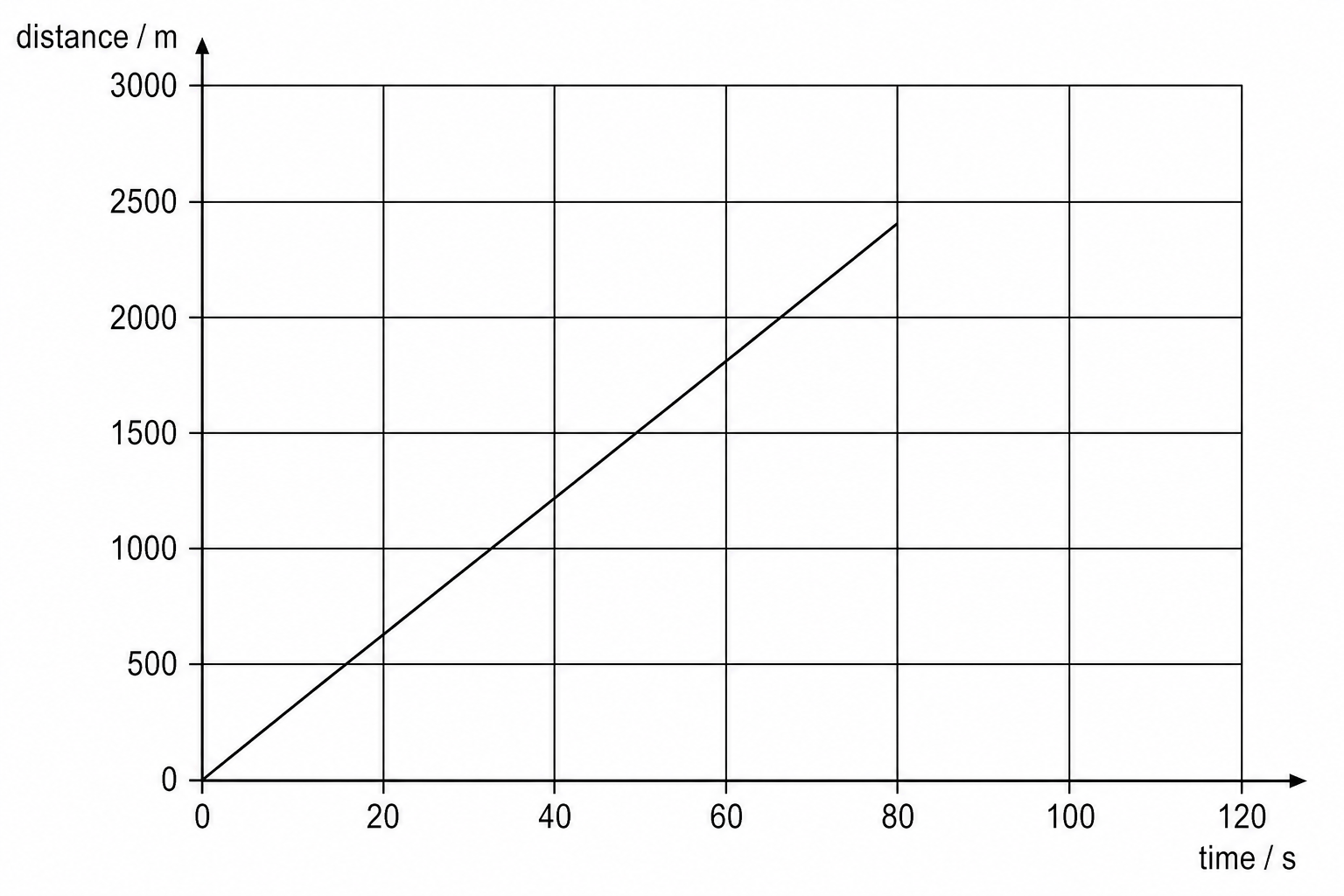
Determine the speed of the maglev sled.
Write down the equation that links acceleration (aaa), change in velocity (Δv\Delta vΔv), and time taken (ttt).
At a different stage of the run, the maglev sled was travelling at a velocity of 54 m/s.
The sled then decelerated at a constant rate of 1.8 m/s2.
Calculate the time taken for the sled to decelerate from 54 m/s to 18 m/s.
Write down the equation that links distance (sss), force (FFF), and work done (WWW).
When the sled's emergency brakes were fully engaged to bring it to a stop, it travelled a distance of 80 m.
The work done by the braking force to stop the sled was 440,000 J440,000\text{ J}440,000 J.
Calculate the mean braking force used to stop the sled.
Forces and motion Questions
Practise AQA GCSE Physics Forces and motion with exam-style questions for Foundation and Higher tier. 83 questions covering Describing motion along a line, Forces, accelerations and Newton's Laws of motion, and Forces and braking, matched to the AQA GCSE Physics (8463) specification and written in Paper 1 and Paper 2 style. Every question includes a full worked solution and mark scheme, so you can see where marks are awarded rather than just whether you got the answer right.