Pneumatic Test Sled Run
An engineering team is testing a pneumatically-powered research sled on a straight, horizontal track.
Complete the sentence by choosing from: equal to, greater than, less than.
The magnitude of the force from the high-pressure air pushing forwards on the sled is _________________ the magnitude of the force from the sled pushing backwards on the air.
Figure 1 shows a distance-time graph for the sled from the moment it is launched.
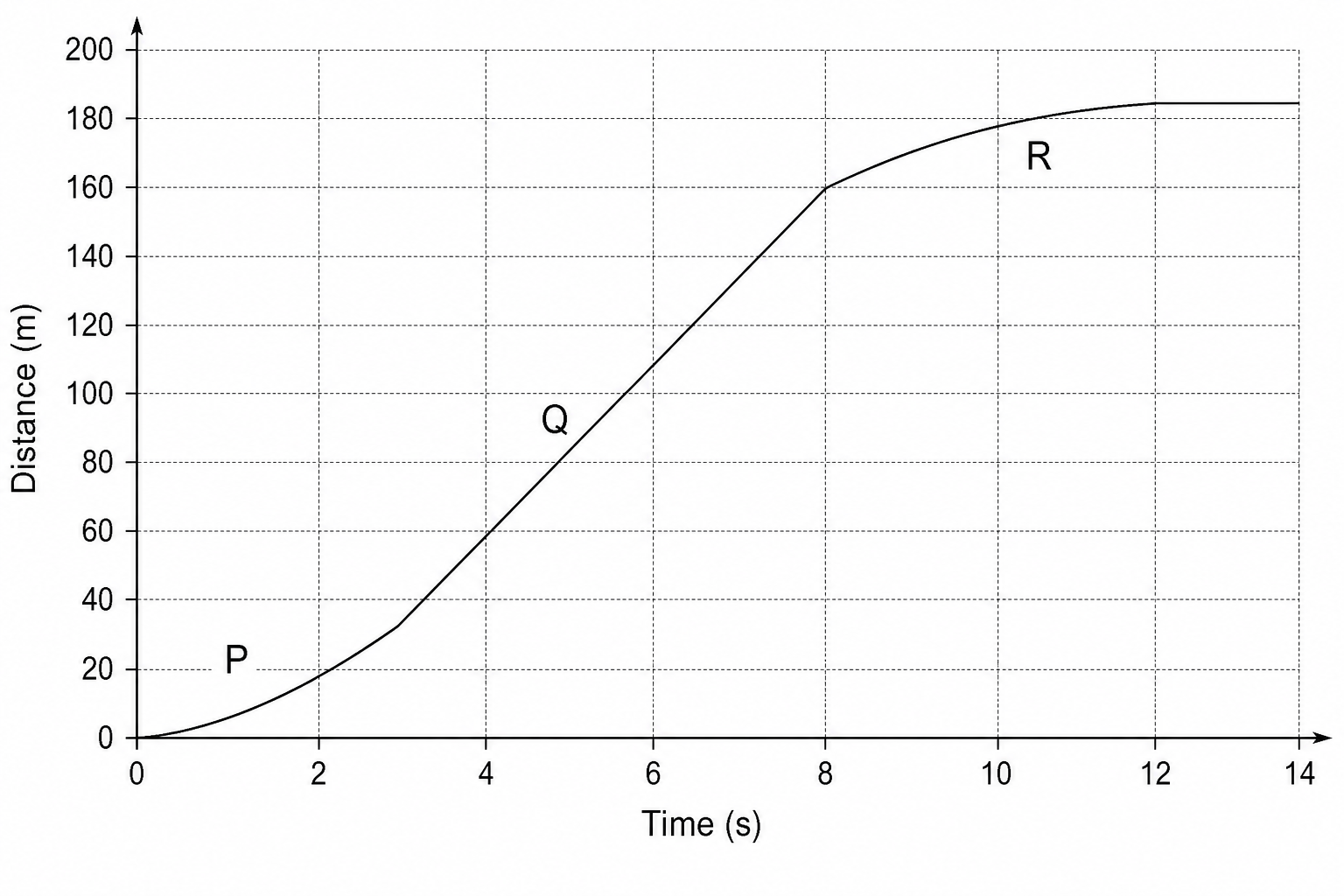
Three sections of the distance-time graph are labelled P, Q, and R. Draw one line from each of the labels to the correct description of the sled's motion:
- P
- Q
- R
Descriptions: not moving, constant speed, decreasing speed, increasing speed.
What distance does the sled travel after passing the 160-metre marker before coming to a complete stop?
Calculate the average speed of the sled between the start of the run and the 160-metre marker. Use the equation:
average speed=distance travelledtime taken \text{average speed} = \frac{\text{distance travelled}}{\text{time taken}} average speed=time takendistance travelledWhat is the average running speed of a typical healthy adult in metres per second? Choose one box:
- 1.5
- 3.0
- 4.5
- 6.0