An industrial testing facility uses sealed spherical storage pods to hold different chemical solutions.
Four different pods, labeled P, Q, R, and S, have the same external volume but are made of different materials and contain different solutions. They are shown floating in a tank of water below.
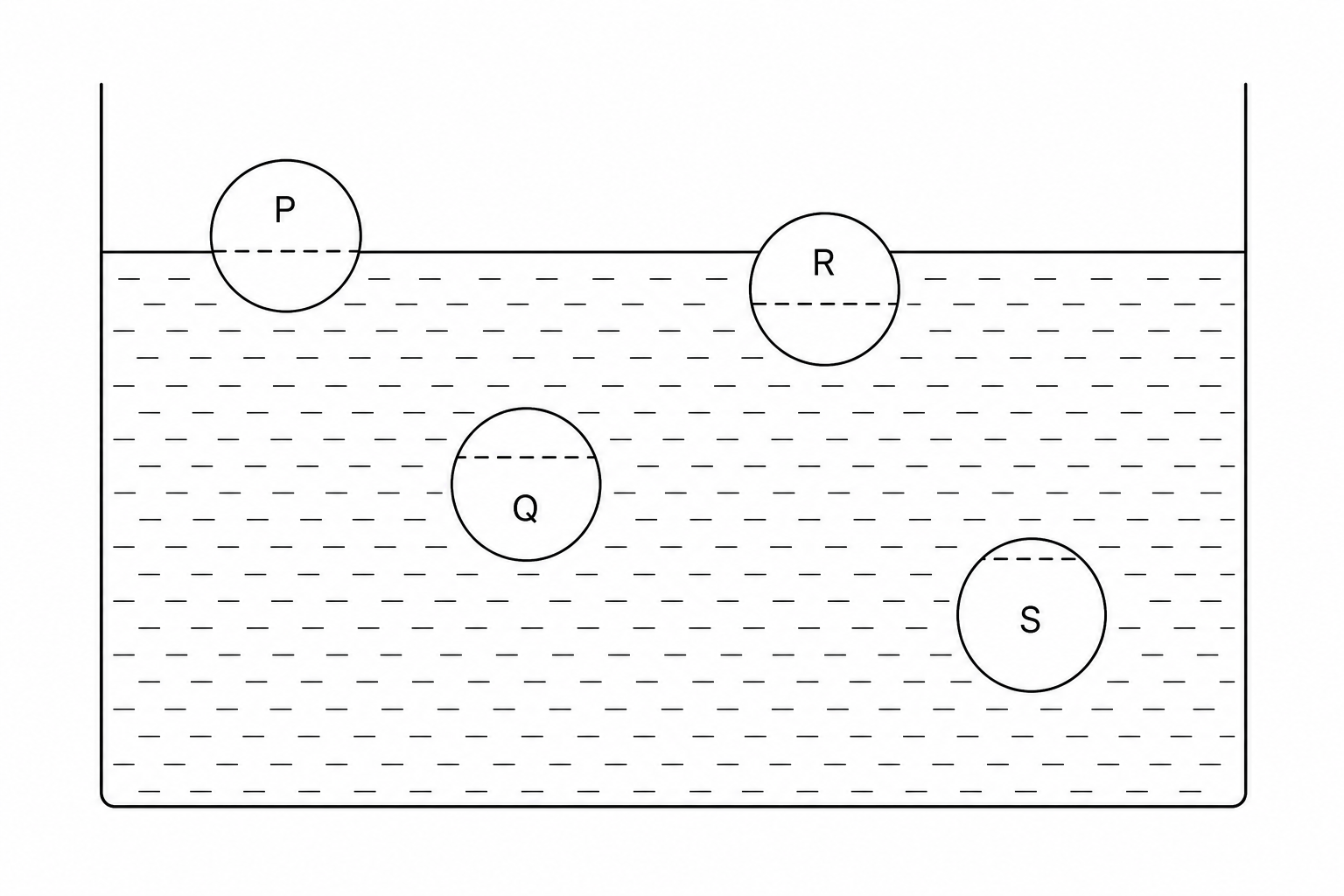
Which pod has the largest weight?
One of the pods has a mass of 35 kg35\text{ kg}35 kg. The gravitational field strength on Earth is 9.8 N/kg9.8\text{ N/kg}9.8 N/kg. Calculate the weight of this pod. Use the equation: weight=mass×gravitational field strength\text{weight} = \text{mass} \times \text{gravitational field strength}weight=mass×gravitational field strength
When a pod is floating at rest on the water, the two vertical forces acting on it are its weight downwards and the upthrust upwards. How does the magnitude of the upthrust compare to the weight of the pod?
- The upthrust is greater than the weight.
- The upthrust is less than the weight.
- The upthrust is equal to the weight.
Write down the equation which links acceleration, mass, and resultant force.
An overhead winch pulls one of the pods upwards with a cable. A vertical resultant force of 112.0 N112.0\text{ N}112.0 N acts on the pod. Calculate the acceleration of the pod if its mass is 35 kg35\text{ kg}35 kg.
Forces and motion Questions
Practise AQA GCSE Physics Forces and motion with exam-style questions for Foundation and Higher tier. 83 questions covering Describing motion along a line, Forces, accelerations and Newton's Laws of motion, and Forces and braking, matched to the AQA GCSE Physics (8463) specification and written in Paper 1 and Paper 2 style. Every question includes a full worked solution and mark scheme, so you can see where marks are awarded rather than just whether you got the answer right.