Question 2
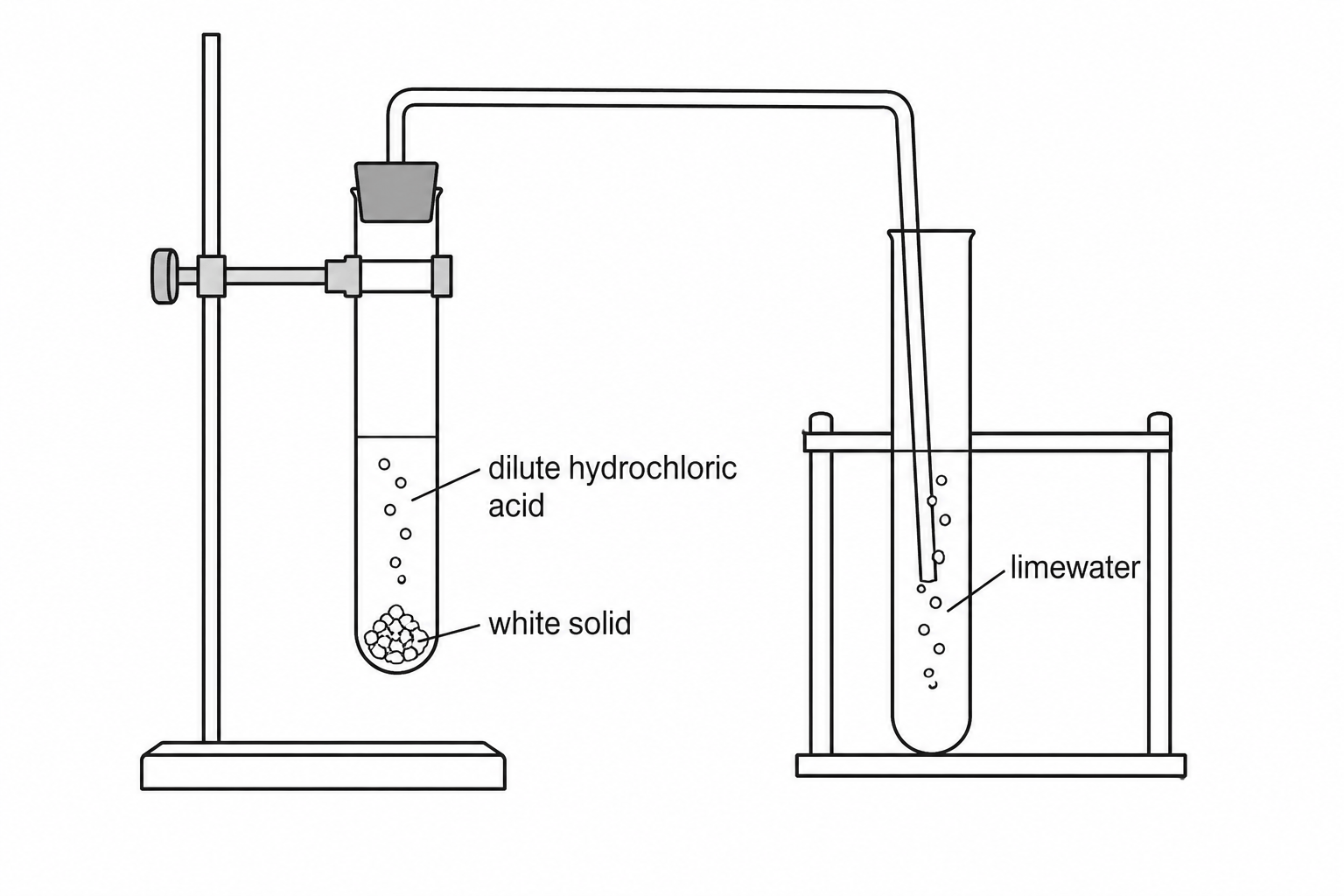
FA student tests a white solid to find out whether it contains carbonate ions. The student adds dilute hydrochloric acid to the solid and passes the gas produced into limewater.
Figure: The apparatus a student uses to test the gas produced when dilute hydrochloric acid is added to a white solid
a.[1]
Name the gas produced when a carbonate reacts with a dilute acid.
b.[1]
Give what the student sees in the limewater if the gas is carbon dioxide.
c.[2]
The white solid is calcium carbonate. Complete the word equation for the reaction.
calcium carbonate + hydrochloric acid →\rightarrow→
8.3 Identification of ions by chemical and spectroscopic means Questions
40 exam-style questions on AQA GCSE Chemistry 8.3 Identification of ions by chemical and spectroscopic means, covering 8.3.1 Flame tests, 8.3.2 Metal hydroxides, 8.3.3 Carbonates, 8.3.4 Halides, 8.3.5 Sulfates, 8.3.6 Instrumental methods, and 8.3.7 Flame emission spectroscopy. Each one has a worked solution and a mark scheme showing where the marks go.