Skip to content

Course home

8.3 Identification of ions by chemical and spectroscopic means

8.3 Identification of ions by chemical and spectroscopic means

EasyMedium
12345678910111213141516171819202122232425262728
Question 2

A student investigated an aqueous solution of an unknown salt. The student identified that the salt solution contained only calcium ions and chloride ions.

a.

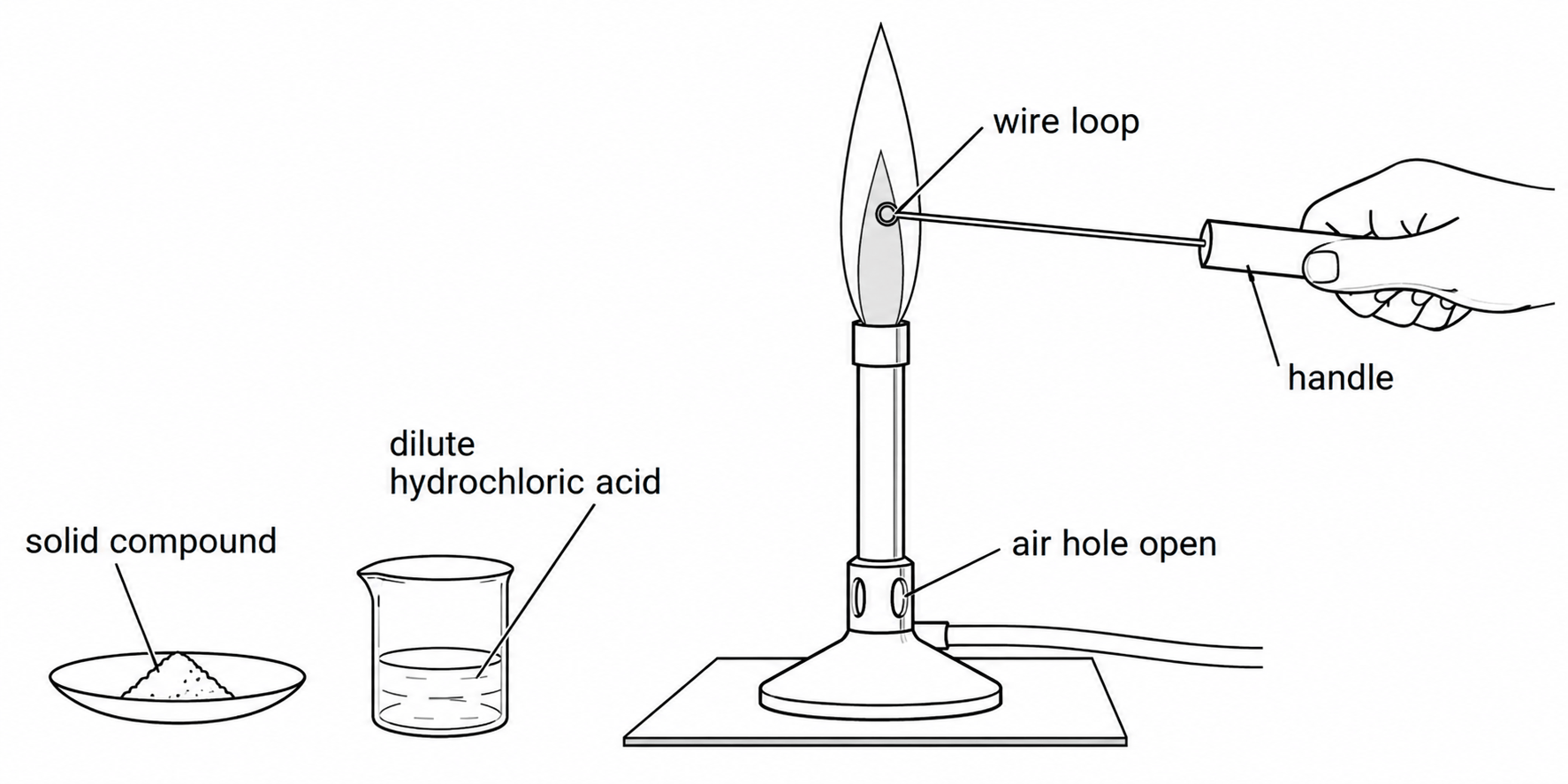
Describe a test to identify calcium ions. Give the result of the test.

[2]
b.

Describe a test to identify chloride ions. Give the result of the test.

[2]
c.

The student determined the concentration of calcium chloride in the salt solution using the following method:

  1. Weigh an empty evaporating basin.
  2. Add 25.0 cm325.0\text{ cm}^325.0 cm3 of the salt solution into the evaporating basin.
  3. Heat the evaporating basin and contents.
  4. Weigh the evaporating basin and contents.
  5. Repeat steps 3 to 4 until there is no further change in mass.
  6. Repeat steps 1 to 5 three more times.

Why did the student heat the evaporating basin and contents until the mass did not change?

[1]
d.

How did the student calculate the mass of solid calcium chloride remaining after steps 1 to 5?

Select one option:

  • Option A: Mass of 25.0 cm3 of salt solution+mass of empty evaporating basin\text{Mass of } 25.0\text{ cm}^3\text{ of salt solution} + \text{mass of empty evaporating basin}Mass of 25.0 cm3 of salt solution+mass of empty evaporating basin
  • Option B: Mass of 25.0 cm3 of salt solution−mass of empty evaporating basin\text{Mass of } 25.0\text{ cm}^3\text{ of salt solution} - \text{mass of empty evaporating basin}Mass of 25.0 cm3 of salt solution−mass of empty evaporating basin
  • Option C: Mass of evaporating basin and dry contents+mass of empty evaporating basin\text{Mass of evaporating basin and dry contents} + \text{mass of empty evaporating basin}Mass of evaporating basin and dry contents+mass of empty evaporating basin
  • Option D: Mass of evaporating basin and dry contents−mass of empty evaporating basin\text{Mass of evaporating basin and dry contents} - \text{mass of empty evaporating basin}Mass of evaporating basin and dry contents−mass of empty evaporating basin
[1]
e.

The student calculated the concentration of calcium chloride in the salt solution. Table 1 shows the results:

Trial 1 (g/dm3\text{g/dm}^3g/dm3)Trial 2 (g/dm3\text{g/dm}^3g/dm3)Trial 3 (g/dm3\text{g/dm}^3g/dm3)Trial 4 (g/dm3\text{g/dm}^3g/dm3)
34.835.434.635.2

The percentage by mass of calcium ions in calcium chloride is 36.1%36.1\%36.1%.

Calculate the mean concentration of calcium ions in the salt solution.

[3]
Markscheme

8.3 Identification of ions by chemical and spectroscopic means Questions

  1. GCSE
  2. /Chemistry
  3. /8.3 Identification of ions by chemical and spectroscopic means

29 exam-style questions on AQA GCSE Chemistry 8.3 Identification of ions by chemical and spectroscopic means, covering 8.3.1 Flame tests, 8.3.2 Metal hydroxides, 8.3.3 Carbonates, 8.3.4 Halides, 8.3.5 Sulfates, 8.3.6 Instrumental methods, and 8.3.7 Flame emission spectroscopy. Each one has a worked solution and a mark scheme showing where the marks go.

Question bank