Question 3
FHuman papillomavirus (HPV) is spread by sexual contact. Infection with some types of HPV can lead to cervical cancer.
In 2008, a programme started to vaccinate girls aged 12 to 13 against HPV.
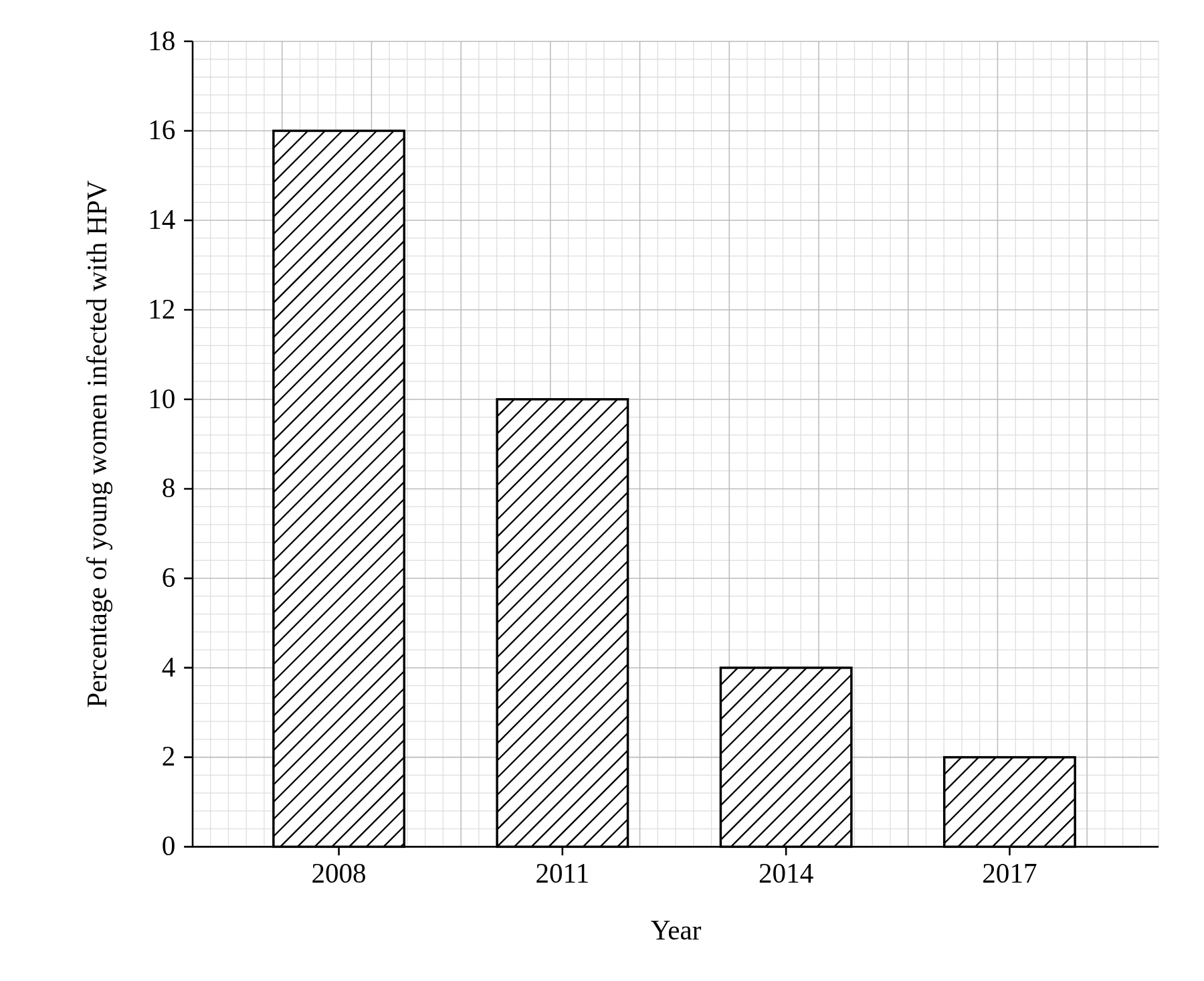
The Figure shows the percentage of young women infected with HPV in one country between 2008 and 2017.
Figure
a.[2]
Cancer is caused by changes in cells.
Describe how a tumour forms.
b.[2]
Calculate the percentage decrease in young women infected with HPV between 2008 and 2017.
Use the Figure.
c.[2]
Explain why the vaccine is given to girls aged 12 to 13, and not to older women.
d.[1]
A doctor says:
'Women who have had the HPV vaccine should still go for regular cervical cancer checks.'
Suggest why.
6.3 Monitoring and maintaining health Questions
181 exam-style questions on OCR GCSE Biology 6.3 Monitoring and maintaining health, covering 6.3.1 Health and disease, 6.3.2 Interactions between diseases, 6.3.3 Spread of communicable diseases, 6.3.4 Common infections and diseases, 6.3.5 Physical plant defence responses, 6.3.6 Chemical plant defence responses, 6.3.7 Detecting and identifying plant diseases, 6.3.8 White blood cells and platelets, 6.3.9 Non-specific defence systems, 6.3.10 The immune system, 6.3.11 Monoclonal antibodies, 6.3.12 Vaccines and medicines, 6.3.13 Aseptic techniques, 6.3.14 Discovery and development of new medicines, 6.3.15 Causes of non-communicable diseases, 6.3.16 Treatments for cardiovascular disease, 6.3.17 Lifestyle factors and non-communicable diseases, 6.3.18 Cancer, 6.3.19 Stem cells in medicine, 6.3.20 Gene technology in medicine, and 6.3.21 The human genome and medicine. Each one has a worked solution and a mark scheme showing where the marks go.