The diagram shows a cross-section of the human spinal cord and the pathway of a spinal reflex arc.
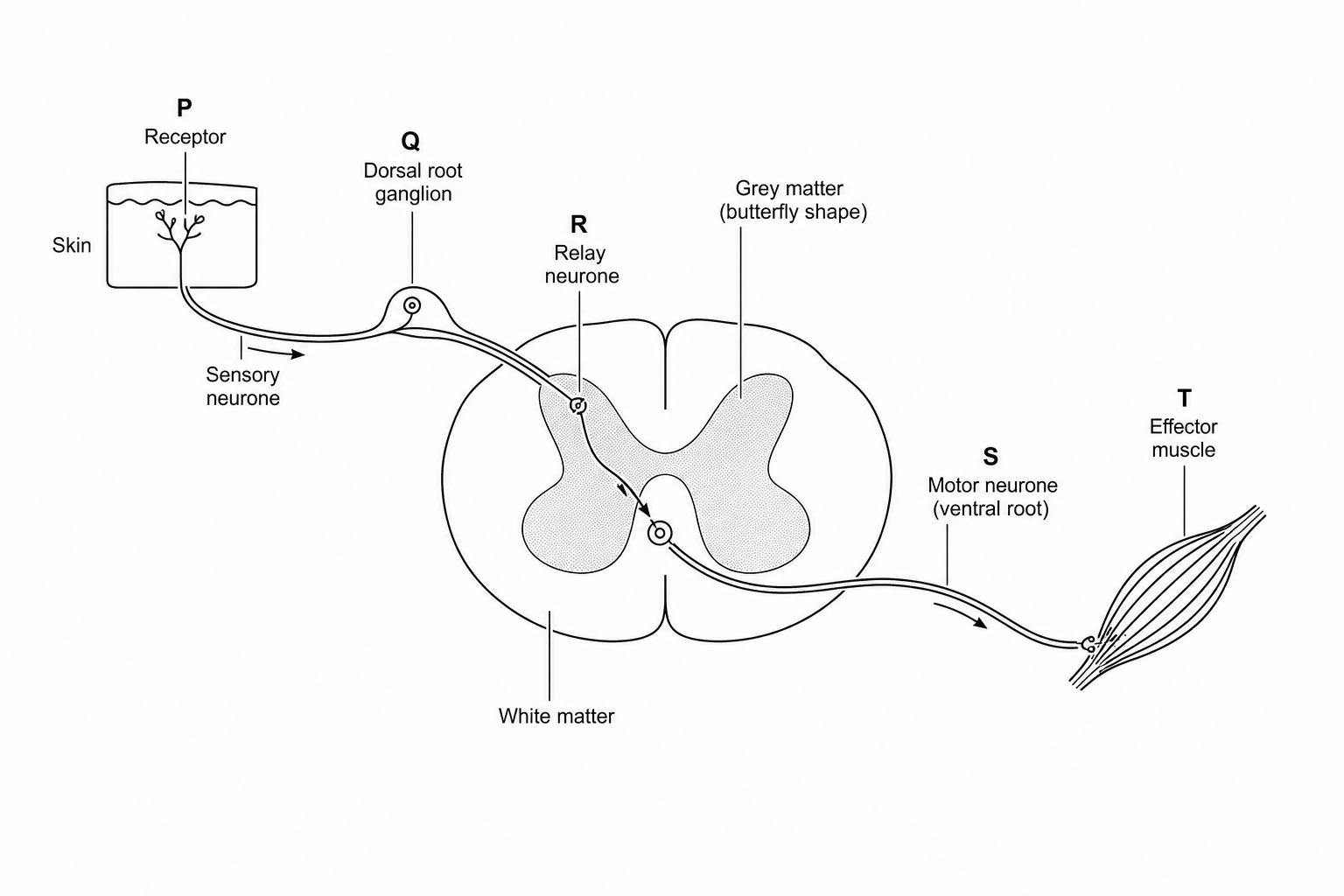
Which sequence correctly describes the direction of nerve impulse transmission during a reflex action, and correctly identifies the anatomical pathways involved?
P→Q→R→S→T\text{P} \rightarrow \text{Q} \rightarrow \text{R} \rightarrow \text{S} \rightarrow \text{T}P→Q→R→S→T, where Q\text{Q}Q is an afferent neurone entering the spinal cord via the dorsal root and S\text{S}S is an efferent neurone exiting via the ventral root.
P→S→R→Q→T\text{P} \rightarrow \text{S} \rightarrow \text{R} \rightarrow \text{Q} \rightarrow \text{T}P→S→R→Q→T, where S\text{S}S is an afferent neurone entering the spinal cord via the ventral root and Q\text{Q}Q is an efferent neurone exiting via the dorsal root.
T→S→R→Q→P\text{T} \rightarrow \text{S} \rightarrow \text{R} \rightarrow \text{Q} \rightarrow \text{P}T→S→R→Q→P, where S\text{S}S is an efferent neurone exiting the spinal cord via the ventral root and Q\text{Q}Q is an afferent neurone entering via the dorsal root.
P→Q→R→S→T\text{P} \rightarrow \text{Q} \rightarrow \text{R} \rightarrow \text{S} \rightarrow \text{T}P→Q→R→S→T, where Q\text{Q}Q is an efferent neurone entering the spinal cord via the dorsal root and S\text{S}S is an afferent neurone exiting via the ventral root.