Coordination and control – the nervous system

EasyMediumHard
12345678910111213141516171819202122232425262728293031
Question 15
Medium

A person walks out of a dark cinema into a brightly lit street.

Diagram C shows the person's eye while inside the dark cinema. Diagram D shows the person's eye after they have walked out into the bright street.
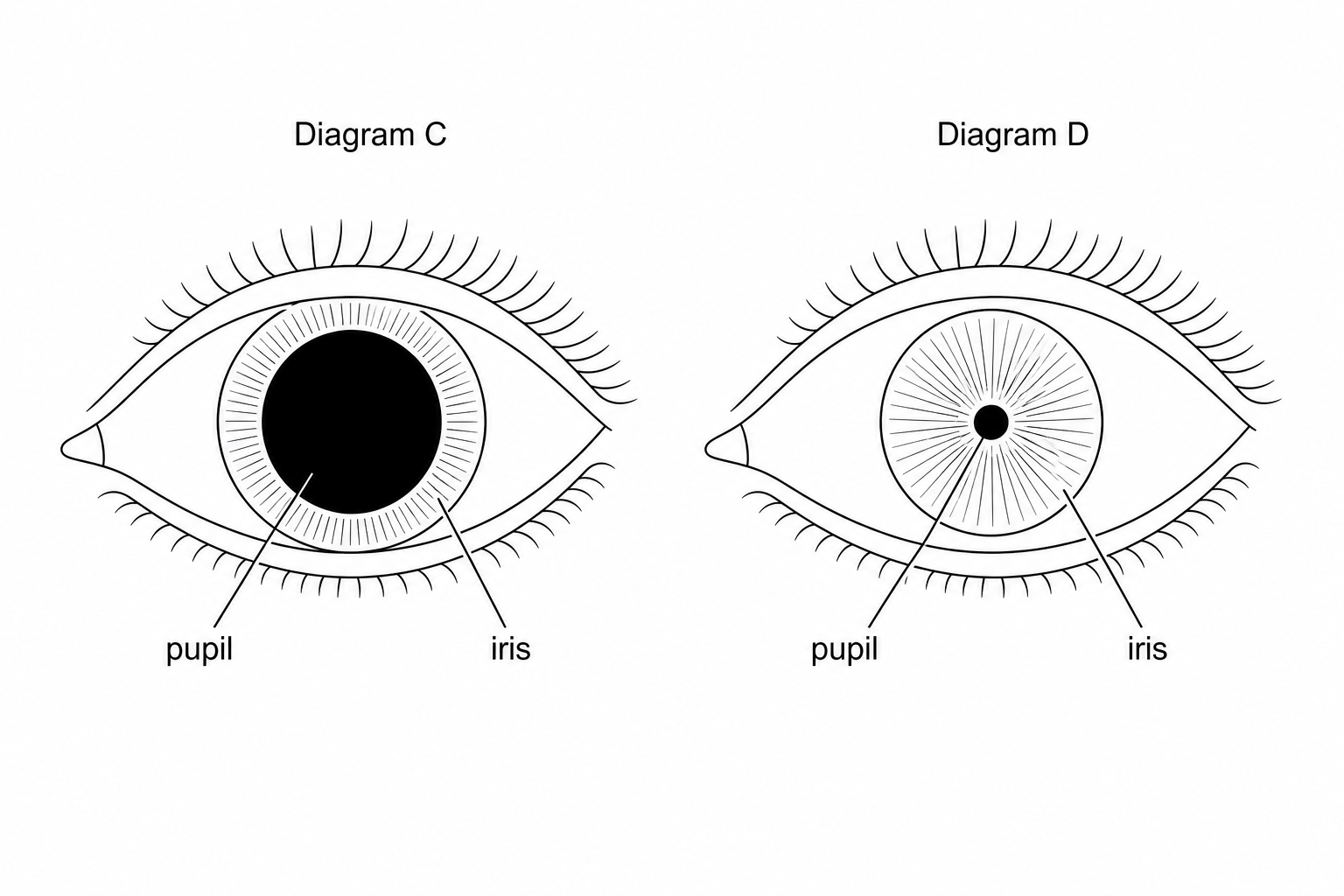
Two diagrams of an eye. Diagram C shows an eye with a very large, dilated pupil occupying most of the iris. Diagram D shows the same eye but with a very small, constricted pupil at the center of the iris.

a.

Explain why the pupil changes from Diagram C to Diagram D, and describe the mechanism that causes this change.

[4]
b.

The diagrams below show how light from a distant object is focused in the eyes of two different people, Person P and Person Q.
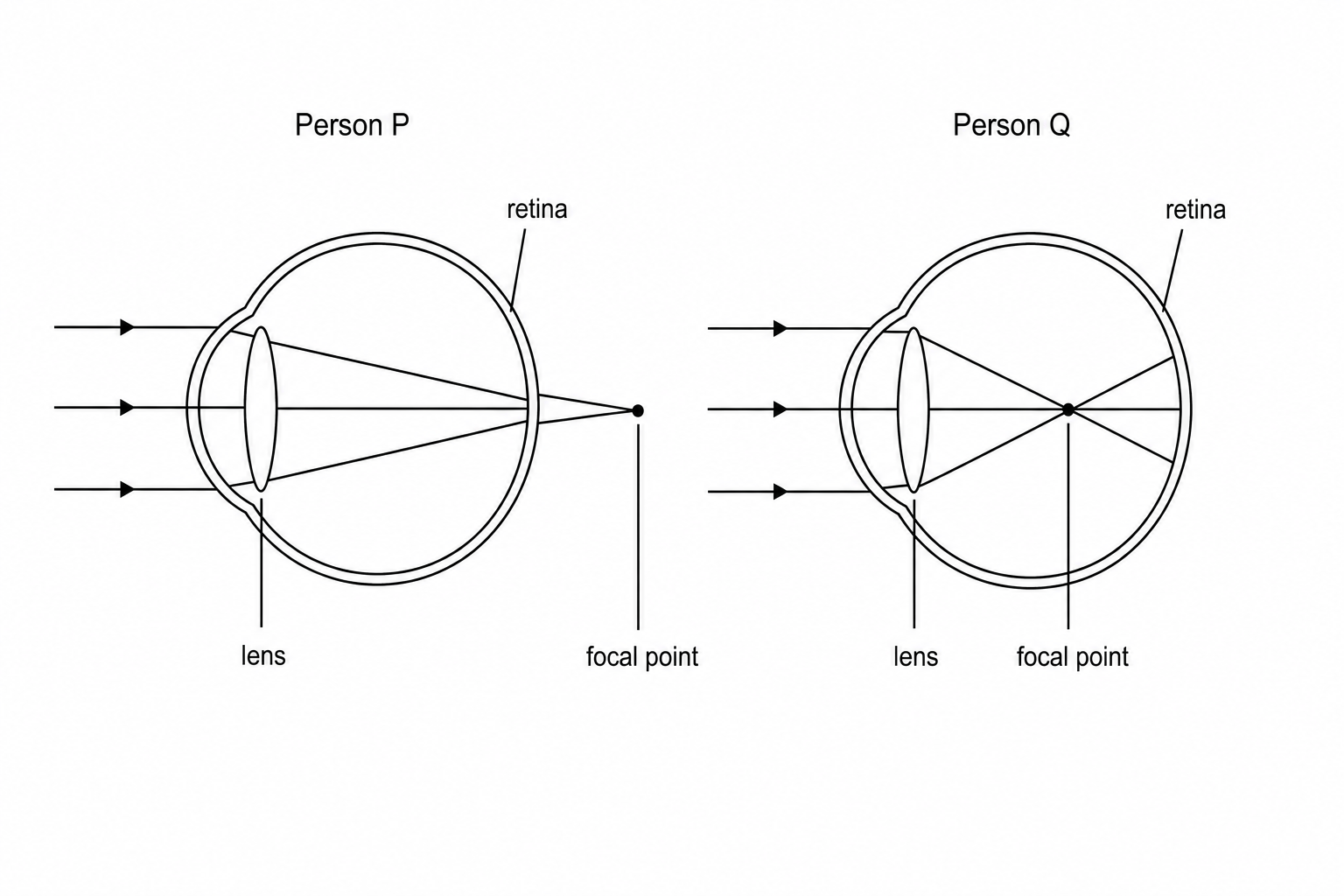
Two diagrams showing simplified horizontal cross-sections of human eyes. In the eye of Person P, two parallel incoming horizontal light rays pass through the lens and converge at a point behind the retina at the back of the eye. In the eye of Person Q, two parallel incoming horizontal light rays pass through the lens and converge at a point in the middle of the eyeball, well in front of the retina.

Name the eye defect shown for each person.

  • Person P
  • Person Q
[2]
c.

Identify the type of corrective lens needed for each person and explain how these lenses work.

[4]

Coordination and control – the nervous system Questions

  1. GCSE
  2. /Biology
  3. /Coordination and control – the nervous system