

YouTube Channels GCSE Geography: Are They Enough?
YouTube channels GCSE Geography guide: learn what videos do well, what they miss, and how to add recall, fieldwork, case studies and exam practice.
A video can make coastal erosion feel obvious in six minutes. The diagrams move, the explanation is tidy, and everything seems to make sense. Then you close the tab and face an exam question asking you to assess whether one coastal management strategy is sustainable. Suddenly, recognising an explanation is not the same as producing one.
So, are YouTube channels for GCSE Geography enough on their own? Usually, no. They can explain difficult content, introduce case studies and make revision easier to begin. But passing also depends on recalling knowledge without prompts, applying it to unfamiliar resources, using fieldwork evidence and writing answers that match the command word. Those abilities develop through active practice, not watching alone.
A strong revision system should include:
- your exam board specification and school guidance;
- concise videos for explanation and review;
- active recall of definitions, processes and case studies;
- practice with maps, graphs, photographs and numerical data;
- fieldwork revision;
- timed exam questions and mark-scheme review;
- deliberate work on weaker topics.
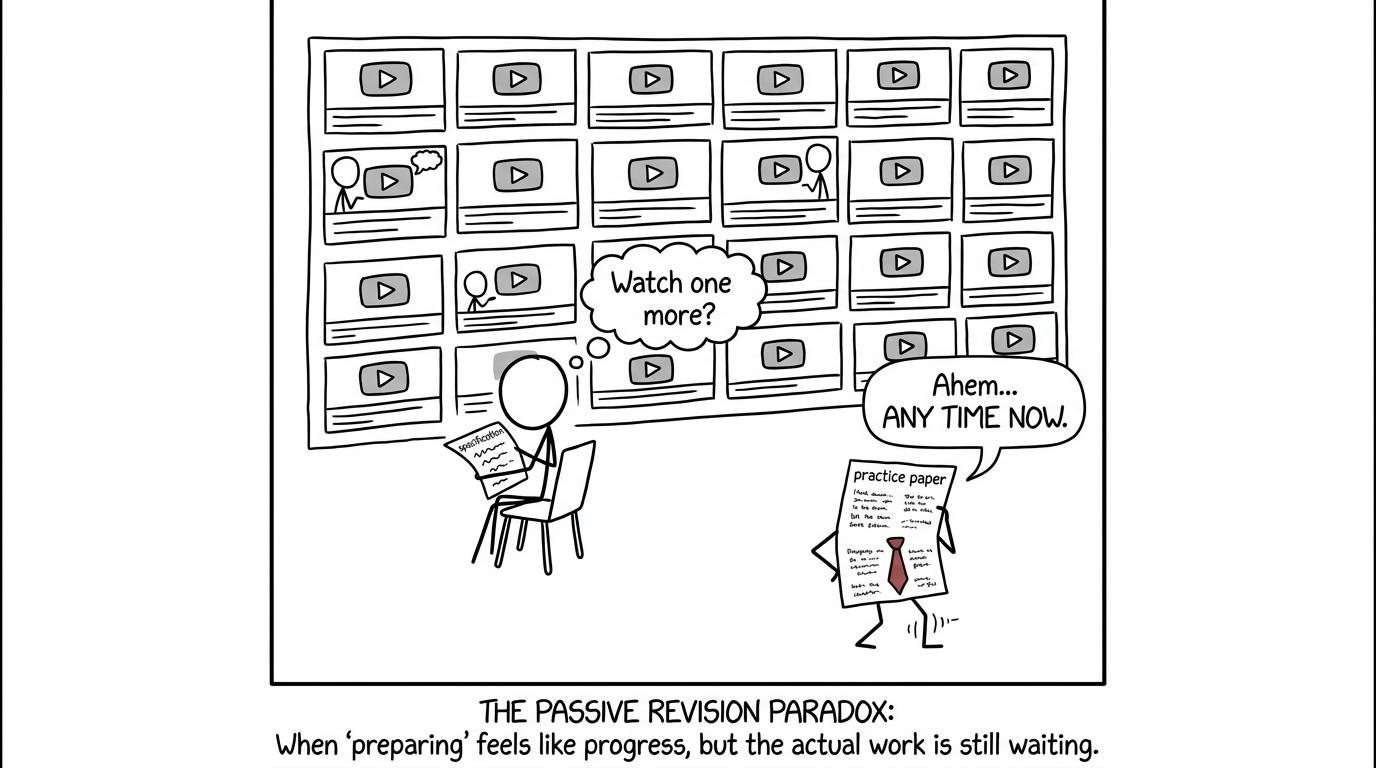 A student surrounded by video thumbnails while an unopened practice paper waits
What GCSE Geography YouTube channels do well
Good educational videos reduce the friction of starting. Opening a textbook can feel demanding when you are tired, while pressing play feels manageable. That matters because revision cannot help until it begins.
Video is particularly useful for geographical processes. An animation can show the movement of sediment along a coastline, the formation of a meander or the sequence of events at a destructive plate boundary. Narration and diagrams can make relationships easier to follow than a dense page of notes.
YouTube can also help when:
- you missed a lesson or need a second explanation;
- a textbook description is unclear;
- you want a quick overview before practising questions;
- you need visual support for physical geography;
- you want to hear subject vocabulary used correctly;
- you are checking the broad structure of a case study.
The important distinction is between using a video as a lesson and treating it as proof that revision is complete. Understanding while the explanation is visible is only the first stage.
Why videos alone are unlikely to be enough
GCSE Geography assessments do not simply ask whether information looks familiar. Across Edexcel, AQA, OCR and Eduqas courses, students are expected to demonstrate knowledge, interpret geographical information, apply understanding and make reasoned judgements. Exact paper structures and topic requirements vary, so you should always check the current specification for your qualification.
Watching creates recognition, not guaranteed recall
A well-made video supplies the diagram, vocabulary and sequence for you. In the exam, those supports disappear. You have to retrieve the relevant material from memory and decide how to use it.
After a video, close it and write down everything you can remember. Then check your account against your notes or specification. This simple change turns viewing into retrieval practice.
If you cannot explain the idea without reopening the video, it is not secure yet. That is not failure. It is useful information about what to revise next.
Examinations require application
A video may explain urban change using one familiar location. An examination resource could present a different city, a map you have not seen or data that initially appears contradictory. Your task is then to apply geographical ideas rather than repeat the original explanation.
This is similar to maths revision. Watching someone solve a problem can feel smooth because each decision has already been made. Independent questions reveal whether you can choose the method yourself. MathsGenie's GCSE maths revision lessons and practice questions are organised around that movement from explanation to independent practice.
Case studies need accurate, usable detail
A memorable video can provide context, but your required examples depend on your course and what your school has taught. A channel may use a different named example, outdated detail or a case study that does not match your specification closely enough.
Build a compact case-study record from your class materials. For each example, know:
- its location and geographical context;
- the causes or processes involved;
- key social, economic and environmental effects;
- relevant management responses;
- a small number of accurate supporting details;
- how the evidence could support a judgement.
Do not collect facts simply because they sound impressive. A detail earns value when it helps answer a question.
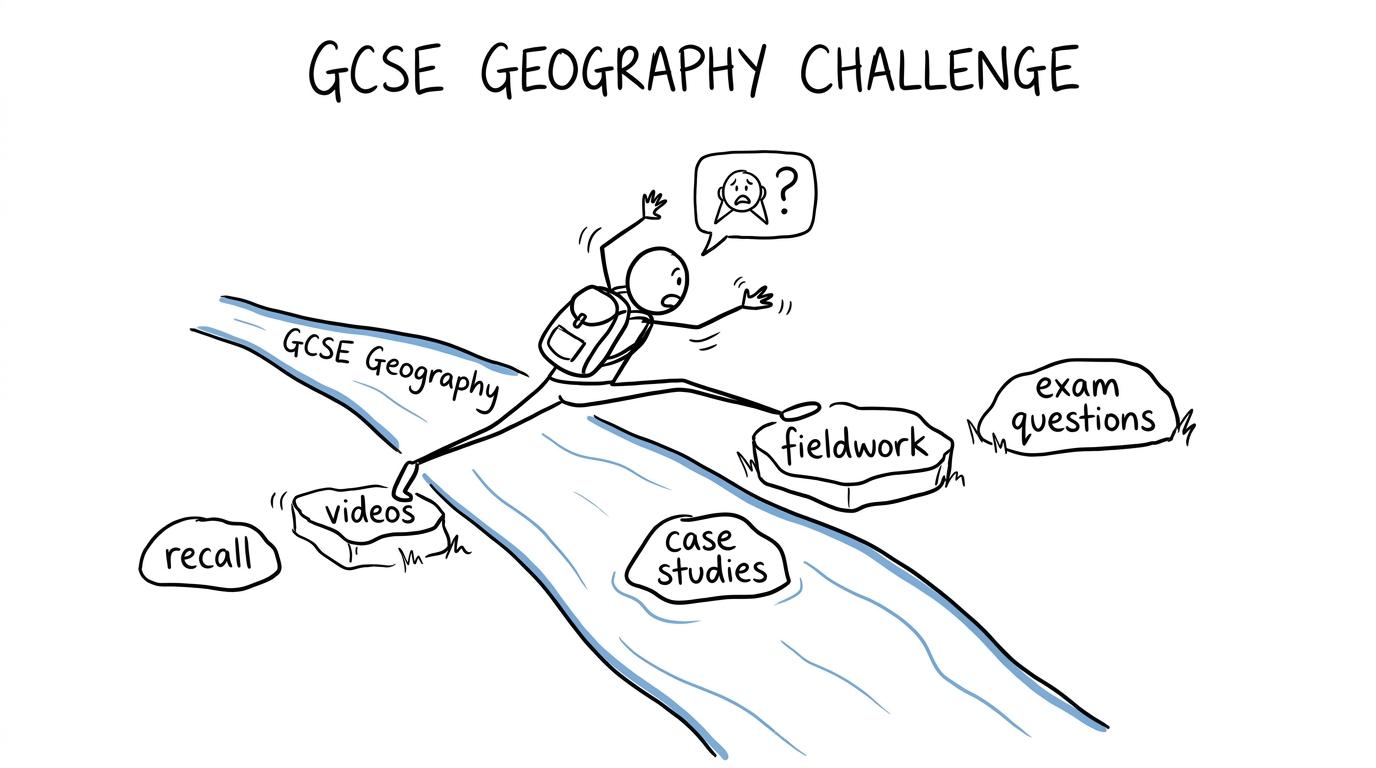 A student trying to cross GCSE Geography using only the video stepping stone
Fieldwork cannot be revised as generic content
Fieldwork questions may require you to understand enquiry questions, sampling, data collection, presentation, analysis, conclusions and evaluation. Your own fieldwork matters because you need to discuss decisions that were actually made and the limitations of the resulting evidence.
A general video can clarify terms such as systematic sampling or reliability. It cannot know precisely what your class investigated, where data was collected or why your method had particular limitations. Use your fieldwork booklet, teacher feedback and course materials as the main source.
Exam technique has to be performed
Knowing what an evaluative answer should contain is not the same as writing one under time pressure. You need practice interpreting command words, selecting evidence and building a conclusion that follows from your argument.
A sensible cycle is:
- attempt an exam question without notes;
- compare your answer with the mark scheme;
- identify one missing element;
- improve the response;
- revisit a similar question later.
Mark schemes are most useful as diagnostic tools. Copying their wording does not necessarily teach you how to respond to a new question.
What else you need alongside free videos
The solution is not to stop watching YouTube. It is to give every video a defined job within a broader revision process.
Start with the specification
Your exam board specification is the boundary of the course. Turn its content statements into a checklist and label each topic:
- secure;
- partly secure;
- not yet secure.
This prevents recommendation algorithms from deciding what you revise. A fascinating video may still be irrelevant to your paper, while a less exciting fieldwork skill could be essential.
Follow viewing with active recall
Pause before the explanation ends and predict the next stage. Sketch a process from memory. Define the key vocabulary aloud. Write a short comparison without looking at your notes.
Keep the task small enough to repeat. Ten focused minutes of retrieval can expose more than another hour of passive viewing because mistakes become visible.
Use exam questions regularly
Do not save all question practice for the final week. Begin with short questions, then progress to extended responses and timed sections. Include unfamiliar maps, graphs, tables and photographs because geographical thinking often begins with evidence.
For students balancing geography with maths, the same principle applies across both subjects. GCSE maths past papers help you practise selecting methods under exam conditions, while MathsGenie predicted papers provide further maths practice in an exam-style format. Predicted papers are practice resources, not guarantees of what will appear.
Review quantitative geographical skills
Geography can involve calculations, scales, ratios, percentages, averages, graphs and interpreting change. The exact skills assessed depend on your specification, but weak numerical fluency can make resource questions harder than they need to be.
MathsGenie's free GCSE maths topic resources can support those foundations. If your school uses a different maths exam board from a friend, use the relevant GCSE exam paper collection rather than assuming every paper has the same structure.
Create a realistic weekly routine
A useful geography session might contain:
- a short video to clarify one weak idea;
- closed-book recall;
- a check against reliable course materials;
- one or two exam questions;
- correction using the mark scheme;
- a note of the next action.
The sequence matters more than making beautiful notes. Explanation comes first, but retrieval and application complete the learning.
Maths revision deserves the same planning. Use the MathsGenie revision planner to organise maths topics around your available time rather than repeatedly choosing whatever feels easiest.
How to choose a useful geography channel
Subscriber numbers and confident presentation do not guarantee that a video fits your course. Before relying on a channel, ask:
- Does it identify the relevant exam board or specification?
- Is the content current and consistent with your teacher's materials?
- Does it distinguish general knowledge from required case studies?
- Are geographical terms used precisely?
- Does it explain reasoning rather than offer slogans to memorise?
- Can you verify factual details elsewhere?
- Does it encourage questions and retrieval rather than endless viewing?
You do not need one perfect channel. One teacher may explain physical processes clearly, while another is more helpful for exam technique. Choose resources by purpose.
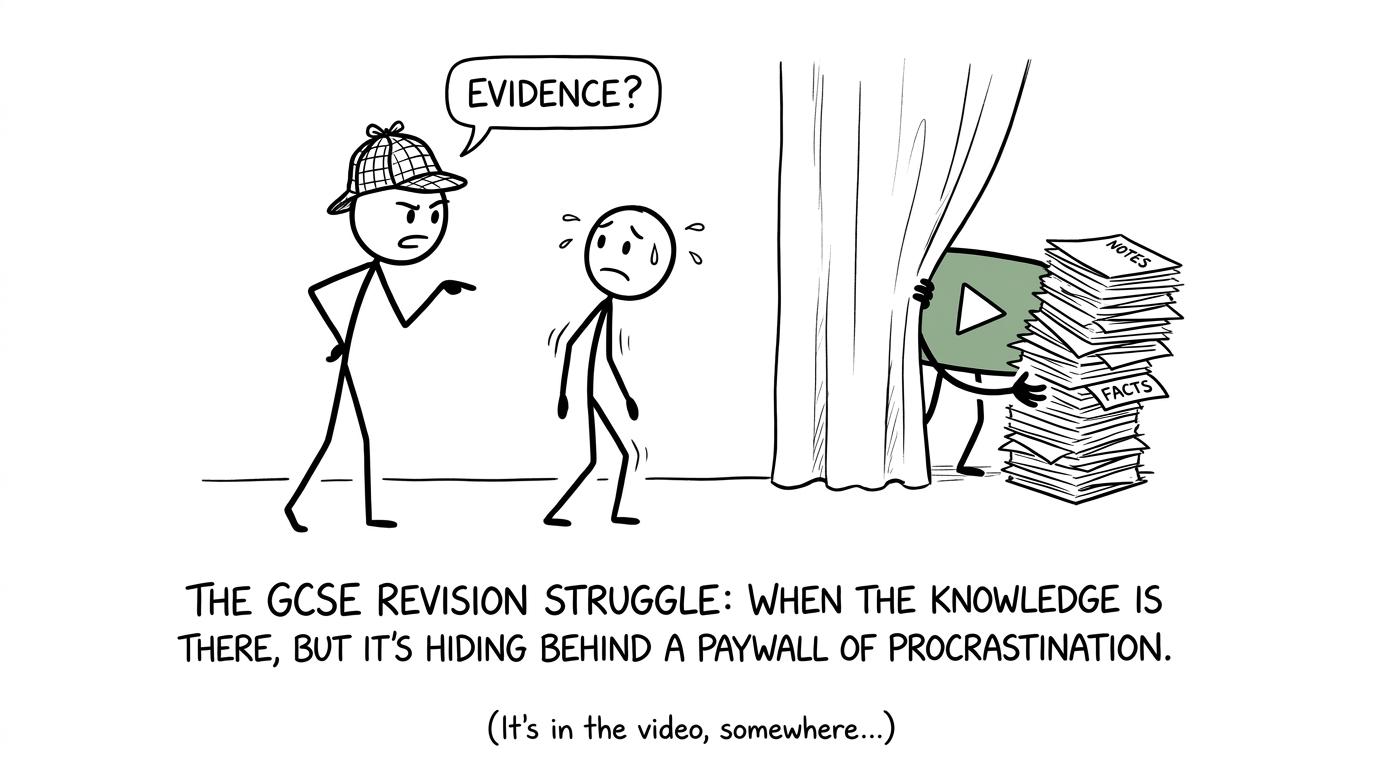 An exam question asks for evidence while a play button hides with the notes
Common mistakes when revising through YouTube
Mistaking completion for learning
Finishing a playlist measures videos watched, not knowledge retained. Test yourself after each useful section and return later to check whether the information remains accessible.
Making long notes while copying the screen
Transcription can keep your hands busy without requiring much thought. Record only the essential process, vocabulary, evidence or misconception. Then use it from memory.
Ignoring the exam board
AQA, Edexcel, OCR and Eduqas specifications are not interchangeable. Shared geographical ideas may be assessed through different content, examples and paper structures. Confirm your qualification with your school and check the current specification.
Learning somebody else's fieldwork
A model investigation can teach the enquiry process, but it does not replace knowledge of your own fieldwork. Revise what your group did, what the evidence showed and how the investigation could be improved.
Avoiding timed writing
Videos feel safer than a blank page because they never expose what you cannot yet produce. That exposure is exactly why timed questions are valuable. Start with one response, review it carefully and build from there.
Neglecting other subjects
Recommendation feeds have no knowledge of your exam timetable. Protect time for maths and other GCSEs. MathsGenie provides A Level maths revision resources for students progressing beyond GCSE as well as structured GCSE materials for current revision.
The verdict: use YouTube as a tool, not the whole system
Free YouTube channels can be an excellent part of GCSE Geography revision. They may help you begin, visualise processes and repair gaps in understanding. On their own, however, they rarely provide enough retrieval, specification control, personalised fieldwork preparation or assessed practice.
The strongest approach is simple: watch selectively, retrieve from memory, verify against your course, practise exam questions and learn from the mark scheme. Videos explain the landscape. Practice teaches you how to travel across it.
And while you organise geography, keep your maths preparation equally active. Start with MathsGenie's free GCSE revision resources, work through practice questions and video solutions, use mini tests to identify gaps, and move on to past papers and predicted papers when you are ready. The goal is not to consume more revision. It is to become able to do more without help.











