YouTube Channels GCSE Art and Design: Are They Enough?
YouTube channels GCSE Art and Design can teach techniques, but are they enough to pass? Learn what portfolios, feedback and independent practice add.
A tutorial can make a difficult technique look effortless. The artist selects a brush, makes three confident marks and produces something polished before your tea has gone cold. Yet when you close the video and face your own sketchbook, the path is less obvious.
So, are YouTube channels GCSE Art and Design students watch enough to pass the qualification? The short answer is no, not reliably on their own. Videos can teach techniques, introduce artists and help you overcome creative blocks. But GCSE Art and Design is assessed through your own sustained development, experimentation, recording and personal response. Watching supports that process; it cannot replace it.
You need a combination of practical work, specification knowledge, teacher guidance, independent decisions and consistent portfolio development.
The short checklist: what you actually need to pass
YouTube can be one useful tool, but a secure approach includes:
- knowing your exam board and specification title
- understanding all four assessment objectives
- producing sustained, authentic practical work
- researching relevant artists, designers or other sources
- experimenting rather than repeating one successful technique
- recording observations and explaining important decisions
- responding to feedback from your art teacher
- managing school deadlines and the supervised assessment
- creating a personal outcome connected to your development
This distinction matters. A video gives you information. Your GCSE submission must provide evidence.
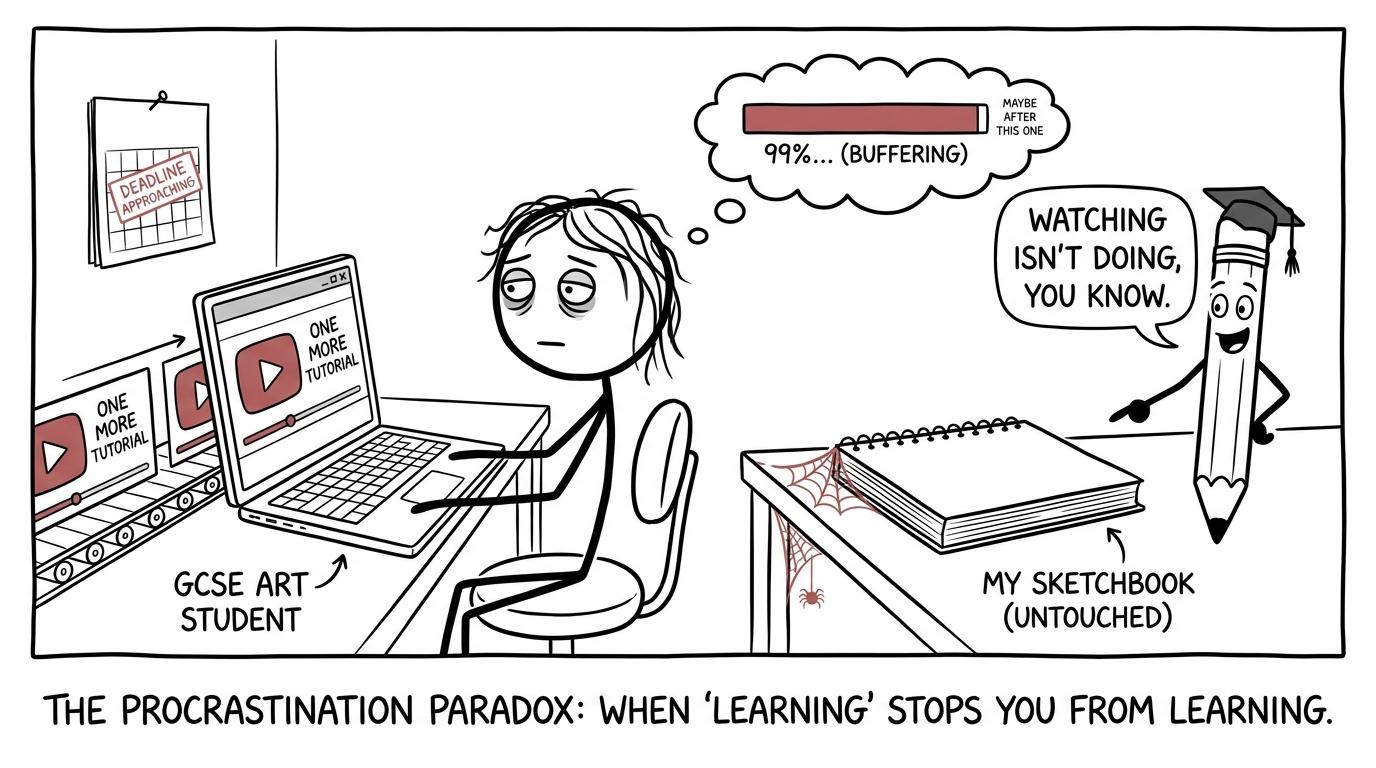 A student discovers that watching another tutorial is not the same as opening the sketchbook
What GCSE Art and Design actually assesses
The major exam boards, including AQA, Pearson Edexcel, OCR and Eduqas, organise their specifications somewhat differently. However, GCSE Art and Design assessment is built around four common objectives.
In broad terms, students must show that they can:
- AO1: Develop ideas through investigations and demonstrate critical understanding of sources.
- AO2: Refine work by exploring ideas and experimenting with suitable media, materials, techniques and processes.
- AO3: Record ideas, observations and insights as work progresses.
- AO4: Present a personal and meaningful response that realises intentions and demonstrates an understanding of visual language.
Each objective contributes 25%25\%25% of the overall assessment. Across current specifications, the portfolio contributes 60%60\%60% and the externally set component contributes 40%40\%40%. The externally set component includes preparatory work followed by 101010 hours of supervised time.
That structure explains why passive viewing is insufficient. Even an excellent tutorial does not prove that you investigated sources, refined your choices, recorded observations or produced a meaningful personal response.
Your exact requirements still depend on your board, title and examination year. Fine Art, Photography, Textile Design, Graphic Communication and Three-Dimensional Design may generate very different evidence. Follow the specification and instructions provided by your school rather than assuming that a general online checklist applies perfectly to you.
What YouTube channels can do well
YouTube is valuable when it solves a defined problem. If you need to understand how to blend coloured pencils, control watercolour, create a contact sheet or use a digital editing tool, a clear demonstration can save time.
Demonstrate unfamiliar techniques
Some processes are easier to understand when you see the movement, sequence and materials involved. You can pause, replay and compare approaches before testing the method yourself.
The useful word is testing. After watching, move away from the screen and make your own trials. Label materials, note what changed and decide which result best supports your intentions. That practical response may contribute to AO2; merely completing the video does not.
Introduce possible sources
Videos can introduce artists, craftspeople, photographers, architects and designers you have not encountered before. They can also provide historical or cultural context.
Treat the video as a starting point, not as your entire investigation. Check names, dates and claims against dependable sources. Record where imagery and information came from, and acknowledge work that is not your own. Your teacher can advise you on the referencing expected by your centre.
Make a process feel approachable
A blank sketchbook page can make a manageable task feel enormous. A short tutorial may reduce that friction by showing you where to begin.
This is similar to effective maths revision. A lesson can explain a method, but confidence grows when you answer questions without help. On the MathsGenie GCSE Maths revision hub, students move from lessons into independent practice. Art requires the same transfer: watch, close the video, create, review and improve.
Why YouTube alone is not enough
The limitation is not the quality of free content. The limitation is that GCSE Art and Design assesses a journey that must be yours.
Videos cannot see your whole portfolio
A tutorial creator does not know your starting point, previous pages, chosen sources, available materials or intended outcome. Advice that is sensible in isolation may create a disconnected page in your project.
Your teacher can view the submission as a whole and help you notice missing evidence or weak connections. They also know your centre's deadlines, your exam board and the conditions applying to assessed work.
Copying can hide the skills being assessed
Following a tutorial exactly may produce an attractive image. But a polished copy does not automatically demonstrate personal development or independent refinement.
Ask yourself:
- Why have I selected this technique?
- How does it connect to my source material?
- What did I change after the first trial?
- Which visual qualities am I trying to communicate?
- How will this investigation influence my outcome?
The goal is not to make your work look like the creator's work. It is to use what you learned in service of your own intentions.
Algorithms do not follow specifications
YouTube recommends content that keeps people watching. An exam board assesses evidence against published criteria. These are very different systems.
A dramatic sketchbook transformation may be entertaining without addressing all four objectives. Equally, a quiet page of purposeful material tests may be valuable because it reveals thoughtful refinement. Popularity, production quality and examination relevance are not the same thing.
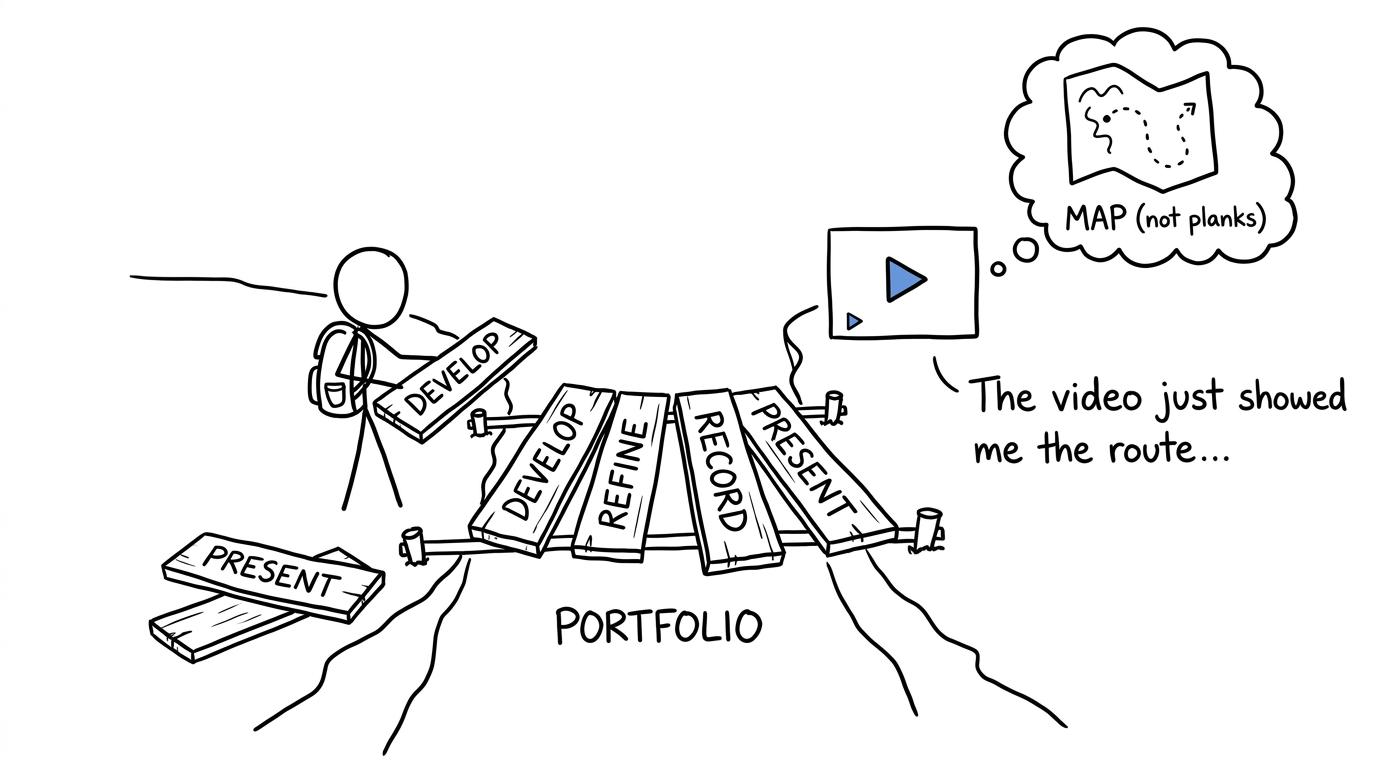 A video provides the map, but the student still has to build the four-part portfolio bridge
A better way to use YouTube for GCSE Art and Design
The strongest approach is to give every video a job. Do not begin with, “What should I watch?” Begin with, “What evidence or skill does my project need next?”
Use a watch, make, reflect cycle
Try this routine:
- Define the problem: identify one technique, material or contextual question.
- Choose carefully: select a relevant video rather than opening several similar tutorials.
- Watch actively: note materials, key stages, risks and possible adaptations.
- Make independently: close the video and test the process through your own subject matter.
- Reflect: annotate what worked, what failed and what you will change.
- Connect: explain how the experiment moves your project towards its next stage.
This turns online content into action. It also prevents “research” from quietly becoming an evening of recommendations and unrelated studio tours.
Build revision around evidence, not hours
Art time can be deceptive. Spending three hours near a sketchbook is not the same as producing three hours of purposeful development.
Set an outcome for each session: complete material tests, improve observational records, compare two compositions or write a concise reflection. For students balancing art with GCSE maths, a realistic schedule matters. The GCSE maths revision timetable guide can help you organise recurring sessions without allowing one subject to consume every evening.
For especially busy days, the 20-minute maths revision routine offers a useful principle that transfers across subjects: choose one small objective, work without distraction and finish by recording the next action.
Ask for feedback before the final stage
Feedback is most useful while you can still act on it. Bring your teacher a focused question rather than asking whether the entire project is “good”. You might ask whether your experiments show genuine refinement, whether your sources connect clearly to your intentions, or whether an important decision needs stronger visual evidence.
You remain responsible for the work. Feedback helps you recognise the gap between what you intended and what the portfolio currently communicates.
Balancing art coursework with maths revision
The students searching for art help are often also preparing for demanding maths papers. The danger is switching constantly between tasks and feeling that neither subject is moving forward.
Separate the kinds of work. Art often benefits from a longer practical block because materials need setting up and cleaning away. Maths can fit effectively into shorter, sharply defined sessions. Use GCSE mini tests when time is limited, then schedule a fuller paper at the weekend.
When you are ready for exam practice, choose resources that match your board and tier. MathsGenie's Edexcel GCSE Maths past papers include mark schemes and worked solutions where available. The guide to using GCSE past papers properly explains how to turn mistakes into a focused revision list.
Predicted papers can add fresh practice, but they should not replace real papers or topic learning. The same logic applies to YouTube and art: one resource can strengthen a process, but it should not become the whole process. If you take Edexcel maths, use GCSE Maths predicted papers after repairing your weaker topics.
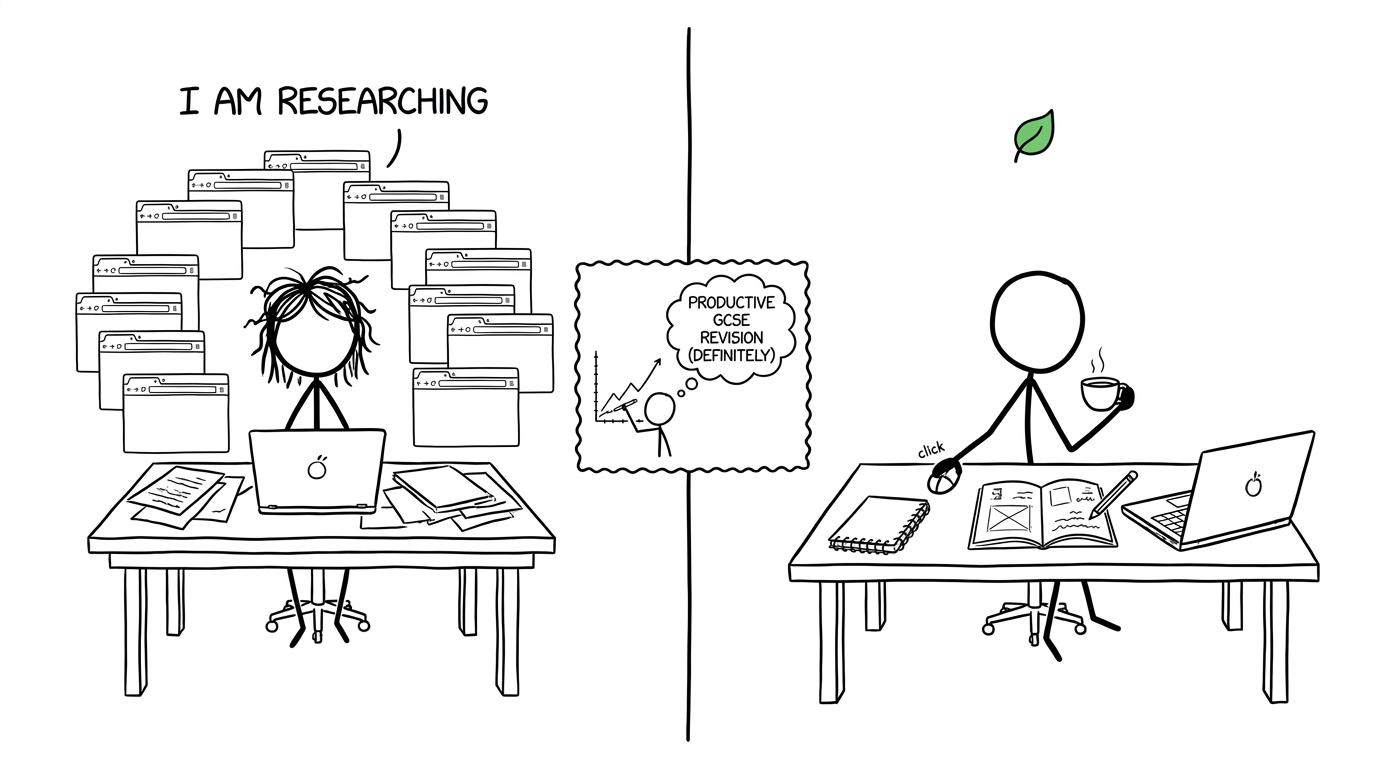 One student collects browser tabs while another turns one useful source into practical work
Common mistakes when revising GCSE Art through YouTube
Watching without producing anything
Tutorials can create the feeling of progress because the process makes sense while somebody else performs it. Test your understanding by working independently as soon as possible.
Copying a finished piece too closely
A close imitation may show some technical control, but it can weaken the sense of personal investigation. Adapt techniques to your own imagery, purpose and visual decisions.
Choosing sources because they are easy to copy
Select sources because they have a meaningful relationship with your theme and can influence your thinking. The easiest image to reproduce is not necessarily the richest source to investigate.
Treating annotation as a diary
A list of actions tells the moderator what happened, but thoughtful annotation explains choices. Focus on intention, visual effect, connections, evaluation and the next decision.
Ignoring unsuccessful experiments
An unsuccessful trial can still show refinement if you identify precisely why it failed and how the result changed your next attempt. Do not hide the thinking that moved the project forward.
Following generic grade claims
Be cautious with videos promising a particular grade. Grade boundaries can vary between examination series, and assessment depends on the complete evidence submitted. Use your board's criteria and your teacher's guidance rather than relying on a thumbnail promise.
The verdict: useful support, not a complete course
Free YouTube content can make techniques clearer, widen your knowledge and help you begin. But it cannot independently plan a coherent portfolio, provide informed feedback on your complete submission or create the evidence required across all four assessment objectives.
Use videos selectively. Then make, record, refine and connect. Your sketchbook should reveal your decisions rather than simply prove what you watched.
And while art develops through sustained practical work, keep your maths revision equally active. Start at the MathsGenie resources hub, choose revision lessons and practice questions for your weakest skills, and check progress with mini tests. Move on to past papers, mark schemes, video solutions and predicted papers when you are ready to perform under exam conditions. Free resources become powerful when they lead to independent work, in the studio and at the exam desk.