Why Bearings Confuse GCSE Students (And How to Fix It)
GCSE bearings confuse students because of north lines, clockwise angles and 3-digit rules. Learn the method, avoid mistakes, and revise with Maths Genie.
The moment bearings stop feeling like “just angles”
In GCSE maths, bearings are one of those topics that feels fine until the exam question quietly changes one word, and suddenly your diagram doesn’t match the mark scheme. You draw a neat triangle, you measure an angle, you even get a sensible-looking number… and it’s still wrong. Not because you can’t do angles, but because bearings hide three tiny rules inside one sentence. It’s rarely the maths that gets you. It’s the translation.
Bearings confuse students because they sit in an awkward middle ground: part geometry, part map-reading, part “do what the examiner meant, not what you first pictured”. The good news is that once you make the rules automatic, bearings become a reliable source of marks.
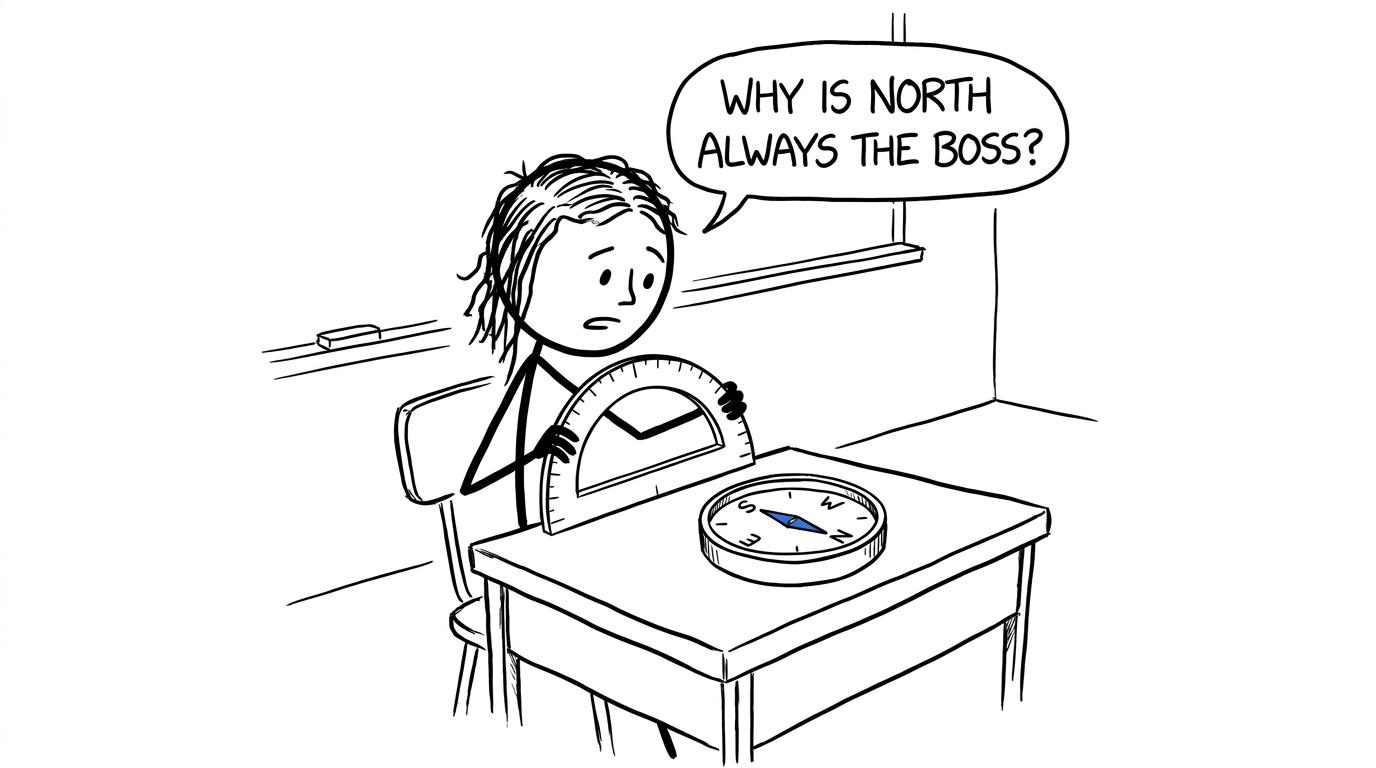 Student holding a protractor like a steering wheel
A quick bearings checklist (the one your future self will thank you for)
Before you touch your calculator or protractor, run this checklist:
- Bearings are measured from north.
- Bearings are measured clockwise.
- Bearings are written as three digits (e.g. 047∘047^\circ047∘, not 47∘47^\circ47∘).
- “Bearing of BBB from AAA” means you start at AAA.
- Draw a north line at the point you start from, not somewhere else on the page.
- If you end up with an angle bigger than 360∘360^\circ360∘, or negative, you’ve probably gone the wrong way.
If your angles skills are rusty, revise them first because bearings sit on top of angle facts: Angles Revision and the focused practice in Angles Exam Questions.
Why bearings confuse students (the real reasons)
Bearings are “local” angles, not global ones
Many students subconsciously treat north as a single arrow at the top of the page. But bearings are measured from a north line drawn at the starting point. That means every time the question says “from AAA”, you should imagine a tiny compass placed at AAA.
This is why the same triangle can contain multiple bearings that don’t look related unless you draw north lines carefully.
Clockwise feels unnatural when your diagram leans the other way
If the line from your starting point slopes left, your instinct may be to measure the smaller anti-clockwise angle because it’s “right there”. GCSE examiners expect clockwise from north every time. The clockwise rule is not a preference. It’s the definition.
The wording flips direction more than you expect
“Bearing of BBB from AAA” versus “bearing of AAA from BBB” are different directions. Students often see the same two letters and assume the same answer.
The word from is doing all the work.
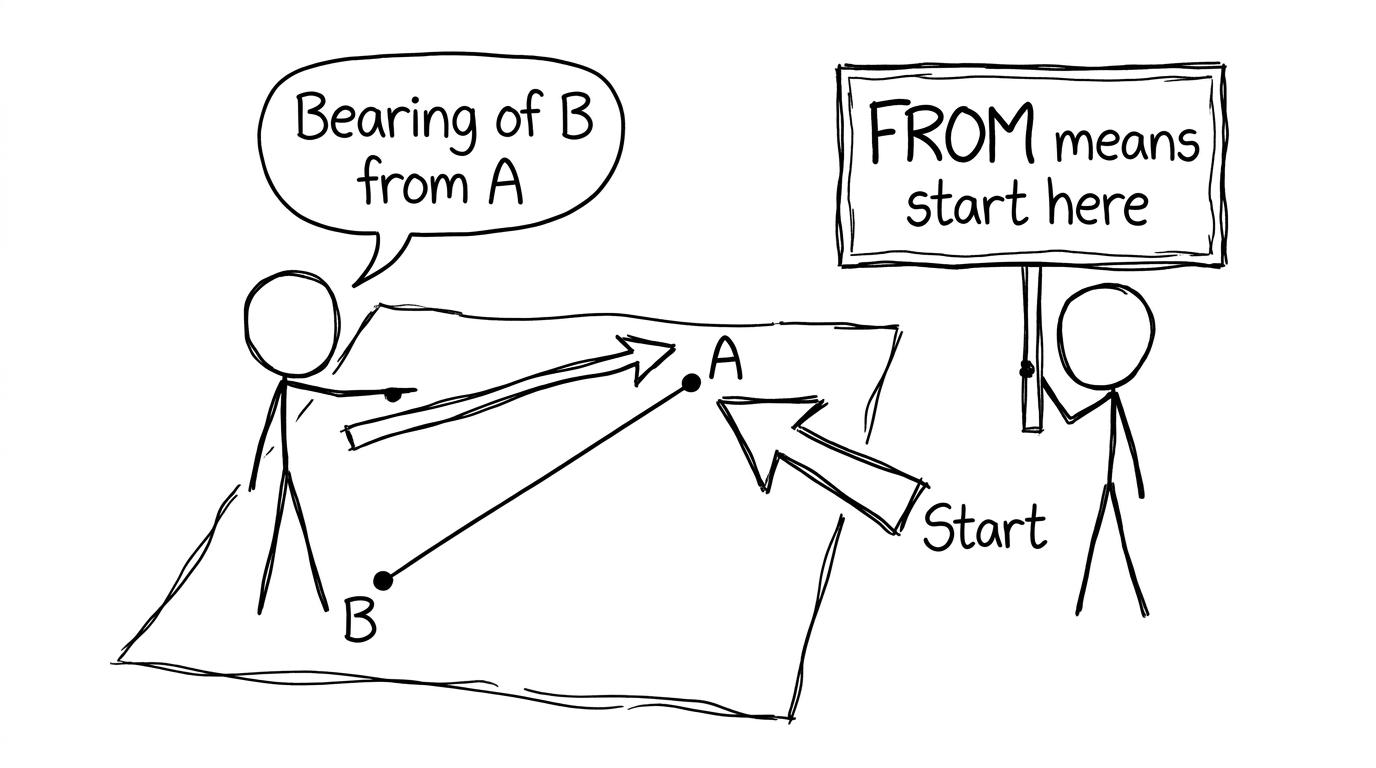 Two stick figures arguing about “from”
Three digits sounds cosmetic, but it changes how you think
Writing 005∘005^\circ005∘ instead of 5∘5^\circ5∘ forces you to remember bearings live on a 000 to 360360360 scale, like a full turn. It’s a small habit that stops bigger mistakes.
For targeted practice, Maths Genie has a dedicated bearings set: Bearings Revision Topic and the exam questions booklet Bearings Exam Questions (PDF).
The core method for GCSE bearings (draw first, calculate second)
Step 1: Put the compass at the starting point
If the question asks for the bearing of BBB from AAA, draw a north line at AAA.
Step 2: Draw (or identify) the line of travel
Draw the line from AAA to BBB.
Step 3: Measure or calculate the clockwise angle
The bearing is the clockwise angle from the north line to the line ABABAB.
Step 4: Write it as three digits
For example, 70∘70^\circ70∘ becomes 070∘070^\circ070∘.
This method is exactly what mark schemes reward: a correct diagram and a clear clockwise measurement.
Worked example 1: Finding a bearing from given angles
Question: From point AAA, the line to point BBB is 35∘35^\circ35∘ east of north. Write the bearing of BBB from AAA.
Solution:
“East of north” already means clockwise from north. So the bearing is:
035∘ 035^\circ 035∘That’s it. The GCSE trap is writing 35∘35^\circ35∘ (missing the leading zero).
Worked example 2: Using angles on a straight line to get a bearing
Question: At point AAA, the line ABABAB makes an angle of 120∘120^\circ120∘ with the south line (measured inside the diagram). Find the bearing of BBB from AAA.
Solution:
A south line is 180∘180^\circ180∘ from north. If the line is 120∘120^\circ120∘ from south on the inside, then from north the clockwise angle is:
180∘−120∘=60∘ 180^\circ - 120^\circ = 60^\circ 180∘−120∘=60∘So the bearing is:
060∘ 060^\circ 060∘Notice what happened: we didn’t guess. We anchored everything to north.
If this sort of angle-chasing feels wobbly, build confidence with Angle Problems and Angles in Polygons because the same angle habits show up inside bearings questions.
Worked example 3: Reverse bearings (the one-word switch)
Question: The bearing of BBB from AAA is 050∘050^\circ050∘. Find the bearing of AAA from BBB.
Solution:
Reverse bearings differ by 180∘180^\circ180∘.
Since 050∘<180∘050^\circ < 180^\circ050∘<180∘, add 180∘180^\circ180∘:
050∘+180∘=230∘ 050^\circ + 180^\circ = 230^\circ 050∘+180∘=230∘So the bearing of AAA from BBB is:
230∘ 230^\circ 230∘If the original bearing had been, say, 275∘275^\circ275∘, you would subtract:
275∘−180∘=095∘ 275^\circ - 180^\circ = 095^\circ 275∘−180∘=095∘Reverse bearings are a classic GCSE marks opportunity because the method is consistent and quick.
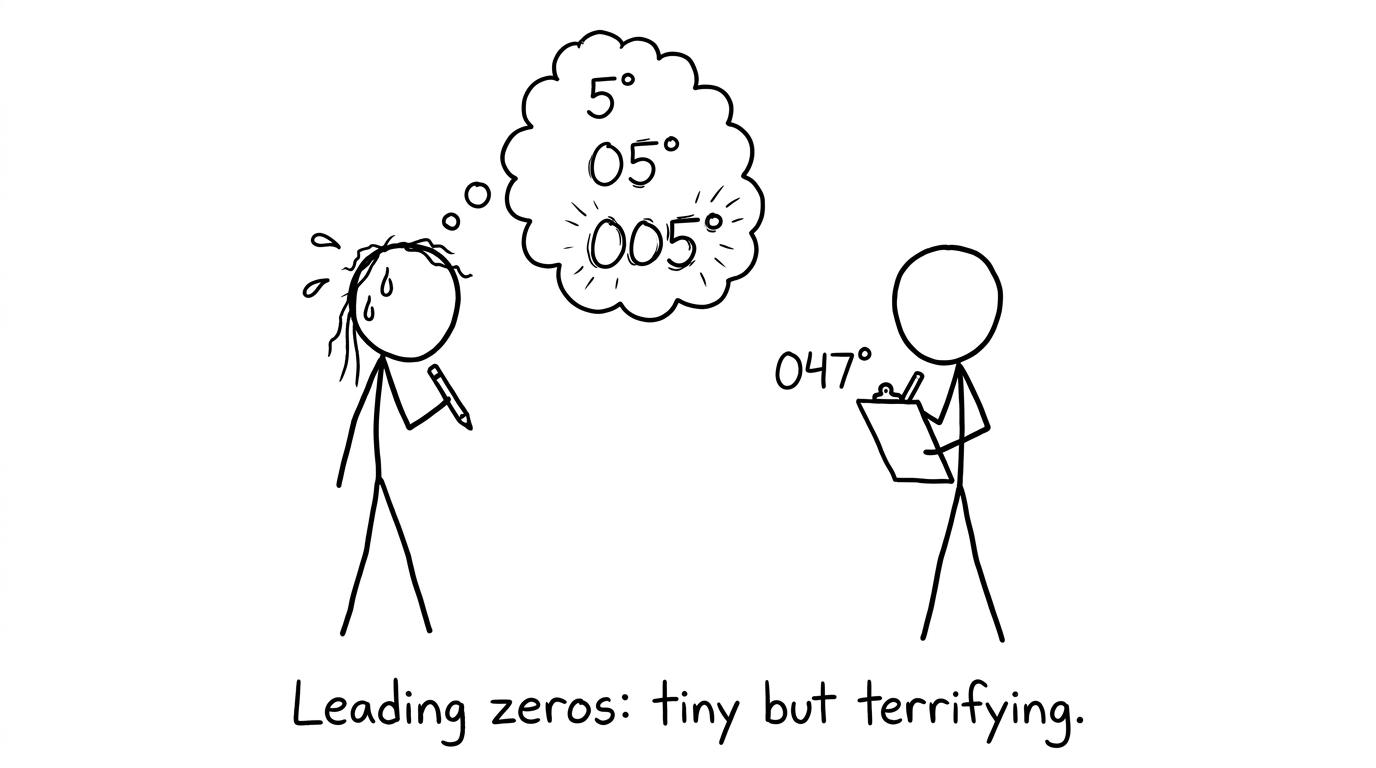 Stick figure panicking about leading zeros
Worked example 4: Bearings with trigonometry (GCSE higher and A Level confidence)
Some GCSE higher tier questions blend bearings with Pythagoras or trig, especially when distances are involved.
Question: Point CCC is 12 km12\,\text{km}12km from AAA on a bearing of 040∘040^\circ040∘. How far east of AAA is CCC?
Solution:
A bearing of 040∘040^\circ040∘ means the line ACACAC is 40∘40^\circ40∘ clockwise from north. Think of a right-angled triangle where:
- the hypotenuse is 121212
- the east component is opposite the 40∘40^\circ40∘ angle (because the angle is measured from the vertical north line)
So the east displacement is:
East=12sin(40∘) \text{East} = 12\sin(40^\circ) East=12sin(40∘) East≈12×0.6428=7.7136 \text{East} \approx 12 \times 0.6428 = 7.7136 East≈12×0.6428=7.7136So CCC is approximately:
7.71 km 7.71\,\text{km} 7.71kmeast of AAA (to 333 s.f.).
This “east and north components” idea becomes even more powerful at A Level when you start resolving vectors, but it’s already a strong GCSE skill.
For trig support, revise SOHCAHTOA and Trigonometry and, if you’re bridging into A Level, practise with Sine Rule, Cosine Rule and Area of Triangles.
How to practise bearings the way exam boards reward
Bearings questions are often marked for method. Even when the final answer is wrong, a clear diagram can rescue marks.
A good GCSE practice routine looks like this:
- Start with the topic lesson and examples on Bearings Revision Topic.
- Do a small set of focused questions from Bearings Exam Questions (PDF).
- Check your working against the style used in Maths Genie worked solutions across the site (clear diagrams, labelled angles, three-digit bearings).
- Mix in angle fluency using Angles Revision so you don’t lose marks on the “supporting” geometry.
- Then pressure-test yourself with a timed mini-assessment like Foundation Mini Test (PDF) where bearings can appear alongside other topics.
The point isn’t to do hundreds. The point is to make the routine automatic: north line, clockwise, three digits.
Common mistakes (and how to stop making them)
Drawing north at the top of the page, not at the point
Fix: every “from” gets its own north line. If the question changes “from AAA” to “from BBB”, you redraw the north line.
Measuring anti-clockwise because it’s the smaller angle
Fix: physically trace clockwise with your pencil from the north line to the direction line before writing anything down.
Forgetting three digits
Fix: write bearings with a placeholder: ___∘\_\_\_^{\circ}___∘ and fill the slots. If your number has one or two digits, you know you need leading zeros.
Mixing up reverse bearings
Fix: remember the 180∘180^\circ180∘ rule and decide add/subtract based on whether you’d go past 360∘360^\circ360∘.
Doing trig with the wrong angle
Fix: bearings measure from north (a vertical). When resolving into east/west components, your triangle angle is often from the vertical, so use sin\sinsin for east and cos\coscos for north when the bearing is from north.
Bringing it together: bearings are predictable when your method is
Bearings confuse students because GCSE questions hide precision inside ordinary language: “from”, “clockwise”, “three digits”, “north line at the point”. Once those rules become a reflex, bearings stop being a guessing game and start being one of the most dependable topics on the paper.
If you want that dependability, use Maths Genie as your revision base: start with the Bearings Revision Topic, build fluency with Bearings Exam Questions (PDF), and patch any angle gaps using Angles Revision. Then step up the realism with exam-style practice through Maths Genie’s past papers, predicted papers, practice questions, mark schemes and video solutions.
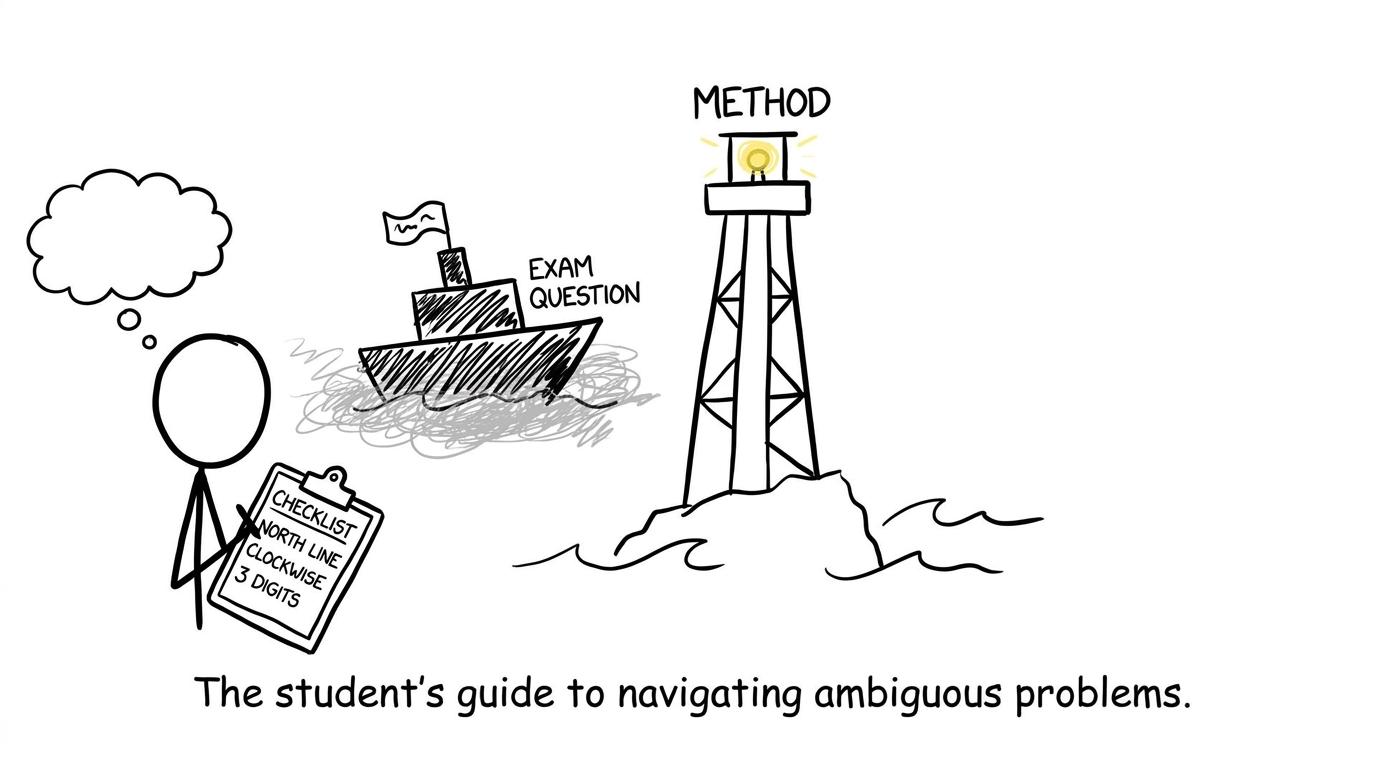 Ship labelled “Exam Question” heading for “Method” lighthouse
The goal isn’t to “understand bearings” in the abstract. The goal is to walk into your next GCSE paper, see a bearings question, and think: same steps as always. North line. Clockwise. Three digits. Marks.