

Whiteboard Revision GCSE English Language and Literature
Whiteboard revision GCSE English Language and Literature advice: use active recall, essay planning and timed practice without simply copying notes.
A clean whiteboard can create a powerful illusion. You write a quotation in neat lettering, surround it with coloured arrows and step back feeling productive. Yet the board may be full while very little has changed in your memory.
So, is whiteboard revision GCSE English Language and Literature genuinely useful? Yes, provided the board is used for retrieval, planning, testing and correction rather than copying. Its real advantage is not that writing can be erased. It is that your thinking becomes visible, temporary and easy to challenge.
That distinction matters when English is competing with GCSE maths and several other subjects for your revision time. You need a method that reveals gaps quickly, not another elaborate note-making project.
The short answer: when a whiteboard is worth using
A whiteboard is useful when your session includes most of this checklist:
- You begin with the board blank and your notes closed.
- You retrieve quotations, themes, vocabulary or structural methods from memory.
- You plan responses rather than repeatedly writing complete essays.
- You compare your work with reliable notes, teacher feedback or a mark scheme.
- You correct errors in a different colour.
- You revisit the same material on another day.
- You finish with a clear record of what still needs attention.
It is less useful when you copy pages from a revision guide, spend too long making the board attractive or erase mistakes before learning from them.
Research into retrieval practice supports the underlying principle: actively attempting to recall information can strengthen learning more effectively than simply encountering it again. The Education Endowment Foundation also emphasises the importance of feedback, because retrieving an incorrect idea without correction risks reinforcing it. A whiteboard provides the surface; retrieval and feedback provide the learning.
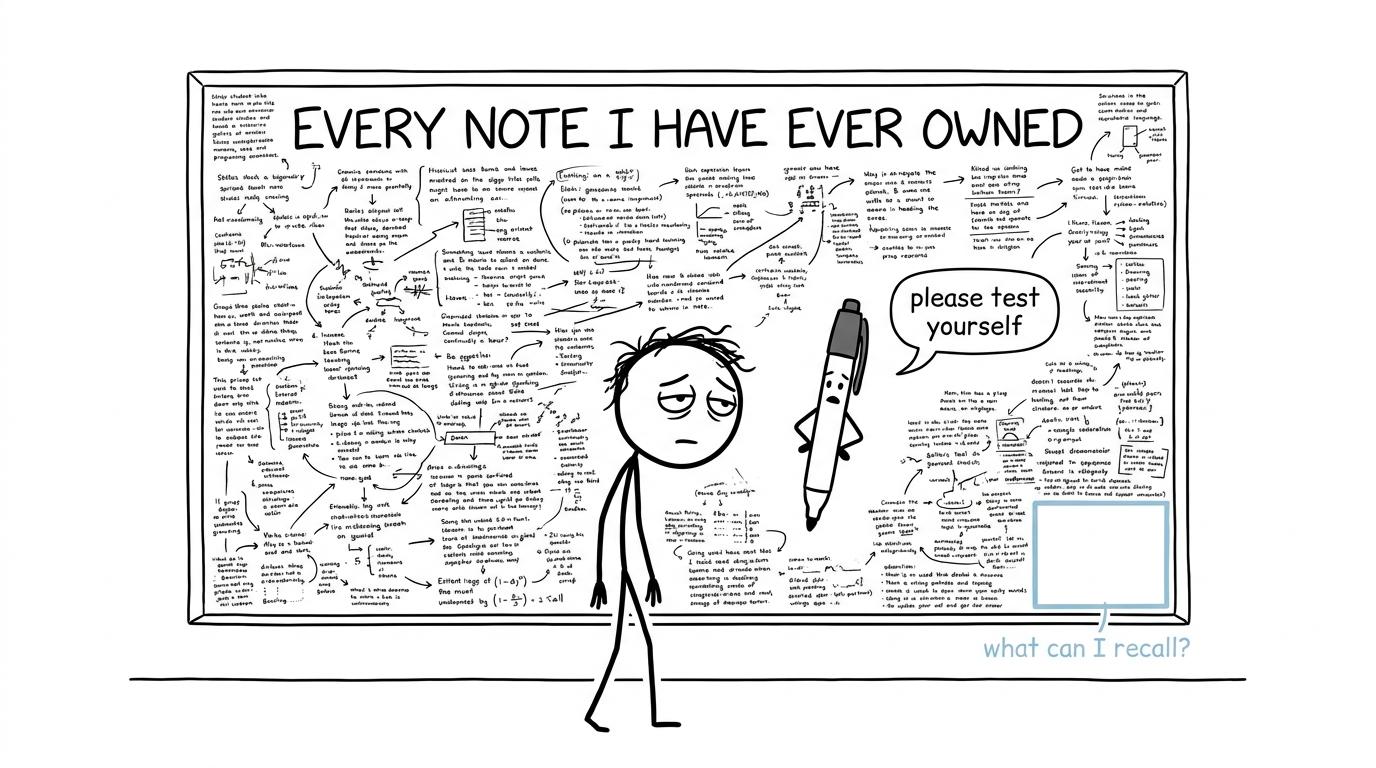 A student discovers that filling a whiteboard is not the same as testing memory
Why whiteboards can improve English revision
English revision involves both knowledge and performance. In Literature, you need secure knowledge of texts, characters, themes, contextual relationships and useful textual references. You must then shape that knowledge into a relevant interpretation. In Language, you need to read unfamiliar material, analyse choices, compare ideas where required and produce effective writing for a specified purpose and audience.
A whiteboard can help with both sides because it reduces the temptation to treat revision as preservation. Paper notes often feel permanent, so students become protective of them. A whiteboard invites experimentation. You can move an idea, reject a weak connection and start again without treating the first attempt as precious.
There is also an immediate diagnostic benefit. If you close the book and can recall only one quotation for a major character, the empty space tells you something useful. It is not a judgement on your ability. It is information about your next task.
It makes retrieval visible
Try beginning with a narrowly defined prompt such as a character, theme, writing purpose or reading skill. Set a short timer and record everything you can recall without assistance. Then check your source material.
Use one colour for accurate recall, another for missing knowledge and a third for misconceptions. The colour is not there for decoration. It separates what you genuinely knew from what you only recognised after opening the book.
This resembles the diagnose-and-repair cycle used in effective maths revision. MathsGenie's guide to finding your weakest GCSE topics applies the same honest principle: test first, identify the precise gap and then target it.
It lowers the cost of planning
A full English response takes time. Planning five possible responses on paper can begin to feel like a major commitment, so students avoid it. On a whiteboard, planning becomes lighter and faster.
For Literature, divide the board into areas for:
- the central argument;
- supporting textual references;
- language, form and structure;
- alternative interpretations;
- relevant context;
- links back to the question.
For Language writing, use sections for audience, purpose, form, tone, sequence and technical accuracy. You are rehearsing decisions rather than decorating a mind map.
The board should eventually produce a clear route through the response. If it contains twenty disconnected ideas, erase the weaker ones. Selection is part of exam skill.
Using a whiteboard for GCSE English Literature
The assessment objectives for GCSE English Literature are shared across exam boards, although paper structures and prescribed texts vary. Broadly, students must respond to texts, use textual references, analyse language, form and structure, and show understanding of relationships between texts and their contexts. Accurate spelling, punctuation and vocabulary are also assessed in specified parts of the qualification.
Check the current specification for your board: AQA, Edexcel, OCR or Eduqas, rather than assuming every paper has identical rules. For example, AQA states that its Literature assessments are closed book and provides any required stimulus material in the examination.
Build quotation webs from memory
Place a character or theme in the centre of the board. Around it, retrieve a small set of short, flexible quotations. Connect each quotation to:
- what it suggests;
- a significant word or structural choice;
- another moment in the text;
- a possible interpretation;
- relevant contextual understanding.
The purpose is not to create the largest possible web. It is to build a small network you can reconstruct later. Short textual references that you can analyse confidently are generally more useful than long quotations remembered without understanding.
Practise argument before paragraphs
Write an exam-style question at the top of the board. Give yourself a brief period to produce only a thesis and the main claim of each paragraph. Then test the sequence:
- Does every claim answer the question?
- Does the argument develop rather than repeat itself?
- Is each textual reference doing a distinct job?
- Have you included context because it illuminates the text, or merely because you remembered it?
This is especially valuable for students who know the text but freeze when deciding what to say. The whiteboard turns the invisible act of organising an argument into something you can inspect.
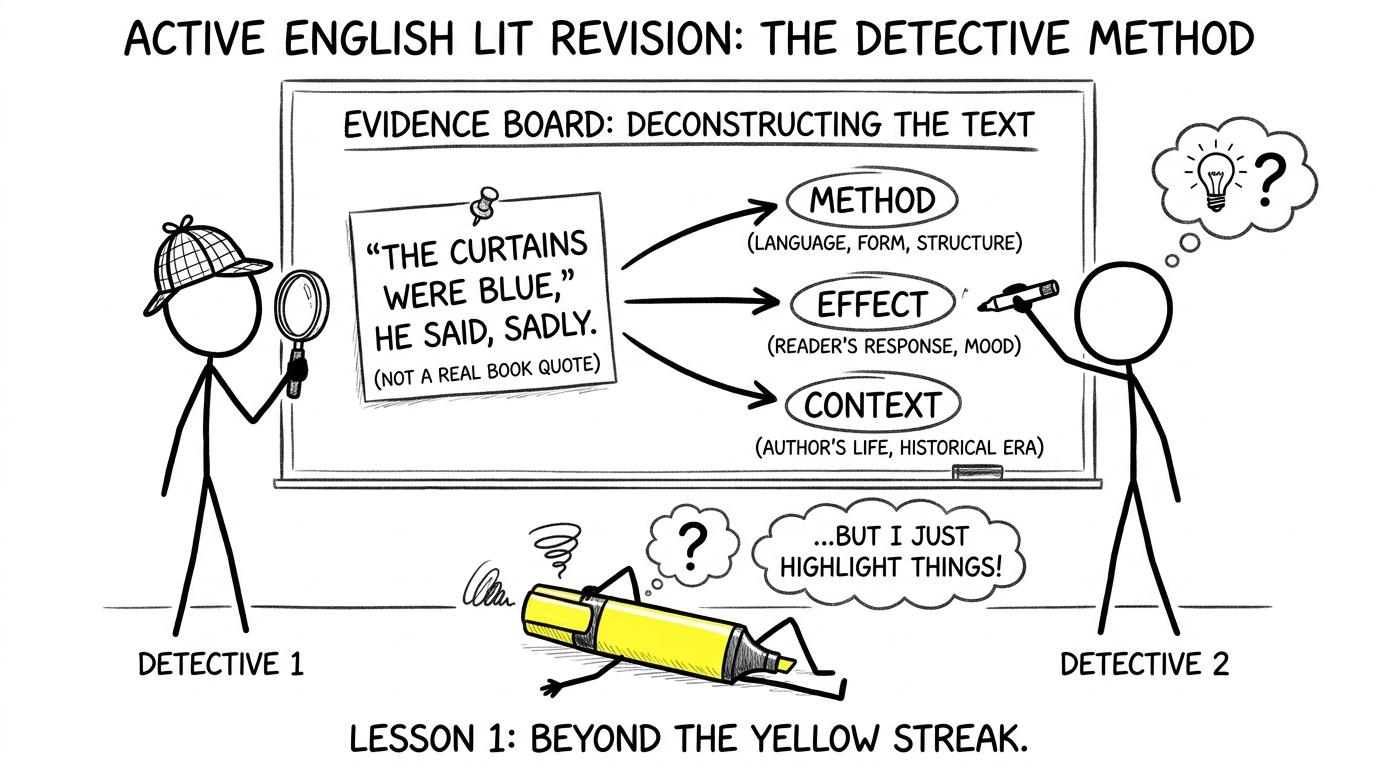 Revision detectives connect a quotation to method, effect and context
Using a whiteboard for GCSE English Language
GCSE English Language is untiered. National subject requirements divide the written qualification equally between reading and writing, while spoken language is reported separately and does not contribute to the final GCSE grade. Exact questions and paper arrangements differ between boards, so practise with material that matches your specification.
A whiteboard cannot replace sustained reading or handwritten exam practice. It can, however, sharpen the decisions that happen before and around them.
Deconstruct unseen texts
After reading an unseen extract, close or cover it and reconstruct its movement on the board. Record where the focus begins, how it shifts, where the pace changes and what impression remains at the end. Then reopen the text and correct your reconstruction.
For language analysis, create columns for evidence, method, effect and connection to the question. Avoid treating terminology as the destination. Naming a metaphor is useful only if you can explain how the writer's choice contributes to meaning or influence.
Rehearse comparison efficiently
When a paper requires comparison, split the board vertically. Put one source on each side and reserve the centre for direct connections. Organise similarities and differences by ideas, perspectives and methods rather than producing two unrelated lists.
The centre should become the busiest part of the board. That is where comparison happens.
Train writing choices
For creative, transactional or persuasive writing, use the board to test alternative openings, structural routes and endings. You can also create a final checking strip containing reminders about paragraphing, sentence control, vocabulary, spelling and punctuation.
Do not let planning become an escape from writing. Once the route is clear, move to paper and complete a timed section. MathsGenie's GCSE English Language exam-week checklist offers a practical structure for balancing focused English preparation with short maths-maintenance sessions.
A repeatable whiteboard revision routine
A productive session can follow five stages.
Retrieve
Choose one precise target and write from memory. Keep books, websites and model answers closed. The attempt should feel slightly demanding; that is what distinguishes retrieval from copying.
Organise
Group the recalled material into an exam-ready structure. Remove ideas that are vague, repetitive or unrelated to the prompt.
Check
Compare the board with trusted notes, your specification, teacher feedback or an official mark scheme. Correct inaccurate quotations and unsupported claims immediately.
Apply
Use the corrected board to plan an exam question or begin a timed written response. Retrieval of knowledge is valuable, but English exams also require interpretation, judgement and controlled writing.
Record and revisit
Before erasing the board, photograph it only if the image has a defined purpose. More importantly, transfer unresolved gaps to a small revision log and schedule another attempt. The free MathsGenie revision planner can help you protect time for both English and maths rather than allowing one urgent subject to consume the week.
Spacing matters. Reconstructing the same quotation web tomorrow, then later in the week, is more revealing than admiring today's photograph several times.
Keep GCSE maths moving alongside English
If you are preparing for maths exams, English revision should not quietly remove all maths practice from your timetable. Maths skills become secure through doing questions, checking solutions and returning to errors.
Use the whiteboard for English, then preserve a short, closed maths block. MathsGenie's twenty-minute GCSE maths revision routine is designed for busy school days. You can also choose your board from the GCSE maths revision hub, complete a short topic set and mark it before finishing.
As exams approach, move from isolated skills to timed papers. The guide to using GCSE past papers properly explains the paper, mark, fix and retest cycle. Edexcel students can add GCSE maths predicted papers after topic work, using them as practice rather than as a promise of what will appear.
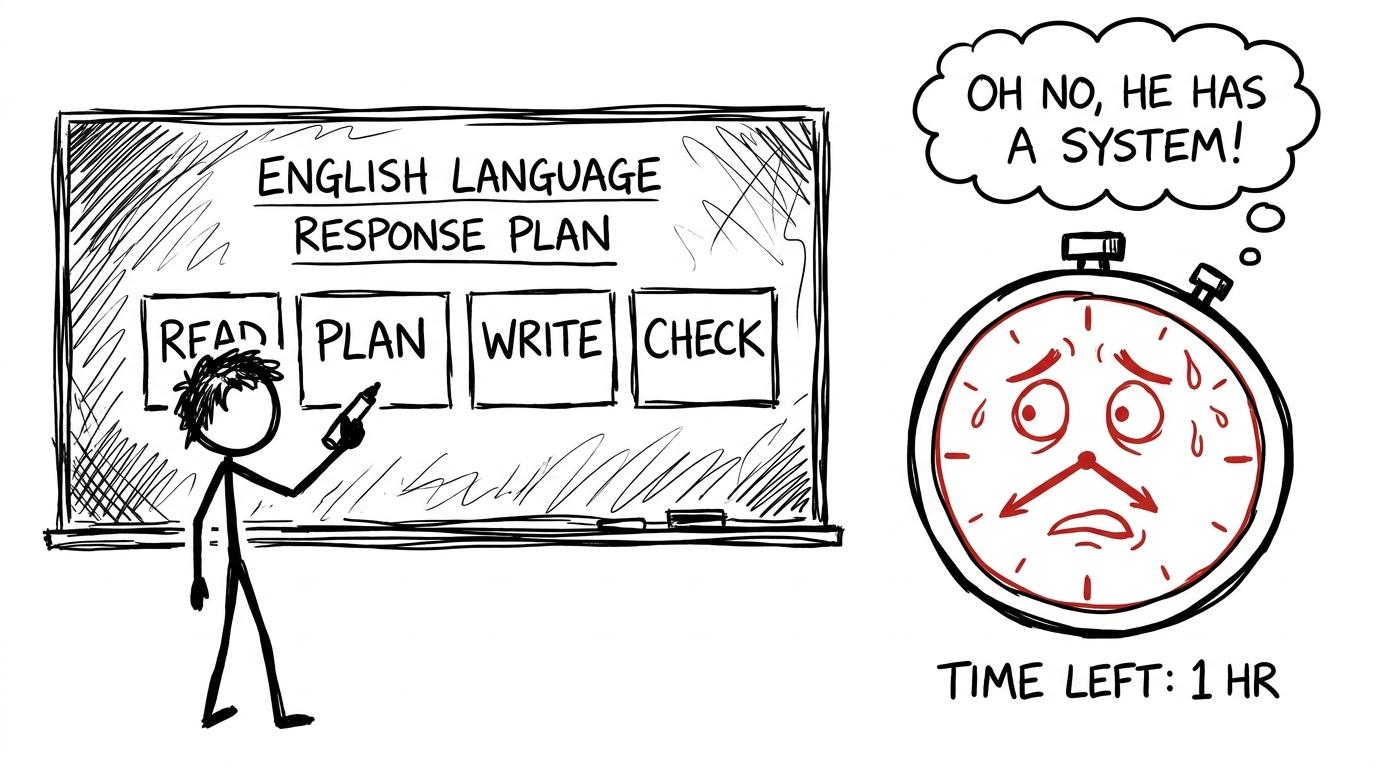 A clear response plan makes the exam countdown clock nervous
Common whiteboard revision mistakes
Copying notes word for word
Copying can make information look familiar without proving that you can retrieve or use it. Start with closed notes, even if the first attempt is sparse.
Making the board too broad
“Revise the whole novel” is not a workable target. Choose one theme, character, relationship or question. For Language, choose one reading skill or writing decision.
Erasing errors immediately
An error is valuable evidence. Correct it visibly, identify why it happened and add it to your revision log before wiping the board.
Photographing everything
A camera roll full of whiteboards can become another unread set of notes. Save only boards you will actively revisit, and schedule a fresh reconstruction rather than relying on recognition.
Avoiding sustained writing
A whiteboard is excellent for recall and planning but poor at replicating the full physical and mental demands of an English examination. Complete regular responses by hand under timed conditions.
Neglecting feedback
Without checking, a confident-looking board may contain inaccurate quotations or weak interpretations. Retrieval must be followed by correction. The same issue appears in maths, which is why common GCSE revision mistakes often involve practising without properly reviewing the result.
The verdict
A whiteboard is genuinely useful for GCSE English Language and Literature when it acts as a testing ground. Use it to retrieve knowledge, map arguments, compare sources, rehearse structure and expose uncertainty. Do not use it as a larger, shinier notebook.
Its best feature is impermanence. You can attempt an idea, inspect it, correct it and try again. But revision only becomes exam preparation when you move from the board to timed writing and reliable feedback.
Then keep your maths moving. Open the MathsGenie GCSE maths revision hub, choose your exam board and use free revision lessons, practice questions and mini tests to repair individual gaps. Build towards past papers, mark schemes, video solutions and predicted papers so that every session ends with evidence of what you can now do, not merely a board that looks busy.










