

Whiteboard Revision GCSE Dance: Is It Useful?
Whiteboard revision GCSE Dance methods can improve recall, comparisons and exam planning. Learn how to revise actively rather than copy notes.
Revision can look productive without demanding much thought. You uncap three pens, copy a page of notes onto a whiteboard and admire how organised it looks. Yet if the board were wiped clean, how much could you reconstruct?
That is the real test. If you searched for whiteboard revision GCSE Dance advice, the short answer is yes: a whiteboard can be genuinely useful, but only when it makes you retrieve, organise, compare or apply knowledge. Simply copying notes onto a larger surface changes the stationery, not the learning.
For students balancing Dance with GCSE maths, the same principle matters twice. Active attempts, immediate checking and later retesting are more valuable than repeatedly reading something familiar.
The quick whiteboard revision checklist
Use your whiteboard to:
- recall knowledge before opening your notes;
- organise facts into meaningful categories;
- compare professional works side by side;
- plan short and extended written answers;
- connect movement, design and choreographic intention;
- record gaps rather than decorate what you already know;
- check your response against reliable notes or a mark scheme;
- erase the answer and retrieve it again on another day.
A whiteboard is not automatically an effective revision tool. Its value comes from what you ask your memory to do.
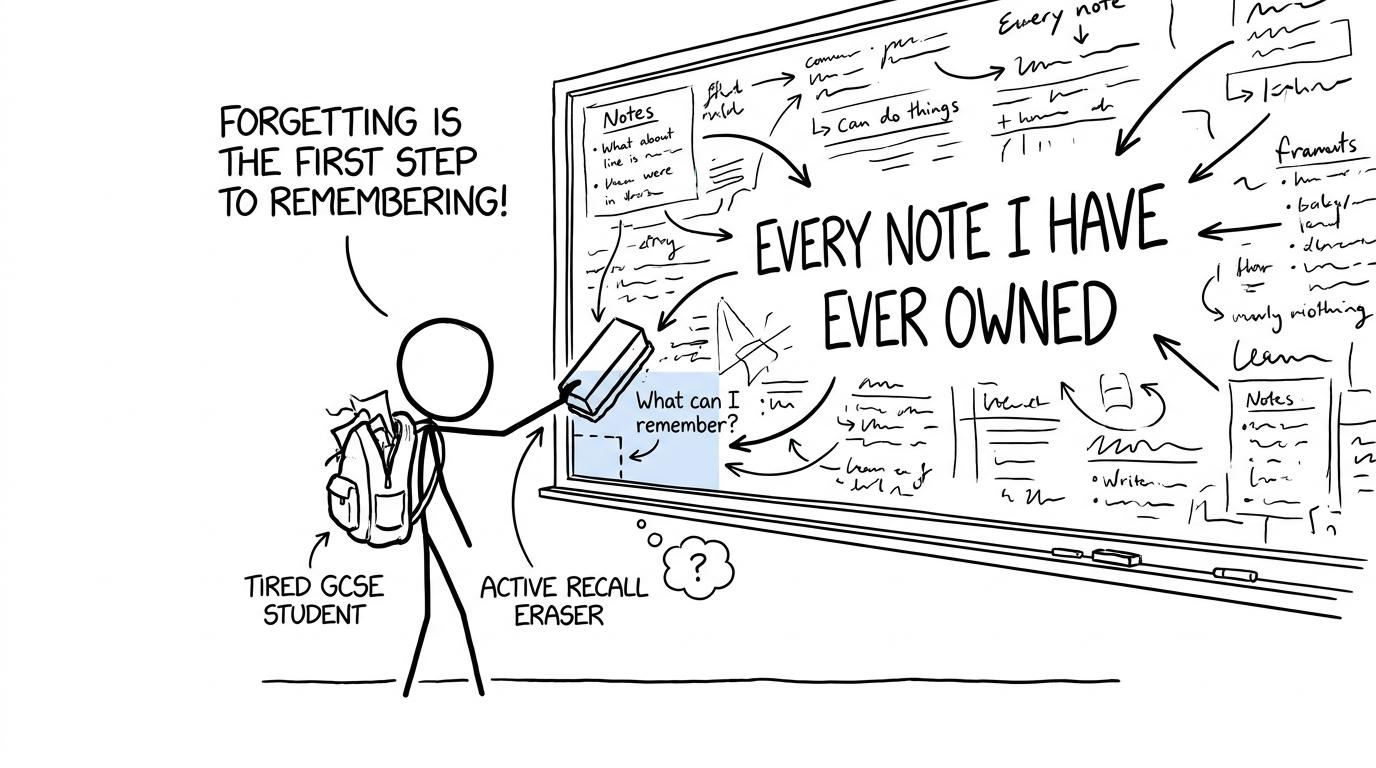 A student discovers that copying every note is less useful than testing recall
Why a whiteboard can help with GCSE Dance
The useful feature of a whiteboard is not its size. It is its temporary nature.
On paper, students often feel that every sentence should be neat and permanent. A whiteboard makes rough thinking feel acceptable. You can attempt an answer, notice a weak connection, erase it and try again. That is well suited to retrieval practice: deliberately recalling information without looking at the source first.
Research conducted in real classrooms generally supports retrieval practice over simply restudying material, although results vary according to the task, feedback and context. The important detail is that retrieval must involve a genuine attempt from memory. Looking at notes while writing removes much of that challenge.
Feedback also matters. An incorrect answer left unchecked can become familiar. Every whiteboard activity should therefore follow a simple loop:
Prompt, recall, check, correct and revisit.
This resembles an effective maths revision cycle. MathsGenie's guide to finding your weakest GCSE topics uses evidence from attempted questions rather than confidence alone. Dance revision benefits from the same honesty: test first, then decide what needs attention.
Whiteboard revision methods beyond copying notes
Build a closed-book brain dump
Choose one narrow prompt, such as physical skills, choreographic devices or one professional work. Set a short timer and write everything you can remember without notes.
Do not worry about order initially. When time ends, use your class materials to check the board. Add missing ideas in another colour and correct anything inaccurate. Before wiping it, write a small list of the gaps that need revisiting.
A brain dump works best when it is focused. “Everything about GCSE Dance” is too broad to diagnose anything. “How costume contributes to choreographic intention in one anthology work” gives your recall a clear direction.
Create a comparison grid from memory
The AQA GCSE Dance specification requires students to study all six professional works and be ready to analyse, interpret, evaluate and compare them. A whiteboard gives you enough room to place two works beside each other without turning the task into another page of prose.
Draw columns for relevant features, such as:
- choreographic intention;
- movement content;
- dancers;
- aural setting;
- costume;
- lighting;
- set or staging;
- performance environment.
Fill the grid from memory, then check it. The final step is essential: draw arrows between details and their effects. Knowing that a design feature exists is weaker than explaining how it communicates an idea, creates an atmosphere or supports the intention.
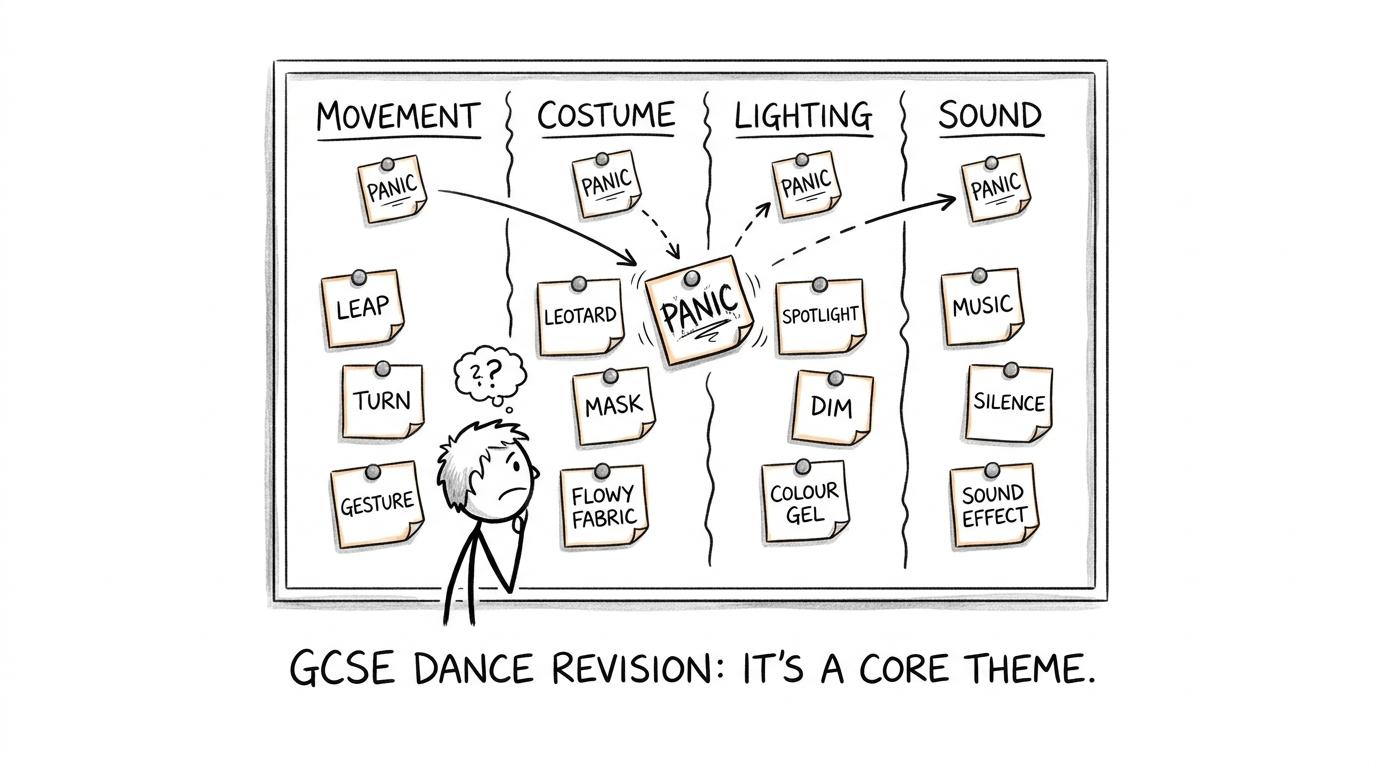 A rebellious panic magnet joins every Dance revision category
Turn command words into answer frames
Students sometimes know the content but respond to the wrong task. AQA defines command words carefully. For example, identify asks you to name or characterise something, while explain requires purposes or reasons. Discuss expects developed key points that consider relevant ideas or features.
Write one command word at the top of the board. Underneath, create an answer frame that reflects what it demands. For an analytical response, your structure might include:
- the specific feature;
- accurate evidence from the work;
- the effect or meaning created;
- the connection to choreographic intention;
- a judgement where the question requires evaluation.
This is planning practice rather than a memorised universal paragraph. The exact response must still fit the question and its mark allocation.
Map the journey from intention to effect
One of the most useful whiteboard activities is a chain of reasoning. Start with a choreographic intention on the left. Add relevant movement or production choices in the middle. Finish with their effect on the audience on the right.
Use arrows and short phrases rather than polished notes. Then challenge each arrow: Why does this choice create that effect? Is the link precise? Could I support it with better evidence?
This prevents isolated fact learning. It also prepares you for the analytical and evaluative thinking required in Dance appreciation.
Reconstruct your own practical work
The written paper is not only about professional works. Under the current AQA specification, Dance appreciation also assesses critical appreciation of your own performance and choreography.
Divide the board into performance, choreography and improvement. Retrieve details from your actual practical experience: decisions made, skills applied, feedback received and changes introduced. Keep the evidence truthful and specific to work you completed.
A generic claim such as “I improved my performance” is difficult to develop. Your board should prompt the precise skill, the action taken and the resulting effect on the choreographic intention.
Use oral rehearsal with the board
A whiteboard does not have to hold the whole answer. Write five key terms, then explain the topic aloud without adding more words. If your explanation breaks down, circle the term where the gap appeared.
This is especially helpful when written answers become vague. Speaking forces you to make the links explicit before you write them under exam conditions.
Match the whiteboard to the actual assessment
For AQA GCSE Dance, performance and choreography contribute 60%60\%60% of the qualification. Dance appreciation contributes 40%40\%40% and is assessed through a written paper lasting 111 hour 303030 minutes, marked out of 808080.
The written paper has three broad areas:
- knowledge and understanding of choreographic processes and performing skills;
- critical appreciation of your own performance and choreography;
- critical appreciation of professional works from the anthology.
That structure should shape your board sessions. If every session becomes a list of anthology facts, you are neglecting your own work and the processes and skills content. Use your current specification, teacher guidance and official assessment materials to confirm exactly what applies to your course.
The board also cannot replace physical rehearsal, viewing the professional works or answering complete exam questions. It is a bridge between learning content and producing an assessed response.
A practical revision routine for Dance and maths
Students preparing for maths exams often have several subjects competing for the same evening. A short, repeatable structure is usually easier to sustain than an ambitious timetable that collapses after two days.
Try this sequence:
- Recall: complete one closed-book whiteboard task.
- Check: compare it with reliable Dance notes or assessment material.
- Apply: plan or write an exam-style response.
- Record: note one gap to revisit.
- Retest: return to that gap after a delay.
You can use the same rhythm for maths. Start with the GCSE Maths revision hub, select your exam board and tier, retrieve a method, complete practice questions and mark them carefully. The GCSE maths revision timetable guide can help you balance short topic sessions with timed paper practice.
On busy school days, MathsGenie's 20-minute GCSE maths revision routine offers a compact model: active recall, exam-style questions and immediate review. The subject knowledge changes, but the learning discipline transfers neatly to Dance.
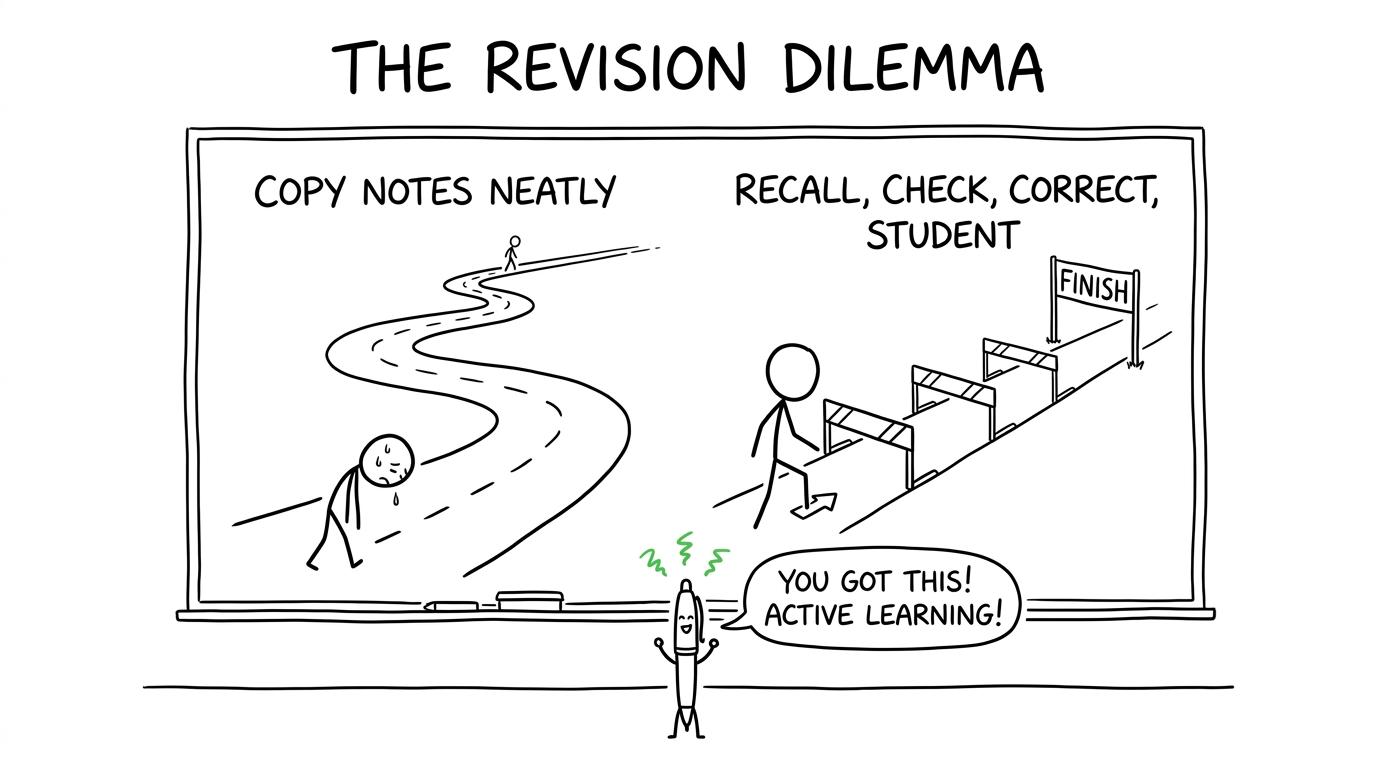 The difficult recall route beats the endless road of copying notes
Common whiteboard revision mistakes
Copying before attempting recall
If your notes remain open, the board becomes an expensive sheet of paper. Close the source, attempt the task, then check.
Producing beautiful but shallow diagrams
Colour coding can clarify categories, but appearance is not evidence of understanding. Every diagram should answer a question or expose a gap.
Revising only facts
Names and features matter, but Dance appreciation requires connections, interpretation and judgement. Move from what to how, why and with what effect.
Never completing full written responses
Planning on a board is useful, but the exam is written on paper. Regularly convert your plans into timed answers and review them using teacher feedback and appropriate mark schemes.
Erasing mistakes without recording them
The freedom to erase is helpful, but disappearing errors cannot guide future revision. Keep a small paper or digital error log containing the topics you need to retrieve again.
Treating confidence as proof
A topic may feel familiar because you have seen it repeatedly. Test it without prompts. Maths students can apply this principle through GCSE past-paper planning advice and, for Edexcel candidates, GCSE Maths predicted papers. Predicted papers should complement official past papers, not replace them.
So, is a whiteboard genuinely worth using?
Yes, if it is a workspace for thinking rather than a display board for copied notes.
Its best uses are retrieval, comparison, answer planning, categorisation and correction. Its limitations are equally important: it cannot replace practical Dance rehearsal, accurate course materials, complete written answers or feedback.
Let the whiteboard reveal what your memory can do unaided. Then let your mistakes choose the next task.
For the maths part of your GCSE preparation, use MathsGenie's free GCSE revision resources to move from revision lessons to practice questions, mini tests and full papers. Mark your work, use video solutions where available, and finish with past papers and predicted papers under timed conditions. A useful revision tool does not merely hold information. It helps you act on it.











