

When to Stop Revising GCSE English the Night Before
When to stop revising GCSE English the night before: choose a sensible cut-off, complete a focused final review and protect the sleep you need.
The difficult part of night-before revision is not starting. It is stopping. There is always another quotation to learn, another language technique to review or another essay plan you could write.
If you are wondering when to stop revising GCSE English Language and Literature the night before, the practical answer is this: stop at least an hour before you intend to sleep, and choose a bedtime that allows roughly eight to ten hours of sleep. For many students with a normal morning exam, that means ending revision at about 8.30 pm or 9.00 pm rather than continuing towards midnight.
That is not giving up early. It is recognising that the purpose of revision is to improve tomorrow's performance, not to make tonight feel impressively difficult.
Your night-before checklist
Keep the final evening deliberately small:
- Confirm whether tomorrow's exam is English Language or English Literature, and check the correct paper with your school.
- Complete one short, active review of familiar material.
- Do not begin a full paper or learn a large new topic late in the evening.
- Stop revising at least an hour before bed.
- Protect enough time for roughly eight to ten hours of sleep.
- Pack your equipment, check your travel arrangements and set an alarm.
- If another GCSE follows soon, write down the next task rather than starting it tonight.
The NHS advises that most teenagers need eight to ten hours of sleep and notes that sleep supports thinking and concentration. It also warns that all-night cramming is usually a poor idea. Research involving adolescents similarly indicates that restricting sleep can damage recall, particularly when material has been crammed into a single session rather than spaced across several days.
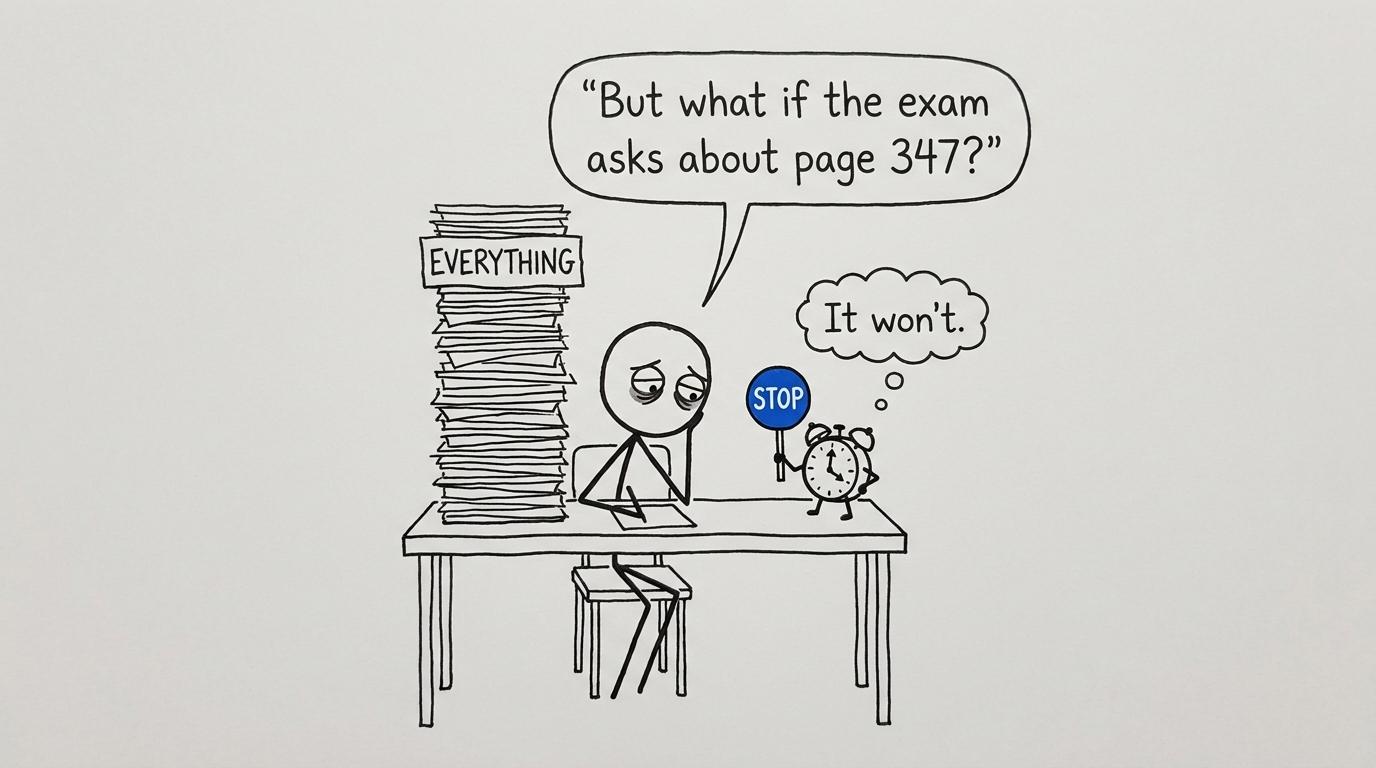 A tired student debates revising every page while an alarm clock holds up a stop sign
Work backwards from when you need to wake up
A sensible finishing time depends on your morning rather than on an arbitrary universal bedtime.
Start with the time you need to wake up. Allow the sleep you normally need within the recommended range, then leave at least an additional hour between revision and bed. That final hour is for packing, washing, relaxing and allowing your mind to slow down.
For example, a student who needs to wake at 6.45 am might aim to be asleep by around 10.15 pm. Their revision cut-off would therefore be about 9.00 pm, leaving time to wind down without rushing.
Treat that cut-off as a decision made in advance. If you wait until you feel completely prepared, you may never stop. English is too broad for that feeling to arrive neatly. There will always be another interpretation or possible question.
A cut-off is useful precisely because it replaces an emotional decision with a practical one.
How to tell that revision has stopped being useful
The clock matters, but your concentration provides another signal. Stop earlier if you notice that you are:
- rereading the same paragraph without recalling it;
- copying notes rather than testing yourself;
- making frequent mistakes in things you already understand;
- jumping anxiously between unrelated topics;
- searching for predictions instead of revising the actual specification;
- sacrificing the sleep window you planned.
One more exhausted hour can look productive from the outside. Often it is only activity without much learning.
This principle also matters when English sits beside maths in your GCSE timetable. If a maths paper is approaching, do not let an anxious English evening consume the rest planned for both subjects. MathsGenie's GCSE maths revision hub lets you choose a short, targeted task for another day instead of carrying a vague sense that you should revise everything at once.
What to revise before the cut-off
The final session should consolidate material you already know. It should not attempt to rescue the entire course.
For GCSE English Language
Choose one or two familiar tasks:
- recall the purpose of each question on tomorrow's paper;
- review how marks are distributed using information from your exam board and teacher;
- plan a response without writing the full answer;
- remind yourself how to select precise evidence;
- review your personal checklist for reading, analysis or writing;
- check one previous answer against the relevant mark scheme.
English Language rewards decisions made under pressure: reading the question accurately, selecting useful evidence, organising ideas and controlling your writing. A short planning exercise can refresh those decisions without creating the fatigue of a complete timed paper.
For GCSE English Literature
Keep the scope equally narrow:
- retrieve a small group of flexible quotations;
- connect each quotation to a character, relationship or theme;
- recall relevant writer's methods;
- outline one or two possible arguments;
- check which texts or components appear on the paper.
Do not try to memorise dozens of new quotations at the last moment. Short, accurate evidence that you can analyse is more useful than a large bank of half-remembered lines.
MathsGenie's English Literature night-before plan offers a focused structure, while the English Literature exam-week checklist is better used earlier in the week.
A calm final-evening routine
A useful evening has a clear ending. Adapt this outline around your normal bedtime and family routine.
Early evening: targeted recall
Spend a short block retrieving information rather than passively rereading it. You might test quotations, annotate a brief extract or create one essay outline. Check what you recalled, correct the gaps and stop that task.
After a proper break: one final check
If you still feel alert, complete a brief second session on familiar material. Avoid a full essay unless your teacher has specifically asked for one and there is genuinely enough time to write and review it without losing sleep.
At the cut-off: close the loop
Write down anything you are worried about on one sheet. Beside each item, add either “already reviewed”, “check briefly in the morning” or “leave it”. This prevents your mind from treating every unfinished thought as an emergency.
Then close the books.
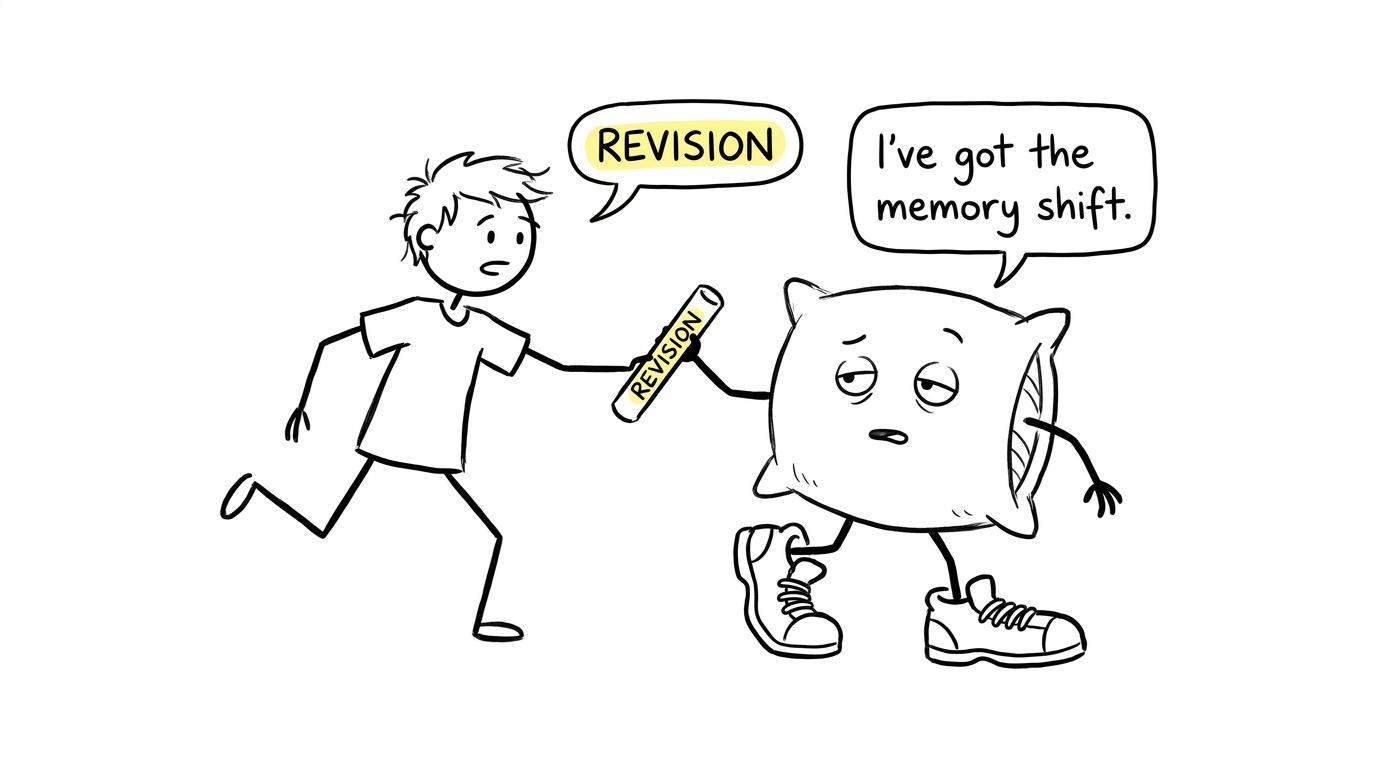 A revision baton is handed to a pillow ready to take the memory shift
During the final hour: prepare, then wind down
Pack the equipment required by your school, check the official timetable, lay out your clothes and plan your journey. Follow your usual calm bedtime routine. Avoid replacing revision with an hour of stressful scrolling, because stopping work only helps if you actually give yourself the chance to rest.
The aim is not to force perfect sleep. It is to create reasonable conditions for it.
Why stopping can improve tomorrow's performance
Sleep is not empty time between revision and the exam. Evidence from research on children and adolescents supports a role for sleep in memory consolidation, working memory and higher-level thinking. An experimental study of adolescent vocabulary learning also found that restricted sleep caused greater forgetting when learning had been crammed rather than spaced.
That distinction matters for English. Literature relies partly on recalling quotations, themes and interpretations. Language requires sustained attention, judgement and controlled writing. Staying awake to collect one more page of notes may weaken the concentration needed to use what you already know.
The same trade-off appears in maths. Knowing a method is only part of a GCSE paper; you must also read accurately, organise working and avoid preventable slips. MathsGenie's GCSE maths night-before plan therefore favours focused correction and a firm stopping time over a late full paper.
What if you feel seriously underprepared?
Panic encourages breadth: every text, every technique and every possible question. The better response is selection.
Ask three questions:
- What paper am I actually sitting tomorrow?
- Which familiar knowledge or skill is most likely to help across several questions?
- What can I review accurately before my fixed cut-off?
Then choose one compact task. For Literature, that could be a set of versatile quotations linked to broad themes. For Language, it might be recalling question purposes and planning one response. Finish by writing a simple exam strategy: read instructions carefully, watch the time, answer the exact question and leave time to check.
Feeling underprepared is not a reason to remove sleep entirely. It is a reason to use the remaining time more carefully.
If exam anxiety feels unmanageable or is repeatedly preventing sleep, speak to a parent, carer, teacher or another trusted adult. You do not need to manage serious stress alone.
Balancing English with GCSE maths revision
During exam season, stopping English revision can feel harder when another subject is waiting. Do not automatically start a long maths session after the English cut-off. Put the next maths action into tomorrow's plan instead.
MathsGenie keeps that action specific. You can return to the relevant AQA GCSE Maths revision resources, OCR GCSE Maths revision resources or Edexcel GCSE Maths past papers when you are rested.
Earlier in the revision period, use the GCSE maths revision timetable guide to space work across the week. Short Edexcel GCSE Maths mini tests can then provide focused practice without turning every evening into a full mock exam.
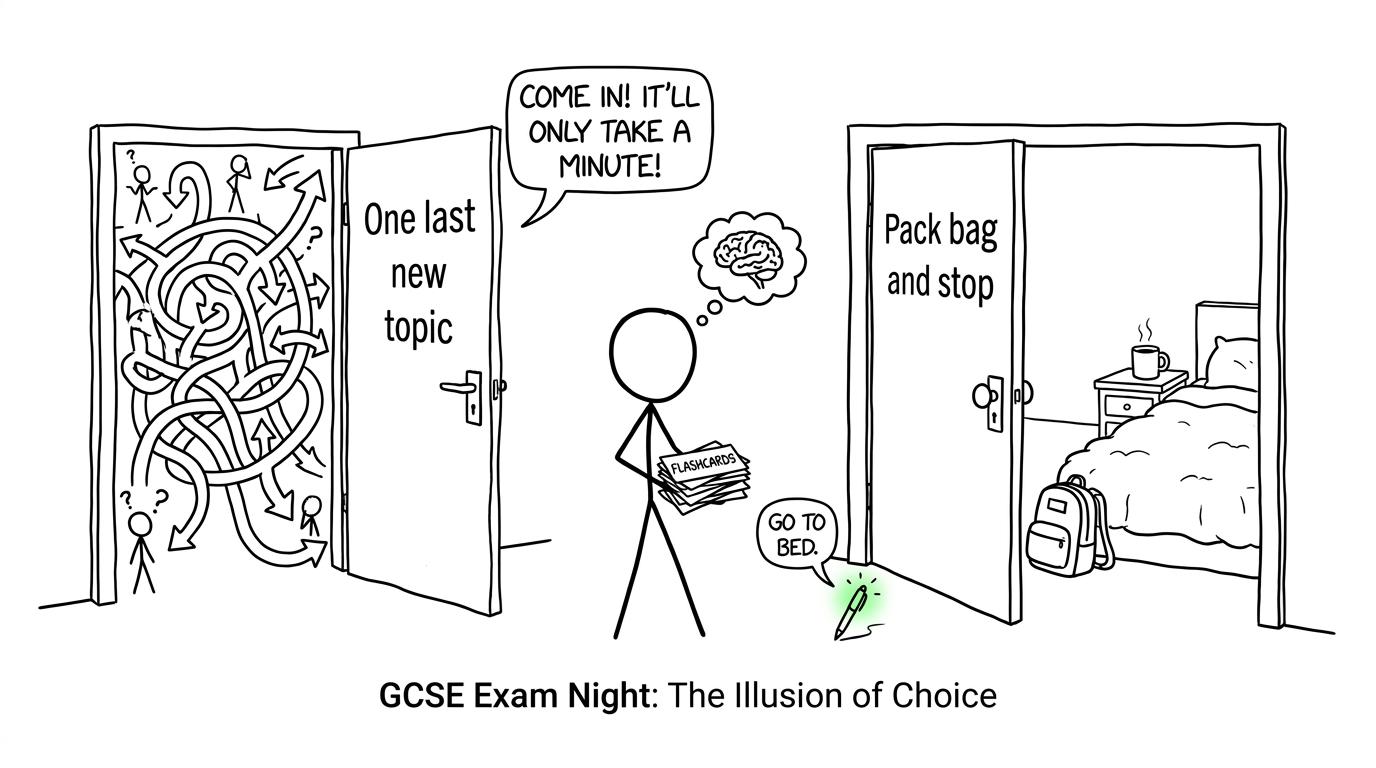 A student chooses between one new topic and the sensible route to bed
Common mistakes the night before an English exam
Waiting until you feel completely ready
English has too many possible questions for complete certainty. Decide your stopping time before revision begins.
Starting brand-new material late at night
New material can expose more gaps and increase anxiety. Consolidate familiar, flexible knowledge instead.
Writing a full paper without time to review it
Practice only creates useful feedback when you check it. Late in the evening, a plan or one focused paragraph is often more proportionate.
Trusting unofficial predictions
Questions cannot be known in advance. Revise the paper defined by your exam board, specification and school guidance rather than gambling on a rumour.
Revising the wrong component
English Language and English Literature contain different papers and tasks, which vary by exam board. Check your school's timetable and the exact component.
Stopping revision but continuing to stimulate your mind
Closing a textbook and immediately scrolling until midnight does not protect your sleep. Preserve a genuine wind-down period.
Turning one difficult evening into a judgement on your ability
Tiredness makes gaps feel larger than they are. Your task tonight is not to measure your worth or predict your grade. It is to make a few useful decisions and arrive able to think.
Stop while the evening is still helping
The best cut-off is early enough to leave at least an hour to wind down and enough time for the sleep your body needs, commonly around eight to ten hours for teenagers. If your concentration has already collapsed, stop sooner.
Review familiar material, check tomorrow's paper, pack your equipment and close the books. The night before is for consolidation, not reconstruction.
Then, when English is finished and maths becomes the next priority, return to MathsGenie with a rested mind. Use the free revision lessons and practice questions to repair individual gaps, mini tests to check recall, and past papers, predicted papers, mark schemes and video solutions to build exam confidence. Start with the GCSE Maths revision hub, choose one clear next task and let tomorrow's revision begin tomorrow.










