GCSE night-before plan for English Lit (no panic)
GCSE night-before plan for English Literature that avoids panic. A calm checklist, smart timings, and a maths-style method to secure marks and sleep.
You know the feeling: it’s the night before your GCSE English Literature exam, and your brain starts acting like it’s just discovered a new sport called “catastrophising”. You’re suddenly convinced you’ve forgotten every quote, every character, every theme. Meanwhile, you’re also a maths student, which means you already know something useful: panic is just noise. A plan is signal.
This night-before plan is built the way good maths revision is built: a small number of high-leverage steps, practised deliberately, checked against the mark scheme, then stopped at a sensible time so you can sleep.
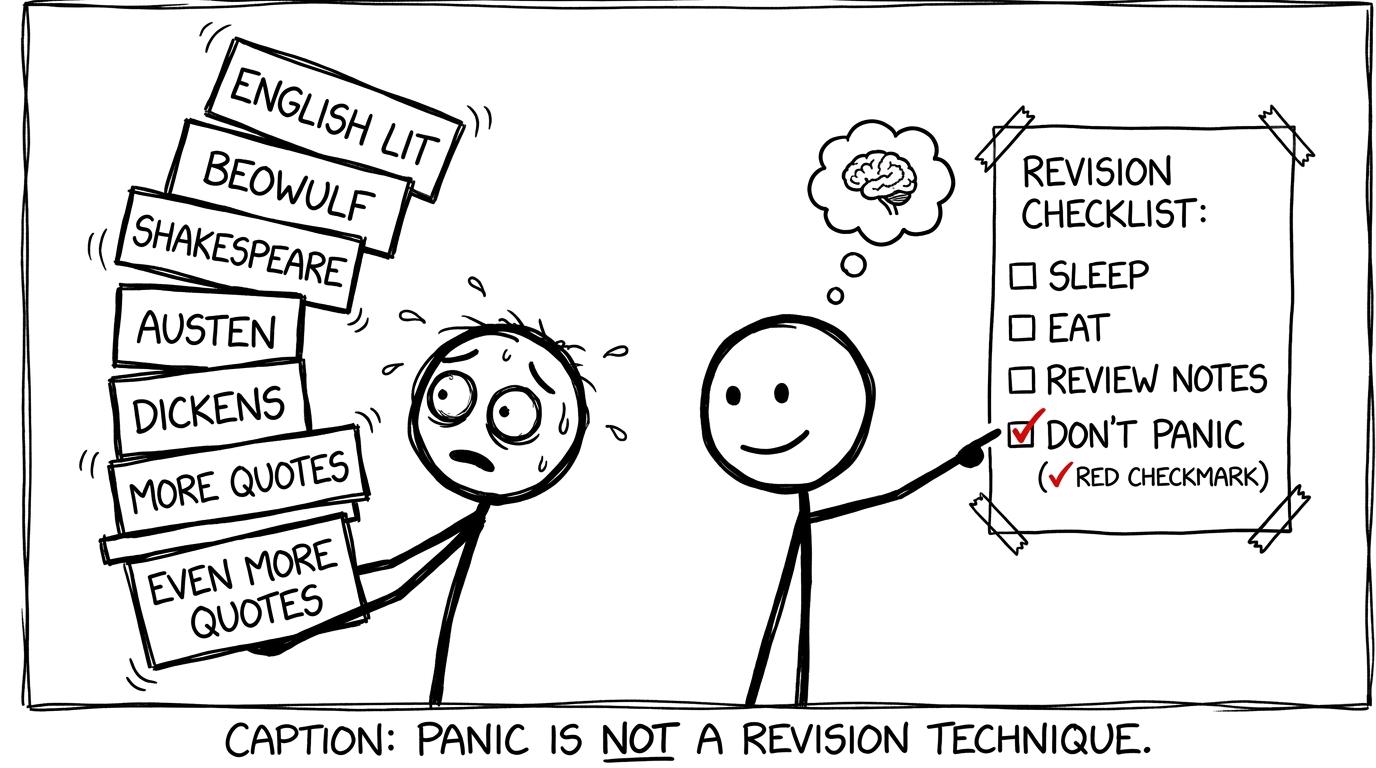 Student holding flashcards while calm checklist appears
The night-before checklist (do this, not everything)
Here’s the calm checklist for GCSE English Literature. It’s short on purpose.
- Choose your texts and decide what you’re actually revising tonight (not all of English Literature)
- Prepare a “quote bank” you can use flexibly (themes, characters, relationships)
- Practise one timed paragraph using a clear structure
- Mark it quickly and improve one thing
- Pack your kit, set alarms, and stop in time to sleep
If you’re thinking, “That’s it?” yes. The night before an exam isn’t for becoming a new person. It’s for reducing avoidable mistakes.
Why a maths student should revise English Lit like this
Maths students often feel out of place in English because the answers aren’t one line long. But the thinking is familiar.
In maths, you win marks by doing three things well:
- choosing a method quickly
- showing steps clearly
- avoiding unforced errors
English Literature is the same. Examiners reward clear argument, relevant evidence, and precise analysis. So tonight you’re not “learning a book”. You’re building a method you can repeat under pressure.
When you’re done with English, you can keep your momentum for maths using YesGenie’s topic practice and exam resources like GCSE Past Papers or the Resources hub. You’re training consistency, not just memory.
The night-before plan (two tracks)
Choose the track that fits your time. Either way, stop at a sensible time.
Track A: You have 90 minutes
- 10 mins: pick texts and identify likely question areas
- 30 mins: build a flexible quote bank
- 25 mins: write one timed paragraph
- 15 mins: self-mark and improve one thing
- 10 mins: pack, wind down, sleep
Track B: You have 3 hours
- 15 mins: pick texts and question types (poetry, modern text, Shakespeare)
- 60 mins: quote bank + theme webs
- 45 mins: two timed paragraphs (different texts)
- 30 mins: mark + redraft one paragraph
- 30 mins: light recall (no new content)
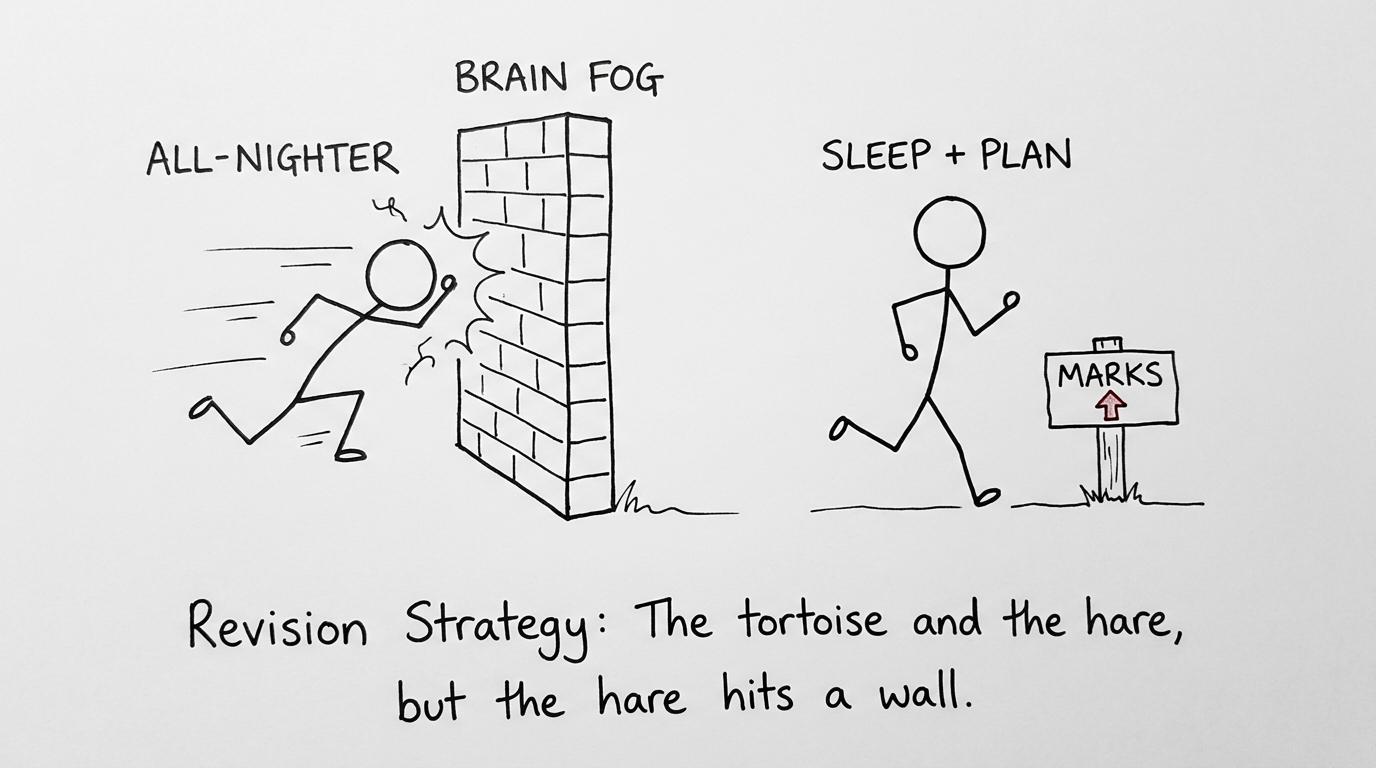 All-nighter sprinting into brain fog wall
Step 1: Decide what you’re revising tonight (and what you’re not)
The fastest way to panic is to treat English Literature as one giant blob. Split it into exam-shaped pieces.
For most GCSE exam boards (AQA, Edexcel, OCR, Eduqas), the paper is made up of sections, each with predictable assessment objectives: understanding the text, analysing language/structure/form, using evidence, and linking to context (depending on the question).
Tonight, choose:
- One Shakespeare focus (e.g. ambition, power, conflict, love, appearance vs reality)
- One modern text focus (e.g. responsibility, class, family, identity)
- One poetry comparison pair (two poems you can link through a shared theme)
This is like choosing which topics you can reliably score on in maths. You don’t revise every theorem the night before. You pick the ones that pay rent.
If your head is full of “I should”, write a tiny boundary:
Tonight’s job=confidence+method \text{Tonight’s job} = \text{confidence} + \text{method} Tonight’s job=confidence+methodNot perfection.
Step 2: Build a quote bank that behaves like a formula sheet
Students often try to cram dozens of quotes. The better move is to pick a small set that can be used in multiple arguments.
Aim for:
- 6 quotes for Shakespeare
- 6 quotes for modern text
- 6 short quotes across 4 poems (so you can compare)
That’s 18 quotes. Manageable. Repeatable.
How to make quotes flexible
For each quote, write two notes:
- What it suggests (theme/idea)
- How the writer does it (method: imagery, contrast, metaphor, stage directions, structure)
Example (generic format you can copy):
- Quote: “…”
- Suggests: power/control/guilt/isolation
- Method: semantic field of violence; imperative verbs; enjambment; dramatic irony
This is the English Literature version of remembering that completing the square works because you’re reorganising the expression into (x+a)2+b(x+a)^2+b(x+a)2+b.
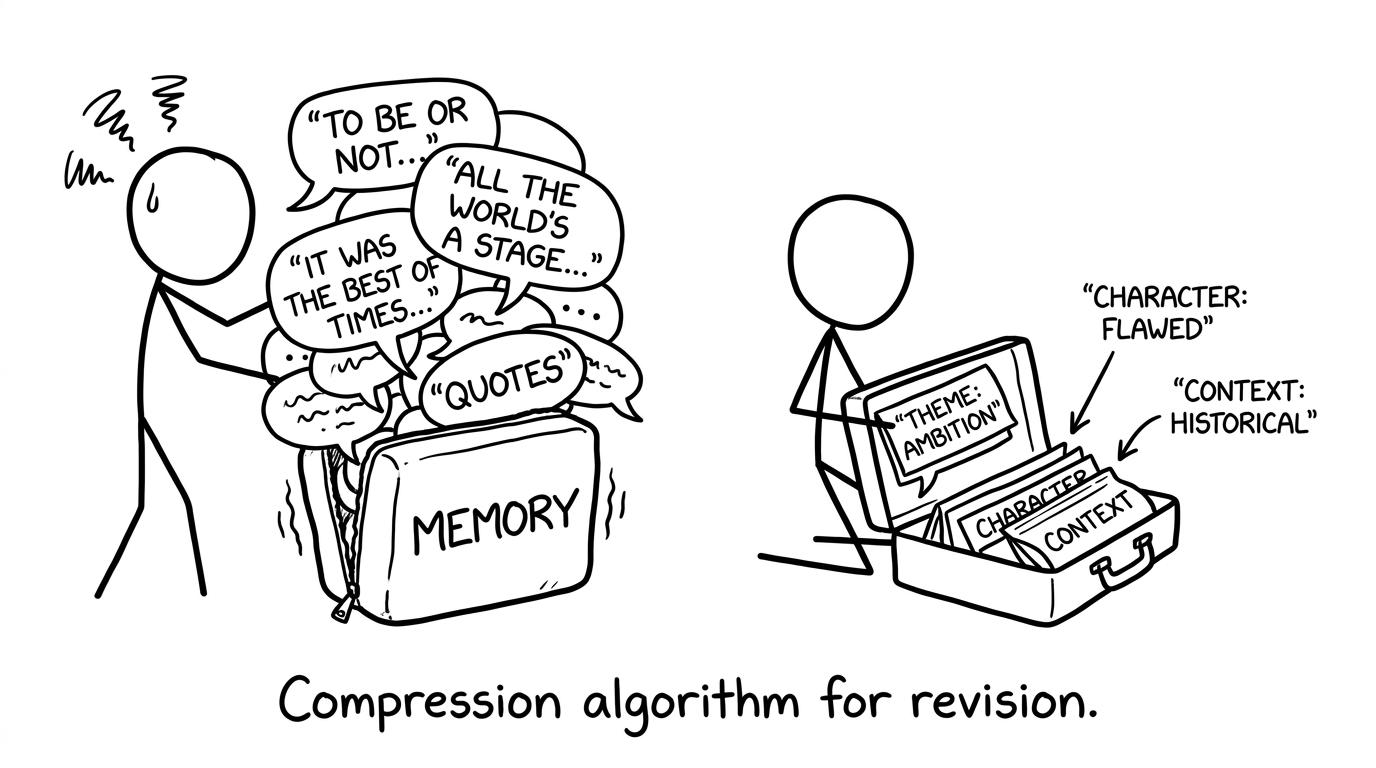 Quotes being folded into themed packets
Step 3: Practise one paragraph like it’s a worked example
A night-before plan should produce something concrete: one paragraph you’ve actually written under time pressure.
Use a reliable structure. A simple one:
- Point (answer the question)
- Evidence (short quote)
- Analysis (language/structure/form)
- Link (to theme, context if needed, and back to the question)
A timed-paragraph method (maths-style timings)
Let’s say you give yourself 121212 minutes.
- 222 mins: plan a one-sentence argument + choose a quote
- 888 mins: write
- 222 mins: check and improve one sentence
That’s a method you can repeat. In maths, you might allocate 222 minutes to reading, 888 to solving, 222 to checking. Same idea.
Worked example: planning with “inputs” and “outputs”
Treat your paragraph like a function:
- Inputs: question + quote + method
- Output: a clear claim that earns marks
If your quote is too long, compress it. If your analysis is vague, make it precise.
For example, you can improve:
- Vague: “This shows he is angry.”
- Precise: “The aggressive verb choices create a threatening tone, suggesting anger is being used as control rather than emotion.”
That’s like replacing “because maths” with the actual algebraic step.
Step 4: Mark it quickly (then fix one thing)
Don’t do a full essay tonight. Do a quick feedback loop.
Ask:
- Did I answer the question in the first sentence?
- Did I embed a quote?
- Did I analyse a method (not just the story)?
- Did I stay focused rather than listing everything I know?
Then fix one thing only. Maybe it’s adding a sharper verb, linking back to the question, or making one sentence more analytical.
This is the same as doing a mini test, checking the mark scheme, and then practising the one skill you missed.
For your maths revision, YesGenie is built around this loop: practise, check, improve. Use Edexcel GCSE Maths Mini Tests for short, low-stress feedback, or go straight to Edexcel GCSE Maths Past Papers when you’re ready.
Step 5: Use anxiety like a timer, not a teacher
Anxiety is loud the night before a GCSE exam because it’s trying to protect you from uncertainty. The mistake is negotiating with it.
Instead, give it a job:
- Anxiety tells you it’s time to do the next small step.
- Your plan decides what that step is.
When you finish your paragraph and your quote bank, you are allowed to stop. Stopping is part of performance.
If you want a gentle “bridge” back to maths after English revision, use a short, structured resource like Other Resources (Formulae to Remember) or a targeted topic page such as Simplifying Algebra. Keep it light. You’re not trying to peak at midnight.
Common mistakes the night before GCSE English Literature
- Trying to relearn the entire text instead of building a flexible quote bank. This creates panic without improving marks.
- Memorising quotes with no analysis. A quote is only valuable if you can say how it works and why it matters.
- Writing a full essay at 1am. The extra paragraph often costs more in tiredness than it gains in skill.
- Collecting “perfect” context facts and forgetting to link them to the writer’s message. Context is not a trivia round.
- Over-highlighting notes. Highlighting can feel productive but often avoids retrieval practice.
- Ignoring timing. If you never practise a timed paragraph, your first timed paragraph becomes the real exam.
A calm ending: close the book, keep the method
The night before a GCSE exam is a strange little hourglass: you can feel the sand falling, and it tempts you to grab at everything at once. But grabbing isn’t revision. A plan is revision.
Build a small quote bank. Write one timed paragraph. Improve one thing. Pack your bag. Sleep.
Then, when you’re ready to switch back to maths, let YesGenie carry the load: use the Resources hub to choose the right tool, practise with GCSE Past Papers, sharpen timing with Edexcel GCSE Maths Mini Tests, and focus on likely areas with Edexcel GCSE Maths Predicted Papers. The goal is the same across every subject: fewer surprises, more marks, and a calmer mind on the day.