

When to Stop Revising GCSE Drama the Night Before
When to stop revising GCSE Drama the night before: set a sensible cut-off, protect your sleep and use a calm final review without last-minute cramming.
The night before GCSE Drama, stopping can feel harder than revising. There is always another quotation to recall, another design choice to consider or another live theatre moment to revisit. Yet the practical answer to when to stop revising GCSE Drama the night before is simple: finish at least an hour before bed and choose a bedtime that allows roughly eight to ten hours of sleep.
For many students, that means closing the folder somewhere between eight and nine in the evening. Your precise time depends on when you must wake up, travel and arrive at school. Work backwards from the morning rather than forwards from the amount left to revise.
The aim is not to know everything by midnight. It is to enter the exam rested enough to retrieve, interpret and evaluate what you already know.
Your night-before cut-off checklist
Use these five decisions to keep the evening under control:
- Decide when you need to wake up.
- Protect enough time for eight to ten hours of sleep where possible.
- Leave at least an hour between revision and bed so you can wind down.
- Spend the final revision block recalling familiar material, not learning an entire new section.
- Stop earlier if your concentration, accuracy or confidence is clearly declining.
A sensible evening is usually one or two focused blocks followed by a definite finish. It is not an open-ended session governed by panic.
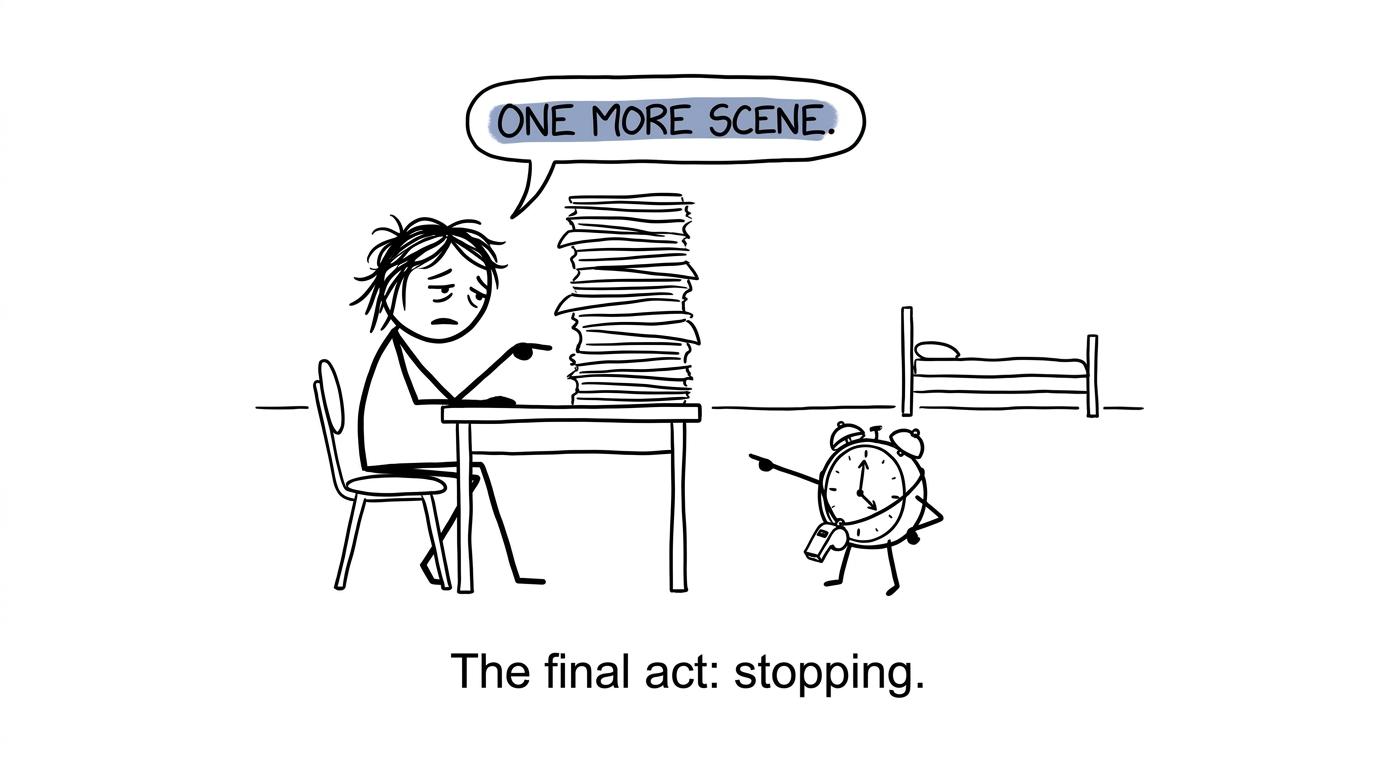 A tired GCSE student being sent to bed by an alarm clock referee
Why sleep should set your finishing time
Official NHS guidance says that most teenagers need eight to ten hours of sleep and warns that cramming through the night before an exam is usually a bad idea. Sleep supports thinking and concentration, while a wind-down period helps the transition from revision to rest.
This changes the decision completely. You are not asking, “How late can I keep going?” You are asking, “What finishing time protects tomorrow’s performance?”
Suppose you need to be awake at seven in the morning. Your plan must include the sleep itself, time to settle and a period away from demanding revision. If your usual routine takes time, account for it honestly. Being physically in bed is not always the same as being asleep.
A late extra hour can feel productive because it is visible: more pages highlighted, more notes read. The cost is less visible until the exam begins. It may appear as slower recall, muddled explanations or difficulty sustaining an argument.
Stopping is therefore part of revision, not the abandonment of it.
What to revise before you stop
GCSE Drama written assessments vary across AQA, Edexcel, OCR and Eduqas, so follow your own specification and your teacher’s instructions. The written component commonly tests knowledge of a set performance text and the ability to analyse or evaluate live theatre. You may also need precise theatre terminology and an understanding of acting, directing and design choices.
Your final review should be narrow enough to finish. Prioritise the following.
Your set text
Recall a small number of flexible moments from the play rather than attempting to reread the whole script. For each moment, consider:
- what happens and why it matters;
- the character’s motivation;
- vocal and physical performance choices;
- staging, lighting, sound, costume or set possibilities;
- the intended effect on the audience;
- relevant social, cultural or historical context.
Do not merely recite a list of techniques. Strong Drama responses explain how a specific choice communicates meaning.
Your live theatre production
Briefly retrieve the production’s title, venue, significant moments and the contributions you could analyse confidently. Concentrate on details you genuinely remember: a performer’s movement, a vocal decision, the use of space, a lighting transition, a sound cue or a design feature.
Evaluation requires judgement. Remind yourself not only what happened, but how effectively it shaped the audience’s response and why.
Command words and response structure
Check the difference between describing, explaining, analysing and evaluating. Then recall the structure your teacher has recommended for longer responses. Avoid inventing a new essay formula at the last moment.
Your final notes should act like stage directions: brief, clear and useful. If they have become a second textbook, they are too long for tonight.
A calm final-evening plan
Begin by writing down the fixed stopping time. A boundary decided while calm is more reliable than one negotiated while anxious.
Early evening: retrieve
Spend a short block recalling information without looking at your notes. You might use prompt cards, blank-page recall or verbal explanations. Check the specification areas your class has prepared, then identify no more than three weak details.
This is the same principle used in effective maths revision: diagnose a precise gap instead of vaguely revisiting everything. Maths students can apply the method through the MathsGenie guide to finding weak GCSE topics.
Middle of the evening: repair
Use your notes, script and teacher materials to correct those limited gaps. Keep the task controlled. If you cannot remember one production moment clearly, revisit that moment. Do not respond by rereading every live theatre note you have made since Year Ten.
If other exams are approaching, resist allowing Drama to consume the time reserved for them. A sustainable GCSE revision timetable protects rest and distributes work across the exam period rather than forcing every subject into its own emergency.
Final block: reassure
End with material you broadly know. Recall key vocabulary, outline a few adaptable set-text moments and check the essentials for the morning. Finish on retrieval, not on an unanswered question that sends you searching through more notes.
Then close the books when the planned time arrives.
How to recognise that revision has stopped helping
The clock is not the only signal. Stop if you notice several of these signs:
- you are reading the same paragraph repeatedly;
- your recall is becoming worse rather than better;
- you keep changing resources without completing a task;
- small gaps feel like proof that you know nothing;
- you are copying notes rather than thinking;
- you are sacrificing the sleep your plan was designed to protect.
Fatigue can make ordinary uncertainty feel catastrophic. One forgotten term does not erase two years of lessons, rehearsals and theatre analysis. It simply feels larger late at night because tired minds are poor judges of proportion.
If concentration collapses well before your intended cut-off, stop early. Ten purposeful minutes are more valuable than an hour spent staring at the same page.
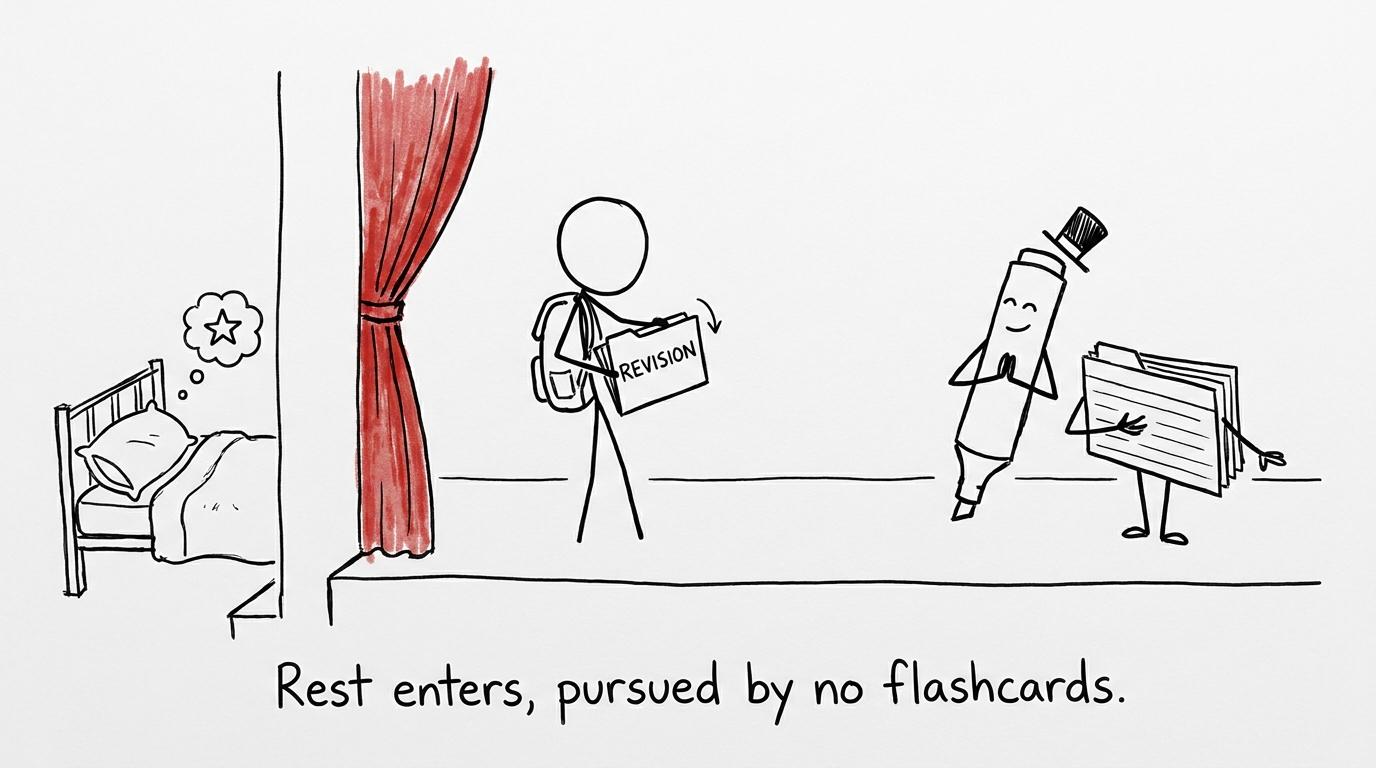 Drama revision materials taking a curtain call as rest enters
What to do after closing your notes
A cut-off only works if revision does not quietly continue on your phone. Avoid searching for predicted questions, comparing preparation with friends or watching an endless stream of revision clips.
Instead:
- pack the permitted equipment you need;
- check the exam time and travel arrangements;
- prepare clothes and breakfast;
- set your alarm;
- place your materials out of sight;
- choose a quiet, familiar wind-down activity.
If a worry appears, write it down rather than reopening everything. A short note such as “review theatre roles at breakfast” gives the thought somewhere to go. Keep any morning review brief and familiar.
Students balancing Drama with maths can follow the same boundary-setting approach in the GCSE maths night-before plan. The subject knowledge changes, but the principle does not: targeted recall, a firm ending and adequate rest.
Common night-before revision mistakes
Starting a full past paper too late
A complete paper can expose problems without leaving enough time to understand them. Save full timed papers for earlier revision. On the final evening, use a small selection of prompts only if they match your exam board and your teacher’s guidance.
For future maths exams, use GCSE maths past papers and revision resources earlier in the process, when there is time to mark, repair and retest weaknesses.
Trying to learn the entire set text again
Drama rewards connected understanding, not frantic coverage. Secure a manageable collection of significant moments and know how performance or design decisions create meaning.
Memorising generic paragraphs
A memorised answer may not address the question that appears. Recall evidence, terminology and analytical relationships instead. You should be able to adapt your knowledge to the wording on the paper.
Treating the latest possible bedtime as a target
The cut-off is a limit, not a challenge. If your planned tasks are complete, stop. Extra tired revision does not become valuable simply because time remains.
Letting one subject destabilise the whole exam season
Students often have several papers close together. Protecting tomorrow matters, but so does remaining functional for the next exam. The one-month GCSE maths revision plan demonstrates how shorter repeated sessions, practice and feedback can replace emergency cramming.
If you also have a maths exam approaching
Do not switch from late Drama cramming into late maths cramming. Note the next maths task and leave it for its scheduled session.
When that session begins, use the MathsGenie GCSE maths revision hub to choose the correct exam board and level of work. Revision lessons and practice questions can rebuild individual topics; mini tests reveal short-term gaps; past papers develop timing; and mark schemes or video solutions show where method marks are gained and lost.
Edexcel students can also use the focused guide to revising Edexcel GCSE Maths efficiently. Planning this now removes the temptation to solve tomorrow’s revision problem tonight.
Let rest take the final scene
Knowing when to stop revising GCSE Drama the night before is an act of judgement. Set your finish at least an hour before bed, protect roughly eight to ten hours of sleep where possible and use the final session for selective retrieval rather than new learning.
You do not need to walk into the exam knowing every possible sentence. You need enough rest to understand the question, select useful evidence and communicate your ideas clearly.
Close the script. Pack your bag. Let the evening end.
Then, when Drama is finished and maths becomes the next priority, open MathsGenie for free revision lessons, practice questions, mini tests, past papers, predicted papers, mark schemes and video solutions. Use the resources early, follow a manageable plan and make the night before an ending rather than a rescue mission.











