What to Revise in May of Year 11 Maths
What to revise in May of Year 11 Maths: follow a practical weekly plan, target weak topics and use past papers wisely before your GCSE exams.
May feels different from every other month in Year 11. Exams are close enough to shape each day, yet there is still time to make meaningful progress.
If you are wondering what to revise in May of Year 11 Maths, prioritise topics costing you marks, practise complete papers under exam conditions, and use mark schemes to decide what happens next. Avoid trying to relearn the course in order.
Imagine a student called Sam with secure topics, uncertain topics and some avoided since the mocks. A useful May plan turns that mixed picture into clear actions.
Your May maths revision checklist
Your plan should include:
- an audit of strong and weak topics
- targeted practice and regular retrieval
- papers matching your exam board and tier
- careful marking and an error log
- calculator and non-calculator practice where relevant
- rest and time for other GCSE subjects
The GCSE maths revision timetable guide helps you balance your workload. In May, keep that timetable responsive: tomorrow’s practice should partly reflect today’s mistakes.
Start May by finding the gaps
Sam’s first instinct might be to open a revision guide and work forwards. That feels organised, but gives secure and uncertain topics equal attention.
Instead, complete a paper or substantial mixed question set without notes. Match your exam board and tier, whether Edexcel, AQA, OCR or Eduqas, Foundation or Higher, and use realistic time limits.
Mark honestly, then classify lost marks:
- Knowledge gap: you did not know the fact or method.
- Application gap: you knew the method but missed when to use it.
- Accuracy gap: your approach worked, but arithmetic, notation or checking failed.
Each needs a different response. A lesson can address missing knowledge; varied questions help method selection; deliberate checking tackles accuracy. Read MathsGenie’s guide to starting GCSE past papers if full papers feel unfamiliar.
What to revise in May of Year 11 Maths
Choose priorities from your marked work. Useful areas to check include fractions, percentages, ratio, equations, inequalities, graphs, angles, area, volume, probability and statistics. Include Pythagoras, trigonometry and problems combining several skills where appropriate to your specification.
Higher-tier priorities may include quadratics, surds, algebraic fractions, vectors, functions and circle theorems. Foundation students should secure accessible number, proportion, algebra and geometry marks while gradually tackling harder questions.
For each weakness, follow a repair cycle:
- Watch a focused revision lesson or video solution.
- Answer practice questions independently.
- Mark immediately and correct errors in full.
- Revisit similar questions a few days later.
That return visit checks whether the method is available without a recent demonstration. Include occasional questions from stronger topics too, so earlier learning stays accessible.
Use the Revision Planner to place these priorities around school, examinations and other subjects.
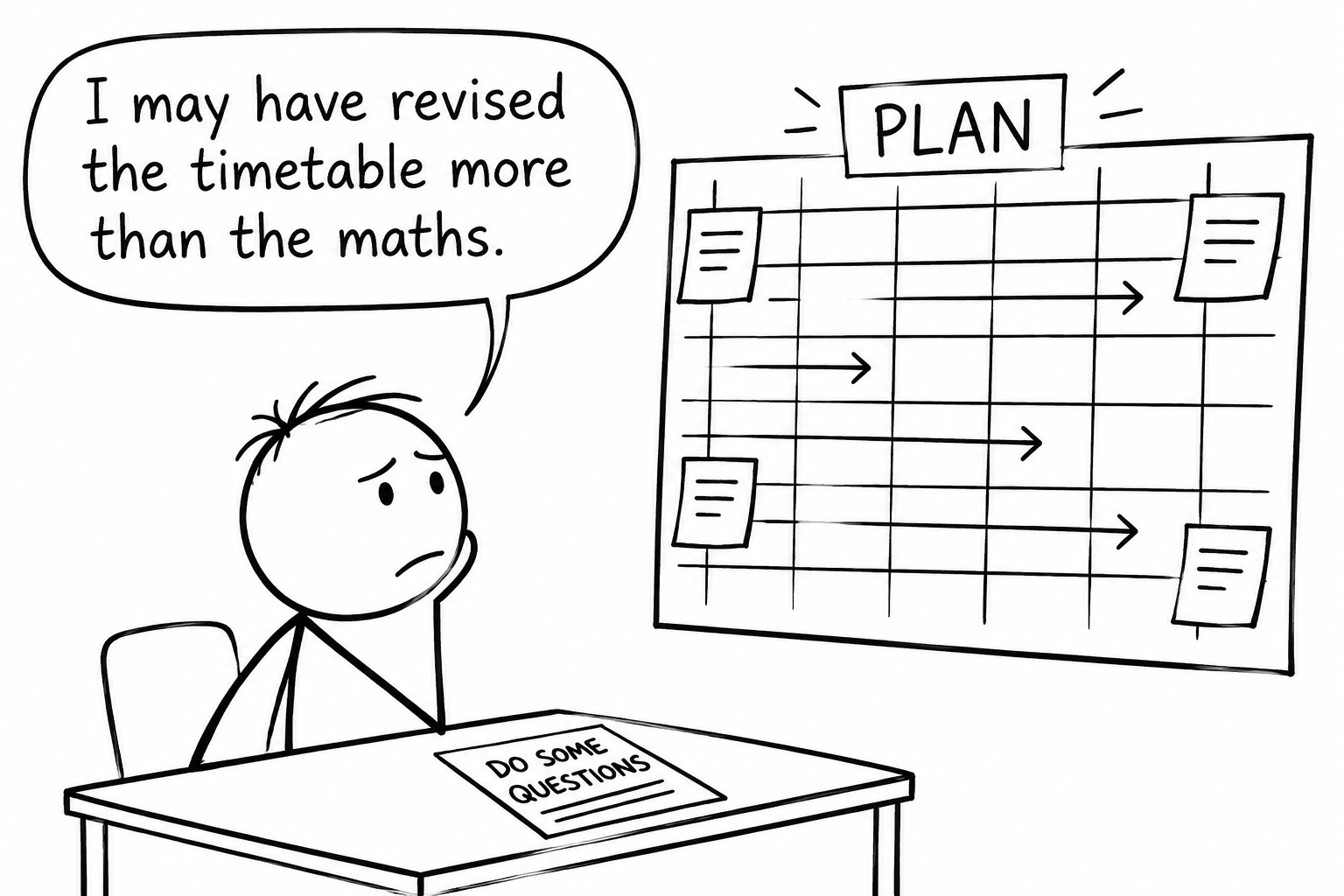 A student realises they have revised the timetable more than the maths
Move from topics to mixed papers
Topic practice builds methods. Mixed practice tests whether you can choose them when the question gives no topic heading.
A manageable starting rhythm is one full paper each week, supported by correction sessions and shorter topic practice. Adjust this around your actual examination dates, rather than treating calendar weeks as fixed stages.
After each paper, mark it, record recurring weaknesses, redo incorrect questions without solutions, and attempt fresh questions on the same skills. Your score identifies a starting point; corrections determine the next revision task.
Learn how to use GCSE past papers properly so the mark scheme becomes feedback rather than a source of hints. Predicted papers offer extra practice, but cannot guarantee topics or replace broad specification coverage.
A flexible weekly template
Move these tasks around your school timetable and other GCSE commitments.
| Day | Main task |
|---|---|
| Monday | Review and practise one weak topic |
| Tuesday | Complete a mixed mini test and correct mistakes |
| Wednesday | Revisit Monday’s topic, then practise another weakness |
| Thursday | Attempt a timed paper section |
| Friday | Review formulae and calculator skills |
| Saturday | Complete and mark a full paper |
| Sunday | Redo mistakes and update next week’s priorities |
Keep sessions focused enough to finish the correction work. When time is short, adapt the one-week GCSE maths revision plan. With longer available, use the one-month revision plan to organise your remaining practice.
Between papers and the evening before
Do not cross topics off because they appeared on an earlier paper. Skills can return in different contexts or combine with other content.
After an examination, take a break before reviewing what comes next. Lengthy answer comparisons cannot change the completed paper and may distract you from useful preparation.
Return to your error log, revise broad weaknesses and keep secure skills active with short mixed sets. Practise calculator use when appropriate, while showing clear working.
The evening before, review familiar errors, prepare equipment and stop at a sensible time. Avoid turning the final evening into an attempt to cover every remaining topic.
Common May revision mistakes
Choosing only comfortable questions: retain some confidence-building practice, but direct targeted sessions towards weaknesses revealed by marked work.
Collecting scores without corrections: every paper should lead to redone questions and a specific revision priority.
Watching without answering: pause video solutions, attempt questions independently and compare your method afterwards.
Using unsuitable papers: check the board, tier and specification before beginning.
Planning exhausting evenings: allow realistic space for other subjects and rest. A timetable needs to remain usable throughout exam season.
Build your May plan
Sam’s hypothetical progress comes from a repeatable loop: test, mark, repair and retest. Start with one marked paper and identify a manageable set of priorities.
Then build your schedule in the Revision Planner. Combine MathsGenie’s free revision lessons, practice questions, mini tests, past papers, mark schemes and video solutions to make each session answer a clear need.