What to Bring to GCSE Food and Nutrition Exam
What to bring GCSE Food and Nutrition exam day: a clear checklist of permitted stationery, banned devices, calculator rules and final student checks.

Exam mornings have a habit of making ordinary objects feel unusually important. A pen becomes essential. A forgotten ruler becomes a crisis. A phone left in your pocket becomes something far more serious.
If you are searching for what to bring GCSE Food and Nutrition exam day, the short answer is: bring black ballpoint pens, basic drawing equipment in a transparent pencil case, any identification required by your school and, where the paper permits it, an approved calculator. Keep phones, watches, notes, smart devices and correction products away from your desk.
This guide covers the written GCSE Food Preparation and Nutrition examination, not the practical assessment. Rules can vary slightly by exam board, paper and centre, so your school’s instructions and the front of the question paper always take priority.
Your exam-day checklist
Pack these items the evening before:
- At least two black ballpoint pens
- Two ordinary pencils
- A ruler
- An eraser
- A pencil sharpener
- A transparent pencil case
- A permitted calculator, if your school or paper confirms that one may be used
- A clear, unlabelled water bottle, if your centre allows water
- Your candidate identification or exam card, if required by your school
- Any approved access-arrangement equipment organised by your centre
Leave these items at home or hand them in exactly as your centre directs:
- Mobile phones
- Watches of every kind, including analogue watches and smartwatches
- Earbuds, headphones and music players
- Notes, textbooks, recipe cards and revision guides
- Internet-enabled or data-storage devices
- Correction fluid, correction tape and correction pens
- Erasable pens
- Calculator cases, lids and instruction leaflets
- Food, ingredients, knives and practical cooking equipment
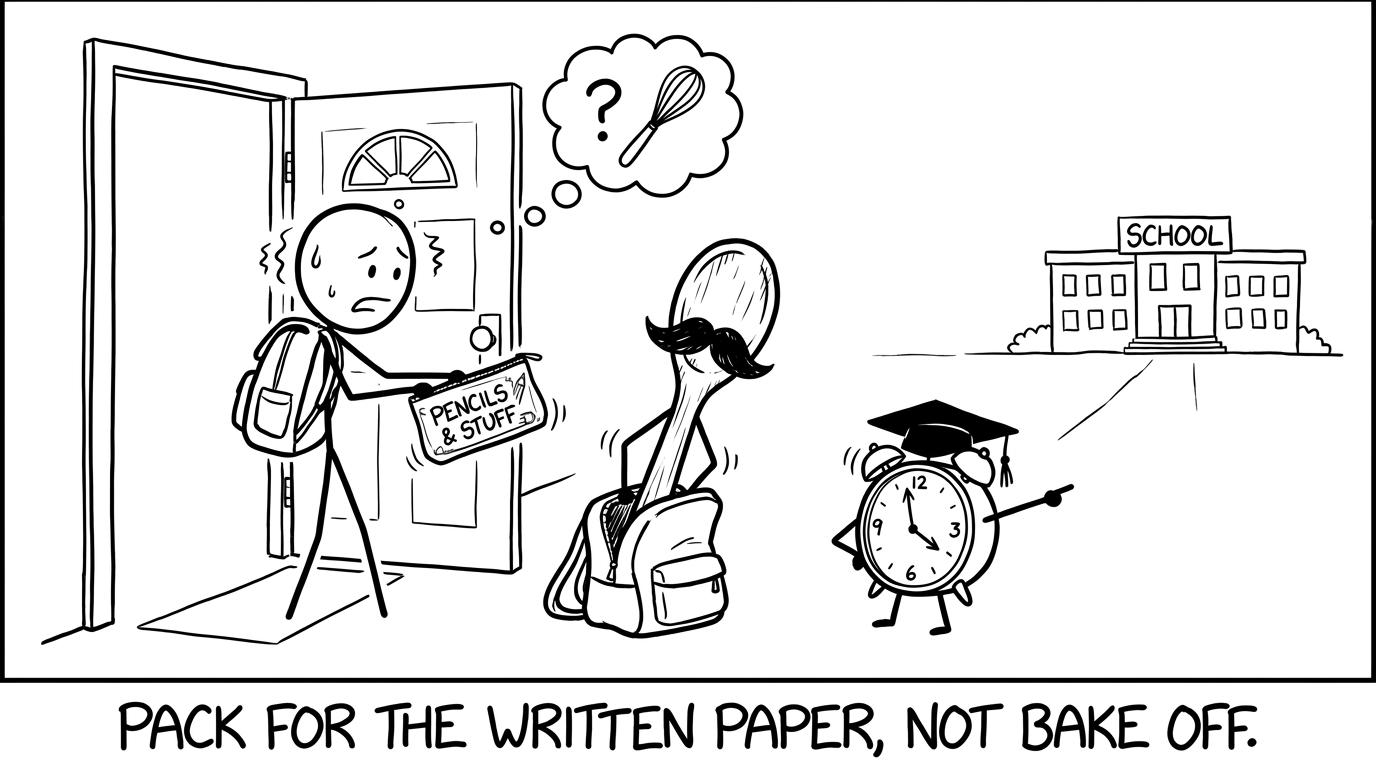 A giant wooden spoon attempts to sneak into a written examination bag
What you should bring to the written paper
Black ballpoint pens
Use a black ballpoint pen for written answers unless the paper gives another instruction. Black ink is designed to reproduce clearly when scripts are scanned for marking.
Bring more than one pen. This is not excessive preparation; it removes a small and avoidable risk. Test each pen at home rather than discovering during the examination that one has dried out.
Avoid relying on blue ink, gel pens or erasable pens. Gel ink can be unsuitable for scanned scripts, while erasable ink may fade or be affected by heat. Current examination instructions specifically warn candidates not to use erasable pens or gel pens in their answers.
Pencils and basic drawing equipment
A pencil is useful for diagrams, graphs or any question where the instructions ask you to draw. Food and Nutrition papers can include data, charts, labels and graphical information, so pack:
- A sharpened pencil
- A spare pencil
- A ruler
- An eraser
- A sharpener
Use pencil only where appropriate. Extended responses explaining nutrition, food science, safety or provenance should normally be written in black ballpoint pen.
Keep everything in a transparent pencil case. An opaque case may have to be removed from your desk because invigilators must be able to see its contents.
A calculator, if the paper permits one
Food Preparation and Nutrition includes numerical ideas such as proportions, nutritional values, quantities, temperatures and time. However, calculator permission is determined by the examination paper and exam board, not by the subject name alone.
Check the front cover of your specific paper and follow your school’s instructions. If a calculator is permitted, it should be a normal examination calculator with no access to stored notes, communication functions or the internet. Remove its lid, case and instruction leaflet before entering the room.
Do not assume that an invigilator can provide a calculator if you forget yours. Equally, never begin using one until you know it is permitted for that paper.
Students who want to strengthen the numerical side of the subject can use MathsGenie’s GCSE maths revision lessons. Topics such as ratio, percentages, unit conversion, averages and interpreting graphs are particularly transferable.
Water and identification
Many centres allow water in a clear bottle with the label removed. Coloured bottles, bottles covered in writing and drinks other than water may not be accepted. Check your school’s policy rather than assuming.
Bring your candidate card, identification or examination timetable if your centre has asked for it. These are school procedures rather than universal items required in precisely the same way nationwide.
Do not write revision notes on your hands, water bottle, calculator or stationery. Something that feels like a last-minute memory aid can be treated as unauthorised material.
What must stay away from your desk
Phones, watches and smart devices
A mobile phone must not be in your possession during the examination. Switching it to silent or aeroplane mode does not make it acceptable. Follow your centre’s procedure for leaving it at home, placing it in a bag or handing it in before entering the room.
Watches are also prohibited in examination rooms under the national instructions, whether they are smart, digital or traditional analogue watches. The room should have a clock visible to candidates.
Other unauthorised technology includes:
- Smart glasses
- Fitness trackers with watch functions
- Earbuds and headphones
- Music players
- Internet-connected devices
- Devices capable of storing or displaying notes
Possession of unauthorised material can be reported even when a student says they did not use it. The safest approach is not clever concealment but complete separation.
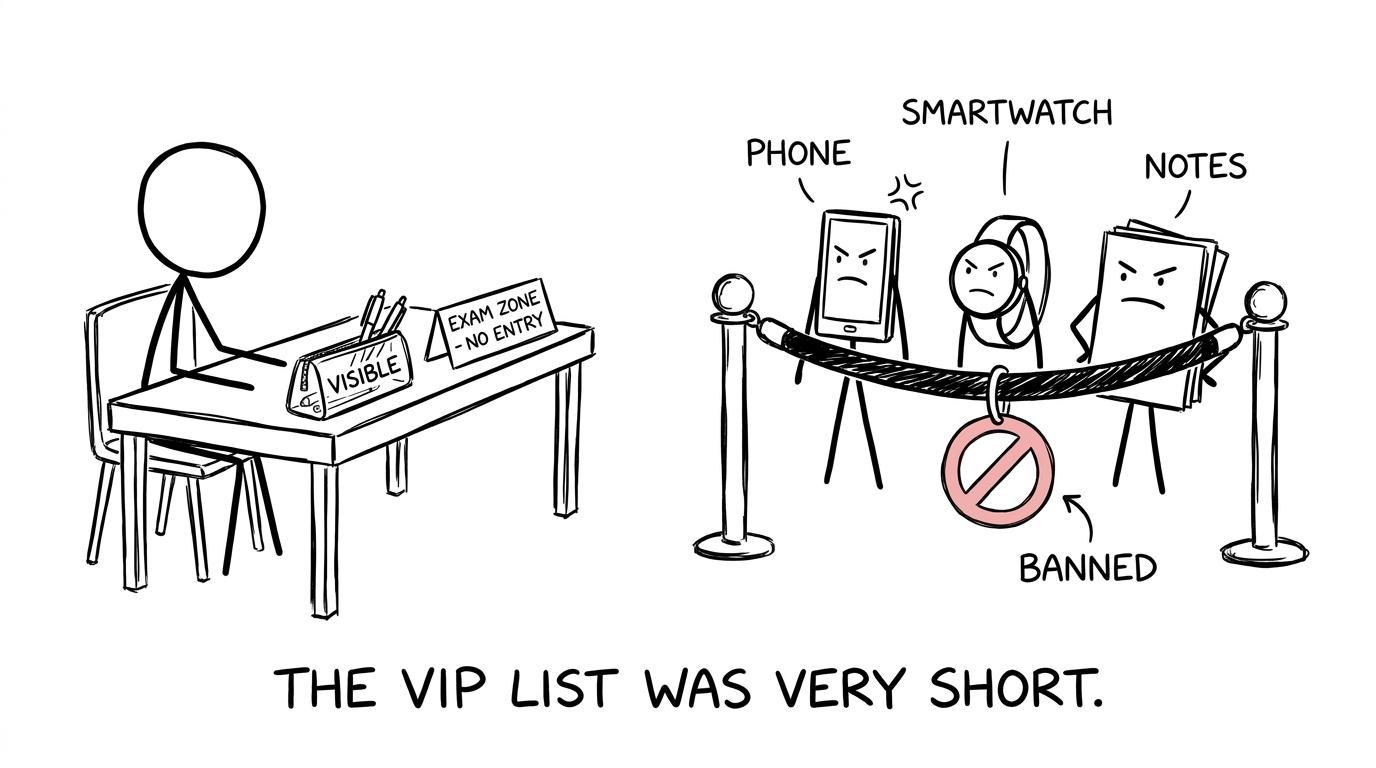 A phone, smartwatch and revision notes discover that the examination desk has a very short guest list
Notes, textbooks and recipe material
The written examination is closed book unless the paper explicitly states otherwise. Do not bring flashcards, nutrition tables, recipe sheets, annotated packaging or a revision guide to your desk.
You may revise from these resources before entering the examination area, but put them away when instructed. Check pockets carefully. A folded revision card forgotten in a blazer pocket is still unauthorised material.
This is also why the final few minutes before an examination are better used for calm recall than frantic reading. MathsGenie’s GCSE revision planner can help move that preparation earlier, when it is more useful.
Correction products and unsuitable stationery
Do not use correction fluid, correction pens or correction tape. If you make a mistake, cross it out neatly with a single line and continue.
Highlighters must not be used in your answers. If your centre allows one for highlighting the question paper, remember that highlighted material may not be reproduced in the scanned script. It is safer to follow the precise instructions given by the invigilator and paper.
Novelty stationery can create unnecessary uncertainty. Pens containing notes, electronic translators, programmable devices and stationery with extensive writing should stay at home.
Cooking equipment and ingredients
The final written examination is not the practical food preparation assessment. You do not need ingredients, an apron, knives, containers, weighing scales or cooking utensils.
That distinction sounds obvious, but it matters when students search for one checklist covering the whole qualification. Practical sessions have separate clothing, hygiene, ingredient and equipment arrangements set by the school. The written paper uses ordinary examination equipment.
Check your exam board and paper instructions
GCSE Food Preparation and Nutrition is offered through boards including AQA, OCR and Eduqas, with arrangements also varying across UK qualifications. Each paper’s front cover tells you what materials are required and whether a calculator may be used.
There is no responsible universal promise that one equipment list will override every future paper. The correct order of authority is:
- The instructions printed on your question paper
- Directions from the invigilator
- Your centre’s written exam guidance
- The general checklist in this article
Look at a recent paper from your own board before exam day. You are not only revising content; you are learning the paper’s language, command words and layout. In maths revision, the same principle applies: GCSE past papers and mark schemes reveal the real structure of an assessment more accurately than guesswork.
MathsGenie also provides dedicated collections of AQA GCSE maths papers and OCR GCSE maths papers, helping students become comfortable with board-specific presentation and instructions.
Prepare the night before, not at the school gate
Lay out your equipment beside your bag. Empty the pencil case, check that it is transparent and return only the items you need. Test the calculator if it is permitted. Remove its cover. Fill an approved clear bottle and remove the label.
Then check the less visible details:
- Confirm the date and start time
- Confirm the examination room
- Check whether your school requires identification
- Arrange transport with time to spare
- Remove notes and devices from uniform pockets
- Set an alarm and protect a sensible night’s sleep
This routine is not about becoming perfectly organised. It is about reducing the number of decisions left for a stressful morning.
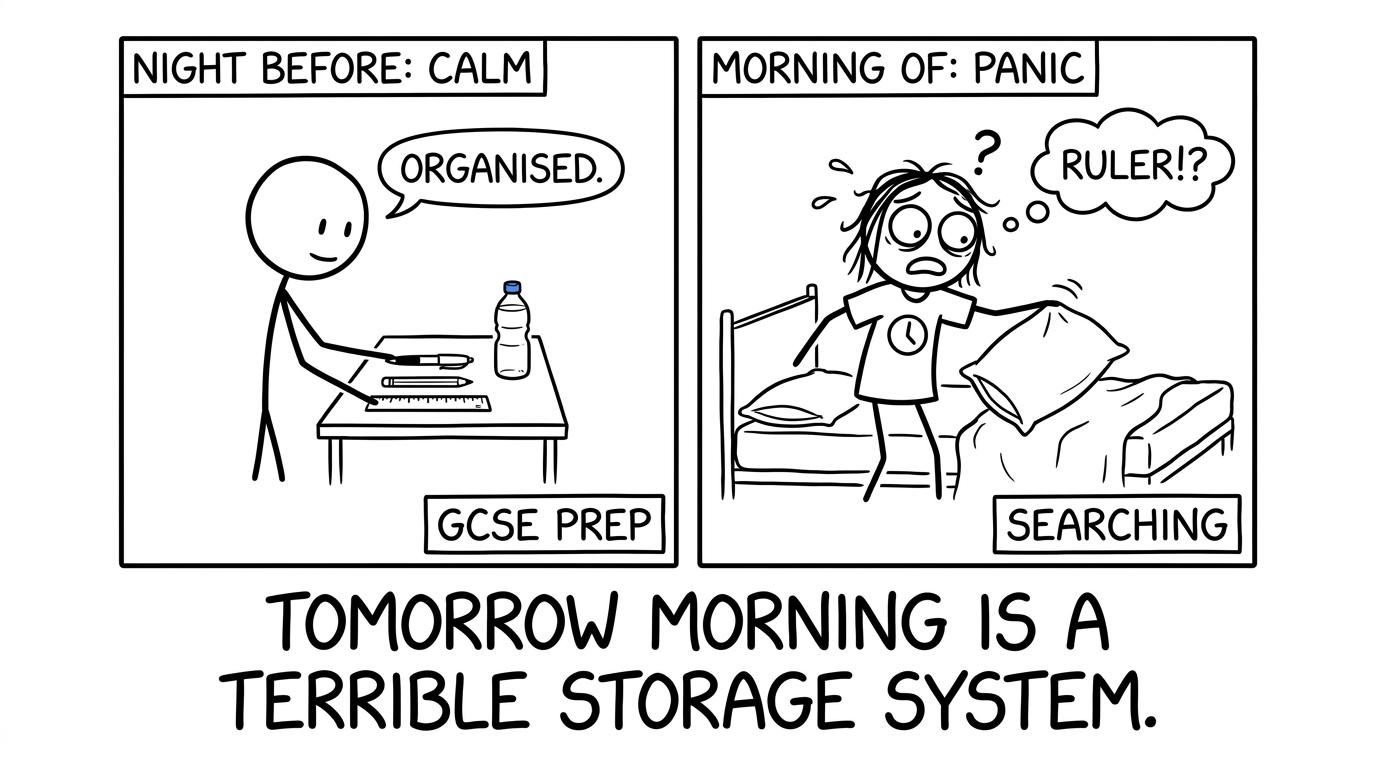 One student packs calmly while another attempts to use tomorrow morning as a storage system
Numeracy worth revising for Food and Nutrition
Your equipment only gets you into the examination prepared. You still need confidence with the numerical information that appears in food contexts.
Relevant skills may include:
- Comparing quantities and proportions
- Reading nutritional tables
- Interpreting graphs and charts
- Converting between units
- Calculating percentages
- Working with averages
- Scaling quantities
- Managing time and temperature information
For broader numerical practice, begin with the MathsGenie GCSE revision hub, then use GCSE predicted papers to practise selecting methods under timed conditions. Predicted papers are practice resources rather than forecasts of exact examination questions, but they can make unfamiliar data feel less intimidating.
Common exam-day mistakes
Packing only one pen
One pen is enough until it stops working. Bring at least two reliable black ballpoint pens and test them beforehand.
Keeping a switched-off phone in a pocket
A switched-off phone remains an unauthorised device. Hand it in or store it according to your centre’s instructions before entering the room.
Wearing an ordinary watch
The restriction is not limited to smartwatches. Remove every type of watch before the examination.
Assuming a calculator is always allowed
Calculator rules belong to the specific paper. Check the front cover and listen to the invigilator. If permitted, remove the calculator’s lid and instructions.
Bringing practical equipment to the written paper
The practical assessment and written examination are different components. Ingredients and cooking tools are not required for the written paper.
Leaving revision notes in a pocket
Empty blazer, trouser and skirt pockets before arriving. Check for flashcards, scraps of paper, earbuds and devices.
Ignoring the front cover
The cover is part of the examination. Read it carefully. It tells you how to complete your details, what equipment you may use and how to answer.
Walk in with fewer things to worry about
The best exam bag is not the fullest one. It contains the small set of permitted items that help you work, with nothing that could interrupt the examination or place your result at risk.
Pack black pens, pencils, a ruler, an eraser and a sharpener in a transparent case. Add a calculator only when permitted, and follow your centre’s rules for water and identification. Leave phones, watches, notes, smart devices and correction products outside the room.
Once the bag is ready, turn your attention back to preparation. Use MathsGenie’s free revision lessons, past papers with mark schemes, predicted papers, practice questions and video solutions to sharpen the numerical skills that support GCSE success. Good revision cannot remove every exam-day nerve. It can, however, ensure that a forgotten pen is not one of them.