What to Bring to the GCSE English Literature Exam
What to bring GCSE English Literature exam day: allowed stationery, banned devices, set-text rules, water and final checks for a calm start in 2026.
The smallest exam-day decisions can create the most unnecessary worry. Is a blue pen acceptable? Can you wear an ordinary watch? Should you bring your copy of Macbeth just in case?
If you are searching for what to bring GCSE English Literature exam day, the short answer is simple: take at least two black ink pens in a clear pencil case, your centre identification if required, and a transparent label-free bottle of water if your school permits it. Leave notes, set texts, watches, phones, earbuds and other smart devices outside the exam room.
This guide reflects the JCQ rules applying to written examinations in the 2025-2026 academic year and the published GCSE specifications for AQA, Pearson Edexcel, OCR and Eduqas. Your school's instructions and the front of your question paper remain decisive, so ask your exams officer if anything is uncertain.
Your GCSE English Literature exam checklist
Pack these items the night before:
- At least two working black ink or black ballpoint pens
- A see-through pencil case
- One or two pencils for planning, if you find them useful
- A pencil sharpener and eraser, although final answers should be written in black ink
- A transparent water bottle with its label removed, if permitted by your centre
- Your candidate card, identification or examination timetable if your school requires it
- Any approved equipment connected to an access arrangement
Do not take these to your desk:
- A mobile phone, even if it is switched off
- Any watch, including an analogue watch
- Earphones, earbuds or AirPods
- Smart glasses, tablets, music players or other smart devices
- Revision cards, notes, quotation sheets or annotated paper
- Your novel, play or poetry anthology for a standard GCSE English Literature examination
- A dictionary, unless you have specifically been told that one is permitted
- A calculator, mathematical instruments or other equipment unrelated to the paper
- Correction fluid, correction tape, erasable pens or gel pens for your answers
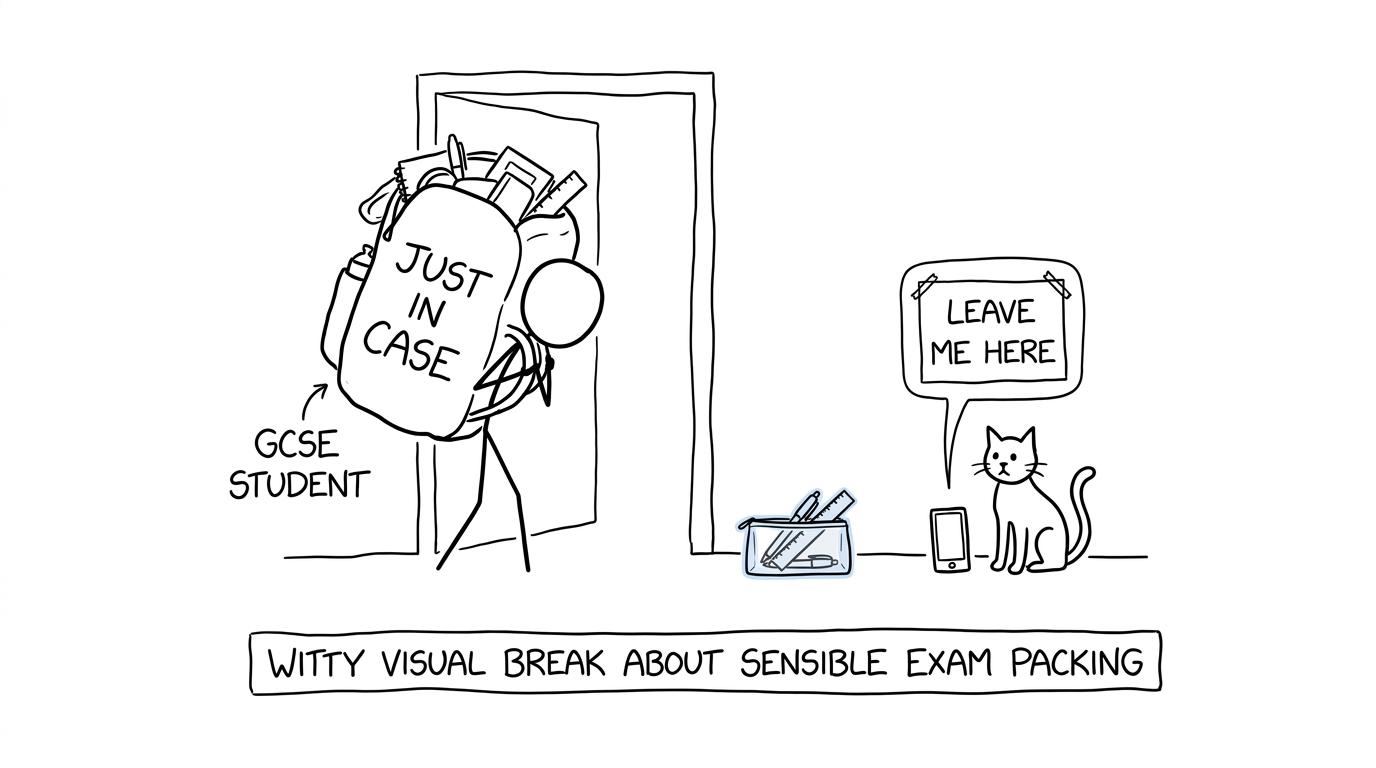 A student discovers that a tiny clear pencil case is more useful than an enormous just-in-case bag
What you should bring into the exam room
Two or more black ink pens
JCQ's current candidate checklist specifies black ink pens. Exam scripts are commonly scanned before marking, so black ink produces a reliable image. Blue pens are not the safe choice, even if you normally use one in lessons.
Bring at least two pens and test them beforehand. A spare costs almost no space but removes a preventable problem. Avoid gel pens, erasable pens and felt-tip pens for your answers. If a pen fails, raise your hand rather than trying to borrow from another student.
A transparent pencil case
Any pencil case taken into the room must be see-through. A patterned, fabric or opaque case may have to be left elsewhere, even if it contains nothing prohibited.
Keep the contents minimal: black pens, pencils, an eraser and a sharpener. English Literature does not require the ruler, protractor, compasses or calculator you might pack for maths.
That distinction is worth practising. When completing a timed paper through the GCSE Maths revision hub, use only the equipment that belongs to that particular paper. Building the habit of checking paper-specific instructions makes every exam morning calmer.
Water, subject to your centre's rules
JCQ permits centres to allow food and drink at the head of centre's discretion. Where water is allowed, the bottle must be transparent and all labels must be removed. A transparent reusable bottle can be acceptable as well as a disposable one.
Do not assume that coloured drinks, branded bottles or cans will be admitted. Water in a clear, label-free bottle is the uncomplicated option. Your school can set stricter local arrangements, so follow the guidance it gives you.
Identification if your centre requests it
Some centres provide a candidate card showing details such as your candidate number, while others place this information on the desk. Private candidates may receive separate identification instructions.
Check your timetable and school guidance before exam day. Know the paper, start time, room and arrival time. Your centre may tell you to bring a candidate card or photographic identification, but this is not a universal requirement for every school student.
Approved access-arrangement equipment
If you have an agreed access arrangement, your centre should organise the approved room, equipment or support. This might involve a word processor, coloured overlay or another authorised arrangement.
Do not substitute your own electronic device or assume that ordinary exam rules no longer apply. Confirm the practical details with your SENCO or exams officer before the examination series begins.
Should you bring your English Literature books?
For the mainstream GCSE English Literature qualifications offered by AQA, Pearson Edexcel, OCR and Eduqas, the examinations are closed book. You must not bring your studied novel, Shakespeare play, modern text or poetry anthology into the room. Any extracts or poems supplied for a question will be provided with the examination materials.
This is one of the most important distinctions in the whole checklist. A well-intentioned copy of A Christmas Carol containing annotations is still unauthorised material if the examination does not permit it.
International GCSE and other qualifications can have different open-book arrangements. Some papers permit clean copies of prescribed editions, while others remain closed book. If your entry says International GCSE, do not use a general GCSE checklist as your only source. Check the exact qualification code and ask your teacher or exams officer what the paper requires.
The same principle applies across subjects: revise with notes, but rehearse without them. MathsGenie's guide to starting GCSE past papers explains why gradually moving towards realistic exam conditions is more useful than waiting until the last week.
What must be left outside the exam room
Phones, watches and smart devices
JCQ lists mobile phones, watches, earphones, earbuds, music players, tablets, smart glasses and other smart devices as unauthorised items. The watch rule includes traditional analogue watches as well as digital and smart watches.
A switched-off phone is not automatically safe. The central issue is possession or access, not whether you intended to use it. Ideally, leave these items at home or use your centre's collection and storage process. Do not put a phone in a bag under your desk or hide it in a blazer pocket.
If you discover an unauthorised item before the paper starts, tell an invigilator immediately. Trying to conceal a mistake is far more serious than asking for help at the final check.
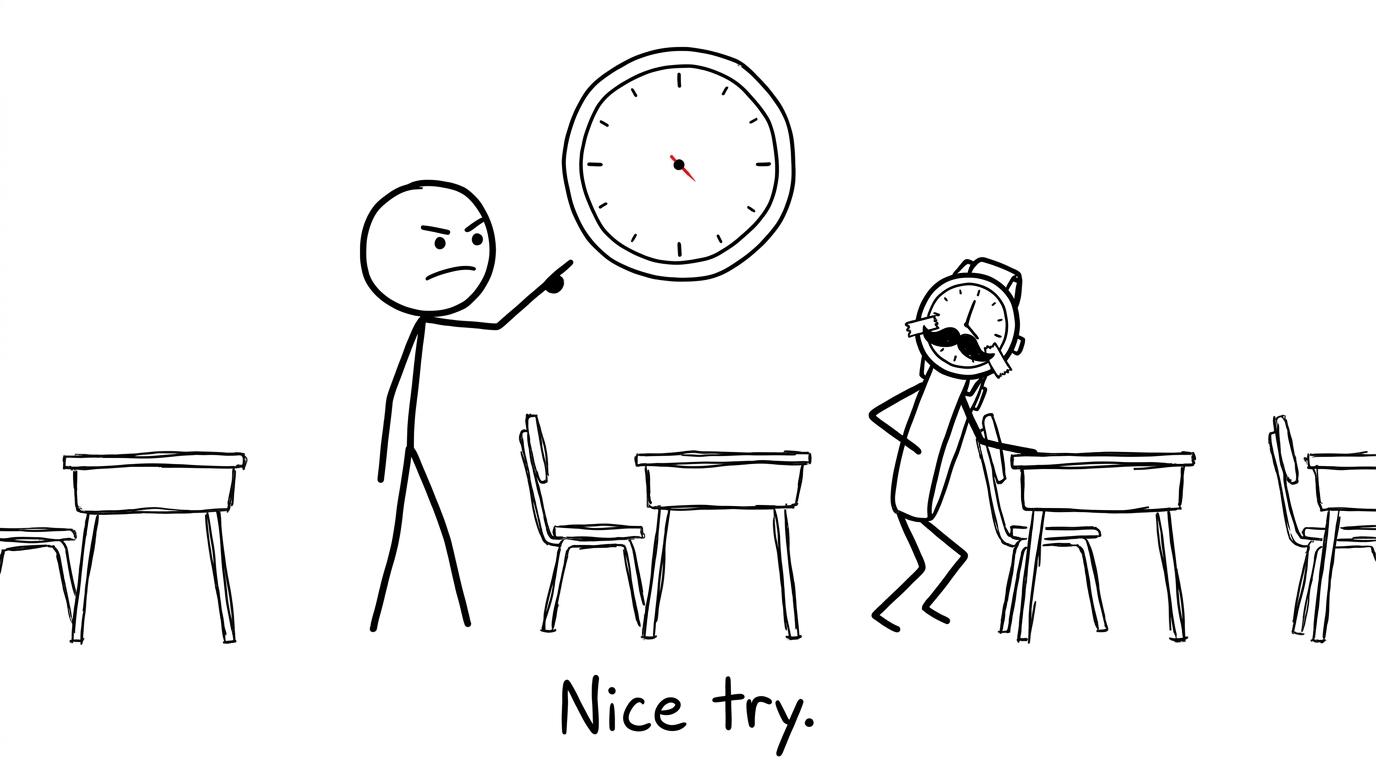 A wristwatch in a fake moustache fails to sneak past an invigilator
Notes and revision materials
Leave quotation cards, essay plans, loose paper and written notes outside. Check pockets carefully, particularly if you revised while wearing the same blazer or coat.
Do not write reminders on your hands, stationery or water-bottle lid. Rough paper and additional answer booklets will be supplied where the paper permits them. You must not bring your own paper into the examination.
Correction products and unsuitable pens
Do not use correction fluid, correction tape or erasable pens. If you make a mistake, cross it out neatly and continue. Avoid gel pens in your answers because JCQ's written examination instructions prohibit them.
A highlighter may be used to highlight material in the question paper or supplied resource material, but it must not be used in your answers. For simplicity, you can leave it at home unless highlighting questions is already part of your practised approach.
Food and unnecessary equipment
Food is controlled by the head of centre. If you need food or medication because of a medical condition, arrange this with the school in advance rather than negotiating it at the door.
A calculator has no role in GCSE English Literature. Neither do mathematical instruments. Keeping your desk clear gives you fewer things to manage and fewer opportunities to bring something inappropriate by accident.
A calm routine for the night before
Exam preparation works best when decisions are made before nerves arrive. Use this routine:
- Check the date, start time, room and exact paper.
- Put two tested black pens into a clear pencil case.
- Prepare a transparent, label-free water bottle if permitted.
- Remove notes from your pockets and pencil case.
- Put your phone, watch and earbuds somewhere they cannot travel with you accidentally.
- Check whether your school requires a candidate card or identification.
- Stop packing once the checklist is complete.
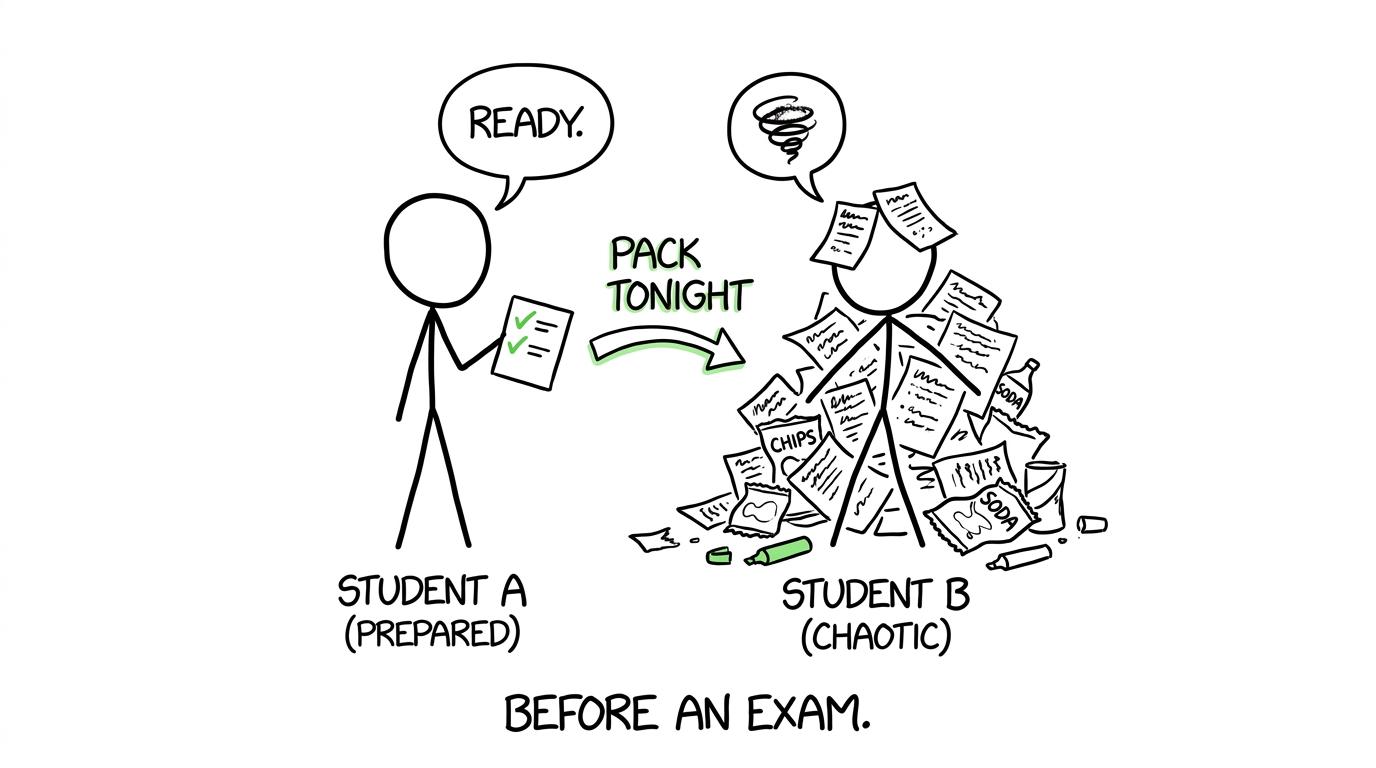 One student packs calmly while another disappears beneath an avalanche of revision notes
This approach also works during a crowded GCSE timetable. The GCSE exam week checklist separates useful preparation from exhausting last-minute work, while the one-week revision plan can help you organise the maths papers surrounding English Literature.
Common mistakes to avoid
Assuming an ordinary watch is allowed
It is not only smartwatches that are prohibited. JCQ's current written examination rules exclude watches generally. Use the clock provided in the room.
Taking a book because the subject is literature
Mainstream AQA, Edexcel, OCR and Eduqas GCSE English Literature examinations are closed book. Bringing a set text does not give you a helpful backup; it creates an unauthorised-material problem.
Keeping a switched-off phone in a pocket
Switched off does not mean authorised. Hand the device in through your centre's system before the examination begins.
Using the wrong pen
Bring black ink or black ballpoint pens, with at least one spare. Do not rely on blue, erasable or gel pens for your answers.
Treating school instructions as optional
JCQ establishes the national framework, but centres manage details such as bags, identification, water, food and arrival procedures. Read your school's candidate information as well as this checklist.
Revising until the moment you enter
A last-minute page of quotations can easily end up in a pocket. Finish revision before you join the exam-room queue and put all notes away securely. The 20-minute GCSE revision routine offers a useful model for keeping final sessions focused rather than sprawling.
Walk in with less to worry about
The best exam kit is deliberately uninteresting: black pens, a transparent pencil case, permitted water and any identification your centre requests. Everything else should have a clear reason for being there.
Once English Literature is finished, use the same calm preparation for maths. Start at MathsGenie's free GCSE Maths revision hub, then combine revision lessons and practice questions with mini tests, mark schemes and video solutions. As your papers approach, use a realistic GCSE one-month revision plan and timed past or predicted papers.
Good preparation rarely feels dramatic. It is usually a series of small decisions made early enough that exam morning has nothing left to surprise you.