

What to Bring to the GCSE Economics Exam
What to bring to the GCSE Economics exam: a clear checklist of permitted stationery, calculators and water, plus phones, watches and notes to leave home.
Exam mornings have a strange ability to make ordinary decisions feel important. Is the calculator allowed? Does the water bottle need its label removed? Can an analogue watch stay on your wrist?
If you are searching for what to bring GCSE Economics exam guidance, the short answer is simple: take at least two black pens, a pencil, an eraser, a ruler, a compliant calculator and, if wanted, water in a transparent unlabelled bottle. Keep everything in a transparent pencil case. Leave phones, watches, notes, earbuds and other unauthorised items outside the exam room.
This guide is based on current JCQ candidate instructions and the published requirements for AQA and OCR GCSE Economics. Your question paper and your school or college's exams officer remain the final authority, so check their instructions before every paper.
Your GCSE Economics exam-day checklist
Pack the following the evening before:
- at least two working black ballpoint pens
- a pencil for diagrams, charts and planning
- an eraser
- a ruler
- a permitted scientific or graphical calculator
- a completely transparent pencil case
- a transparent water bottle with its label removed, if your centre allows water
- any identification or exam documents specifically requested by your school
Before leaving home, check the time, venue, paper and exam board. GCSE Economics is offered by AQA and OCR in England, and both boards permit calculators in their current GCSE Economics papers. Nevertheless, read the front of your particular question paper because its printed instructions are definitive.
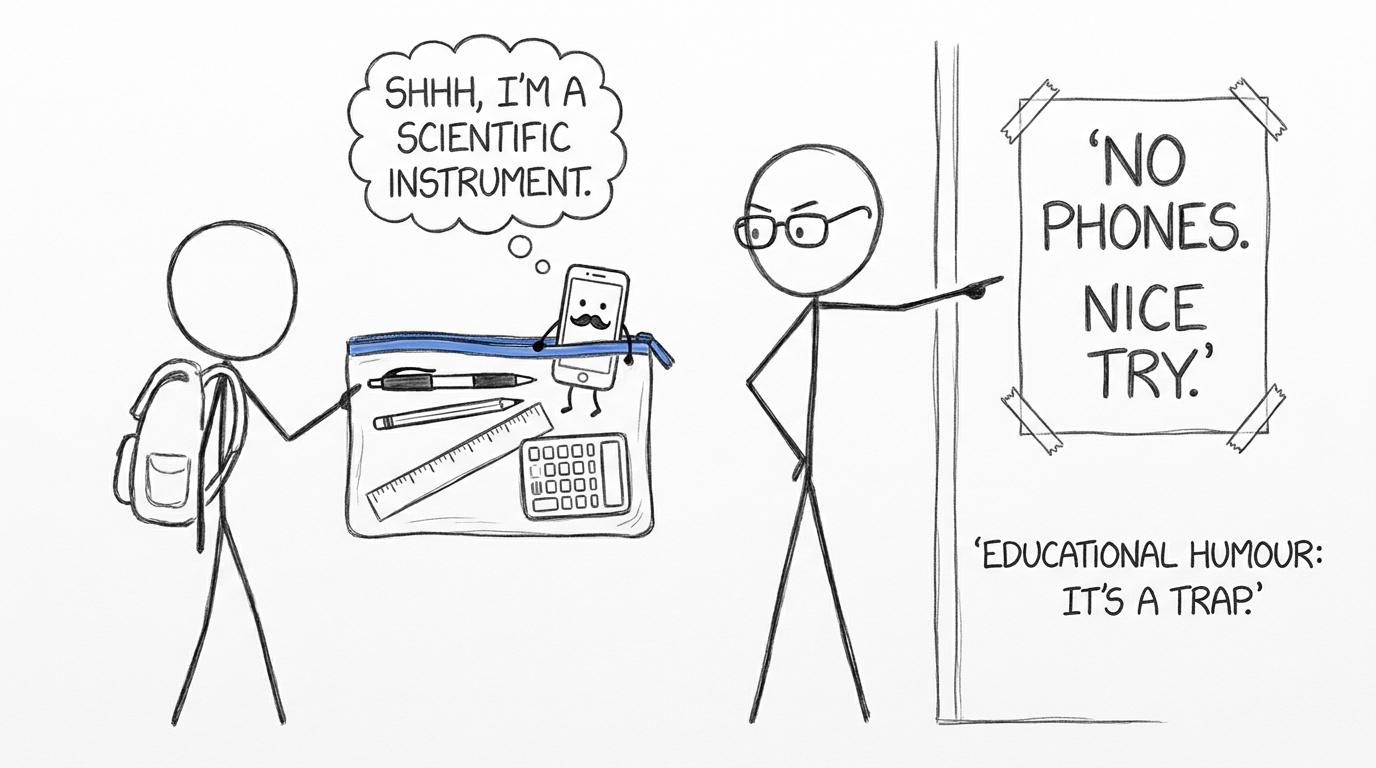 A mobile phone in disguise attempts to enter a GCSE exam
What you should bring into the exam room
Two or more black pens
JCQ instructions require candidates to write clearly in black ink. A black ballpoint pen is the safest choice because completed scripts are commonly scanned for marking.
Take a spare. Pens are small, but the cost of one failing halfway through an extended economics response is disproportionately large. Avoid relying on gel or erasable pens, and never use correction fluid, correction tape or correcting pens.
Coloured pencils or inks may be permitted for diagrams, charts and similar material unless the paper says otherwise. They should not replace black ink in your written answers.
A pencil, eraser and ruler
Economics papers can involve supply and demand diagrams, data, tables and charts. A sharpened pencil and ruler help you produce clear work, even though most written answers should remain in black ink.
An eraser is permitted for pencil work. It should not become a substitute for showing your reasoning: if you change a written answer, cross it out neatly rather than covering it with correction fluid.
A small pencil sharpener is normally acceptable when it is clean and contains no notes, although your centre may provide one. Keep every item visible inside your transparent pencil case.
A compliant calculator
A calculator is worth preparing rather than merely packing. AQA states that students may use a calculator in GCSE Economics. OCR permits a scientific or graphical calculator in both GCSE Economics components, subject to JCQ rules.
Your calculator must not provide facilities such as:
- communication with another device or the internet
- language translation
- symbolic algebra manipulation
- symbolic differentiation or integration
- access to information stored before the examination
Clear stored information and prepared programs. Check the battery, test the main keys and remove any case, lid or cover containing printed instructions or formulae. Do not take calculator instructions into the room. Some centres ask candidates to remove all calculator covers, so follow your school's procedure.
A phone's calculator app is not an acceptable substitute. A calculator must be a permitted standalone device whose primary purpose is mathematical calculation.
The quantitative side of economics often involves percentages, averages, ratios and interpreting data. Students who also want to strengthen these skills can use the free Edexcel GCSE Statistics revision resources, including questions, worksheets and papers.
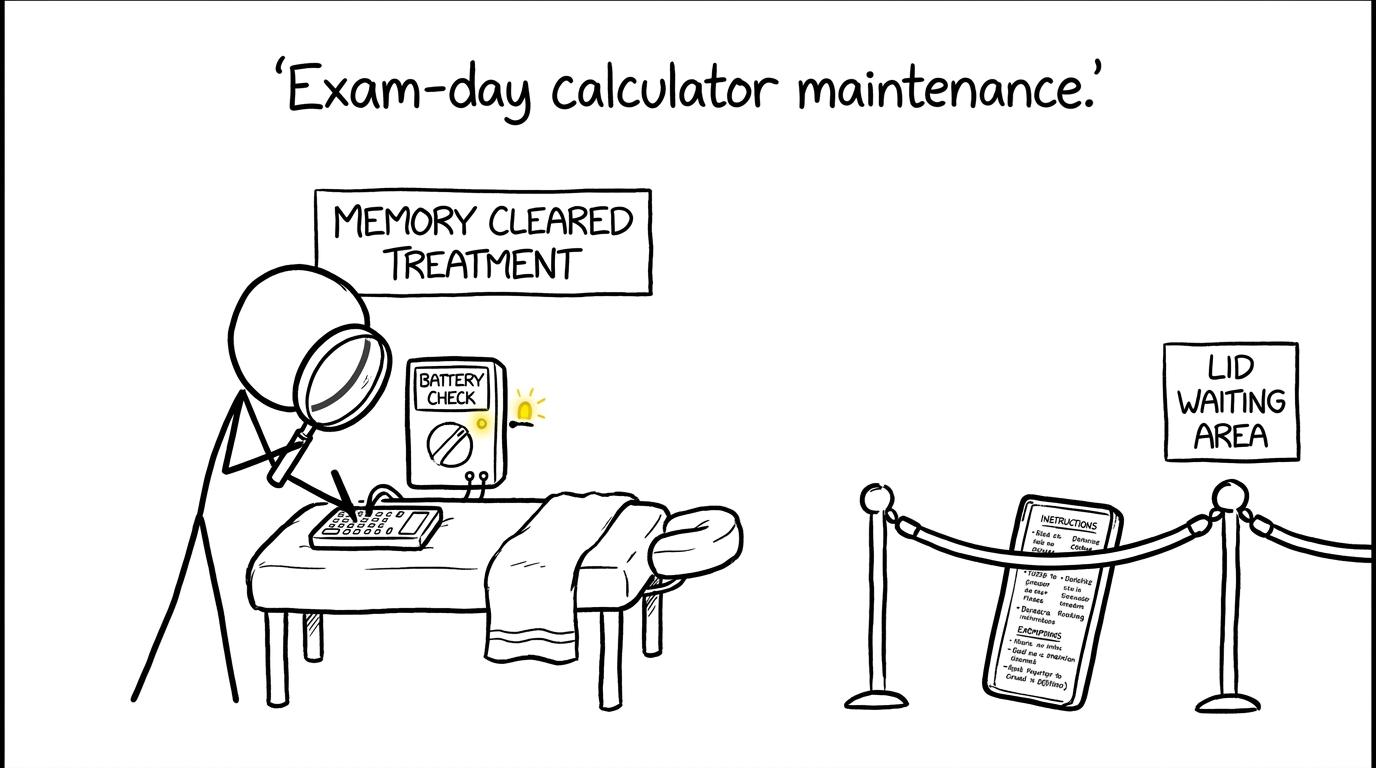 A calculator receives serious exam-day maintenance
A transparent pencil case
Any pencil case taken into the exam room must be see-through. A solid case, calculator tin or fabric pouch may be refused even if it contains only ordinary stationery.
The principle is visibility. An invigilator must be able to see that the case contains permitted equipment and no notes. A small transparent bag can be a practical alternative if your centre accepts it.
Water in a transparent, unlabelled bottle
Current JCQ preparation guidance allows candidates to take a clear water bottle without a label, subject to the centre's arrangements. Use a completely transparent bottle and remove wrappers, branding and labels beforehand.
Do not assume that an opaque reusable bottle, metal flask or coloured drink will be accepted. Your school may apply stricter local rules about drinks, so check rather than improvise on the morning.
What to leave at home or outside the exam room
The safest rule is not merely to switch prohibited technology off. Do not have it in your possession once formal exam conditions begin.
| Item | Exam-day rule |
|---|---|
| Mobile phone | Must not be in your possession in the exam room, even when switched off |
| Any watch | Analogue, digital and smart watches are prohibited |
| Earphones or earbuds | Prohibited, including wireless earbuds |
| Smart devices | Smart glasses, tablets, music players and similar devices are prohibited |
| Revision notes | Prohibited, including notes hidden in pockets or equipment |
| Calculator instructions | Prohibited |
| Non-transparent pencil case | Must remain outside unless replaced with a transparent case or bag |
| Correction products | Do not use correction pens, fluid or tape |
| Erasable or gel pens | Do not use them for answers |
| Highlighters | Must not be used in answers |
Possessing unauthorised material can be treated as malpractice even if you never intend to use it. That distinction matters. A switched-off phone in a pocket is still a phone in your possession; a forgotten revision card is still an unauthorised note.
Ideally, leave these items at home or store them exactly as your school directs. They should not be placed under your desk. If you discover something after entering the room, tell an invigilator immediately and hand it over before the examination starts.
Check your own paper and centre instructions
A useful general checklist cannot replace the front page of your paper. Read it before the exam begins. It confirms the permitted materials and tells you how to complete the candidate information.
Schools also control practical details such as:
- where bags and coats must be stored
- whether candidates need identification
- how medicines are handled
- whether tissues are supplied
- when candidates should arrive
- how approved access arrangements operate
If you require medication, coloured overlays, a word processor or another access arrangement, speak to your school's special educational needs coordinator or exams officer well in advance. Do not bring an unapproved item and hope permission can be arranged at your desk.
Pack the evening before, not at the door
Preparation works best when it removes decisions. Put your permitted equipment together the previous evening, check the calculator and remove the water bottle label. Confirm the exam time and location from your school's official timetable.
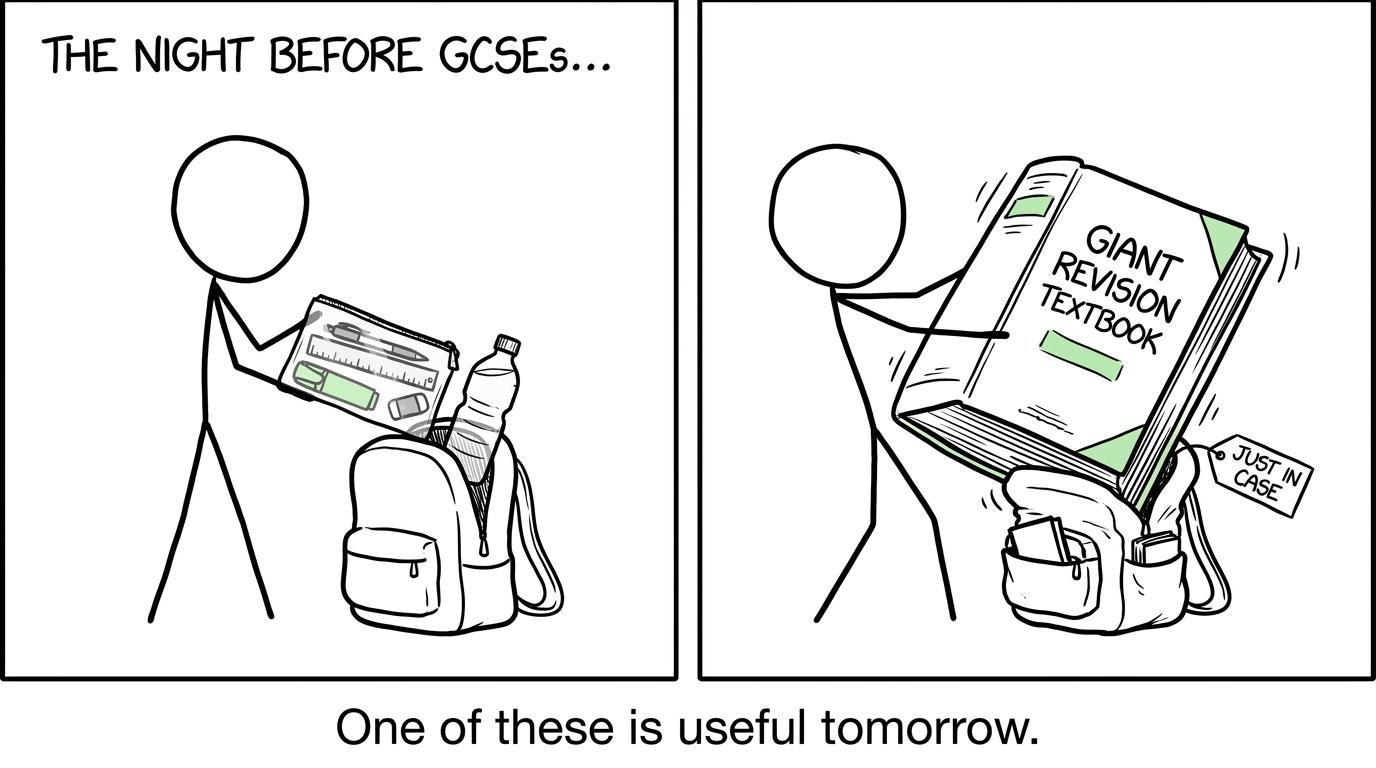 One student packs calmly while another packs an enormous textbook
Then stop. The night before an exam is rarely improved by turning packing into another revision session. MathsGenie's GCSE one-week revision plan explains how to move from focused practice to a calmer final review, while the night-before GCSE exam plan offers a useful model for packing, winding down and avoiding panic.
For OCR Economics, complete an OCR GCSE Economics past paper earlier in your revision rather than on the night before. Practising with the calculator and stationery you intend to use makes the real paper feel more familiar.
Common GCSE Economics exam-day mistakes
Bringing a watch because it is not smart
All watches are prohibited under current JCQ instructions. That includes a basic analogue watch. Exam rooms normally provide a visible clock, and invigilators announce relevant timing information.
Switching off a phone but keeping it in a pocket
Turning a device off does not make it authorised. Store it using your centre's collection or bag procedure before entering the room.
Using blue, gel or erasable ink
Use black ballpoint pen for written answers. Keep a spare black pen beside it so a failed pen becomes a minor interruption rather than a crisis.
Forgetting to prepare the calculator
A calculator with a weak battery, stored notes or an instruction-covered case can create avoidable trouble. Clear and test it before exam day.
Packing revision notes inside the pencil case
A transparent case does not make notes acceptable. Check every pocket, calculator cover and stationery compartment. Also ensure that nothing relevant to the examination is written on your hands or arms.
Revising topics without practising the equipment
Knowing a percentage formula is different from entering it accurately under time pressure. Use timed questions to practise calculator input, data interpretation and checking. The GCSE weakest-topics guide shows how to identify marks lost through knowledge, calculation or exam technique.
Make equipment the easiest part of the exam
The contents of a transparent pencil case will not determine your grade. But forgetting a black pen or carrying a prohibited phone can consume attention that should be spent analysing the question.
Prepare the small things early. Bring black pens, pencil, eraser, ruler, a compliant calculator and permitted water. Leave watches, phones, earbuds and notes outside. Check the paper, listen to the invigilator and ask before the exam if anything is uncertain.
Then turn back to the work that does earn marks. Use MathsGenie's free OCR GCSE Economics past papers to practise under timed conditions, and strengthen quantitative skills through GCSE maths topics organised by exam board and tier. Mark every attempt carefully, repair weak skills with revision lessons and practice questions, and use mini tests, predicted papers, mark schemes and video solutions to make progress visible.
Pack once. Check once. Walk into the exam knowing that the practical details are already settled.











