

GCSE Eduqas: Night-Before Maths Plan (No Panic)
GCSE night-before plan for Eduqas Maths: calm checklist, quick methods, worked examples, and the best YesGenie past papers to use without panic.
The night before your GCSE Maths exam has a strange gravity. You tell yourself you’ll do “a quick recap”… and suddenly it’s midnight, you’ve opened five tabs, and your brain is trying to memorise everything from angles in parallel lines to probability trees in one sitting. Panic feels productive, but it rarely leads to marks.
This guide is for Eduqas students (and honestly any exam board) who want a GCSE night-before plan that trades chaos for calm. Not a fantasy timetable. A real one. The kind you can follow even if you feel behind.
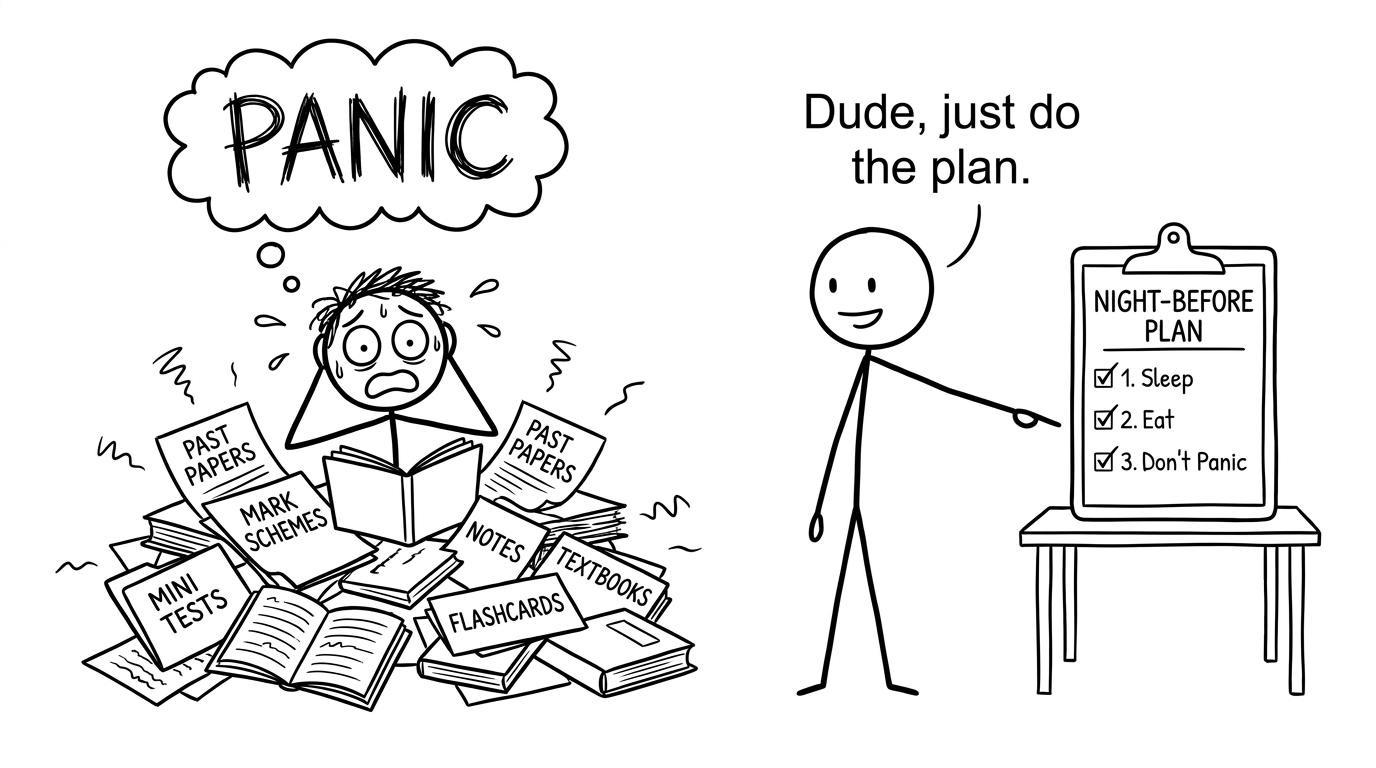 A calm checklist beats panic
The night-before checklist (print this mentally)
Use this as your GCSE “minimum effective dose”. It’s designed for Eduqas papers (Component 1 non-calculator, Component 2 calculator), but the structure works for AQA, Edexcel and OCR too.
- Confirm the paper details: start time, equipment, tier (Foundation/Higher), and what you’ll do in the first 5 minutes.
- Do one short, timed set: 303030 454545 minutes max, exam-style.
- Mark it properly: identify methods, not just answers.
- Patch three weak methods: pick three topics only.
- Pack and wind down: sleep is revision.
To keep everything Eduqas-specific, you’ll want these YesGenie pages open:
- Eduqas GCSE Maths Revision Hub
- Eduqas GCSE Maths Past Papers
- Eduqas GCSE Maths Question Bank
- Eduqas GCSE Maths Exam Booklet
And if you’re revising across boards or want general paper practice:
- GCSE Past Papers (all boards)
- GCSE Maths Revision (overview)
- GCSE Resources (mini tests, predicted papers, more)
- Other Resources (formulae to remember etc.)
Why panic doesn’t work for GCSE Maths (and what does)
Most students treat the night before GCSE Maths like a museum sprint: look at everything, remember nothing, hope for the best. But maths marks don’t come from remembering facts; they come from remembering moves.
A “move” is a method you can execute under pressure:
- rearranging an equation
- setting up Pythagoras correctly
- turning a worded ratio into a calculation
- picking the correct trig ratio
The night before is for strengthening moves you already half-know, not learning brand new ones from scratch. That’s why YesGenie’s structure (topic lessons, question banks, exam booklets, mark schemes) is so powerful: it turns revision into repeatable actions.
Your 2-hour Eduqas night-before plan (calm and realistic)
First 10 minutes: set up your exam brain
Do this before you touch a question.
- Decide your first target: “I will secure the easy marks first.”
- Write a tiny plan on paper:
- Paper type: non-calculator or calculator
- Top 3 topics to check: (choose from algebra, number, geometry, statistics/probability)
- Open one resource only: start with Eduqas GCSE Maths Past Papers.
This is not motivation. It’s friction reduction. In a GCSE exam, the student who starts calmly often beats the student who “knows more” but spirals.
Next 45 minutes: one timed set (don’t overdo it)
Choose one of these options:
- Option A: half a past paper section (roughly 454545 minutes)
- Option B: a focused booklet from the Eduqas GCSE Maths Exam Booklet
- Option C: a targeted run of exam questions from the Eduqas GCSE Maths Question Bank
Rules:
- work in silence
- no notes
- if stuck after 909090 seconds, circle it and move on
This trains the exact skill the GCSE requires: decision-making under time.
Next 25 minutes: mark like a strategist
Mark schemes are not there to judge you. They’re there to reveal what the examiner rewards.
When you mark:
- highlight any question where you lost method marks (not just final answers)
- write a one-line fix: “I must show substitution step” or “I must square-root both sides”
If you feel tempted to do another paper, resist. The night before GCSE Maths, depth beats volume.
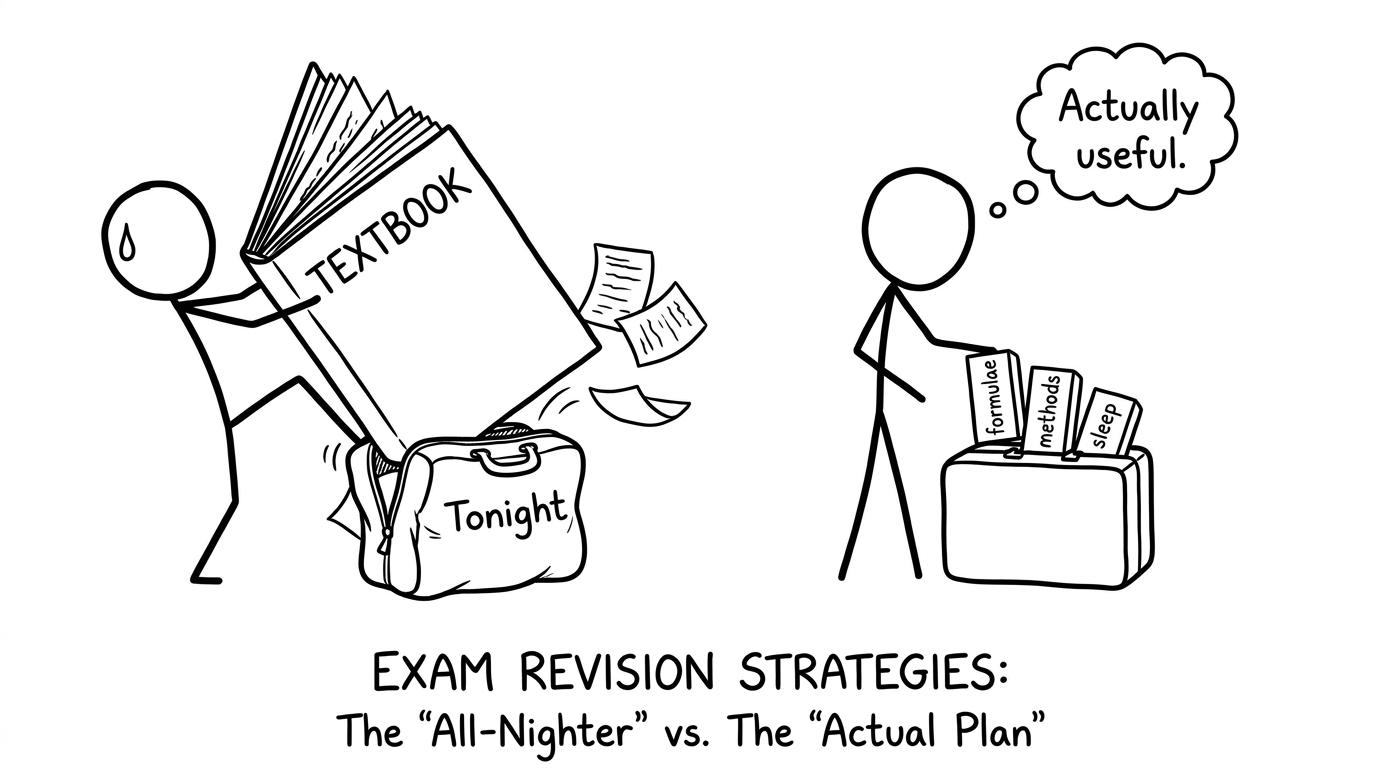 Don’t cram the whole textbook into tonight
Final 40 minutes: patch three high-impact methods
Pick three methods only. For Eduqas, these tend to be reliable mark-makers across Foundation and Higher:
- algebra manipulation (rearranging, solving)
- geometry (angles, area/volume, circle facts)
- probability/statistics (tables, averages, interpreting graphs)
Use YesGenie topic revision guides and questions to patch quickly. If you want a general bank of topics and links, start from GCSE Maths Revision (overview).
Below are three worked examples you can use as a “method reset”. Do them slowly, then check your own version against your working.
Three worked examples (the kind that saves marks)
Example 1: rearranging a formula (algebra move)
Make xxx the subject of y=3x−7y = 3x - 7y=3x−7.
Start by isolating the term with xxx:
y+7=3x y + 7 = 3x y+7=3xNow divide both sides by 333:
x=y+73 x = \frac{y + 7}{3} x=3y+7Why this matters for GCSE: rearranging appears everywhere (including geometry and physics-style questions). One clean line of algebra can be worth multiple method marks.
If rearranging is a weak spot, use the relevant revision guide route from GCSE Maths Revision (overview) and practise a small set from the Eduqas question bank.
Example 2: non-calculator Pythagoras (geometry move)
A right-angled triangle has legs 666 cm and 888 cm. Find the hypotenuse.
Use Pythagoras:
c2=62+82 c^2 = 6^2 + 8^2 c2=62+82 c2=36+64=100 c^2 = 36 + 64 = 100 c2=36+64=100 c=100=10 c = \sqrt{100} = 10 c=100=10So the hypotenuse is 101010 cm.
Why this matters for Eduqas GCSE: Component 1 (non-calculator) loves tidy squares. If you can spot pairs like 666 and 888, or 555 and 121212, you move faster and with more confidence.
Example 3: probability from a table (probability move)
A bag contains 555 red counters, 333 blue counters and 222 green counters. One counter is chosen at random. Find P(not blue)P(\text{not blue})P(not blue).
Total counters:
5+3+2=10 5 + 3 + 2 = 10 5+3+2=10Probability of blue:
P(blue)=310 P(\text{blue}) = \frac{3}{10} P(blue)=103So probability of not blue (the complement):
P(not blue)=1−310=710 P(\text{not blue}) = 1 - \frac{3}{10} = \frac{7}{10} P(not blue)=1−103=107Why this matters for GCSE: complement thinking stops silly errors. It’s often quicker than counting everything again.
If probability is shaky, YesGenie’s probability revision guides are excellent for rebuilding the basics with exam wording. For example: Probability Revision Guide (WJEC GCSE Maths).
Eduqas night-before focus: what to do for each paper
Component 1 (non-calculator) focus
For Eduqas GCSE non-calculator, prioritise:
- fractions, percentage change, ratio
- algebra manipulation (including simple quadratics at Higher)
- angles, Pythagoras, exact values where relevant
Non-calculator rewards students who can keep working tidy. If you do nothing else tonight: practise showing steps clearly.
Component 2 (calculator) focus
For Eduqas GCSE calculator, prioritise:
- calculator accuracy (brackets, rounding, standard form)
- iterative multi-step problems (rates, compound measures)
- graphs and interpreting data
Your calculator is not a mark printer. It only helps if you set up the right calculation.
Common mistakes to avoid tonight (and tomorrow)
These are the errors that create panic because they feel “random”; but they’re predictable.
- Revising topics, not methods: reading notes on “trigonometry” is vague; practising “find a missing side using sin\sinsin” is actionable.
- Doing full papers at midnight: fatigue increases careless arithmetic. A tired brain drops easy GCSE marks.
- Marking with kindness instead of honesty: if you used a wrong method but got the right number, you still need to fix the method.
- Forgetting units: area in cm2\text{cm}^2cm2, volume in cm3\text{cm}^3cm3, speed in km/h\text{km/h}km/h etc. Eduqas will award and remove marks here.
- Rounding too early: keep full calculator values, round at the end (unless the question tells you otherwise).
- Not writing the final answer clearly: box it or underline it. Make it obvious to the examiner.
The sleep strategy (the most ignored revision technique)
The night before GCSE Maths is not the time for heroics. It’s the time for consolidation. Your goal is to walk into the exam with a brain that can retrieve methods without a fight.
Aim to stop heavy work at least 606060 minutes before sleep. Pack your equipment, pick clothes, set two alarms. If you’re anxious, write down three sentences:
- “I don’t need full marks.”
- “I will collect method marks.”
- “I will start with questions I recognise.”
It’s simple. That’s the point.
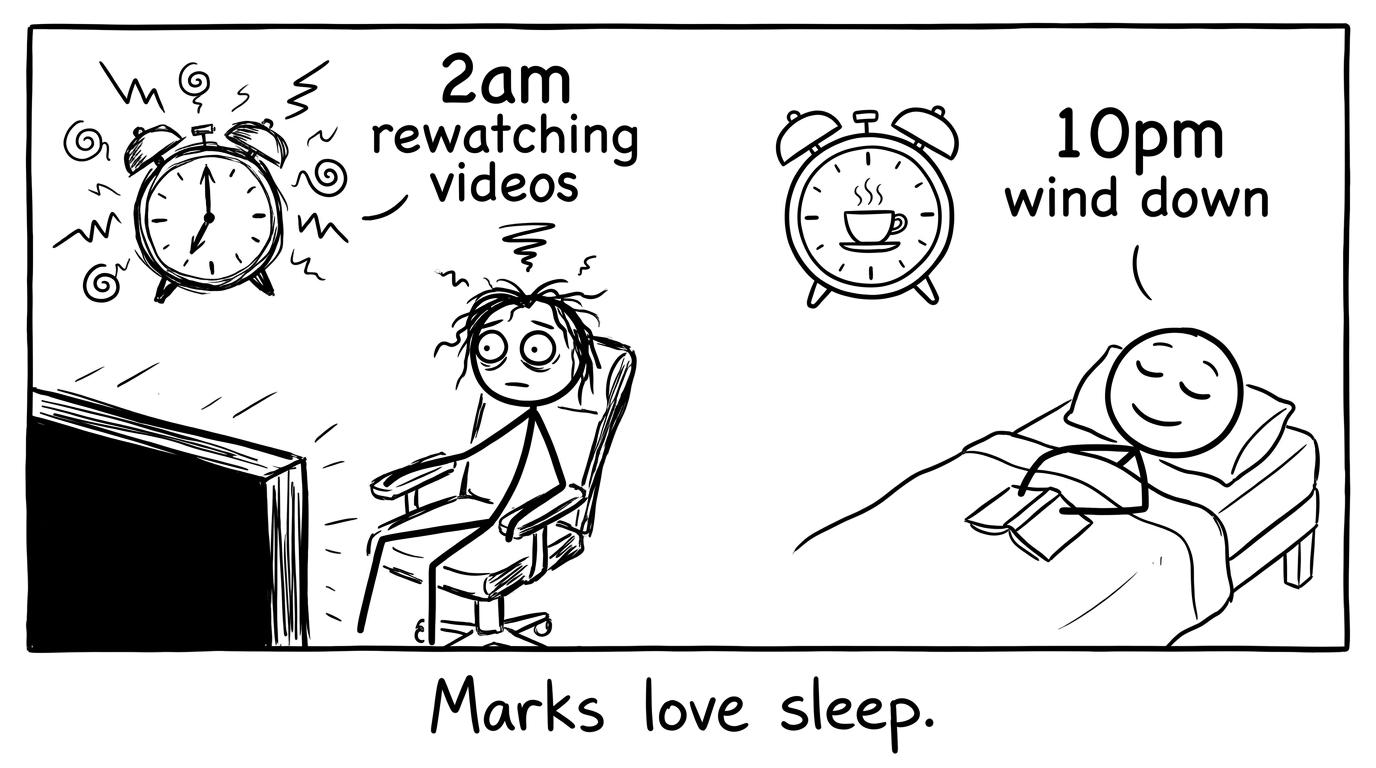 Two alarm clocks: chaos vs calm
Closing: a calm GCSE night-before beats a heroic one
You don’t need to “become a different person” overnight to do well in GCSE Maths. You need a plan that makes panic unnecessary: a short timed set, honest marking, three method repairs, then sleep.
If you want the cleanest path for Eduqas, build your final prep around YesGenie:
- practise with Eduqas GCSE Maths Past Papers
- target weaknesses using the Eduqas GCSE Maths Question Bank
- consolidate with topic booklets in the Eduqas GCSE Maths Exam Booklet
- use GCSE Resources for extra structure (mini tests and more)
Tonight, choose calm. Tomorrow, collect marks. Then come back to YesGenie and keep the momentum going for your next GCSE paper.










