What to Bring to the GCSE Biblical Hebrew Exam
What to bring GCSE Biblical Hebrew exam guide: pack the correct pens and clear pencil case, and leave dictionaries, watches, notes and phones at home.

There is a peculiar kind of exam-morning panic that has nothing to do with the subject. You may know your vocabulary and grammar, yet suddenly find yourself wondering whether you need a dictionary, whether your watch is allowed, or where you put your second pen.
If you are searching for what to bring GCSE Biblical Hebrew exam, the short answer is reassuringly small: take at least two black ink or black ballpoint pens in a transparent pencil case, plus any identification your centre has requested. You may also take a clear, label-free bottle of water if your centre permits it. The official source booklet is supplied for the examination. Do not bring your own Bible, dictionary, vocabulary list, notes, set texts, phone, watch or smart device.
The safest principle is simple: bring only what the paper requires and what your school has authorised.
Your GCSE Biblical Hebrew exam checklist
Pack these items the night before:
- At least two reliable black ink or black ballpoint pens
- A completely transparent pencil case or small transparent bag
- Candidate identification, but only if your school or examination centre requires it
- A clear, unlabelled water bottle if permitted by your centre
- Details of your examination time, room and seat, kept outside the examination room unless instructed otherwise
Leave these items at home or hand them in according to your centre's procedure:
- Mobile phones
- All watches, including analogue, digital and smart watches
- Earphones, earbuds and headphones
- Smart glasses, tablets and other electronic devices
- Dictionaries and electronic translators
- Bibles, set texts and personally printed passages
- Revision notes, vocabulary lists and grammar tables
- Calculator, calculator case or instructions
- Correction fluid, correction tape and erasable pens
- An opaque pencil case
This checklist reflects the current JCQ written-examination rules and Pearson's published materials requirements. Your centre's instructions and the front of the live question paper remain authoritative, so read both carefully.
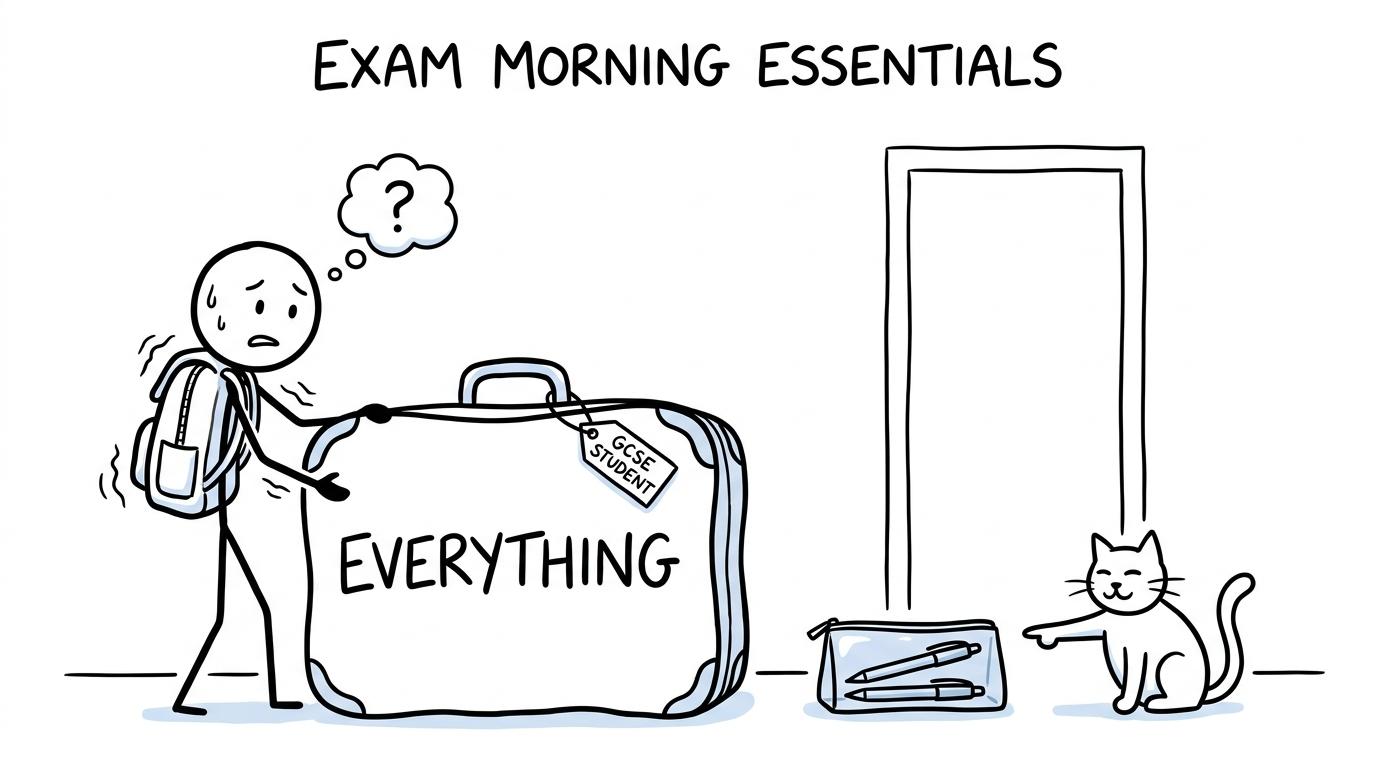 A student choosing a tiny clear pencil case instead of an enormous exam suitcase
Check that you are preparing for the right Hebrew qualification
GCSE Biblical Hebrew is currently offered by Pearson Edexcel under qualification code 1BH0. It has two written components:
- Component 1: Language, paper code 1BH0/01
- Component 2: Literature, paper code 1BH0/02
Biblical Hebrew is not the same qualification as GCSE Modern Hebrew. The content, assessment structure and rules shown on another subject's paper may be different. Do not assume that advice for an AQA Modern Hebrew listening, speaking, reading or writing assessment applies to Pearson Edexcel Biblical Hebrew.
There is no foundation or higher tier for GCSE Biblical Hebrew. Those tier labels are familiar from GCSE maths, but they do not apply here. If you are balancing Hebrew with Edexcel, AQA, OCR or Eduqas maths revision, keep separate checklists for each examination. The equipment needed for a calculator maths paper is not the equipment needed for Biblical Hebrew.
What you should bring into the exam room
Two black pens
Take at least two black pens that you have already tested. Written examination work is normally scanned, and JCQ instructions require answers to be written clearly in black ink unless the question paper says otherwise.
A spare pen is not an elaborate backup plan. It is simply one less problem to solve under pressure. Avoid relying on pale ink, an erasable pen or a pen that occasionally stops working.
Pencils and an eraser may be included in your clear pencil case if your centre permits normal writing equipment, but your final written answers should be in black ink. Biblical Hebrew does not require the geometry equipment you might pack for maths.
A transparent pencil case
Any pencil case taken into the examination room must be see-through. A clear bag is also commonly accepted, but follow your centre's wording.
Check every pocket before you leave home. Remove old flashcards, folded paper, labels or anything carrying revision information. A forgotten note is still unauthorised material even when you had no intention of using it.
Water, if your centre permits it
JCQ guidance allows centres to set their arrangements for food and drink. Where water is allowed, centres normally require a transparent bottle with its label removed. Do not assume that a coloured reusable bottle, a bottle covered in writing or a can will be accepted.
Food is generally not something to place on your desk unless the centre has approved it, for example because of a medical need. Arrange this before the examination rather than asking as the paper begins.
Identification, if requested
Some centres ask candidates to bring a student card or other identification. Others identify candidates through their seating plan and examination records. Follow the instructions issued by your own examinations officer.
Your timetable is useful for getting to the right room, but it does not need to sit on your desk unless your centre specifically says it may. Keep unnecessary paperwork outside the room.
What Pearson supplies for the examination
Pearson's published materials information for GCSE Biblical Hebrew states that a source booklet is included with the question paper. The assessment materials also identify the source booklet as something candidates must have.
That does not mean you should bring your own copy. The clean, official booklet is supplied through the examination centre. Bringing an annotated copy, a printed passage or a personally marked text would introduce unauthorised material.
When the paper arrives, check that you have the correct component and the required source booklet. If anything appears to be missing, raise your hand and tell the invigilator. Do not borrow from another candidate or try to continue silently with incomplete materials.
What to leave at home
Dictionaries, Bibles and revision materials
Do not take a Biblical Hebrew dictionary, English dictionary, electronic dictionary or translation device to your desk unless your centre has explicitly confirmed an approved arrangement. Pearson's standard materials list for the papers requires the supplied source booklet, not a candidate-provided dictionary.
The same applies to:
- A Hebrew Bible or Tanakh
- Printed or handwritten set texts
- Grammar summaries
- Verb tables
- Vocabulary cards
- Literary notes
- Teacher handouts
- Notes written on stationery, clothing or your hands
The source booklet contains the material Pearson intends you to use. Everything else should remain outside the examination room.
Phones, watches and smart devices
JCQ rules prohibit mobile phones, earphones or earbuds, music players, smart glasses, tablets and similar devices in a candidate's possession during a written examination. This applies even if a device is switched off.
All watches are prohibited, not only smart watches. Leave yours at home or store it exactly as your centre directs. The examination room will have a visible clock and invigilators will announce the necessary timing information.
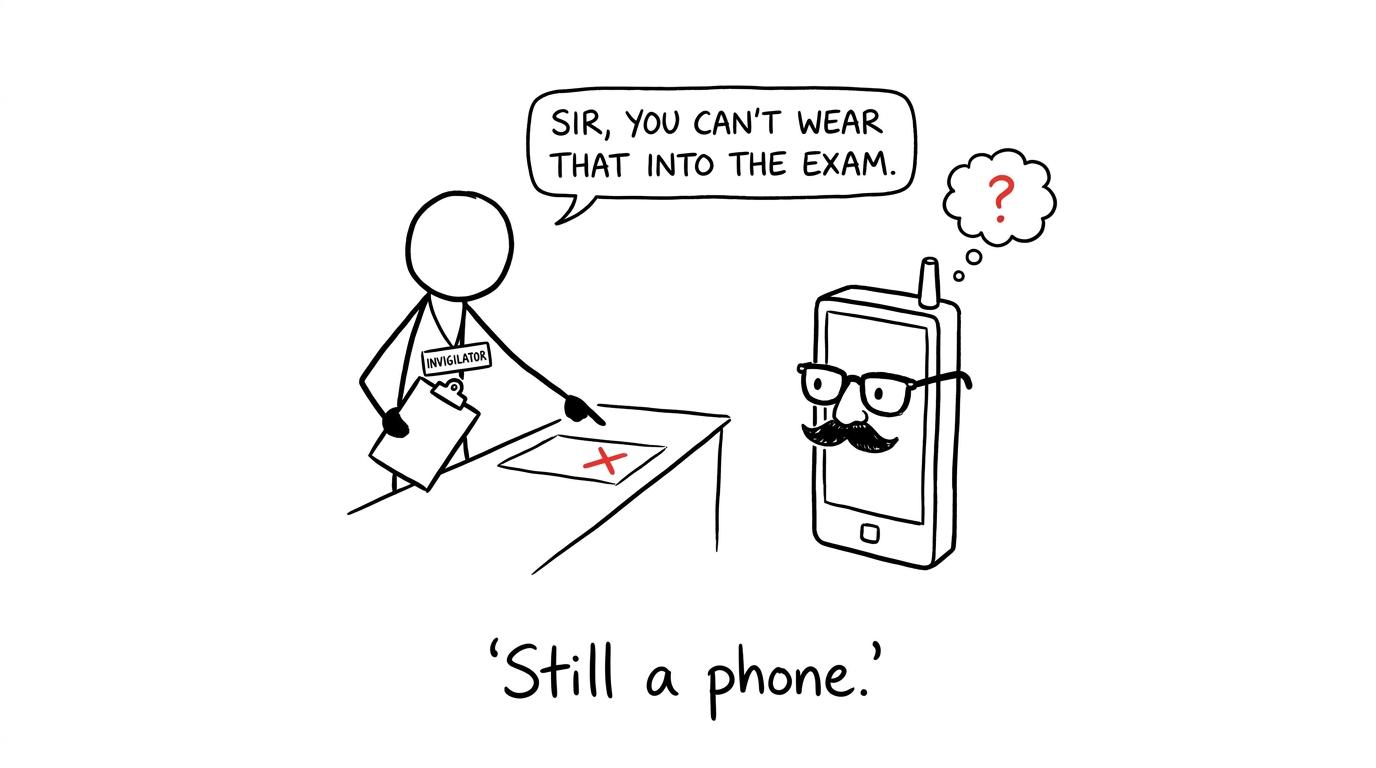 A disguised mobile phone failing to sneak past an invigilator
Calculators and maths equipment
A calculator is not required for either GCSE Biblical Hebrew component. Neither are compasses, a protractor or a mathematical formula sheet. Extra equipment creates clutter and gives the invigilator more items to check.
This is where separate subject packs help. Keep your Biblical Hebrew kit distinct from the equipment used when completing Edexcel GCSE Maths past papers. Before each examination, take only the equipment appropriate to that paper.
Correction products and unsuitable pens
Do not bring correction fluid, correction pens or correction tape. If you make an error, cross it out neatly and write the replacement clearly. Avoid erasable pens because heat, friction and scanning can make the writing unreliable.
Highlighters are unnecessary for this examination. If your centre allows them, they must not be used in your answers. The calmer choice is to leave them out unless a teacher or examinations officer has given a clear reason to bring one.
The night-before packing routine
Good preparation is often less about doing more and more about removing decisions from the morning.
Put your transparent pencil case beside your bag. Test both black pens. Remove your phone charger, watch and revision cards from the things you plan to carry. Check your examination time, room and travel arrangements. Then stop.
MathsGenie's GCSE night-before plan is written for maths papers, but its central idea travels well: use a short final review, pack deliberately and protect your sleep rather than beginning an exhausting late-night session.
If several GCSE examinations are arriving close together, use the one-month GCSE revision plan to organise your maths workload around them. Shorter sessions such as the 20-minute maths revision routine can leave space for Biblical Hebrew without allowing maths practice to disappear.
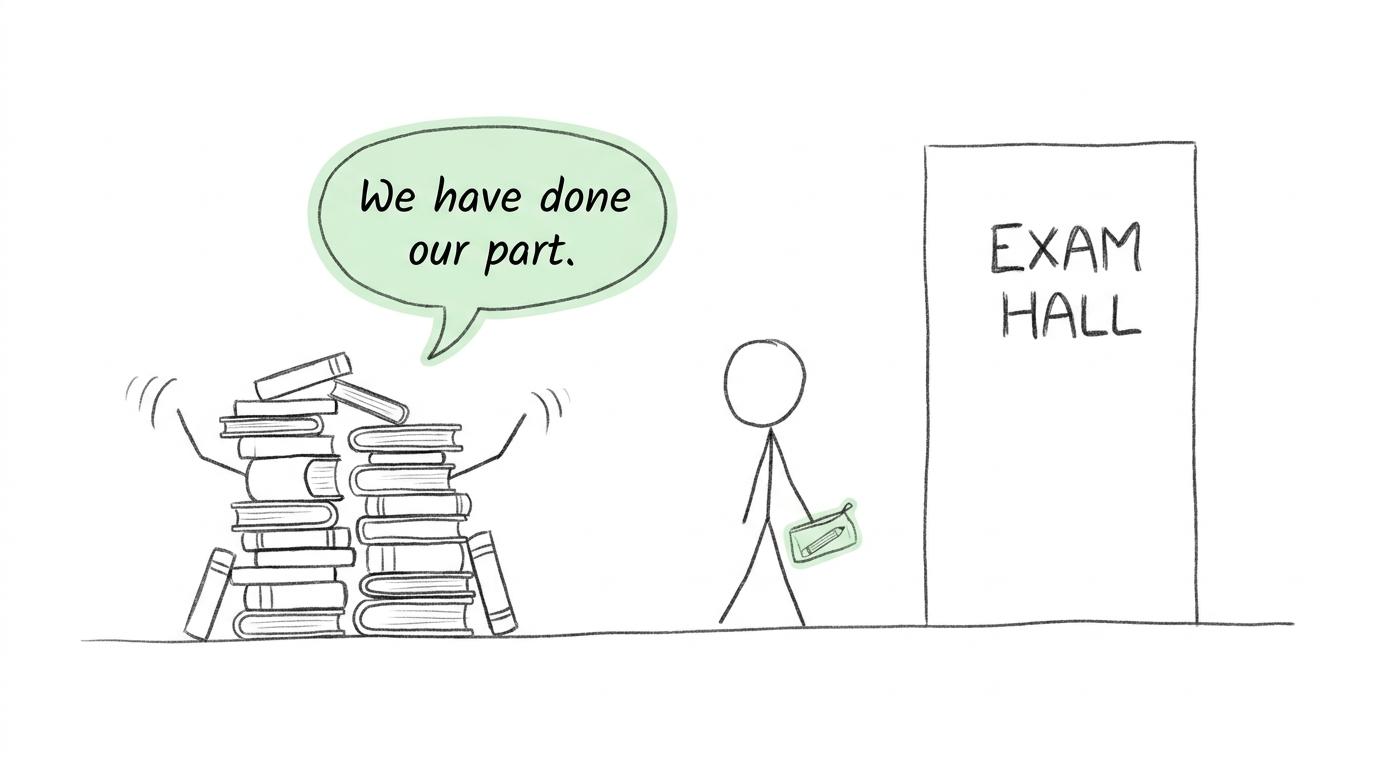 A calm student leaving revision books at home before the exam
Access arrangements and exceptional requirements
An access arrangement is not something to improvise on examination morning. If you have approved extra time, supervised rest breaks, a word processor, enlarged materials or another arrangement, your school will organise it through the examinations office.
Likewise, do not bring a dictionary because you believe you should qualify to use one. Dictionaries may only be used where the regulations, paper instructions or an approved arrangement permit them. Ask your examinations officer in advance if anything is unclear.
Medical equipment and food required for a medical condition should also be discussed with the centre beforehand. Necessary arrangements can be made, but they need to be controlled in a way that protects both you and the examination.
Common exam-day mistakes
Packing for every subject at once
A calculator, geometry set and formula booklet may feel like standard GCSE equipment after weeks of maths practice. They are not required for Biblical Hebrew. Pack by paper, not by habit.
Bringing a dictionary "just in case"
There is no advantage in carrying an unauthorised resource to the examination room. Leave it at home. If a special arrangement applies, your centre should confirm how the permitted resource will be supplied and checked.
Keeping a switched-off phone in a pocket
Switched off does not mean authorised. A phone in your possession can still be treated as an examination-rules breach. Use your centre's collection or secure-storage procedure before entering the room.
Wearing an ordinary analogue watch
The prohibition covers every watch. Students sometimes remember the smart-watch rule but overlook a simple analogue one. Remove it before reaching the examination room.
Bringing your own source text
The official source booklet is supplied. Your own clean-looking copy may contain markings or differ from the examination version, so it must not replace the controlled material.
Assuming another Hebrew exam has the same rules
Modern Hebrew and Biblical Hebrew are separate qualifications. Always check the subject, exam board, paper code and front-page instructions.
Walk in with fewer decisions
The purpose of an exam-day checklist is not to create another thing to worry about. It is to make the morning ordinary. Two black pens. A clear pencil case. Approved identification if required. Clear water if permitted. Nothing that stores, translates or reminds.
Your knowledge belongs in your head; the official source booklet will be waiting on the desk.
For the maths examinations surrounding your Biblical Hebrew paper, use MathsGenie's free GCSE maths revision to move from revision lessons to practice questions and video solutions. Build stamina with GCSE predicted papers, diagnose gaps using Edexcel GCSE mini tests, and learn when to introduce full papers with the GCSE past-paper revision guide.
Pack the right tools tonight. Tomorrow morning, your attention can go where it should, onto the paper.