

What Does GCSE Drama Actually Test? Skills or Facts
What does GCSE Drama actually test? Learn how examiners reward knowledge, performance, creative choices, analysis and evaluation across each assessment.
A student can know every character, dramatic technique and scene in their set text, yet still wonder why an answer did not earn the expected marks. That is because GCSE Drama is not primarily a memory competition.
The question what does GCSE Drama actually test? has a clear answer: it assesses how well you can create, perform, understand, analyse and evaluate theatre. Content knowledge matters, but examiners usually reward what you do with that knowledge: the choices you make, the meaning you communicate and the evidence you use to judge effectiveness.
This distinction matters if you are balancing Drama with maths revision. Both subjects reward application. Knowing a technique or formula is only the beginning; marks come from selecting and using it appropriately.
GCSE Drama assessment at a glance
Under the assessment objectives set for GCSE Drama qualifications in England, your overall result is built from four areas:
| Assessment objective | What it assesses | Overall weighting |
|---|---|---|
| AO1 | Creating and developing ideas to communicate meaning | 20%20\%20% |
| AO2 | Applying theatrical skills to realise artistic intentions in live performance | 30%30\%30% |
| AO3 | Knowledge and understanding of how drama and theatre are developed and performed | 30%30\%30% |
| AO4 | Analysing and evaluating your work and the work of others | 20%20\%20% |
That means knowledge and understanding account directly for 30%30\%30%. The remaining objectives focus on creation, practical application, analysis and evaluation, although knowledge supports all of them.
The exact component names, question formats and allocation of marks vary between AQA, Edexcel, OCR and Eduqas. Your teacher and current exam-board specification should therefore be your final guide. Across the qualification, however, the central pattern remains consistent: you are assessed as a theatre maker, performer or designer, and as an informed audience member.
A useful checklist is:
- Can you explain a theatrical choice precisely?
- Can you connect that choice to an artistic intention?
- Can you apply skills with control in performance or design?
- Can you explain the effect on an audience?
- Can you evaluate effectiveness using specific evidence?
- Can you show how an idea developed, rather than merely stating the final result?
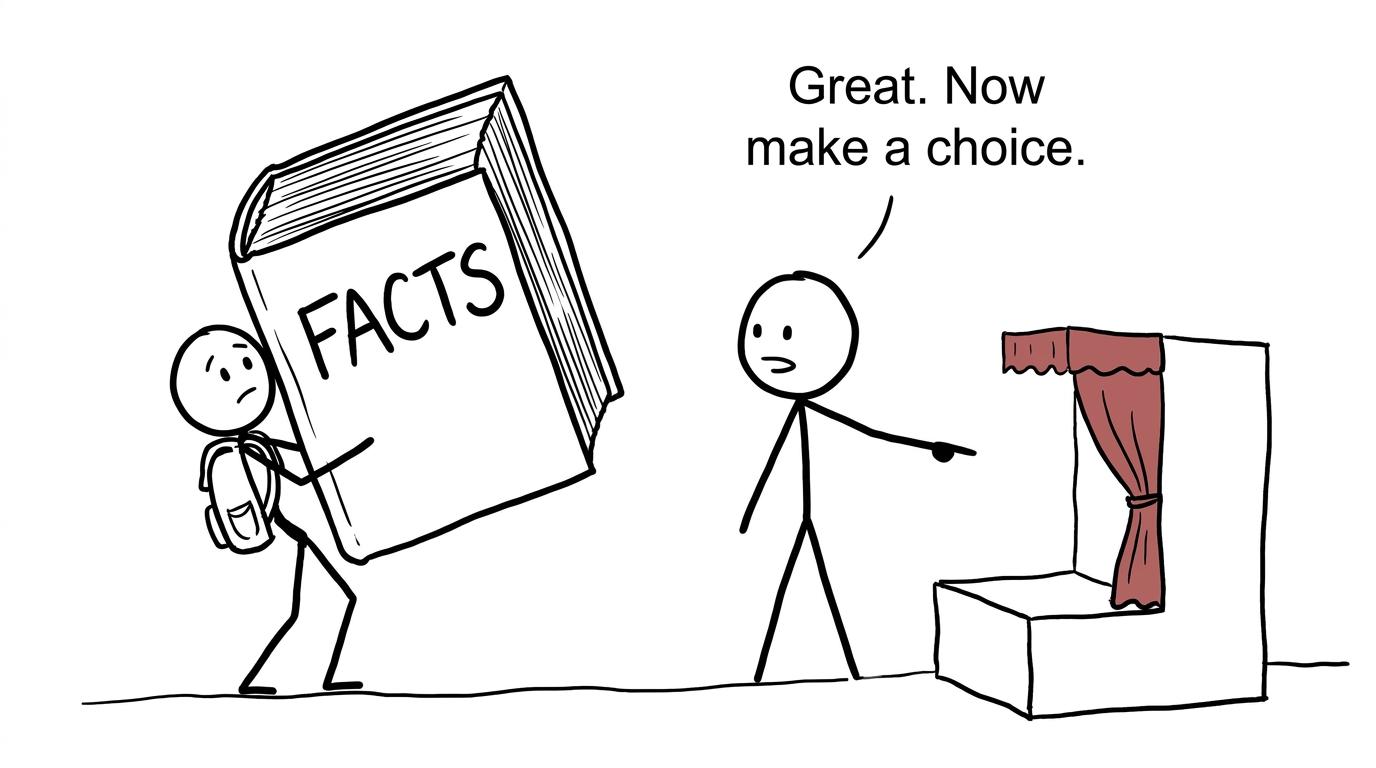 A student discovers that carrying a huge book of facts is not the same as making a theatrical choice
Content knowledge is the foundation, not the finish line
You do need secure subject knowledge. Depending on your specification, that may include theatre terminology, staging configurations, performance skills, design elements, professional theatre roles, a set text and the social, historical or cultural context surrounding it.
Yet isolated facts have limited value. Writing that a production used lighting, for example, demonstrates very little. Identifying the colour, intensity, direction and timing of the lighting is more precise. Explaining how those choices shaped atmosphere, directed attention or revealed a relationship begins to demonstrate understanding.
In the written examination, examiners are interested in theatre as something made for performance. A set text is not assessed only as literature. You may need to think like an actor, director or designer and explain how a moment could be realised on stage.
Strong knowledge therefore includes knowing:
- what a technique or design element is;
- how it can be controlled or varied;
- why a theatre maker might select it;
- how it communicates meaning to an audience;
- how it connects to the text, context or overall interpretation.
This resembles effective maths revision. Memorising a rule without recognising when to use it creates fragile knowledge. MathsGenie's GCSE Maths revision hub combines explanations with questions because application is what turns recall into performance.
What examiners reward in devised work
Devising is not simply being imaginative in the final performance. AO1 rewards the process of creating and developing ideas to communicate meaning.
Examiners are looking for evidence that your choices grew through research, experimentation, rehearsal, feedback and refinement. A productive rehearsal process might involve trying alternative uses of space, changing a transition, simplifying an overcomplicated moment or rejecting an idea that distracted from the intention.
The crucial word is develop. A chronological diary of what happened is not automatically evidence of development. Higher-quality evidence makes the thinking visible:
- What was the original intention?
- Which idea was explored?
- What changed during rehearsal?
- Why was it changed?
- How did the revision communicate meaning more effectively?
- What did you contribute personally?
Collaboration matters, but your individual decisions and contribution must remain clear. Writing only that “we discussed some ideas” hides the very evidence an assessor needs.
What practical performance marks are really measuring
AO2 assesses whether theatrical skills realise artistic intentions in live performance. It is not merely a confidence mark, and it is not a reward for learning every line.
For performers, relevant evidence can include vocal control, physicality, facial expression, movement, interaction, spatial awareness, timing and characterisation. Examiners consider how effectively and consistently these skills communicate the intended role and meaning.
A loud voice is not automatically a strong voice. Volume has value when it fits the character, moment, space and intention. Similarly, dramatic movement earns credit because it is controlled and meaningful, not simply because it is large.
Students following a design route are also applying theatrical skills. Depending on the available route and specification, this may involve lighting, sound, set, costume, hair and make-up. The design must be practical, coherent and connected to the production's artistic intention.
The central question is always: did the chosen skills help realise the intended meaning for a live audience?
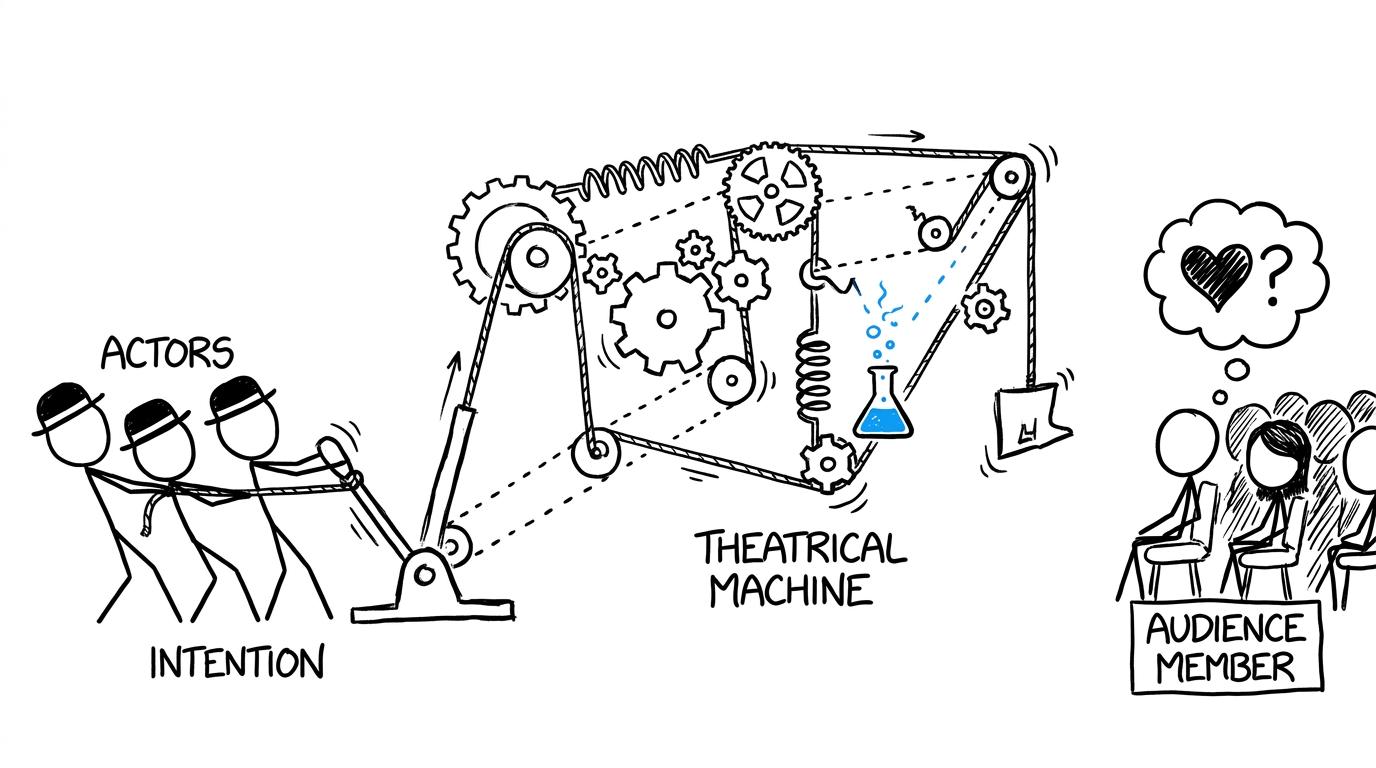 A backstage machine turns artistic intention into an audience response
What the written examination tests beyond recall
Written papers commonly assess knowledge of drama and theatre, interpretation of a set text and analysis or evaluation of live theatre. The precise structure depends on the exam board.
Applying knowledge to a set text
A strong response does not merely retell the plot or describe a character. It converts interpretation into playable or designable decisions.
If discussing performance, you might need to specify vocal qualities, pace, pause, posture, gesture, movement, proxemics or interaction. If discussing design, you may need to describe practical choices involving lighting, sound, set or costume.
Each choice should be connected to meaning. The examiner needs to understand what you would do, how you would do it and why it suits the moment.
Analysing and evaluating live theatre
Analysis explains how theatre makers created an effect. Evaluation reaches a supported judgement about how effective that effect was.
General praise such as “the acting was convincing” leaves several questions unanswered. Which performer? Which moment? What exactly did the performer do? What did this communicate? How did the audience respond, and why was the choice effective?
Useful evidence is concrete: a particular line, movement, pause, lighting transition, costume detail, sound cue or change in spatial relationship. Accurate theatrical terminology helps, but terminology should sharpen your explanation rather than replace it.
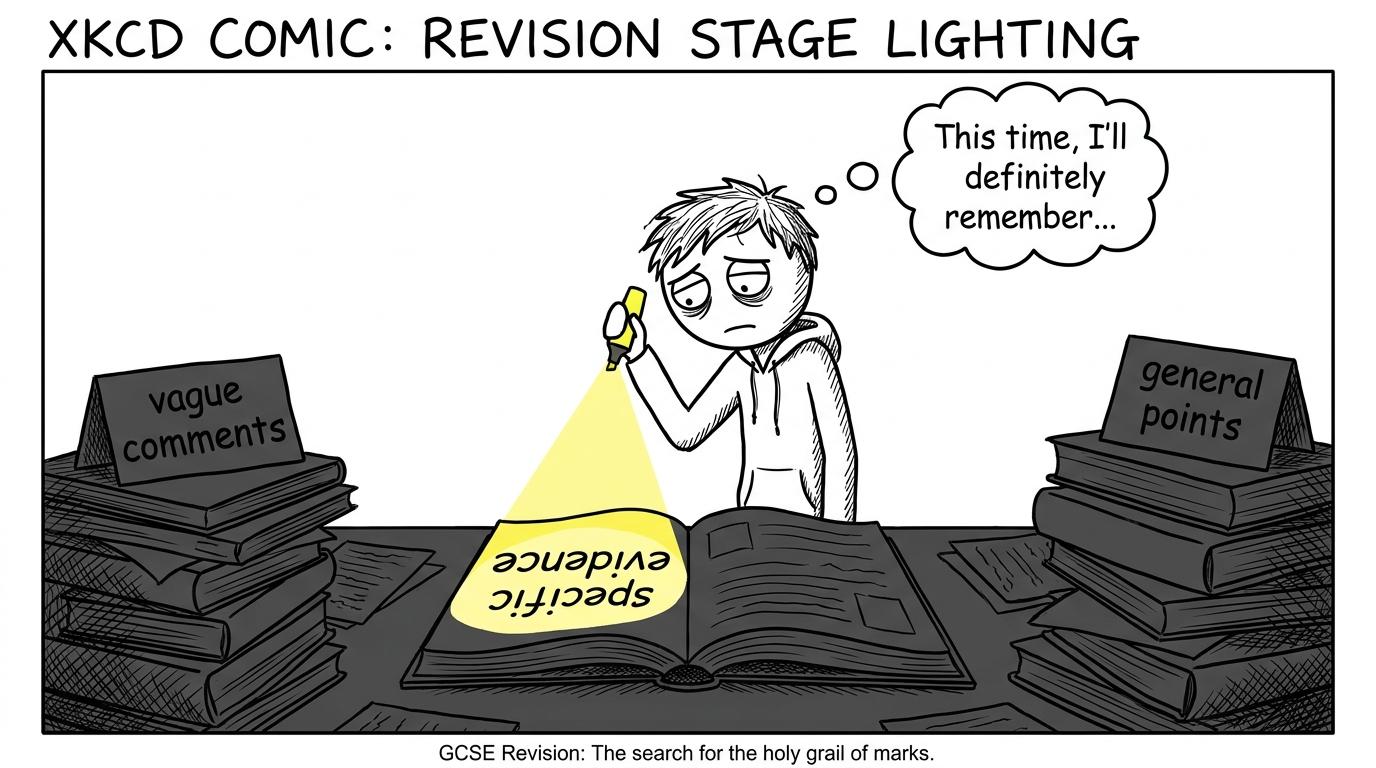 A revision spotlight reveals specific evidence while vague comments remain backstage
A revision method built around marks
The most efficient revision starts with the assessment objectives rather than a pile of disconnected notes.
Make knowledge usable
For each technique, character, scene or production moment, connect four things:
- the specific theatrical choice;
- the intended meaning;
- the effect on the audience;
- a judgement about its effectiveness.
This gives you a flexible chain of reasoning rather than a memorised paragraph that may not fit the question.
Practise decisions, not just descriptions
Take moments from your set text and plan possible acting, directing or design choices. You do not need to predict an exact question. You need a bank of defensible choices that you can adapt to different extracts, characters and themes.
Use mark schemes diagnostically
After a response, identify whether lost marks came from missing knowledge, vague evidence, limited analysis, an unsupported judgement or failure to answer the command word. Maths students can use the same process through MathsGenie's guide to finding weak topics from assessment evidence.
Do not simply record a disappointing mark. Record the reason. That turns feedback into a revision instruction.
Protect your maths revision alongside Drama
Drama preparation includes rehearsals, portfolio work and written revision, so it can expand to fill every available evening. A simple timetable protects your other subjects.
Use short, focused maths sessions through GCSE Maths revision lessons and practice, then move towards papers when your topic knowledge is secure. MathsGenie's guide to when to begin GCSE past papers explains how to make that transition without beginning full papers too early.
If exams are close, a structured one-week GCSE maths revision plan can help you balance subjects without relying on panic.
Common mistakes that lose GCSE Drama marks
Retelling instead of analysing
Plot summary explains what happened in the story. Analysis explains how a theatrical choice communicated meaning. Keep context brief and spend most of the response on the craft of theatre.
Naming a technique without explaining its use
Terms such as pause, projection, levels or spotlight do not earn substantial credit by themselves. Specify how the technique was controlled and connect it to intention and audience effect.
Describing rehearsal without showing development
A list of activities is not the same as explaining progress. Identify the original idea, the change made and the reason the revised version worked better.
Making unsupported judgements
Words such as “effective”, “powerful” and “successful” need evidence. Explain precisely what created the effect and why it supported the production's intention.
Ignoring the wording of the question
“Describe”, “explain”, “analyse” and “evaluate” demand different depths of response. Underline the focus, identify the relevant assessment objective and keep returning to the exact task.
Treating group success as individual evidence
Your group may produce excellent theatre, but assessors still need to identify your contribution. Make your creative, performance or design decisions explicit.
Letting one subject consume the timetable
Revision feels productive when it is familiar, which can lead students to neglect a weaker subject. Use a balanced routine. The GCSE maths night-before plan is useful when time is short, while the guide to recurring GCSE maths topic areas helps prioritise broader revision.
The real lesson behind the assessment
So, what does GCSE Drama actually test? It tests whether you can turn knowledge into purposeful theatre. Examiners reward ideas that develop, skills that communicate intention, knowledge applied to performance, and judgements supported by precise evidence.
Remembering content gives you material. Your choices determine what that material becomes.
As you prepare for Drama, keep your maths moving too. Use MathsGenie's free revision lessons and practice questions to repair individual topics, mini tests to check recall, and mark schemes and video solutions to understand lost marks. Then build exam confidence with past papers and predicted papers. Start at the GCSE Maths revision hub, choose your exam board and turn each revision session into evidence of improvement.











