

What Does GCSE Biblical Hebrew Actually Test?
What does GCSE Biblical Hebrew actually test? Discover how marks reward translation, comprehension, grammar, literary analysis and evidence-based responses.
A revision folder can become very full while an exam answer remains strangely thin. That is the uncomfortable gap many students discover: remembering a text is not the same as earning marks from it. So, what does GCSE Biblical Hebrew actually test? The direct answer is language knowledge, accurate translation, comprehension, understanding of set literature, and the ability to analyse evidence. Memory matters, but examiners reward what you can do with what you remember.
The current Pearson Edexcel GCSE divides assessment equally between language and literature. Across the qualification, Assessment Objective 111 accounts for 50%50\%50%, Assessment Objective 222 for 25%25\%25%, and Assessment Objective 333 for 25%25\%25%. Those weightings reveal the central idea of the course: knowledge is essential, but knowledge must become precise performance.
The GCSE Biblical Hebrew assessment checklist
You are preparing to demonstrate that you can:
- understand unseen Biblical Hebrew passages;
- translate Biblical Hebrew accurately into natural English;
- recognise and explain prescribed grammar, or translate short English sentences into pointed Biblical Hebrew;
- recall relevant details from the set texts;
- identify literary features and explain their effects;
- use textual evidence to support analysis;
- compare ideas, values and social practices across the set texts;
- follow each command word closely and answer in the required language.
That final point is easy to underestimate. Examiners cannot reward everything you know. They reward the knowledge and skill that answer the particular question.
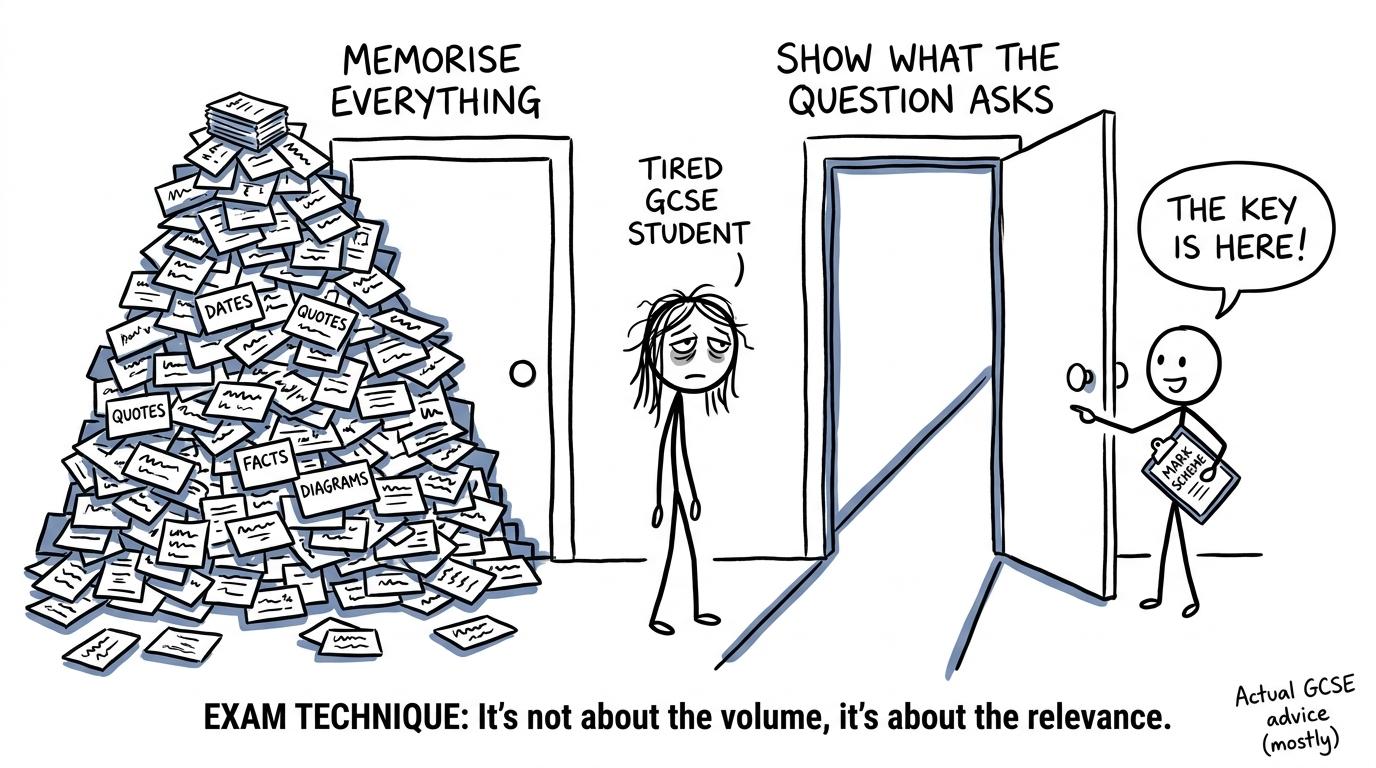 A student chooses between memorising everything and answering the question asked
Content knowledge or skills? The assessment balance
Pearson Edexcel GCSE Biblical Hebrew has two externally examined components, each worth 50%50\%50% of the qualification and carrying 100100100 marks. Both are written examinations lasting 222 hours.
| Component | Main focus | Weighting | Assessment objective |
|---|---|---|---|
| Component 111: Language | Unseen comprehension, grammar or composition, and translation | 50%50\%50% | AO1 |
| Component 222: Literature | Set-text knowledge, translation, analysis and comparison | 50%50\%50% | AO2 and AO3 |
AO1 is defined as demonstrating knowledge and understanding of the language. AO2 covers knowledge and understanding of literature. AO3 requires students to analyse, evaluate and respond to literature.
This is not a clean split between a memory paper and a skills paper. Language skills depend on learned vocabulary and grammar. Literary analysis depends on detailed knowledge of the set texts. In the other direction, memorised vocabulary earns little if it cannot be used to understand a sentence, while recalled literary notes earn little if they are not selected and applied to the question.
What Component 1 rewards
Component 111 assesses how effectively you can use Biblical Hebrew when the wording in front of you is unfamiliar. That makes it the clearest test of transferable language skill.
Comprehension of unseen passages
Section A uses two unseen passages. For each passage, students answer compulsory short-response comprehension questions worth 151515 marks and then complete an optional task worth 101010 marks. Across the section, that produces 505050 marks.
Comprehension is not simply vocabulary recall. You must work out who is acting, what is happening and how the grammar connects the details. A familiar word can mislead if its form, suffix or position changes its role in the sentence.
Short questions also demand restraint. If the command word asks you to state, give, name or identify, the examiner is looking for the requested information, not an essay around it. Precision is a skill.
Grammar or translation into Biblical Hebrew
For the optional part of each comprehension passage, students choose between answering grammar questions and translating three English sentences into pointed Biblical Hebrew. The selected route must be handled accurately.
The grammar option rewards recognition and explanation of morphology and syntax within context. You may know a grammatical label in isolation, but the assessment asks whether you can apply it to the form actually printed.
The alternative tests whether you can construct short, pointed Biblical Hebrew sentences. It therefore requires active command of vocabulary, verb forms and sentence structure rather than recognition alone. Your school will normally prepare you consistently for the appropriate route, so confirm your intended option with your teacher rather than switching casually during final revision.
Translation into English
Section B is worth 505050 marks and moves from words or short phrases to short and longer unseen passages. Pearson's published marking guidance focuses on the proportion of sense communicated. A response with isolated vocabulary is not equivalent to a continuous translation, while a translation that communicates who did what to whom can receive substantial credit even when it contains errors.
The highest marks require accurate meaning without significant omissions. Good English matters because the examiner must be able to see the sense clearly, but an elegant paraphrase that changes the original meaning is not an improvement. Translation rewards controlled accuracy.
What Component 2 rewards beyond recall
Component 222 assesses the two prescribed set texts through short responses, set-text translation, extended responses and a final comparison. Students answer all questions.
Knowledge is more visible here, but it still has to be used purposefully.
Accurate retrieval and set-text understanding
AO2 questions can ask for details stated in a passage or for closely related background knowledge from the studied text. These marks reward secure familiarity: speakers, events, references, context and grammatical features should not feel new on exam day.
Yet more is not automatically better. Pearson examiner feedback has warned that some students gave AO3-style analysis when a straightforward AO2 comprehension response was required. If a question asks for retrieval, provide retrieval. The sophistication of an answer cannot compensate for answering a different question.
Literary analysis based on language
AO3 questions move from knowing the passage to interpreting it. The command word examine requires close analysis of content or literary style followed by a conclusion. Explain asks for reasons, supported where appropriate by knowledge of the text.
Examiners are rewarding a chain of thought:
- identify a relevant word, phrase, feature or event;
- explain what it communicates;
- connect it to the question's focus;
- support the point with precise textual evidence;
- reach a justified interpretation rather than making an unsupported assertion.
Feature spotting alone is incomplete. Naming repetition, direct speech or another literary effect does not explain its significance. The mark-worthy step is showing how that feature shapes emphasis, characterisation, tension, meaning or the reader's response.
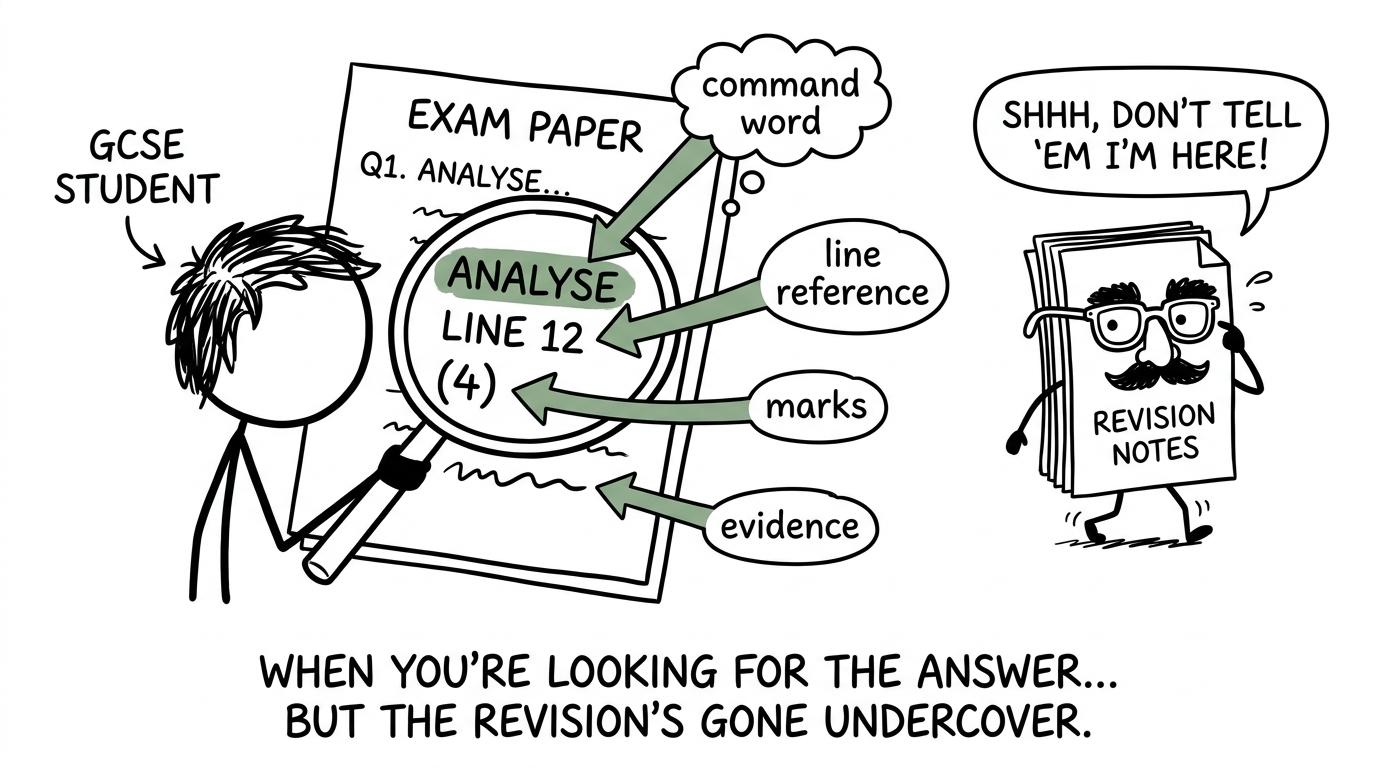 A student investigates command words and evidence like an exam detective
Comparison across the set texts
The final extended response is worth 121212 marks and requires comparison and contrast of ideas, values and social practices across both set texts. It assesses both AO2 and AO3.
A strong response therefore combines secure knowledge with comparative judgement. Writing everything remembered about one text and then everything remembered about the other can leave the comparison implicit. It is more effective to organise the response around points of similarity and difference, selecting evidence from both texts as you proceed.
Official subject content also places an important boundary around revision: for Biblical Hebrew, required cultural, historical and literary context is drawn from the books containing the set texts, rather than an unlimited study of the wider ancient world. Your specification and teacher's set-text guidance should define the material you need.
What examiners are actually rewarding
Marks tend to follow visible evidence of five habits:
- Selection: choosing information relevant to the exact question.
- Accuracy: translating meaning and using grammatical terminology correctly.
- Application: using learned vocabulary, grammar or context in a particular passage.
- Analysis: explaining how textual details create meaning or effect.
- Judgement: reaching a reasoned conclusion supported by evidence.
This is why passive rereading can feel reassuring while producing limited progress. Familiarity tells you, “I have seen this.” An examination asks, “Can you retrieve it, apply it and communicate it under pressure?”
That distinction will already be familiar to students balancing Biblical Hebrew with GCSE maths. Knowing a formula is not the same as recognising when to use it. In both subjects, the reliable cycle is attempt, mark, diagnose, repair and retest. MathsGenie's guide to finding your weakest GCSE topics explains how to turn lost marks into focused revision rather than vague rereading.
How to revise for the skills being assessed
Separate knowledge from performance
Create two revision lists. The first should contain knowledge to retrieve: vocabulary, grammatical terminology, set-text details and literary features. The second should contain performances to practise: unseen comprehension, continuous translation, short retrieval answers, analysis and comparison.
A balanced session might include brief recall followed by an exam-style task completed without notes. Afterwards, classify each lost mark:
- knowledge gap;
- mistranslation or grammatical error;
- misunderstood command word;
- unsupported analysis;
- incomplete comparison;
- time-management problem.
This diagnostic approach mirrors the method in MathsGenie's GCSE revision timetable guide: practise, mark, identify the weakness and schedule a focused return.
Read mark schemes as definitions of quality
A mark scheme is not only an answer sheet. It shows what counts as rewardable material and, for extended responses, how the quality of analysis develops across levels.
After attempting a task, ask:
- Did my response match the command word?
- Did I communicate the complete sense?
- Did I use evidence rather than merely make a claim?
- Did I explain the effect of the evidence?
- In comparison, did I discuss both texts directly?
Maths students can build the same habit using Edexcel GCSE Maths past papers and mark schemes. The subjects differ, but the principle does not: marks become easier to earn once you understand how they are awarded.
Build pressure gradually
Begin with short passages or individual question types. Then combine them into timed sections before completing whole papers. Short testing makes weaknesses visible without turning every revision session into an endurance test.
For maths, Edexcel GCSE Maths mini tests serve the same purpose. When longer practice is appropriate, MathsGenie's guide to using GCSE past papers properly sets out a paper, mark, fix and retest cycle that transfers well to language revision.
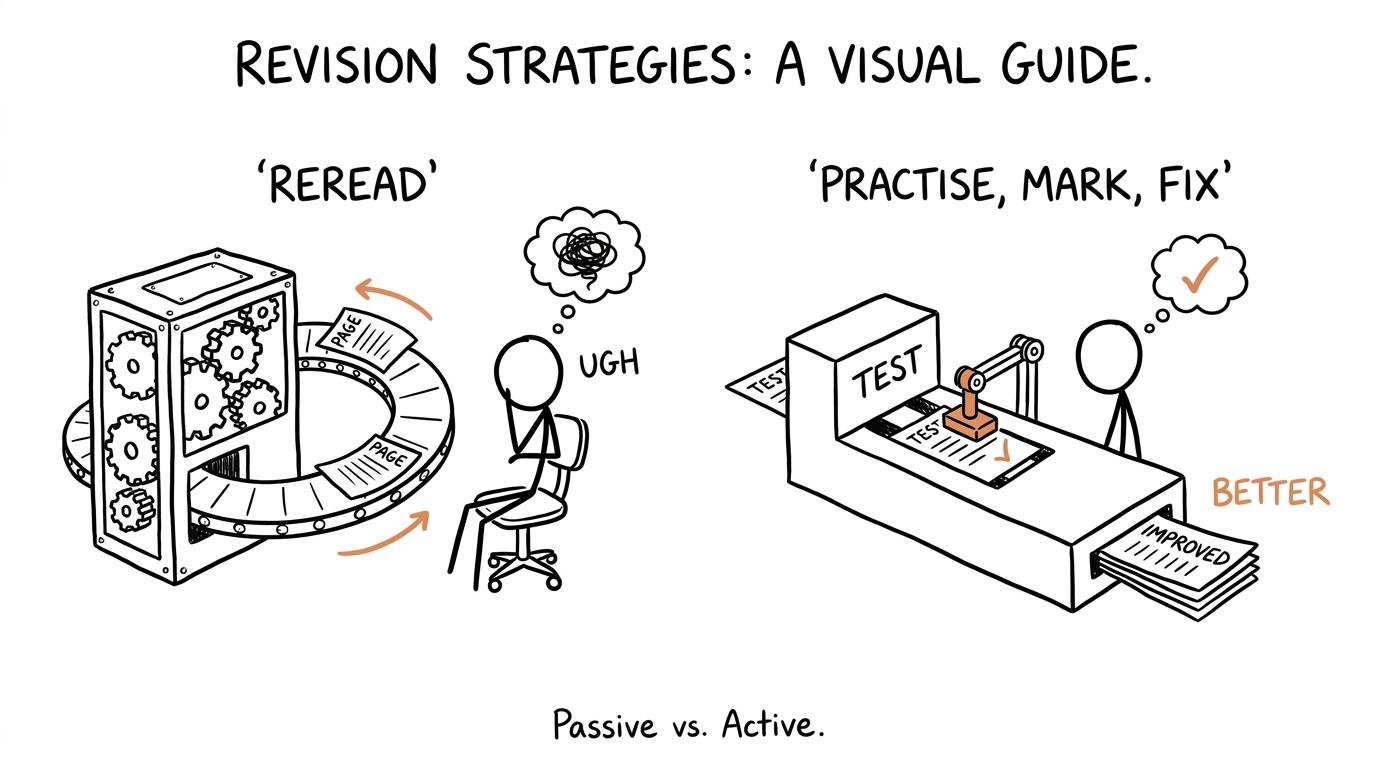 One revision machine rereads forever while another practises, marks and fixes
Common mistakes that cost Biblical Hebrew marks
Treating recognition as mastery
Recognising vocabulary or a set-text passage can create false confidence. Test yourself with the text or notes covered, then apply the knowledge in an unfamiliar question.
Translating individual words but losing the sentence
A list of plausible meanings may not communicate continuous sense. Track the grammatical relationships and check that your English makes clear who acted, what happened and to whom.
Ignoring the command word
A state question does not need extended analysis. An examine question does. Let the command word determine the depth and structure of your response.
Naming a literary feature without explaining it
Identification is only the beginning. Connect the feature to meaning, emphasis, character, atmosphere or impact, and keep that explanation tied to the question.
Writing grammatical terms or proper nouns in the wrong language
Pearson examiner feedback has noted lost marks where candidates wrote proper nouns or grammatical terms in Hebrew when English was required. Unless a question specifically requires Biblical Hebrew, responses are assessed in English. Read the instructions carefully.
Revising every weakness at once
A long list often produces shallow work. Choose the two or three patterns costing the most marks, repair them and then retest. MathsGenie's short GCSE revision routine offers a practical model for keeping this process manageable.
Turn remembered content into earned marks
GCSE Biblical Hebrew is neither a pure memory test nor an abstract skills test. It assesses learned vocabulary, grammar and literature through comprehension, translation, accurate retrieval, analysis and comparison. The examiner rewards relevant evidence of understanding on the page.
Once that becomes clear, revision becomes calmer. Learn what must be known, practise what must be done, and use mark schemes to close the distance between the two.
For your maths preparation alongside Biblical Hebrew, make MathsGenie your free revision base. Start with focused revision lessons and practice questions, build confidence through mini tests, then use Edexcel GCSE Maths predicted papers, past papers, mark schemes and video solutions to rehearse the skills that turn knowledge into marks.










