What Does GCSE Arabic Actually Test? Skills vs Content
What does GCSE Arabic actually test? Learn how examiners reward listening, speaking, reading, writing, grammar, accuracy and communication skills.
The unsettling part of GCSE revision is not always the amount you need to learn. Sometimes it is not knowing what the examiner wants you to do with it.
If Arabic sits alongside maths on your timetable, you may instinctively revise both subjects by memorising more: more vocabulary, more grammar rules, more formulae. But what does GCSE Arabic actually test? The short answer is practical language ability. Examiners assess whether you can understand and communicate in listening, speaking, reading and writing. Vocabulary, grammar and topic knowledge matter because they enable those skills, not because the exam is mainly a test of recalled facts.
This guide focuses on the current Pearson Edexcel GCSE Arabic qualification used in England. If your entry is for an International GCSE or a different qualification, check its specification because the assessment structure may be different.
GCSE Arabic assessment at a glance
The Pearson Edexcel GCSE in Arabic divides the qualification equally across four assessment objectives:
| Assessment objective | What it assesses | Weighting |
|---|---|---|
| AO1 | Understanding and responding to spoken Arabic | 25%25\%25% |
| AO2 | Communicating and interacting in spoken Arabic | 25%25\%25% |
| AO3 | Understanding and responding to written Arabic | 25%25\%25% |
| AO4 | Communicating in written Arabic | 25%25\%25% |
Together, these account for:
25%+25%+25%+25%=100% 25\% + 25\% + 25\% + 25\% = 100\% 25%+25%+25%+25%=100%The practical checklist is simple:
- learn vocabulary and grammatical structures across the specified themes;
- practise extracting messages, details and opinions from unfamiliar material;
- communicate relevant ideas rather than relying only on memorised scripts;
- use different time frames and an appropriate range of language;
- study mark schemes so you know how communication and accuracy earn marks;
- practise the precise task formats required at your tier.
Students enter either foundation or higher tier across the qualification. Dictionaries are not permitted, including during speaking preparation, so secure vocabulary recall still matters. It is the foundation of performance, however, rather than the whole performance.
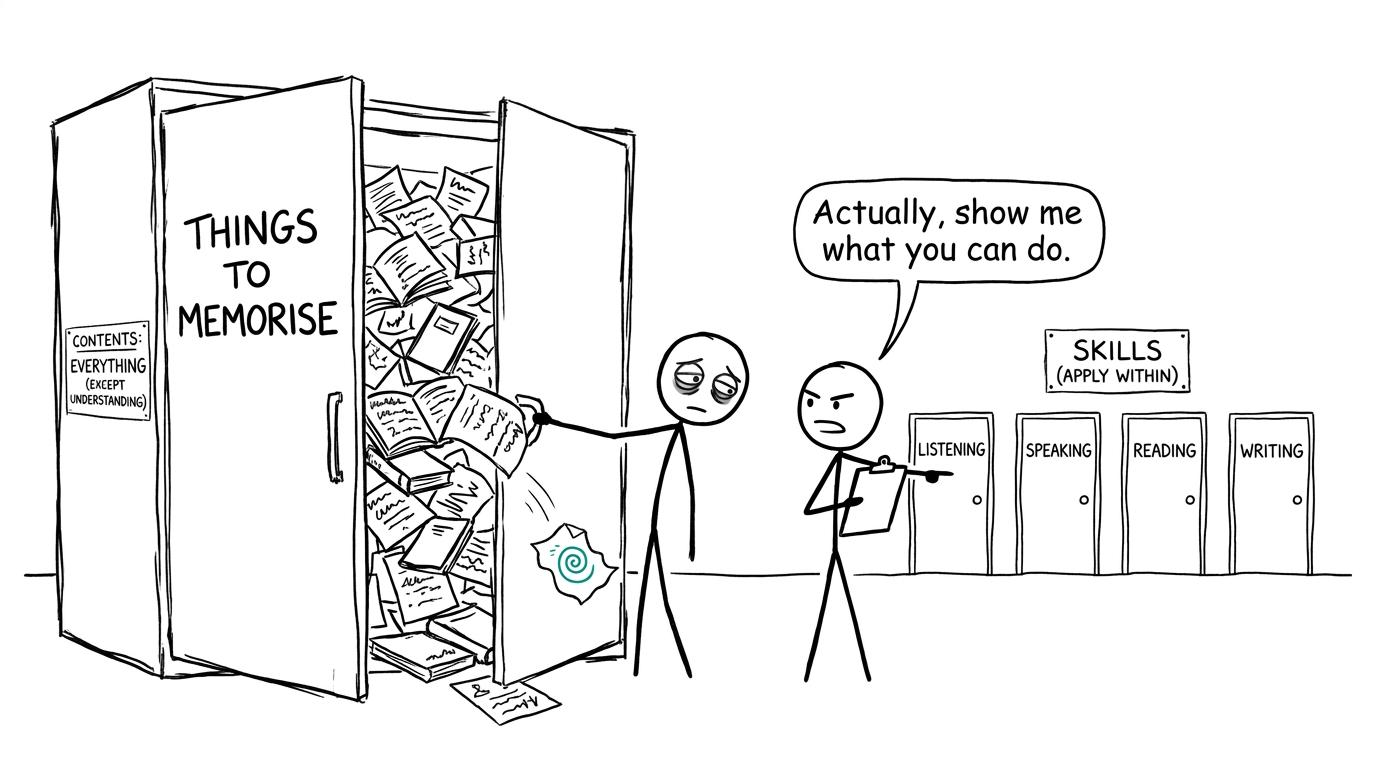 A student discovers that GCSE Arabic is assessed through four practical language skills
Is GCSE Arabic testing content knowledge or skills?
It tests both, but not in equal ways.
The specification supplies thematic content such as identity and culture, local area and travel, school, future study and work, and international issues. These themes define the situations in which Arabic is used. They help determine the vocabulary, opinions and experiences that may appear.
You are not usually being asked to reproduce a textbook chapter or recall a collection of cultural facts. Instead, a familiar theme becomes the setting for a language task. You might need to identify someone’s opinion, understand a change between past and future, respond to an unexpected speaking question or write for a stated purpose.
Think of content as the landscape and skill as movement through it. Knowing the landscape helps. Marks are earned by navigating it.
This distinction matters in maths too. Knowing a formula is useful, but an examiner rewards its correct selection and application. The GCSE Maths revision hub is organised around that same progression: learn the knowledge, practise the skill and then apply it under exam conditions.
What examiners reward in each GCSE Arabic paper
Listening: extracting meaning rather than recognising sounds
Listening assesses understanding of standard spoken Arabic across public and social settings. Recordings can require you to identify the overall message, specific details, opinions, reasons and relationships between events in different time frames.
Examiners reward the information you successfully extract. Simply recognising several familiar words may not be enough if you miss a negative, confuse who did something or overlook whether an event has already happened.
Crucially, the listening paper does not require written responses in Arabic. Some questions and instructions are presented in Arabic and others in English, but the assessment objective is listening comprehension. Your revision should therefore include deciding what a passage means, not merely writing down every word you hear.
Speaking: communication, interaction and control
The speaking assessment contains a role play, a picture-based task and a conversation. It is conducted by a teacher and externally marked by Pearson.
Across these tasks, examiners reward several distinct qualities:
- relevant information that addresses the task;
- clear communication of opinions and ideas;
- development through reasons, descriptions and detail;
- a suitable range of vocabulary and grammatical structures;
- accurate enough language to keep meaning clear;
- understandable pronunciation and intonation;
- interaction, spontaneity and responses to less predictable questions.
This explains why a perfectly memorised paragraph can be less valuable than it appears. If it does not answer the question, or if you cannot adapt it when the conversation changes, it cannot demonstrate effective interaction.
You do not need to imitate a particular regional accent. You do need to use pronunciation that allows your meaning to be understood. The specification assesses standard Arabic, so students who speak a dialect at home should deliberately practise moving between familiar spoken forms and the standard language required by the assessment.
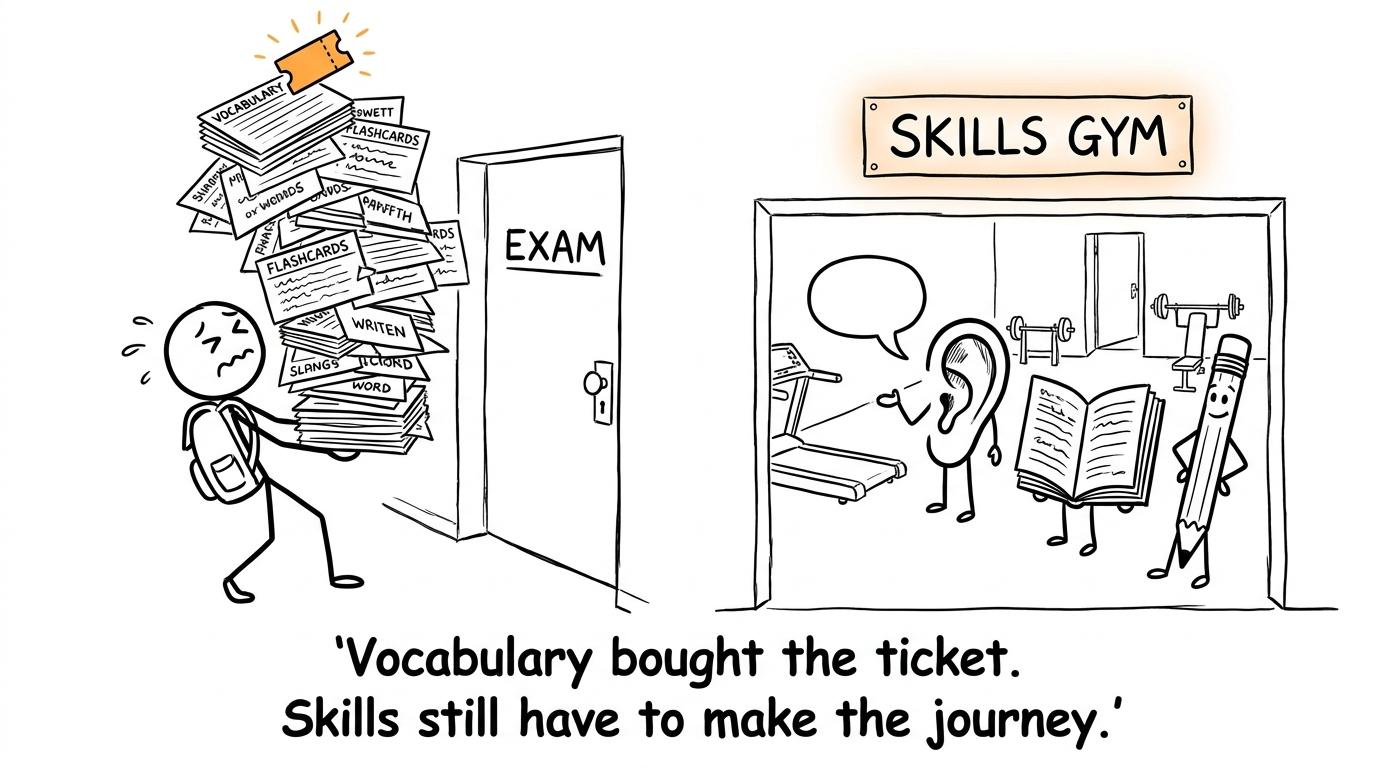 A tower of vocabulary cards discovers that practical language skills still matter
Reading: understanding ideas, details and language in context
Reading passages can include advertisements, emails, letters, articles and adapted literary material. Questions test more than word recognition. You may need to distinguish a main idea from supporting detail, identify an attitude, connect information across a passage or deduce the meaning of unfamiliar language from context.
The reading assessment also includes translation from Arabic into English. A successful translation preserves the meaning of the whole passage. It is not enough to produce a loose summary or a chain of individually translated words.
Answers should be based on the text rather than outside knowledge. If a passage discusses school or travel, what you personally know about those subjects does not replace careful reading.
Writing: relevant communication supported by accuracy
Writing requires responses of specified lengths and a translation into Arabic. Examiners are looking for effective communication for the given purpose and audience, alongside the application and accuracy of language.
Strong responses generally:
- cover every part of the prompt;
- develop ideas instead of listing disconnected statements;
- express opinions and support them with reasons;
- refer successfully to different time frames where required;
- use a range of vocabulary and structures;
- remain coherent and understandable;
- show grammatical accuracy without becoming so cautious that the language stays extremely limited.
Grammar is therefore not decorative. Ofqual’s requirements specify that part of the available marks in speaking and writing must reward knowledge and accurate application of prescribed grammar and structures. Yet accuracy is not the only goal. A response can contain correct sentences and still lose marks if it avoids the task or communicates too little.
What topic knowledge is worth learning?
Topic knowledge should be learned as usable language. For each specification theme, build four things:
- core vocabulary: common nouns, verbs, adjectives and connectives;
- functional language: ways to give opinions, justify them, compare ideas and discuss plans;
- grammatical control: agreement, sentence construction and reliable use of time frames;
- flexibility: the ability to adapt known language to an unfamiliar question.
A long vocabulary list can create the feeling of progress because every highlighted word looks like work completed. But recognition is not the same as retrieval. Test whether you can understand the word in a recording, read it in context, pronounce it clearly and use it accurately in a sentence.
The same lesson helps with maths revision. MathsGenie’s guide to stopping GCSE content from being forgotten combines active recall, spaced practice and exam-style questions. Those principles transfer well to vocabulary and grammar, even though the subject content is different.
How to revise for the skills examiners mark
A productive revision cycle has four stages: retrieve, apply, mark and adapt.
First, retrieve vocabulary and structures without looking. Next, apply them through a short listening, speaking, reading or writing task. Then compare your response with the mark scheme or teacher feedback. Finally, identify one change to make when you repeat the skill.
Avoid recording only the topic of an error. Write down its cause:
- knowledge gap;
- misunderstood instruction;
- missed detail;
- inaccurate grammar;
- unclear communication;
- weak development;
- poor timing.
That turns a disappointing mark into useful evidence. Maths students can use exactly the same process through the guide to finding weak GCSE topics, then apply it with Edexcel GCSE Maths past papers or AQA GCSE Maths past papers.
Short, frequent sessions are often easier to sustain than occasional revision marathons. The 20-minute GCSE revision routine offers a useful structure: retrieval, focused practice, marking and an error note. For Arabic, rotate the skill being practised so that speaking and listening are not neglected in favour of written flashcards.
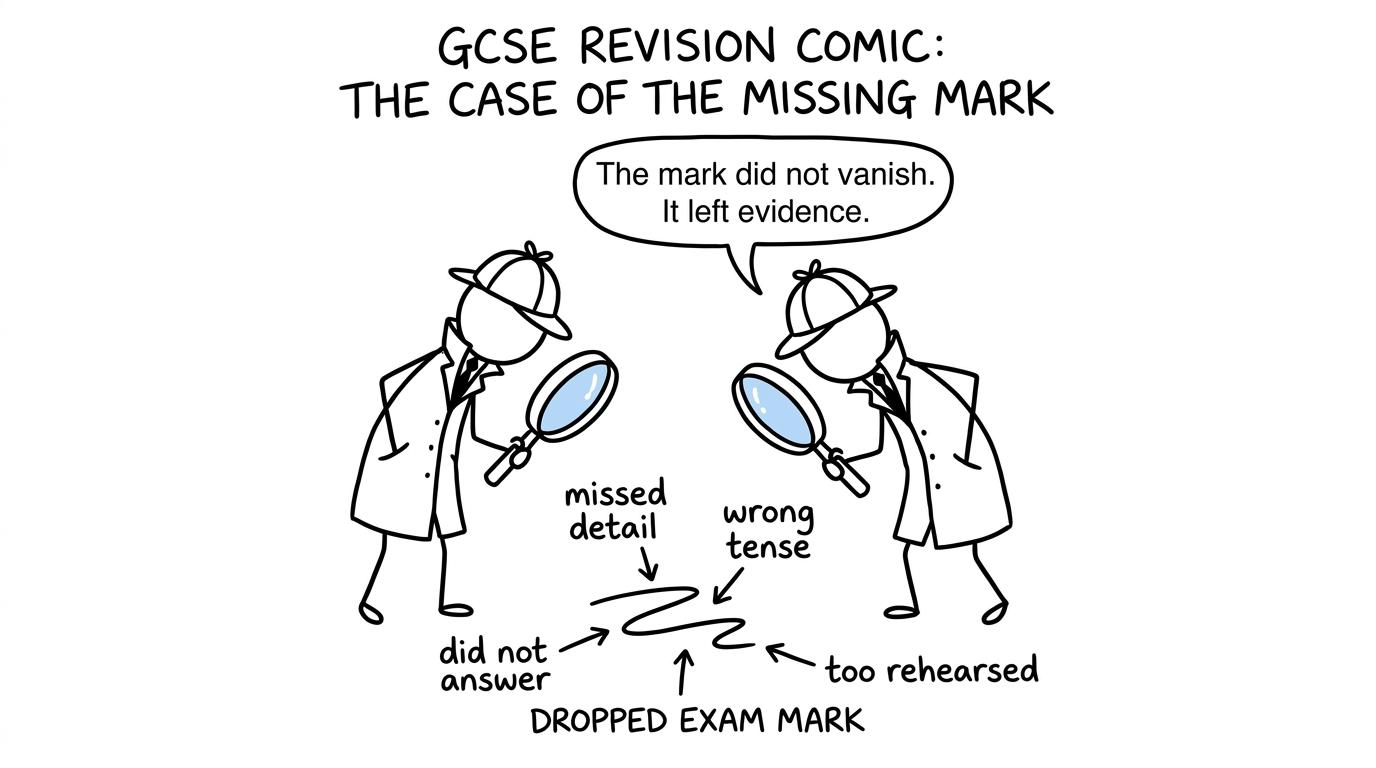 Revision detectives investigate exactly where an exam mark was lost
Common mistakes that lose GCSE Arabic marks
Memorising answers instead of learning adaptable language
Prepared material can provide confidence, but it must remain flexible. A polished response that does not answer the question is not fully relevant, while a speaking answer that sounds recited may not demonstrate spontaneity.
Giving minimal speaking answers
One-word responses can communicate a basic fact but rarely show range, development or sustained interaction. Where the task allows, add an opinion, reason or relevant detail.
Missing one element of a writing prompt
Students sometimes produce accurate Arabic about the general theme while overlooking a bullet point, time frame or required purpose. Underline each demand and check it off before finishing.
Treating translation as word substitution
Translation is about preserving meaning. Word order, tense, pronouns and idiomatic phrasing may need to change between Arabic and English.
Revising only preferred skills
Reading vocabulary can feel safer than speaking aloud or listening at normal speed. Equal assessment weighting means a neglected skill can affect a substantial part of the final result.
Ignoring the mark scheme
A mark scheme is not merely a score sheet. It reveals whether a task rewards content, interaction, linguistic range, accuracy or precise comprehension. The broader habit is valuable across your timetable, which is why MathsGenie recommends marking work carefully in its guide to using GCSE past papers effectively.
Turn assessment knowledge into a revision plan
GCSE Arabic is not a memory contest disguised as a language qualification. It tests whether knowledge remains available when you must listen carefully, respond naturally, interpret an unfamiliar text or construct a clear written message. Vocabulary opens the door. Grammar gives you control. Skill is what carries both into the exam.
Use that insight across your GCSE preparation. For maths, start with MathsGenie’s free revision resources, mini tests and predicted papers. Learn weak topics through revision lessons, complete practice questions, mark them honestly and use video solutions when your method breaks down. Then move to past papers and predicted papers under timed conditions.
Whether the subject is Arabic or maths, the most useful question is not simply, “What have I remembered?” It is, “What can I now do accurately, independently and under pressure?” That is where exam marks live.