

Week Before GCSE Results Day: 7-Day Checklist
Week before GCSE results day: use this calm seven-day checklist to confirm collection, plan next steps and handle an unexpected grade confidently in 2026.
The final exams are over, but your mind may still be marking them. One remembered mistake becomes three; one difficult maths question starts to feel like an entire paper. That is why the week before GCSE results day can feel strangely long.
The useful answer is simple: do not try to predict your grades. Confirm the practical details, understand your options and make a flexible plan for what comes next. GCSE results day in 2026 is Thursday 20 August, although your school decides when and how you receive your results.
Your preparing for GCSE results checklist
By results morning, aim to have:
- confirmed the collection time, place or online arrangements
- checked what your sixth form, college or apprenticeship provider needs
- written down useful school and admissions contacts
- prepared questions about reviews of marking and resits
- planned who you want with you afterwards
- packed a small results-day bag
- avoided unreliable grade predictions on social media
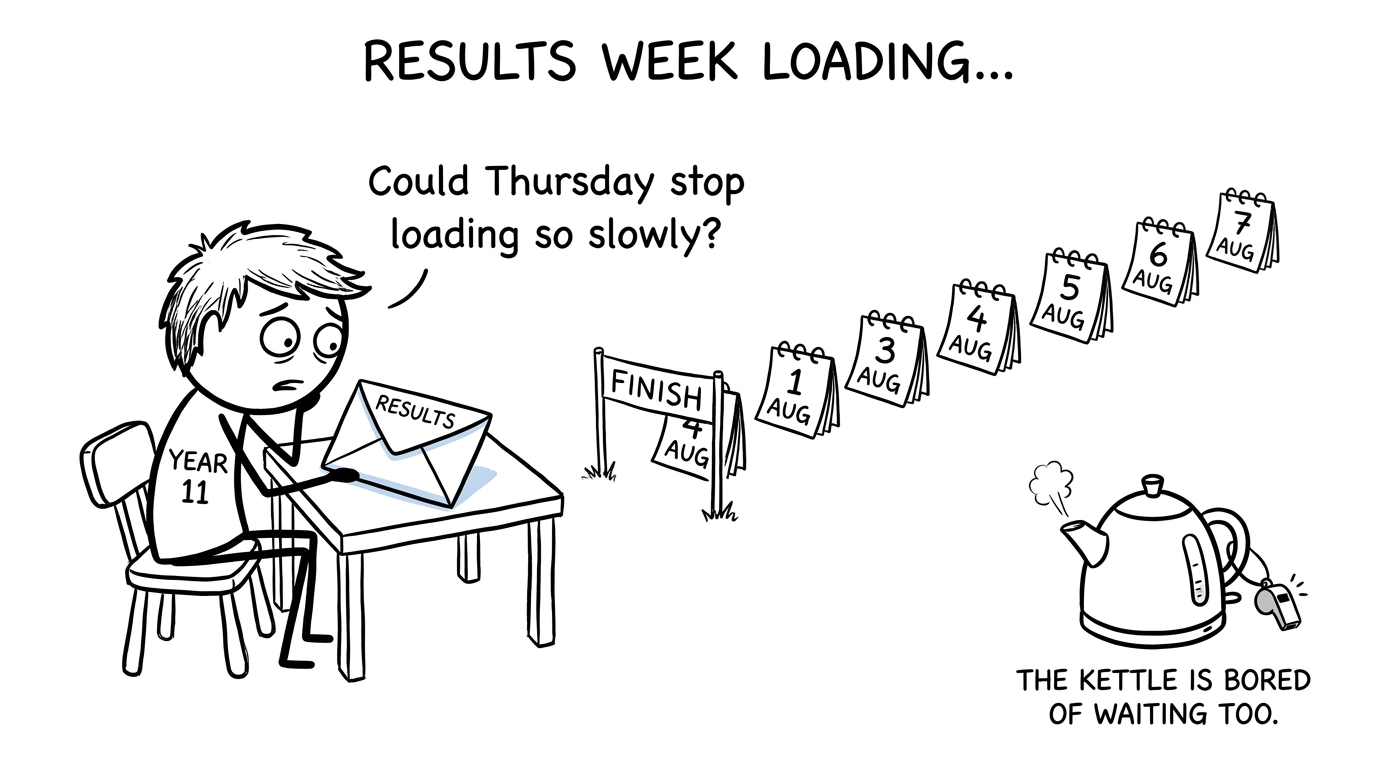 A student waits for GCSE results day while calendar pages queue
Seven days before: confirm the arrangements
Check your school’s official email, portal or letter. Find out:
- when results are available
- whether you collect them in person or receive them online
- where to go
- whether your school requests identification
- who to contact if you cannot attend
Do not assume your friend’s arrangements are yours. Schools manage distribution differently, and results cannot be released to candidates before the official release time.
Save the details somewhere accessible without relying on mobile data. If another person may collect results for you, ask the school about permission requirements now.
Six days before: check your next-step conditions
Read your sixth form or college offer carefully. Note any subject-specific requirements, particularly if you hope to take A Level Maths or another course that requires a particular GCSE Mathematics grade.
Create three short plans:
- Plan A: you meet all conditions
- Plan B: one grade is below a condition
- Plan C: your preferred course is unavailable
A backup plan is not pessimism. It prevents one unexpected grade from forcing a rushed decision. Keep admissions telephone numbers, enrolment instructions and deadlines together.
If A Level Maths is part of Plan A, you can also explore MathsGenie’s free GCSE and A Level maths revision to see how the next stage develops.
Five days before: understand the results sheet
Your results may show subjects, exam boards, qualification details and grades. GCSEs in England generally use grades 999 to 111, with 999 the highest. Some qualifications use different grading systems, so ask school staff if anything is unclear.
Do not compare a raw mark with an old grade boundary and assume the result is wrong. Boundaries can vary between exam series and specifications. Your school can help you interpret the official information for Edexcel, AQA, OCR or Eduqas.
For a reminder of the resources attached to each board, visit the GCSE Maths revision hub, including dedicated pages for Edexcel GCSE Maths, AQA GCSE Maths and OCR GCSE Maths.
Four days before: learn what happens if a result looks wrong
If you believe there may be an error, speak to your school or college. It can request access to your script and consider whether a clerical re-check or review of marking is appropriate. Most students cannot submit these requests directly to an exam board; private candidates may have different arrangements.
A review does not simply award extra marks. The mark and grade can rise, remain unchanged or fall, and a fee may apply. Your school will normally need your consent and can explain the deadline, cost and possible effect on your next step.
The calm question is not, “Can I get one more mark?” It is, “Is there evidence of a marking or administrative error?”
Three days before: prepare useful questions
Write a short list so that emotion does not erase the questions you meant to ask:
- Have I met my course conditions?
- Who should I speak to about enrolment today?
- How far is this result from the relevant boundary?
- Would accessing the script help?
- What are my resit options?
- When must a decision be made?
For GCSE Mathematics, students who do not achieve the required pass grade may need to continue working towards the qualification, depending on their age and circumstances. Your school or college can explain the route that applies to you.
Two days before: plan the morning
Decide how you will travel, when you will leave and who you want nearby. Charge your phone, but do not make social media the first place you process your grades.
Pack lightly:
- phone and charger
- water
- identification if your school requires it
- offer and enrolment information
- notebook and pen
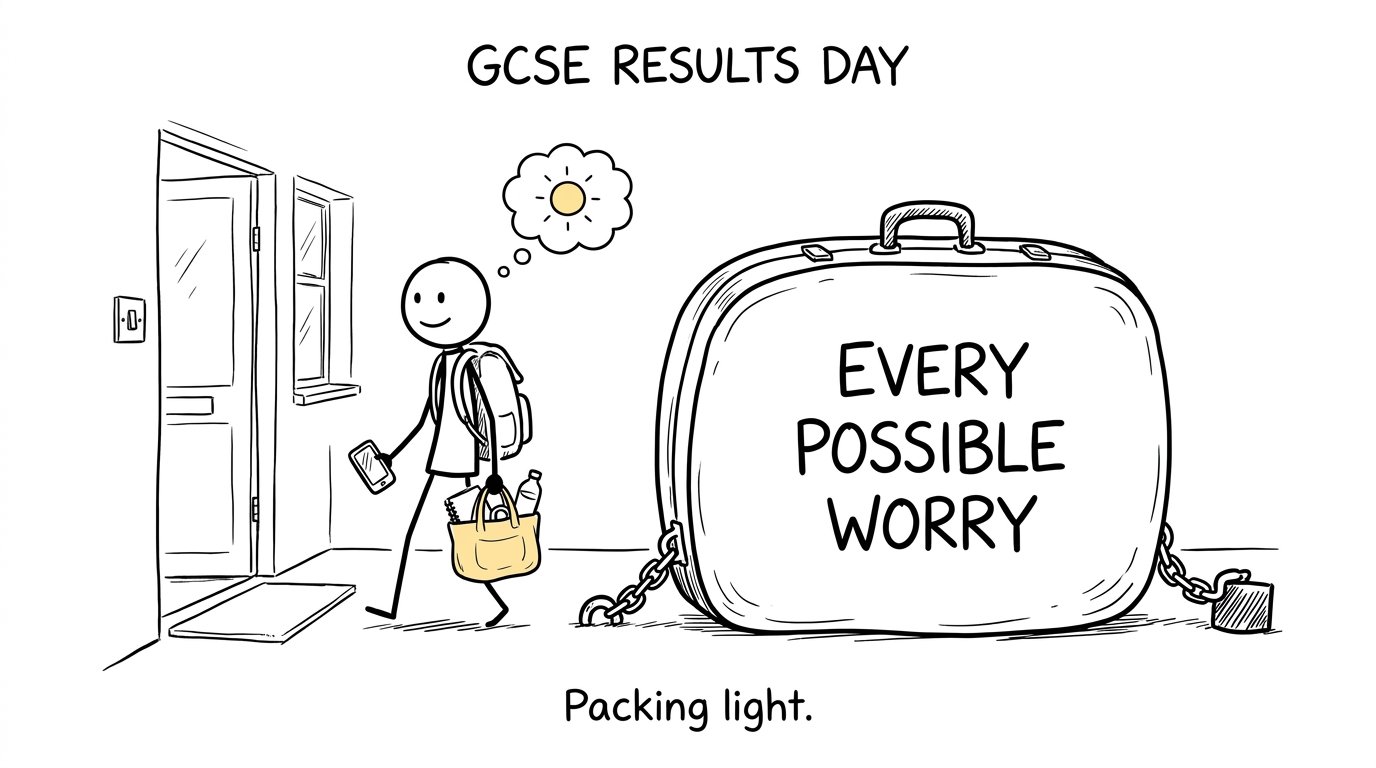 A student leaves an enormous suitcase of worries at home
One day before: stop trying to calculate the outcome
You cannot reconstruct every paper accurately months later. Looking through Edexcel past papers and mark schemes now will not change the result.
Choose an ordinary evening instead. Eat normally, set an alarm and do something absorbing. You are preparing for GCSE results, not sitting another exam.
Results morning: pause, read and ask
Open the results in your own time. Read every subject carefully before reacting to one grade. Then compare the results with your actual course requirements and speak to the relevant staff.
Celebrate what went well. If something did not, gather facts before making decisions. One sheet can change a route, but it does not remove the destination.
Common mistakes in the final week
- Trying to predict boundaries: unofficial estimates create noise, not certainty.
- Assuming collection details: check your school’s instructions directly.
- Having no alternative route: prepare options without treating them as failures.
- Requesting a review automatically: first discuss the script, evidence, cost and risk.
- Comparing immediately: another student’s grades do not explain your choices.
- Forgetting deadlines: post-results and enrolment decisions can be time-sensitive.
Take the next step with MathsGenie
Results day closes one chapter, but it also makes the next plan clearer. If you are continuing with maths, preparing for a resit or moving towards A Level, begin with the free MathsGenie revision planner.
Use it alongside revision lessons, practice questions, mini tests, past papers, predicted papers, mark schemes and video solutions. You do not need to solve the whole future in one morning. Choose the next sensible action, write it down and begin there.











