

University GCSE Psychology Requirement: Does It Matter?
University GCSE psychology requirement explained: learn when the grade matters, what admissions teams prioritise, and why strong GCSE maths keeps options open.
A university application can make an old GCSE result feel unexpectedly important. You may be concentrating on A Levels, yet wondering whether an admissions team will look back at the Psychology grade you received in Year 11.
The short answer is reassuring: a university GCSE psychology requirement is uncommon. Most courses do not specifically require GCSE Psychology, including many undergraduate Psychology degrees. However, universities can consider your wider GCSE profile, and the grade may matter indirectly if a competitive course assesses several or all of your GCSE results.
In practice, GCSE Maths, English Language and sometimes Science are far more likely to appear as specific entry requirements. Your Psychology result is normally one part of the academic picture rather than a gate that determines whether you may apply.
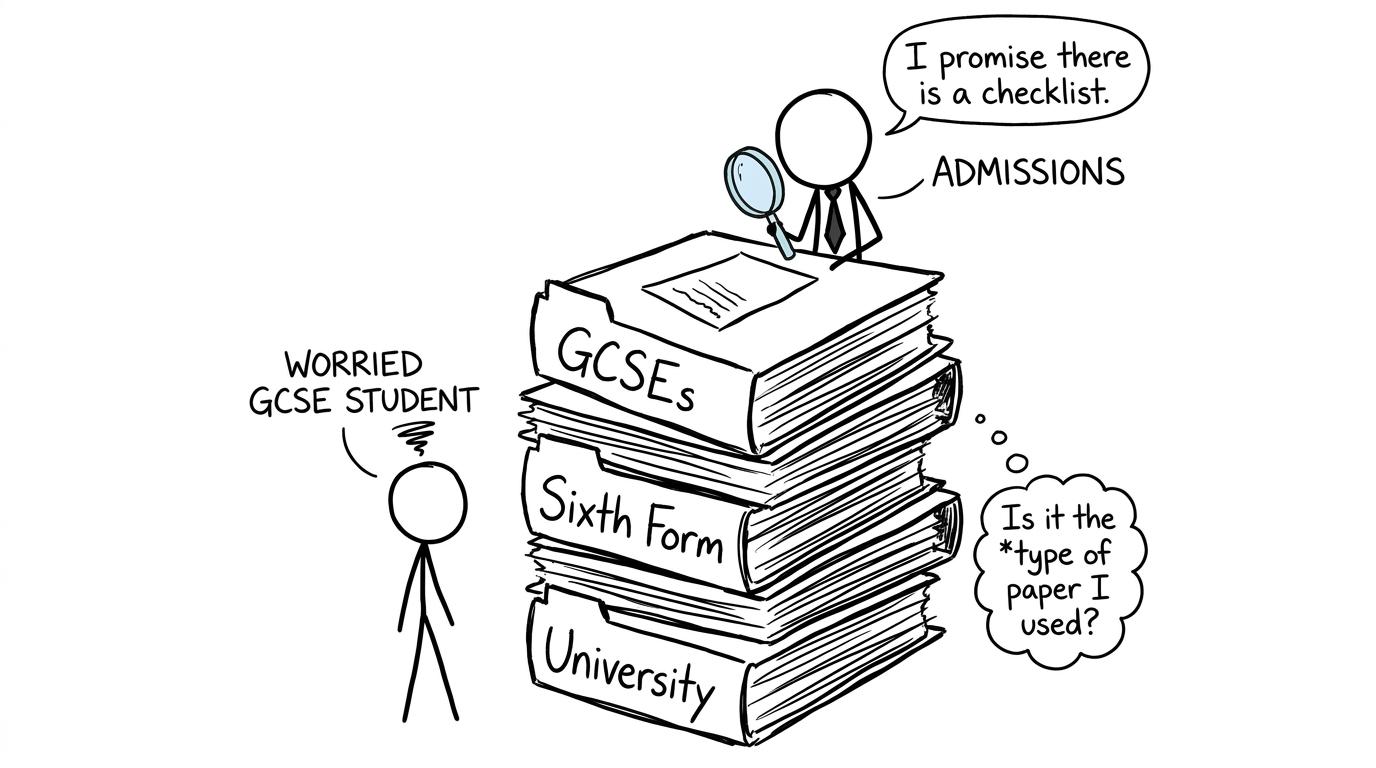 A student and an admissions officer confront a towering checklist of qualifications
The quick university GCSE psychology requirement checklist
Before worrying about one grade, check these points:
- Does the course page explicitly name GCSE Psychology?
- Does it require a minimum number of GCSEs at certain grades?
- Are there specific requirements for GCSE Maths, English Language or Science?
- Does the university assess the overall GCSE profile when selecting applicants?
- Does the course require or prefer particular A Level subjects?
- Are contextual offers or alternative entry routes available?
- Are you reading the requirements for the correct course and entry year?
The exact course page matters more than general advice. Universities set their own requirements, and two courses with the same title can use different criteria.
Do universities see your GCSE Psychology grade?
Universities normally receive the qualifications declared through your UCAS application. This means an achieved GCSE Psychology result may form part of the information available to an admissions team.
Seeing a grade is not the same as requiring it. Admissions decisions can involve several layers:
- minimum GCSE requirements;
- Level 3 qualifications such as A Levels or BTECs;
- required or preferred subjects;
- predicted or achieved grades;
- contextual information;
- personal statement information where relevant;
- admissions tests, portfolios or interviews for certain courses.
For many degrees, GCSE Psychology will simply appear among your other qualifications. The admissions team may confirm that your application meets its basic academic conditions and then focus more heavily on your A Level subjects and grades.
The distinction is important. A grade can be visible without being decisive.
When does your GCSE Psychology grade actually matter?
When a university assesses your overall GCSE profile
Some highly competitive courses use GCSE performance as part of selection rather than merely checking a few minimum grades. They may consider the number of strong grades, your performance across particular subjects or your highest GCSE results.
In that situation, Psychology can matter because it is one of the grades being considered. It is not necessarily treated as more important than History, Geography or another optional GCSE. A strong Psychology grade may strengthen the overall profile; a weaker grade may have some effect, but it is rarely sensible to view one result in isolation.
Medicine provides a useful illustration of the principle. Certain medical schools score a collection of GCSE results that includes specified core subjects and a number of an applicant's other highest grades. If Psychology is among those highest grades, it could enter the calculation. Other medical schools look only at named subjects such as Maths and English. The policy depends on the institution.
When a course has broad minimum GCSE conditions
A course may ask for a particular number of GCSE passes or a broad set of grades. If you are using Psychology as one of the qualifications needed to satisfy that condition, its result matters even though Psychology itself is not required.
For example, a requirement might refer to several GCSEs at grade 444 or above, with Maths and English Language included. Psychology could help complete that set, but another accepted GCSE could often serve the same purpose.
When your sixth form uses it for A Level entry
The more immediate issue may arise before university. A school or college can set its own entry conditions for A Level Psychology. It might ask for a particular grade in GCSE Psychology where the subject was available, or it may focus on English, Maths and Science because many students begin A Level Psychology without having studied it at GCSE.
This is a sixth-form admissions decision, not a universal university requirement. Check the published policy of the school or college you intend to attend.
When you need to explain unusual circumstances
A single lower result does not automatically define an application. Universities may use contextual admissions processes, and applicants can sometimes provide relevant information about serious disruption or circumstances that affected their education.
Do not assume that a university will infer the story behind a grade. Follow the institution's published process and speak to your school, college or the university admissions team if you need guidance.
What Psychology degrees usually prioritise instead
Current entry requirements for UK Psychology degrees show considerable variation, but a recurring pattern is clear: universities commonly specify A Level grades and GCSE Maths and English Language rather than GCSE Psychology.
Some courses accept a wide range of A Level subjects. Others require or prefer at least one subject from a list that may include Psychology, Biology, Chemistry, Physics, Maths, Further Maths or Statistics. More selective courses can also ask for stronger GCSE Maths, English or Science grades.
That reflects what degree-level psychology involves. It is not only discussion and essay writing. Students encounter research methods, experimental design, data interpretation and statistics. Universities therefore often look for evidence that applicants can manage both written and numerical work.
Requirements are not permanent. A course can change its offer, accepted subjects or GCSE conditions from one admissions cycle to the next. Always use the official page for your intended year of entry and contact admissions if the wording is unclear.
Why GCSE Maths may matter more than GCSE Psychology
It can feel surprising that a Psychology degree might specify Maths but not Psychology. Yet the logic is straightforward: degree-level psychology relies on evidence, and evidence relies on careful quantitative reasoning.
Useful GCSE Maths foundations include:
- averages and measures of spread;
- percentages and proportional reasoning;
- probability;
- interpreting tables, charts and graphs;
- sampling and bias;
- comparing distributions;
- understanding correlation without assuming causation.
These skills support later work with research data. They also keep more university options open because GCSE Maths requirements appear across a wide range of courses.
If Maths is currently a concern, begin with the GCSE Maths revision hub. It brings together free revision lessons, exam questions, worksheets, past papers and board-specific resources for Edexcel, AQA, OCR and Eduqas.
Your tier also affects the grades available. Foundation tier normally offers grades 111 to 555, while Higher tier offers grades 444 to 999. The right choice depends on your current attainment and future requirements, not on which tier sounds more impressive. The Foundation versus Higher Maths guide explains the decision clearly.
How to check a university course properly
A calm application strategy replaces rumours with a repeatable process.
Read the course entry requirements
Use the official university course page for the correct year. Look separately for:
- the standard offer;
- required A Level subjects;
- GCSE requirements;
- contextual offers;
- accepted equivalent qualifications;
- resit policies;
- additional selection methods.
Do not rely only on a search-result summary, an old prospectus or advice written for a previous admissions cycle.
Compare several realistic choices
Build a shortlist containing courses with different typical offers. Record the exact Maths, English, Science and Level 3 conditions for each one. If GCSE Psychology is not named, do not quietly turn it into a requirement in your own mind.
Ask a precise question when necessary
If the published wording is ambiguous, contact the university. A useful question identifies the course, entry year, qualification and grade involved. Admissions staff can answer a precise query more reliably than a broad question about whether your GCSEs are “good enough”.
 A student juggles qualifications while a calm adviser points towards the course page
Turn the concern into a sensible revision plan
You cannot endlessly revise every subject at once. The better question is where your next hour can create the greatest improvement.
If a future course specifies a minimum GCSE Maths grade, treat that requirement as a priority. Use the GCSE Maths topics by exam board and tier to identify what Edexcel, AQA, OCR or Eduqas can assess, then focus on the topics currently costing you marks.
A reliable revision loop is:
- learn or revisit one method;
- complete focused practice questions;
- mark them carefully;
- record the exact reason for each lost mark;
- practise that weakness again;
- test it later in a mixed paper.
The GCSE maths revision timetable can help you fit this around Psychology and your other subjects. Once your topic knowledge is developing, use the guidance on when to start GCSE past papers to build timing and exam stamina.
Predicted papers should sharpen revision rather than replace the specification. The guide to predicted GCSE topics explains how to combine likely themes with proper topic coverage.
Common mistakes when thinking about GCSE requirements
Assuming every Psychology degree requires GCSE Psychology
Many schools do not offer the subject at GCSE, so universities commonly provide routes into Psychology without it. Check the named requirements rather than assuming the degree title creates a GCSE prerequisite.
Confusing GCSE Psychology with A Level Psychology
A course may accept or request Psychology at A Level while saying nothing about the GCSE. These are different qualifications with different roles in an application.
Ignoring Maths and English conditions
Students sometimes concentrate on the subject named in the degree title and overlook core GCSE conditions. A required Maths or English grade can be a firm minimum even when GCSE Psychology is not considered separately.
Treating one lower grade as the whole application
Admissions teams may consider Level 3 results, subject choices, contextual information and the wider GCSE profile. One grade can matter without controlling everything.
Using outdated or second-hand requirements
Entry policies change. Advice from an older student may have been correct for their application year but wrong for yours. Recheck official course information before choosing A Levels and again before submitting your application.
Letting university worries replace current revision
Research is useful until it becomes avoidance. Once you know the relevant requirements, return to the work that can still change your grades. For Edexcel students, the guide to revising GCSE Maths without wasting time offers a focused topic-to-paper routine.
Keep the grade in perspective
Universities can see and sometimes consider your GCSE Psychology grade. It matters most when a course evaluates the wider GCSE profile, when the result contributes to a broad minimum requirement, or when a particularly competitive selection process scores several GCSEs.
But a specific university GCSE psychology requirement is unusual. GCSE Maths, English Language and sometimes Science are much more commonly named, while Psychology courses tend to place greater weight on Level 3 qualifications and evidence of numerical and written ability.
Check the exact course. Note the genuine requirements. Then put your attention where it can still earn marks.
MathsGenie gives you a free route from uncertainty to action: revision lessons for learning methods, practice questions for building accuracy, mini tests for finding gaps, and past papers, predicted papers, mark schemes and video solutions for exam preparation. Start with the free MathsGenie revision resources and turn the next revision session into evidence that your options are still growing.










