University GCSE Geography Requirement: Does It Matter?
University GCSE Geography requirement explained: learn when your grade matters, what universities can see and how to check course entry rules before applying.
A university application can make an old grade feel unexpectedly important. You may be concentrating on GCSE maths now, yet wondering whether an admissions team will one day inspect Geography and decide your future from a single result.
The short answer is reassuring: a university GCSE Geography requirement is uncommon. Most university courses do not ask for a particular GCSE Geography grade. However, universities can consider the GCSE qualifications listed on your application, and the grade may matter when a course explicitly requires it, assesses your wider GCSE profile or expects related subject knowledge.
The safest principle is simple: never rely on a general rule when a specific course page can give you the real answer.
The quick checklist
Before worrying about GCSE Geography, check these points:
- Does the university course list GCSE Geography as an explicit requirement?
- Does it ask for a minimum GCSE profile rather than named subjects?
- Are GCSE English language and maths specified?
- Does it require A Level Geography or another relevant subject?
- Could your Geography grade affect whether your school or college lets you take that subject at A Level?
- Are there separate admissions rules for a foundation year, contextual offer or professional course?
- Are you reading the requirements for the correct year of entry?
If Geography is not named, do not quietly turn it into an imaginary requirement.
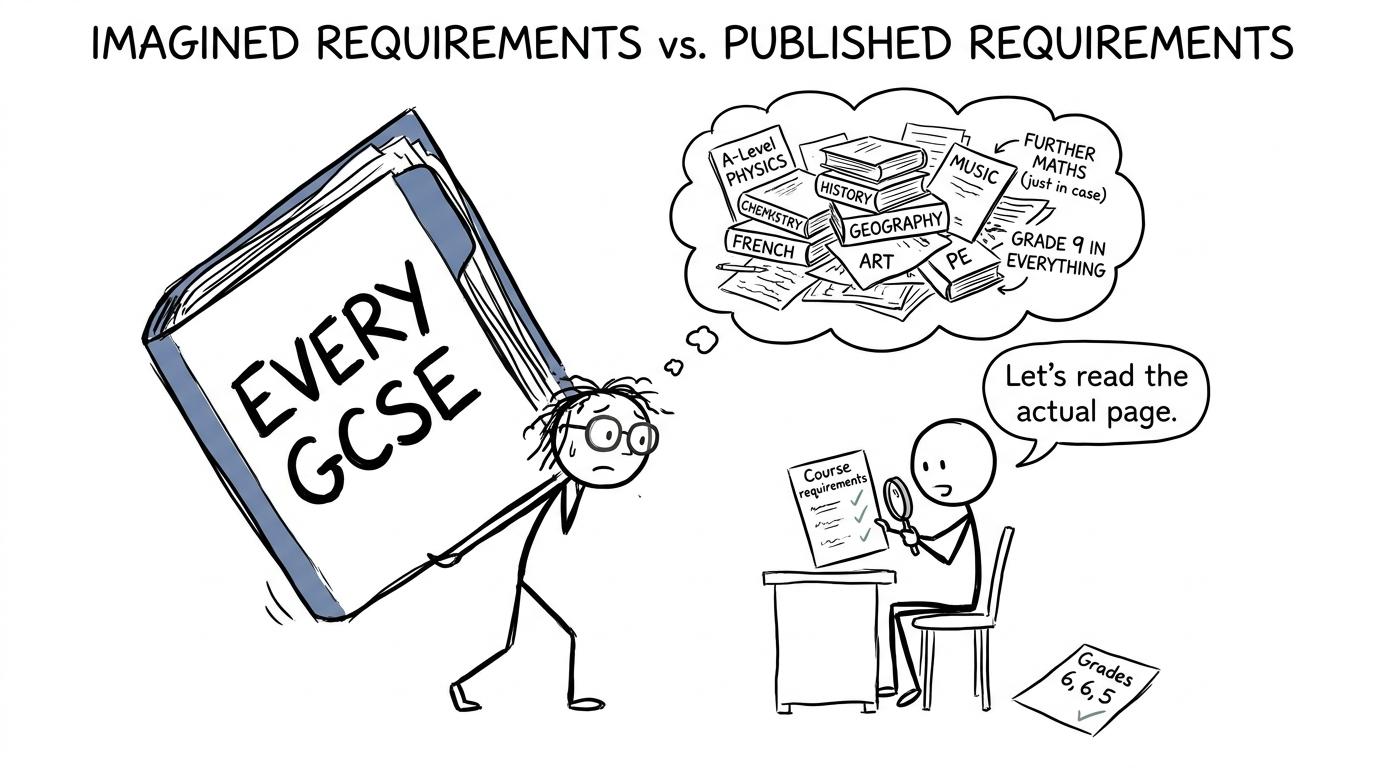 A student discovers that the admissions checklist is smaller than the enormous folder of requirements they imagined
Can universities see your GCSE Geography grade?
Universities normally receive the qualifications declared through your application. UCAS guidance tells applicants to include completed and pending qualifications from secondary education onwards, so an admissions team may see your GCSE Geography result alongside your other GCSEs.
Seeing a grade is not the same as requiring a grade.
For many courses, the admissions decision centres on Level 333 qualifications such as A Levels, alongside any subject requirements and minimum GCSE conditions. Those GCSE conditions are much more likely to name maths or English language than Geography. Requirements vary, though, and selective courses may also assess the strength of an applicant's overall academic record.
This distinction matters. Your Geography result might be visible without being a deciding factor. Admissions teams work from published criteria and their institution's admissions policy, not from a universal rule that every GCSE receives equal weight.
When a GCSE Geography grade might matter
The course explicitly asks for it
This is the clearest case. If the entry requirements name GCSE Geography and give a minimum grade, you need to meet that condition unless the university confirms an accepted alternative.
Such requirements are not typical across university courses, including many geography degrees. Universities commonly place greater emphasis on A Level results and may request Geography, a science or another relevant subject at Level 333. But course rules differ, so the absence of a widespread requirement is not a promise about every course.
Read the detailed entry requirements rather than relying only on a search-result summary. If the wording is unclear, contact the university's admissions team and keep its written response.
The university considers your overall GCSE profile
Some competitive courses consider GCSE performance more broadly. A university might look at the number and pattern of strong grades, or use selected GCSE subjects within an admissions scoring process.
In that situation, Geography can contribute as one part of your academic record even when there is no standalone university GCSE Geography requirement. Its importance depends on the published selection method. One course may focus on specified subjects, while another may consider a wider set of results.
This is particularly relevant when applications are academically similar in other respects. Even then, students should avoid guessing how an undisclosed process works. Look for an admissions policy, selection procedure or course-specific guidance.
Geography affects your next subject choice
The most important effect may be indirect.
A school or college may set its own GCSE entry condition for A Level Geography. If a university course later requires or prefers A Level Geography, your GCSE result could therefore influence the route available to you. The university is not necessarily demanding the GCSE grade; your sixth form's subject-entry policy creates the link.
Check those sixth-form rules early. They belong to the school or college and should not be confused with university admissions requirements.
Your course needs related knowledge or skills
Degrees involving environmental science, planning, geology, earth sciences or geographical data may value relevant preparation. That does not automatically mean GCSE Geography is required. A course may instead accept or prefer A Levels such as Geography, Biology, Chemistry, Physics, Geology or Mathematics.
Geography itself uses data interpretation, percentages, averages, graphs, scale and statistical reasoning. Strengthening these areas through MathsGenie's GCSE revision lessons can support both your maths exams and the quantitative work found in geographical subjects.
Why GCSE maths often receives more attention
If you are deciding where to put your revision time, there is an important practical difference between Geography and maths. Many university courses publish a minimum GCSE maths condition, even when the degree is not called Mathematics. English language is also commonly specified.
There is no single minimum maths grade for every university course. Requirements depend on the institution, subject and year of entry. Some courses may accept a standard pass, while quantitatively demanding degrees can ask for a stronger result or require A Level Mathematics.
That makes maths revision valuable because it protects more possible routes. Start with the GCSE maths revision hub, identify the topics that are costing you marks, and then use focused pages such as probability revision and questions, averages revision and ratio practice.
The goal is not to panic about university at GCSE. It is to avoid closing a door that steady practice could keep open.
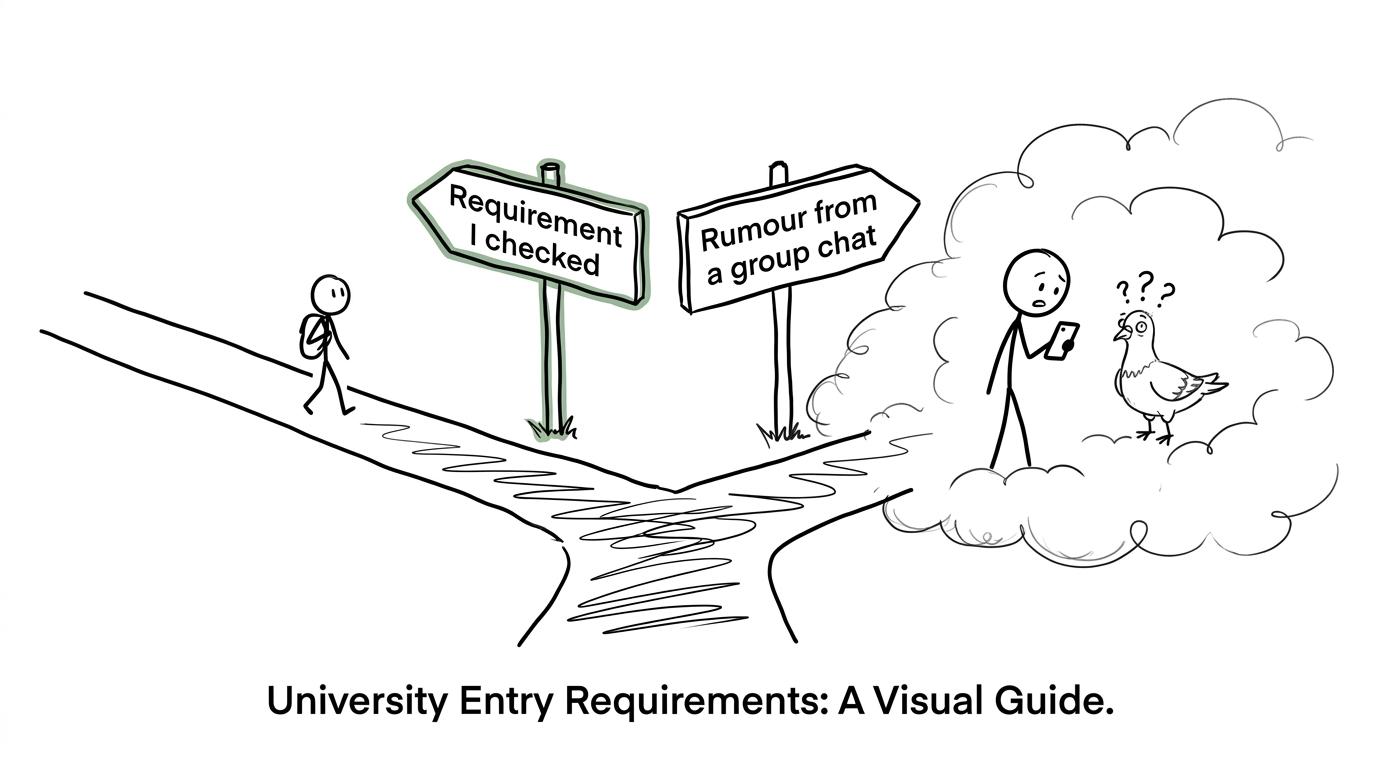 A confused pigeon offers unreliable university advice from inside a fog bank
How to check a university GCSE Geography requirement
Requirements can change between admissions cycles. Check them again when you are choosing post-161616 subjects and when you are ready to apply.
Begin with the exact course page
Search for the named degree at the named university. A Geography BA and Geography BSc at the same institution may have different expectations, while combined courses can introduce further subject conditions.
Confirm that you are viewing the correct:
- course title;
- campus;
- year of entry;
- qualification type;
- home or international requirements;
- standard or foundation-year route.
Read beyond the headline offer
An A Level offer does not always display every condition. Open the full entry-requirements section and look for headings covering GCSEs, required subjects, contextual admissions and alternative qualifications.
Useful wording to notice includes "required", "must include", "preferred", "recommended" and "typical". These terms are not interchangeable. A preferred subject can strengthen preparation without operating as an absolute condition.
Ask the university about ambiguity
Contact admissions if the page does not answer your situation. Give the exact course name, entry year and qualifications you expect to hold. Ask a narrow question, such as whether GCSE Geography is required when you have not taken Geography at A Level.
Do not assume that an answer from one university applies elsewhere. Each institution controls its own admissions decisions.
Build a sensible range of choices
Later, when you compare courses, include options with requirements that match your likely results. Aspirational choices can be worthwhile, but every choice should be based on the published conditions rather than hope that a named requirement will disappear.
The same principle improves exam preparation: use evidence. Complete questions, check the mark scheme and revise the weakness that the result exposes. MathsGenie's GCSE past papers help you practise that cycle under realistic conditions, while predicted maths papers provide further exam-style preparation.
What to do if your Geography grade is lower than expected
First, check whether it creates a genuine problem. A disappointing result and a failed entry condition are not the same thing.
If Geography is not required, concentrate on meeting the qualifications that are. If a course does name the subject, ask its admissions team whether it accepts an alternative qualification, later evidence of geographical ability or a foundation route. Do not presume that an exception will be made, but do not reject yourself before asking.
If you believe the GCSE result may be wrong, speak promptly to your school or college about the official post-results process. Reviews and appeals have rules, deadlines and possible outcomes, so decisions should be based on your exam board's current guidance rather than social-media advice.
Most importantly, keep the grade in proportion. University entry is about satisfying a defined set of conditions. One lower result may narrow a particular route without erasing every route.
Common mistakes when thinking about GCSE requirements
Treating visibility as importance
Universities may see a declared qualification, but that does not mean every grade has a minimum condition or equal influence.
Assuming every university follows the same policy
Course names can look similar while requirements differ. Check every institution separately and repeat the check for your intended entry year.
Confusing GCSE and A Level requirements
A course asking for A Level Geography is not necessarily asking for GCSE Geography. Equally, having GCSE Geography does not replace a required Level 333 subject.
Focusing on Geography while missing maths or English
Applicants sometimes search for the unusual condition and overlook the common one. Read the entire requirements section, including GCSE maths and English language conditions.
Relying on old forum posts
Admissions information from a previous cycle may no longer be accurate. Use the university's current course page and contact admissions where necessary.
Letting a future possibility derail today's revision
You do not need to solve your entire university application during GCSE exam season. Record questions to investigate later, then return to the next useful task: a lesson, a mini test or a paper.
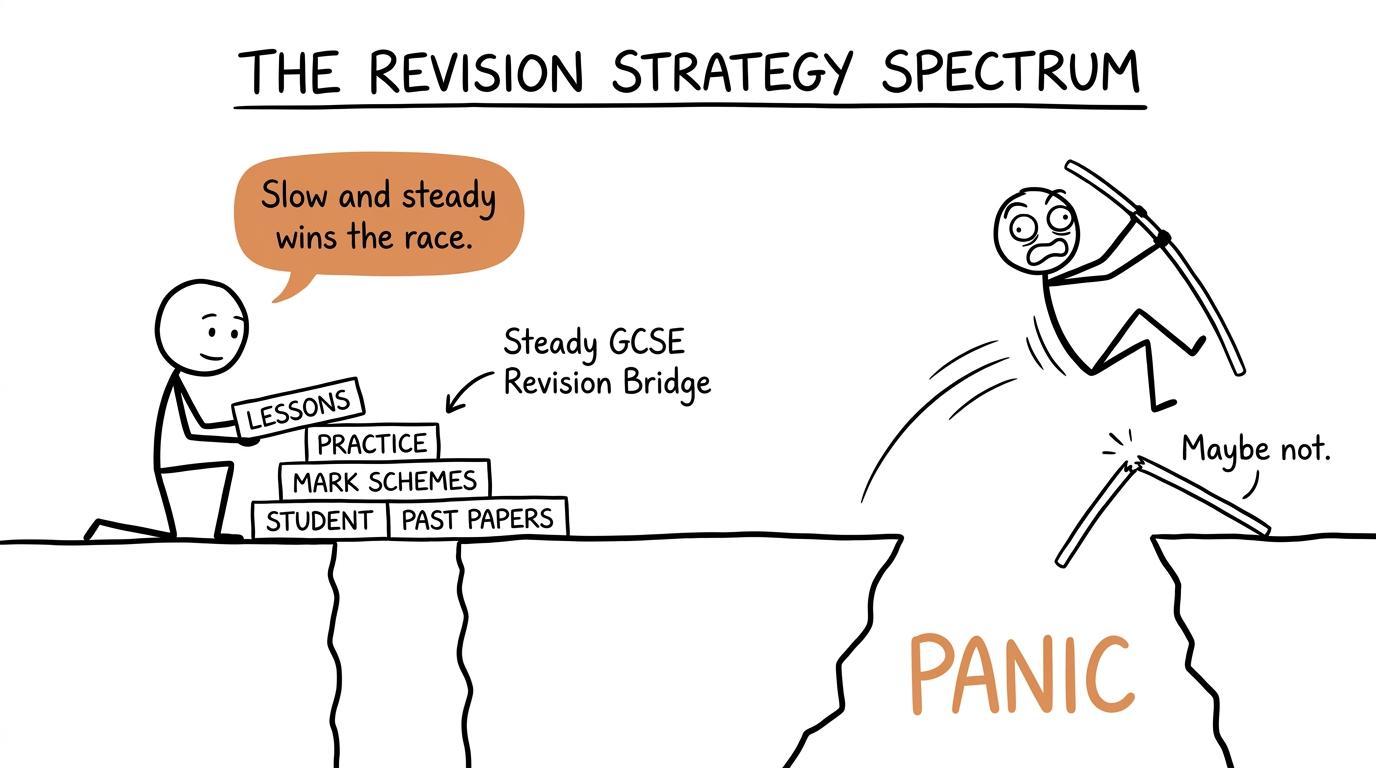 One student builds a revision bridge while another attempts to pole-vault over panic
Keep the grade in perspective and keep your options open
A specific university GCSE Geography requirement is possible, but it is not the normal condition across most degree courses. Your result can still matter as part of your wider GCSE record, through sixth-form subject entry or where a university publishes course-specific selection rules.
The useful response is not endless worry. It is a short sequence: check the exact course, read every condition, ask admissions about anything unclear, and revise the subjects that preserve the widest range of options.
For maths, MathsGenie turns that intention into something practical. Use the free revision lessons and practice questions to repair individual topics, then move to past papers, mark schemes, video solutions and predicted papers. If you later progress to A Level Mathematics, the A Level maths revision hub gives you the same clear route forward.
University decisions may feel distant. The next revision session is not. Start there.