

University GCSE Engineering Requirement: Does It Matter?
University GCSE engineering requirement explained: learn when your grade matters, what admissions teams check, and how to plan your maths revision.
A single GCSE grade can feel as though it follows you forever. You imagine an admissions tutor opening your university application years later, ignoring everything else and circling the result you wish had been higher.
The short answer to the university GCSE engineering requirement question is reassuring: universities may see your GCSE Engineering grade because applicants normally declare their completed qualifications, but most engineering degrees do not specify GCSE Engineering as an entry requirement. GCSE Maths and English are much more commonly checked, while A Level Maths and sometimes Physics or another relevant subject often carry greater weight for engineering degrees.
There are exceptions. Your grade could matter if a course names Engineering or a related technical qualification, if your wider GCSE profile is considered, or if you are applying through a foundation year or an alternative qualification route. The only definitive answer comes from the current course page and admissions team for the university you are considering.
The quick admissions checklist
Before worrying about one grade, establish what the course actually asks for:
- Check the university's current entry requirements for the precise course and year of entry.
- Separate compulsory GCSE requirements from preferred subjects.
- Check whether the page refers specifically to GCSE Engineering or more broadly to science and technical qualifications.
- Look at the required A Level subjects, especially Maths and Physics.
- Confirm whether contextual offers, foundation years or alternative qualifications have different rules.
- Use the exact title of your qualification when asking an admissions team for guidance.
- Keep working towards the strongest GCSE Maths grade you can achieve.
This distinction matters because an admissions requirement is not the same as a qualification that merely appears on your application.
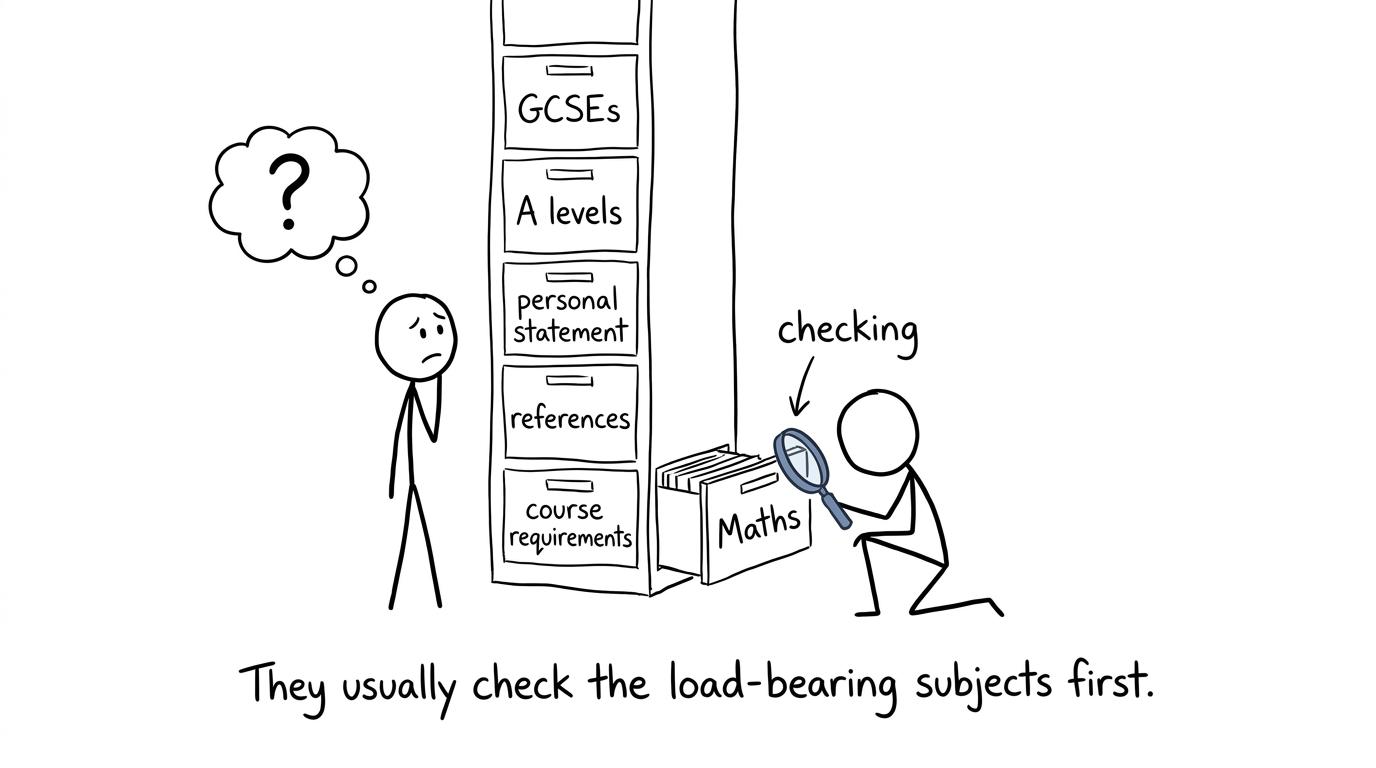 A student discovers that admissions teams check the load-bearing subjects first
Will universities see your GCSE Engineering grade?
Usually, yes. UCAS applicants are expected to provide an accurate education history and declare completed and pending qualifications. If GCSE Engineering is one of your qualifications, its title and result would ordinarily form part of that record.
Seeing a grade, however, does not mean treating it as a decisive requirement. Admissions teams evaluate applications against their published criteria. A university can see GCSE Geography without requiring it for mechanical engineering; the same principle can apply to GCSE Engineering.
A grade may still contribute to the overall academic picture. This is more likely where a university considers the breadth and strength of GCSE results, where competition is high, or where applicants with similar predicted A Level grades need to be assessed using additional evidence. Universities set their own policies, so there is no single rule covering every institution and course.
It is also important to name the qualification correctly. A GCSE in Engineering, a BTEC technical qualification and an OCR Cambridge National in Engineering Design are not interchangeable labels. They may be at a similar stage of education, but universities can treat their content and grading structures differently.
When a GCSE Engineering grade actually matters
The course explicitly includes it
The clearest case is the simplest: the published entry criteria name GCSE Engineering or accept it within a specified group of technical subjects. If that happens, the required grade should be treated as seriously as any other formal condition.
This is not the usual pattern for mainstream engineering degrees. Nevertheless, requirements change and can differ between courses at the same university. Civil engineering, electronic engineering, general engineering and engineering foundation years may not share identical criteria.
You are following an alternative route
Students do not all arrive at university with the same combination of GCSEs and A Levels. Some apply with vocational or technical qualifications, mixed programmes, access courses or an engineering foundation year in mind.
In these cases, previous technical experience may be more relevant. A university might examine the units studied, the qualification level and your mathematical preparation rather than relying on the word “Engineering” in the title. Contact admissions if the equivalence is unclear rather than assuming that a technical qualification automatically satisfies a subject requirement.
Your broader GCSE profile is assessed
Some courses publish minimum GCSE expectations alongside their Level 333 requirements. The important phrase is usually “minimum”: meeting it may make an application eligible, but it does not guarantee an offer.
An Engineering grade can sit within this wider profile. A strong result may support evidence of technical interest, while a weaker result may attract less attention if you later demonstrate substantial improvement in Maths, Physics and other relevant subjects. Universities generally care about whether you are prepared for the course, not whether every result in your record is perfect.
It helps explain your subject interest
Engineering involves designing, testing, modelling and improving systems. A school Engineering course can therefore help you understand whether you enjoy that kind of thinking.
That experience can inform an application, but interest is not the same as an entry condition. Universities may place more emphasis on the evidence behind your interest: what you learnt, how you responded to difficulty and whether you understand the degree you have chosen. Avoid treating the qualification title itself as a substitute for the required grades and subjects.
What engineering degrees are more likely to require
For many engineering courses, the mathematical foundation matters more than a GCSE carrying the name Engineering. Degree-level work can involve algebra, functions, trigonometry, vectors, mechanics, calculus, statistics and numerical modelling.
Universities commonly publish requirements involving some combination of:
- GCSE Maths, often at a stated minimum grade;
- GCSE English Language;
- A Level Maths;
- A Level Physics, Further Maths, Chemistry or another named subject for certain courses;
- an overall A Level, vocational or equivalent offer;
- additional conditions for applicants taking mixed or international qualifications.
These are patterns, not universal rules. A course may accept A Level Maths without Physics, while another may expect both. Foundation years can have different subject expectations because they are designed to build preparation before the main degree.
A GCSE Engineering grade does not normally replace a required Maths qualification. If a course asks for GCSE Maths at grade 666, for instance, a higher result in Engineering would not usually compensate unless the university explicitly says it will.
This is why your current maths revision has long-term value. The skills being tested are not merely hurdles at the school gate. They become tools used later.
Why GCSE Maths deserves your attention now
A distant university decision is difficult to control. Today's revision session is not.
Start by identifying gaps through the free GCSE Maths revision topics on MathsGenie. Each topic brings together revision support, practice questions and video explanations, allowing you to move from recognising a method to using it independently.
Your exam board matters when you move on to full papers. MathsGenie provides Edexcel GCSE Maths past papers, AQA GCSE Maths past papers and OCR GCSE Maths past papers. Students taking Eduqas should use the correct official specification and papers for their board rather than assuming every paper has the same structure.
Past papers are most useful after you analyse them. Mark the paper carefully, record which topics cost you marks, return to those revision lessons and then try fresh questions. A paper completed and forgotten measures performance once. A paper reviewed properly changes what happens next.
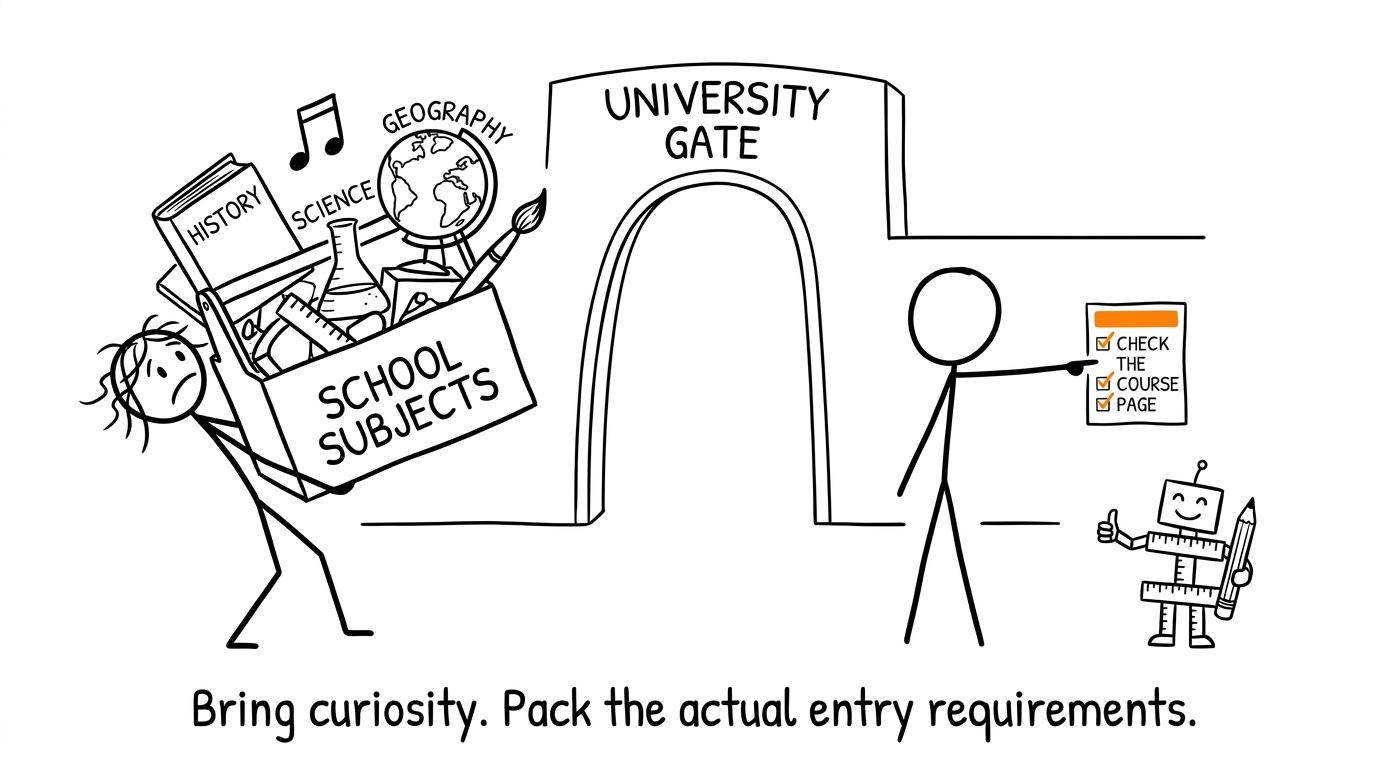 A student carries every subject while a friend points towards the actual course requirements
How to research a university requirement properly
Admissions pages can feel dense because they have to cover many qualifications. Read them in layers.
First, select the exact course. A university's general admissions page cannot tell you every subject condition for a particular engineering degree. Next, choose the correct year of entry, as requirements can change between application cycles. Then check the sections for GCSEs, A Levels and alternative qualifications separately.
Pay attention to words such as “required”, “preferred”, “recommended” and “considered”. They do not mean the same thing. A required grade is a formal threshold. A preferred subject may strengthen preparation without being compulsory. A qualification that is considered may be accepted only in a particular combination.
If the answer remains unclear, contact the university's undergraduate admissions team. Give them:
- the full course title;
- your intended year of entry;
- the awarding organisation and exact qualification title;
- your achieved or predicted grade;
- the other qualifications you are taking.
A precise question is easier to answer accurately than “Does my Engineering GCSE count?” Save the reply so that you can refer to it when planning your choices.
If your Engineering grade is lower than you hoped
One disappointing result can feel enormous because it is visible and permanent. But applications contain more than one piece of evidence.
Begin by checking whether the grade creates an actual eligibility problem. If the course does not specify GCSE Engineering and you satisfy its required GCSE and Level 333 conditions, the result may have limited practical significance. Do not turn an imagined barrier into a real distraction.
If the qualification is required, ask the university what routes are available. Depending on the institution and course, possibilities may include a different degree, a foundation year or meeting the requirement through another accepted qualification. Never assume that a resit or substitute will be accepted without written confirmation.
Then focus on progression. Improving in GCSE Maths, making thoughtful A Level choices and developing strong revision habits all provide more useful evidence than repeatedly worrying about a result you cannot change.
Students considering A Level Maths can explore the free A Level Maths revision resources to see how GCSE algebra, graphs and trigonometry develop later. This is not a reason to race ahead. It is a reminder that today's foundations matter.
Common mistakes when thinking about GCSE requirements
Confusing visibility with importance
A qualification appearing on your application does not automatically make it an entry requirement. Check what the university says it uses.
Assuming every engineering course has the same rules
Requirements vary by institution, specialism and year. Advice about one course cannot safely be applied to all engineering degrees.
Treating GCSE Engineering as a replacement for Maths
Technical experience can be valuable, but it does not normally override a stated GCSE or A Level Maths condition.
Using an informal qualification name
“Engineering GCSE” may refer to different qualifications in conversation. Admissions teams need the awarding organisation, level and complete title.
Reading old entry requirements
Search results and cached pages can show information from an earlier admissions cycle. Always return to the live course page and select your intended year of entry.
Letting one grade derail current revision
Worry often feels productive because it keeps the problem in view. It is not the same as action. Use MathsGenie's predicted papers, practice questions and mark schemes to turn concern about future entry requirements into stronger preparation now.
 A revision planner refuses entry to rumours, panic and one bad mark
Build the qualifications that keep doors open
Universities can look back at GCSE results, including Engineering, but they do so in context. For most engineering degrees, GCSE Engineering is less likely to be a formal requirement than Maths, English and the relevant Level 333 subjects. It matters most when a course names it, when you are applying through a technical route, or when your wider academic profile forms part of the selection process.
The useful response is not to predict what every admissions tutor might think. It is to check the exact requirements, ask when something is unclear and strengthen the subjects that engineering courses consistently depend upon.
MathsGenie gives you a free place to do that. Begin with the MathsGenie revision library, work through targeted lessons and mini tests, practise exam questions, and use past papers, predicted papers, mark schemes and video solutions to review your progress. The future is uncertain by nature. A well-planned revision session is much simpler, and it is something you can start today.










