UCAS Clearing Explained: A-Level Results Day
UCAS Clearing explained clearly: prepare for A-Level results day, call universities confidently, compare offers and add the right course in UCAS Hub.
A-Level results day can change shape in a few seconds. You open your results expecting one route and discover that your university place has not been confirmed. The temptation is to treat that moment as a verdict. It is not. It is a decision point.
Here is UCAS Clearing explained simply: Clearing helps applicants without a confirmed place find university courses that still have vacancies. On Clearing A-Level results day, you check your status, research available courses, contact universities yourself, receive informal offers and add one agreed choice to your UCAS application.
For current A-Level students, this guide is a practical walkthrough. For GCSE students looking ahead, it explains what happens after sixth form and why calm preparation matters as much as any individual result.
Your Clearing checklist
Before looking at each step, keep this short list nearby:
- Collect your official results from your school or college.
- Check your application status in UCAS Hub.
- Find your UCAS Personal ID and Clearing number, if one is shown.
- Ask your school or college adviser for help if your status is unclear.
- Search the official UCAS course vacancy list.
- Compare the course, university, location, costs and accommodation.
- Telephone universities with your results in front of you.
- Record every offer and its deadline.
- Add only the course you have chosen and have permission to add.
- Wait for the university to confirm the place in UCAS Hub.
In 2026, A-Level, AS and T Level results are released on Thursday 13 August. UCAS Clearing runs from 2 July to 19 October for applicants seeking entry that year, although individual courses can fill earlier.
What UCAS Clearing actually means
Clearing is the part of the UCAS application system that connects applicants who do not hold a university place with courses that still have spaces. It is not a separate type of degree, and a place obtained through Clearing is not labelled differently once you begin university.
You may be able to use Clearing if:
- neither your firm nor insurance choice confirms your place;
- you applied after the main UCAS deadline and do not hold an offer;
- you did not receive any offers;
- you have your results but have not yet submitted a UCAS application; or
- you choose to decline a confirmed place and enter Clearing.
That final decision needs particular care. Declining a confirmed place is not a way to browse without risk. Speak to your school, college and prospective university before releasing a place you already hold.
Your status in UCAS Hub tells you whether Clearing is available. Your grades themselves normally come from your school or college, so have both sources open rather than expecting Hub to provide every detail.
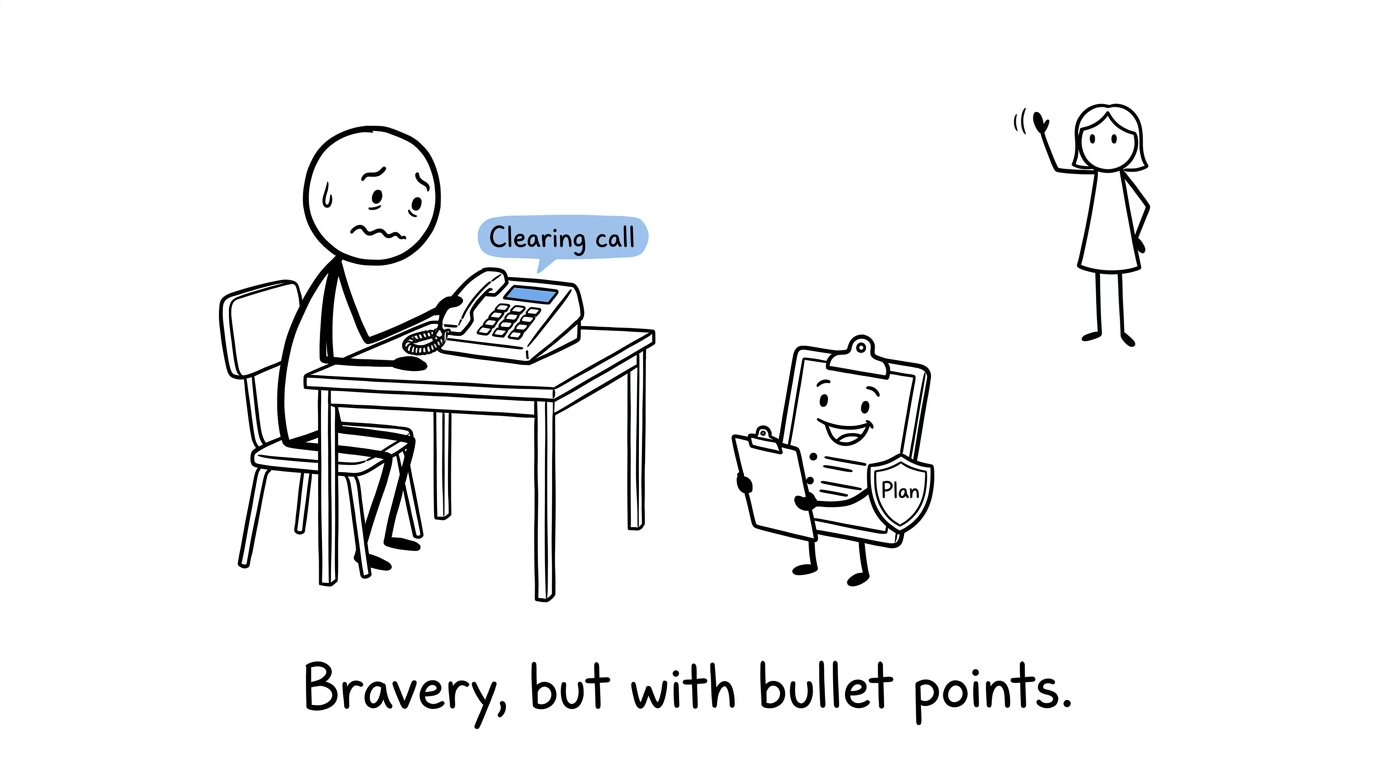 A student facing a Clearing telephone with a checklist for protection
Clearing A-Level results day: step by step
Collect your results and check UCAS Hub
Begin with facts, not assumptions. Collect your full results and sign in to UCAS Hub. You may find that your place has been confirmed even if you narrowly missed the published conditions, because universities make their own final admissions decisions.
If your firm choice has not accepted you, UCAS will consider your insurance choice where applicable. If neither place is confirmed and you are eligible, your application should indicate that you are in Clearing and provide a Clearing number.
If the decision is still pending, contact the university rather than immediately searching for a replacement. A pending decision is not the same as a rejection.
Speak to your school or college
An adviser can help you interpret an unfamiliar status, discuss alternative subjects and check whether there is a sensible reason to request a review of marking. Do not wait indefinitely for a possible review before investigating Clearing, however. A review can change a grade, but it does not guarantee that a university will hold a place.
This is similar to using a mark scheme after an exam: first establish exactly what happened, then decide what action follows. MathsGenie students can check published GCSE, IGCSE and A-Level grade boundaries, but remember that boundaries explain how marks became grades; they do not decide whether a university accepts you.
Search for suitable vacancies
Use the official UCAS search service for the current vacancy list. Courses can appear or disappear as universities update availability, so verify the details directly with each institution.
Do not search only for the name of your original course. Consider related degrees, foundation years and different locations, but check what you would actually study. Read the modules, assessment methods, professional accreditation information and entry requirements.
Create a shortlist with three categories:
- courses you would be pleased to accept;
- courses you need to investigate further;
- courses that are available but do not suit your goals.
Availability is a filter, not a reason to spend several years somewhere.
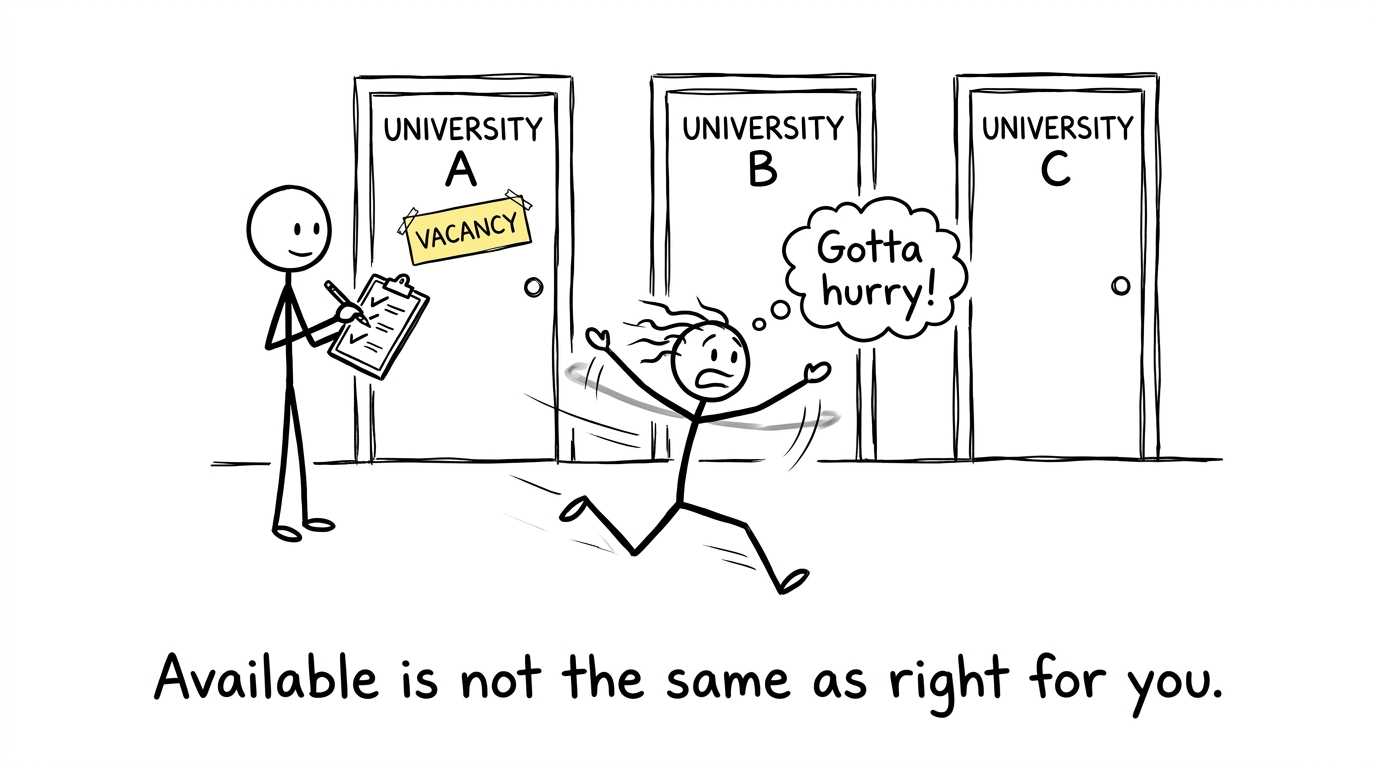 A calm student compares university doors while another rushes towards the first vacancy
Prepare before telephoning
Universities normally want to speak to the applicant. A parent, carer or teacher can sit with you, take notes and offer support, but you should make the call unless accessibility needs require another arrangement.
Have the following ready:
- your UCAS Personal ID and Clearing number;
- your complete qualifications and grades;
- the exact course title and course code;
- your personal statement;
- a short explanation of why the course interests you;
- questions about modules, accommodation and next steps;
- a working email address and telephone number;
- paper or a document for recording names, deadlines and decisions.
Preparation does not make the conversation artificial. It makes it useful.
Use a clear phone-call script
You do not need a speech. You need an opening that gives the admissions adviser the information required to help you.
Try this structure:
Hello, my name is [name]. I am calling about Clearing for [course title and code]. My UCAS Personal ID is [ID], and my Clearing number is [number]. I achieved [grades] in [subjects]. Could you tell me whether I may be considered for this course?
If the adviser asks why you want the course, answer specifically:
I am interested in [area of the subject], particularly because [brief academic or career reason]. I have looked at the course modules and would like to know more about [relevant module or feature].
Before ending the call, ask:
- Is this an informal offer or a confirmed decision?
- What conditions, if any, still apply?
- When does the offer expire?
- Which institution and course codes should I enter?
- Will the offer be sent in writing?
- What accommodation is currently available?
- Who should I contact if my UCAS status does not update?
Be accurate about your grades. Admissions teams can inspect your application, and an honest conversation gives them the best chance to identify a suitable route.
Compare informal offers before choosing
You can contact several universities and may receive more than one informal offer. That gives you room to compare, provided you respect each university's stated deadline.
Look beyond the entry requirements. Consider:
- whether the course content fits your interests;
- travel distance and living costs;
- accommodation availability;
- placement, year-abroad or foundation-year arrangements;
- how the course is taught and assessed;
- whether any professional recognition matters for your intended career.
A university being quick to answer does not automatically make it the right choice.
Add your Clearing choice in UCAS Hub
Only add a Clearing choice after the university has given you permission. Enter the institution and course details exactly as supplied and do so within its deadline.
Adding a choice counts as accepting that offer. You can add only one Clearing choice at a time, so do not enter the first informal offer merely to reserve it while you continue deciding. If the university does not confirm the choice, UCAS can then allow you to add another.
Once the institution confirms your place, check the next instructions carefully. You can then address accommodation, student finance and enrolment.
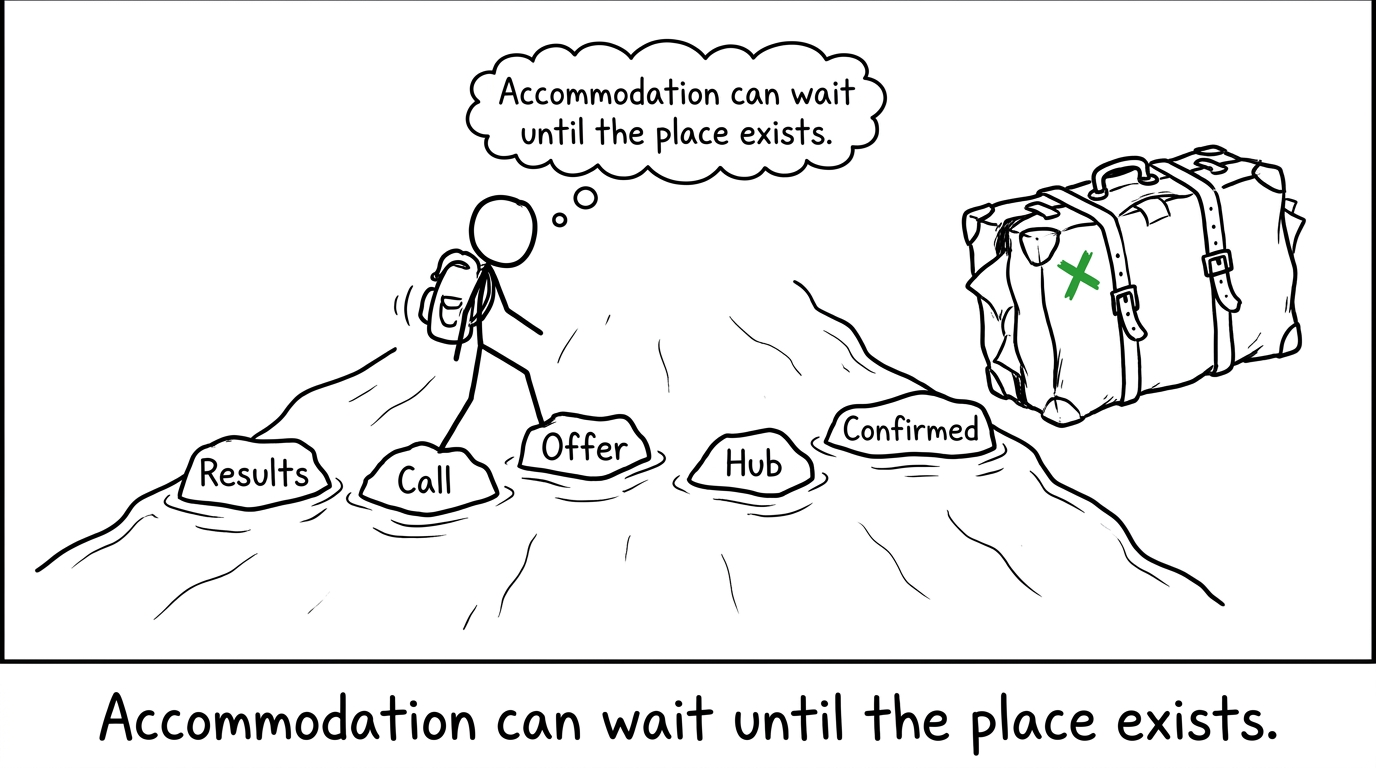 A student crosses results-day stepping stones before reaching a waiting suitcase
What to do if there is no immediate offer
A difficult morning does not require a rushed decision. Course availability can change, and universities may suggest a related degree or foundation year. Keep searching, return missed calls and check your email, including the junk folder.
You can also consider applying for the following year, taking a planned gap year, resitting qualifications or choosing another education or training route. Clearing is an opportunity, not an obligation. A later, deliberate application may be better than accepting a course you do not want.
GCSE students can reduce future uncertainty by building strong foundations now. Start with the GCSE Maths Revision hub, organise weekly work using the MathsGenie revision planner, and use Edexcel GCSE Maths past papers or the equivalent page for your exam board.
Common Clearing mistakes
Panicking before checking your status
Missing an expected grade does not prove that your place has been rejected. Read UCAS Hub and contact the institution if its decision is pending.
Calling without course details
Saying that you want “any business course” gives the adviser little to work with. Know the exact title and code, and be ready to explain why it fits you.
Letting somebody else lead the call
Support is helpful, but admissions staff usually need to hear from you. Practise your opening aloud before results day if telephone calls make you anxious.
Adding a choice too soon
An informal offer gives you something to consider. Adding the course in UCAS Hub is the formal acceptance step. Compare realistic options first.
Ignoring accommodation and course content
A vacant place can still be unsuitable. Ask what you will study, where you will live and what deadlines follow the offer.
Treating one result as your whole record
Admissions staff may consider subjects, grades, the course and your wider application. Give complete information rather than apologising repeatedly for one disappointing result.
Prepare for the decision before it arrives
Results day feels dramatic because many decisions are compressed into a short period. The antidote is not prediction. It is preparation.
Use the MathsGenie maths revision blog as your results-day timeline and planning hub. Before the exams, build confidence through A-Level Maths revision, Edexcel A-Level past papers and A-Level predicted papers.
MathsGenie brings revision lessons, practice questions, mini tests, mark schemes, video solutions, past papers and predicted papers together for free. Start with one topic, test it under exam conditions and learn from every dropped mark. Results day may contain uncertainty, but the work leading to it does not have to.