Typing Answers Under Timer: GCSE Religious Studies
Typing answers under timer GCSE Religious Studies: learn whether timed keyboard practice improves speed, structure and exam-ready written responses.
The clock is often the hardest part of a written exam. You may know the beliefs, quotations and arguments, yet still reach the final question with too much to say and too little time. That is why typing answers under timer GCSE Religious Studies practice can look so appealing: typing feels faster, editing is easier and the finished response looks organised.
The short answer is that timed typing can improve your planning speed, answer structure and awareness of time. However, if you will handwrite the real examination, typing alone will not adequately train handwriting pace, physical stamina or page-based editing. The strongest method is to use typing for focused practice, then transfer the same skills to handwritten exam conditions.
The quick verdict
Use this checklist before making timed typing part of your revision:
- Typing can help you retrieve ideas quickly and practise completing answers within a limit.
- It can improve structure when you review paragraph order, relevance and balance afterwards.
- It does not automatically improve marks. More words are useful only when they answer the question.
- It is most realistic if a word processor is your approved, normal way of working in school.
- If you will handwrite, complete regular handwritten practices too.
- Always mark the response against your exam board's mark scheme or teacher guidance.
- Track quality as well as speed, including relevance, developed reasoning and use of evidence.
The principle transfers directly to maths. Timed work is useful only when it resembles the performance required in the real paper. MathsGenie's GCSE maths revision hub follows that same progression: learn a skill, practise it, check the solution and then test it under pressure.
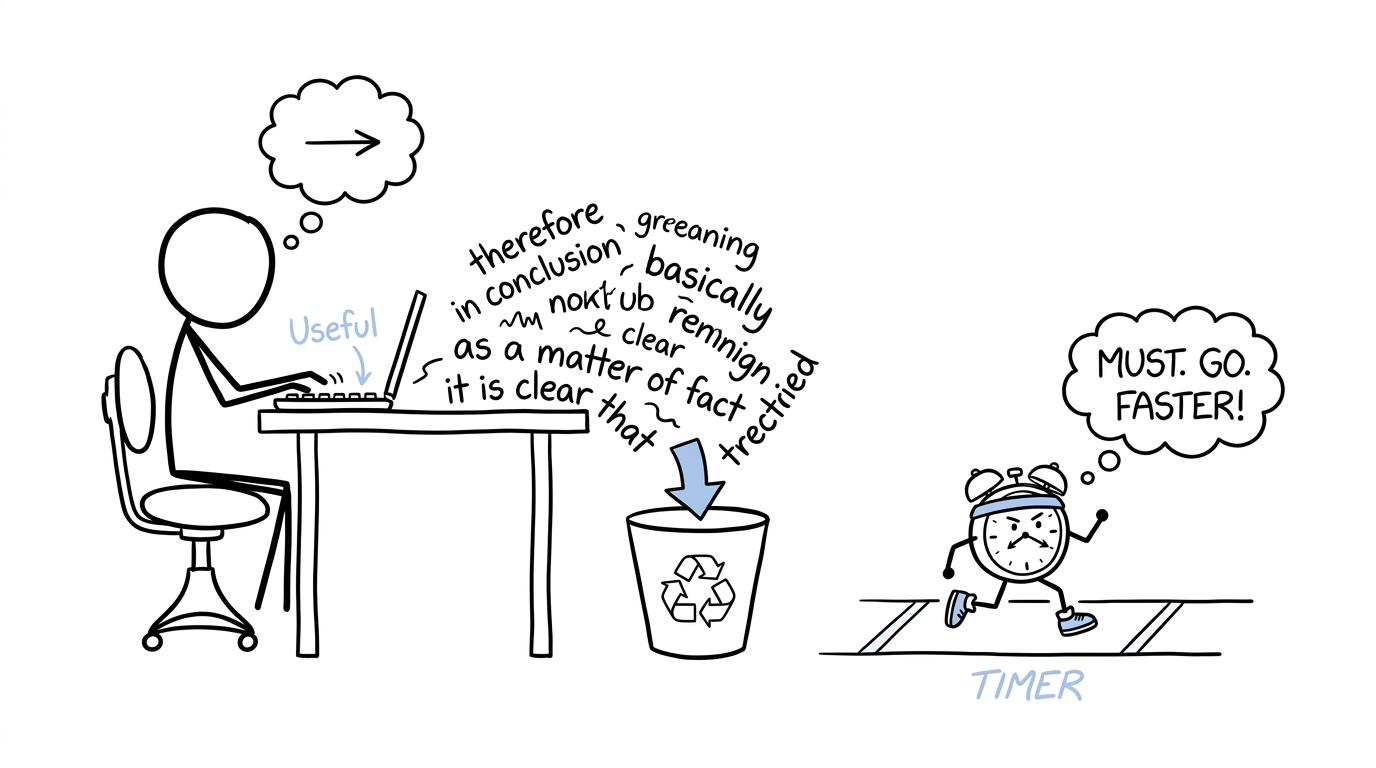 A student calmly types while racing an energetic alarm clock
What timed typing actually trains
A timed Religious Studies response involves several different forms of speed. Treating them as one skill can hide the real problem.
Retrieval speed
You must recall relevant beliefs, teachings, sources of authority and contrasting viewpoints. Typing can reveal whether that knowledge is available quickly enough. If you spend most of the timer staring at an empty screen, the problem is probably retrieval rather than keyboard speed.
Decision-making speed
Extended answers require choices. Which arguments deserve development? Which evidence directly supports the point? Where should evaluation appear? Timed practice forces you to make these decisions instead of waiting for a perfect opening sentence.
Composition speed
This is the ability to turn ideas into precise sentences and connected paragraphs. Typing may reduce the physical effort of getting those sentences onto the page, particularly for a confident keyboard user. Research on typed and handwritten examination responses is mixed, however. Reviews have found that the mode often makes little meaningful difference to scores, while familiarity with the chosen method can matter.
Physical writing speed
Typing does not reproduce the movement, fatigue or legibility demands of handwriting. If you type every practice response but handwrite the examination, you may improve your thinking without improving the final stage of delivery.
That distinction matters in maths too. Watching a solution can improve recognition, but only completing questions yourself builds performance. Edexcel GCSE Maths Mini Tests provide short, timed opportunities to practise that final stage.
Does typing improve GCSE Religious Studies speed?
It can, but the improvement is usually more specific than students expect.
Timed typing is likely to improve your ability to:
- start promptly rather than overthink the introduction;
- organise points into a logical sequence;
- notice when one paragraph is consuming too much time;
- produce a complete response before the limit;
- review and remove repetition;
- compare attempts using word count, completion and quality.
It is less likely to improve:
- handwritten fluency;
- handwriting legibility under pressure;
- the physical stamina needed for a long written paper;
- your knowledge of the specification;
- your understanding of command words;
- judgement about what earns marks, unless you mark the work afterwards.
Typing faster is not the same as answering better. Some examination research suggests that students can produce more words when typing, but longer responses do not automatically receive higher marks. A concise paragraph with a clear claim, accurate evidence and developed explanation is more valuable than a page that circles the question.
Match practice to your real examination method
For most students, the decisive question is simple: how will you complete the actual exam?
Under current JCQ guidance, a school may provide a word processor where it reflects the candidate's normal way of working within the centre. Spellcheck, grammar checking and predictive text are normally switched off. A word processor cannot simply be granted because a student prefers typing, types faster at home or wants to change method shortly before the exam.
Speak to your teacher, SENCo or exams officer if you are uncertain. Do not assume that typing practice means you will be allowed to type in the examination.
If you will type the exam
Timed keyboard practice is highly relevant. Practise using an uncluttered document without automated corrections, internet access or distracting tools. Learn to plan briefly, type paragraphs in order and leave enough time to check that every part of the question has been addressed.
Use the equipment and arrangements provided by your centre whenever possible. Familiarity reduces the number of decisions competing for your attention.
If you will handwrite the exam
Use typing selectively. It is excellent for quick retrieval drills, paragraph planning and testing alternative structures. Your longer timed responses should increasingly be handwritten as the examination approaches.
A useful balance is to type early attempts while learning how to structure an answer, then handwrite later attempts under full conditions. The keyboard helps you build the thinking. The pen proves that the thinking survives the real format.
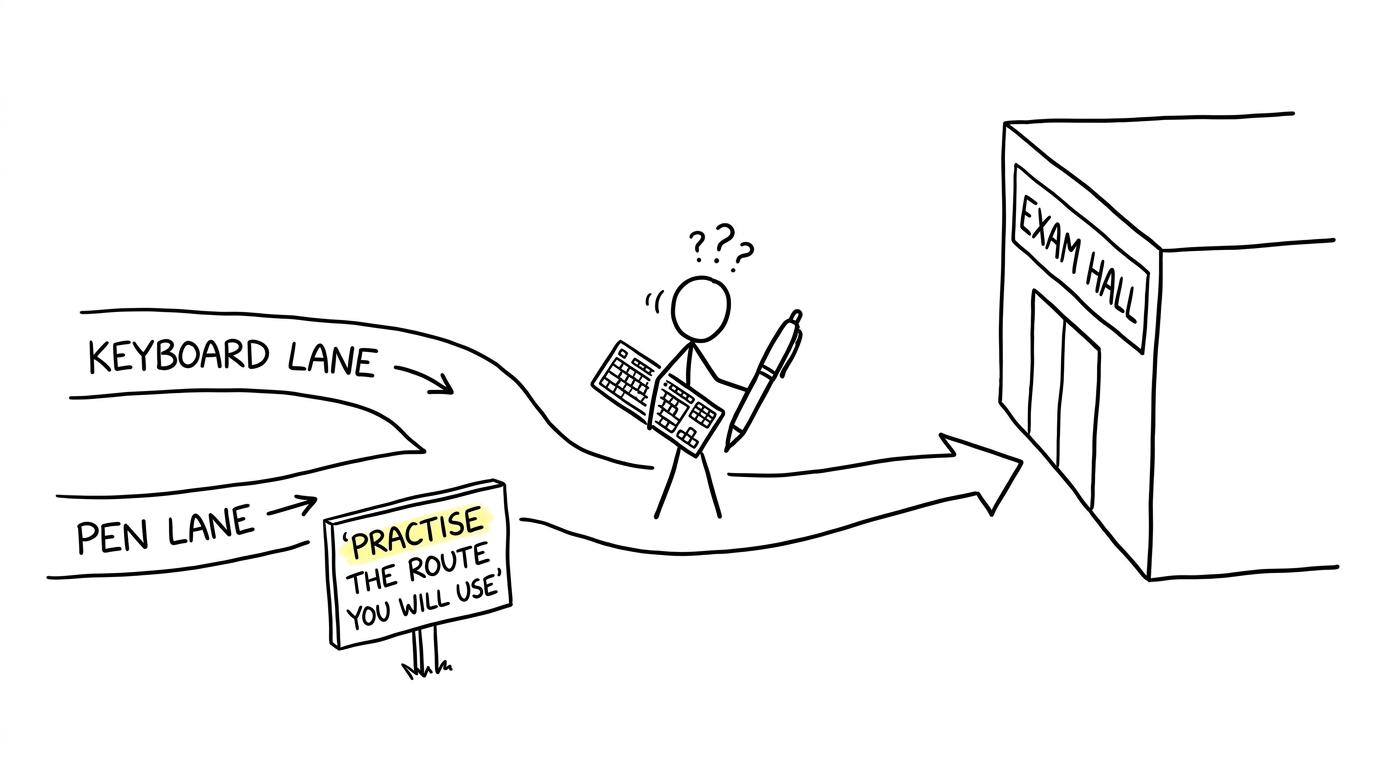 A student chooses between keyboard and pen lanes leading to an exam hall
A practical timed-answer routine
The aim is not to type as much as possible. It is to produce a complete, relevant answer and learn from the result.
Choose the right question
Use a question that matches your exam board and current specification. AQA, Edexcel, OCR and Eduqas do not necessarily use identical question structures, mark totals or assessment language. Religious Studies is not divided into foundation and higher tiers, so use the exact paper and course your school teaches.
Set a deliberate time limit
Base the limit on your teacher's advice, the mark allocation and the demands of your paper. Do not assume that every mark deserves exactly the same amount of writing.
You can calculate your average available time per mark as a starting reference:
average minutes per mark=working time in minutestotal marks\text{average minutes per mark}=\frac{\text{working time in minutes}}{\text{total marks}}average minutes per mark=total marksworking time in minutesThis is only a planning guide. Reading, selecting questions and checking also consume time, while extended evaluation needs a different approach from short recall.
Use a short plan
Before writing, note the position you will take, the main reasons, relevant evidence and any contrasting view. Keep the plan brief enough that it protects writing time rather than replacing it.
Write without artificial help
Turn off spelling suggestions, predictive text and grammar correction if you are trying to imitate word-processor exam conditions. Put your phone away and stop when the timer finishes. Honest conditions produce useful evidence.
Review in two passes
First, assess content: Did you answer the exact question? Are beliefs and teachings accurate? Are reasons explained rather than merely listed? Is the conclusion supported?
Second, assess performance: Where did time disappear? Did you repeat an argument? Did the final paragraph become rushed? Use the relevant mark scheme and teacher feedback rather than judging the response by length.
This is the same feedback loop used in effective maths revision. MathsGenie's guide to finding your weakest GCSE topics shows how evidence from timed work can become a focused next step.
Measure improvement without chasing word count
Record a small set of useful indicators after each attempt:
| Measure | What it tells you |
|---|---|
| Completion | Whether you reached every necessary part of the response |
| Relevance | Whether each paragraph answered the wording set |
| Development | Whether reasons and evidence were explained fully |
| Structure | Whether the argument progressed logically |
| Time control | Whether one section consumed a disproportionate share |
| Transfer | Whether the same quality appears when handwriting |
You can also record a simple completion rate:
completion rate=completed required sectionstotal required sections×100%\text{completion rate}=\frac{\text{completed required sections}}{\text{total required sections}}\times 100\%completion rate=total required sectionscompleted required sections×100%Do not let this become a substitute for marking. A fully completed weak response is still weak; an unfinished response can reveal strong knowledge but poor pacing. You need both quality and completion.
For maths, the equivalent evidence comes from a marked paper. Students can use Edexcel GCSE Maths past papers, AQA GCSE Maths past papers or the OCR GCSE Maths revision hub to test whether methods remain accurate under a timer.
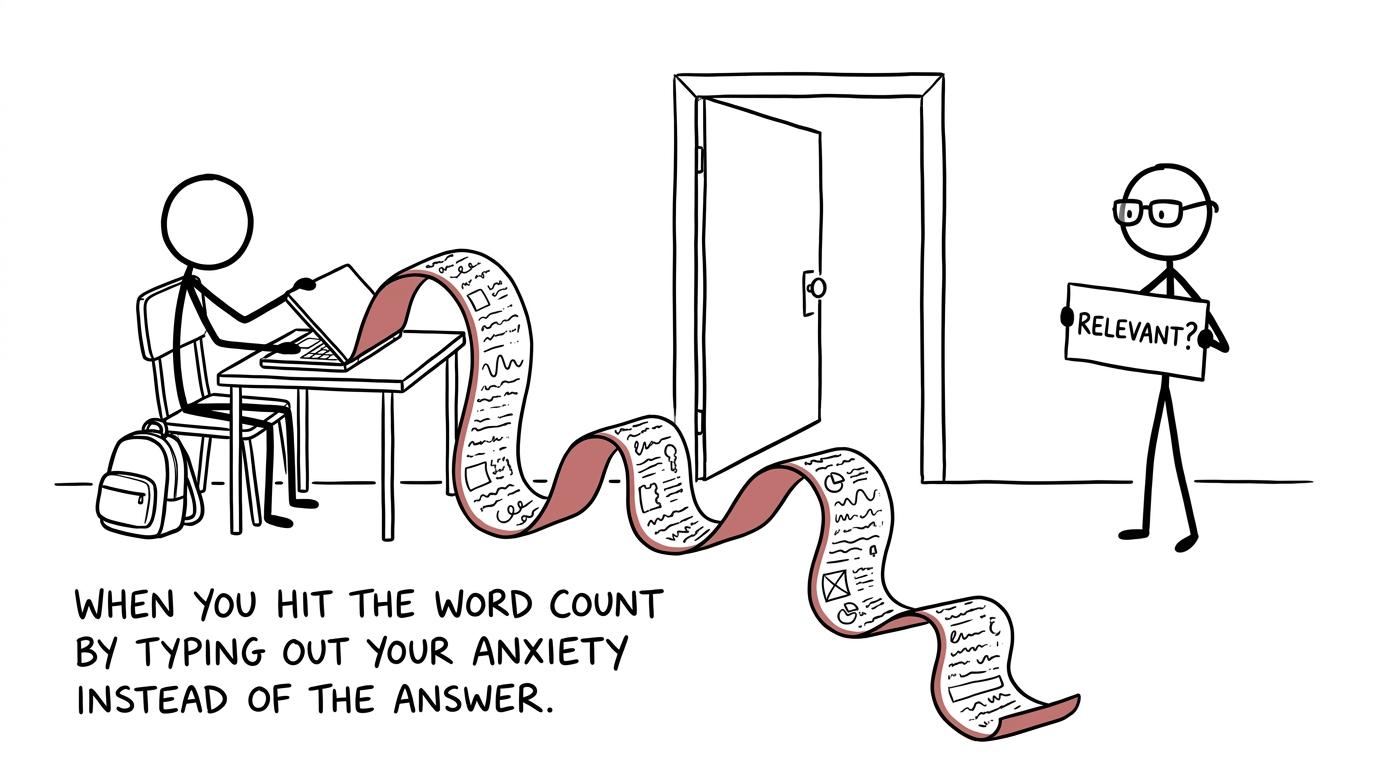 An examiner questions an absurdly long typed essay scroll
Common mistakes with timed typed practice
Treating speed as the only goal
A fast answer that misunderstands the command word is not progress. Track whether the response is accurate, developed and relevant.
Practising in an unrealistic setup
Typing with internet access, automated corrections, saved notes or unlimited editing does not reproduce exam conditions. Remove assistance during timed attempts.
Never handwriting a full response
If the real examination is handwritten, this creates false confidence. Transfer your improved structure to paper and check whether your pace, legibility and stamina hold up.
Using questions from the wrong board
An extended question that is suitable for one specification may not reflect another board's structure. Check your course with your teacher and use board-specific materials.
Failing to mark the answer
Completion feels satisfying, which makes it tempting to start another question immediately. Feedback is where improvement happens. Compare the response with assessment guidance, annotate weaknesses and rewrite only the parts that need correction.
Writing more because typing makes it easy
Extra words can hide repetition and weaken the line of reasoning. Ask whether each paragraph contributes a distinct point. If it does not, remove or reshape it.
Build speed that transfers between subjects
The wider lesson is not really about keyboards. It is about practising the complete performance you will eventually need.
In Religious Studies, knowledge must become a relevant, structured argument before time expires. In maths, understanding must become accurate working, sensible decisions and a clear final answer. Both improve through the same calm cycle: attempt, time, mark, diagnose and repeat.
Use typed Religious Studies practice to sharpen retrieval and structure, but match substantial practices to your genuine exam arrangement. Then apply the same discipline to maths through MathsGenie's free revision lessons, practice questions, mark schemes and video solutions. Start with a short GCSE mini test, progress to past papers, and use GCSE predicted papers when you need fresh exam-style practice.
A timer does not create skill by itself. It reveals where skill breaks down. That information, used honestly, is what makes the next attempt faster and better.