Typing Answers Under a Timer for GCSE Food and Nutrition
Typing answers under timer GCSE Food and Nutrition: learn when timed typing improves speed, structure and exam performance, and when handwriting matters.

The timer starts. You understand the question, but your first sentence takes too long, your explanation wanders, and the final part remains unfinished. It is tempting to assume that faster fingers will solve everything.
So, does typing answers under timer GCSE Food and Nutrition practice improve your speed? Usually, yes, but only if you will type in the real examination and your practice includes planning, subject knowledge and checking. If you will handwrite the paper, typed practice can sharpen answer structure and recall, but it should not replace timed handwriting.
The useful distinction is simple: typing speed is a physical skill; answering speed is a thinking skill. A strong revision routine develops both in the form you will actually use.
The short answer: when timed typing works
Timed typing is most valuable when:
- a word processor is your normal way of working in the examination;
- you practise genuine GCSE Food Preparation and Nutrition questions;
- your timer reflects the marks and demands of each question;
- you review answers using the relevant mark scheme;
- you improve accuracy and structure, rather than merely producing more words;
- you complete occasional full sections under realistic conditions.
It is less useful if you type despite having to handwrite the real paper, repeatedly answer familiar questions from memory, or finish each session without checking what earned marks.
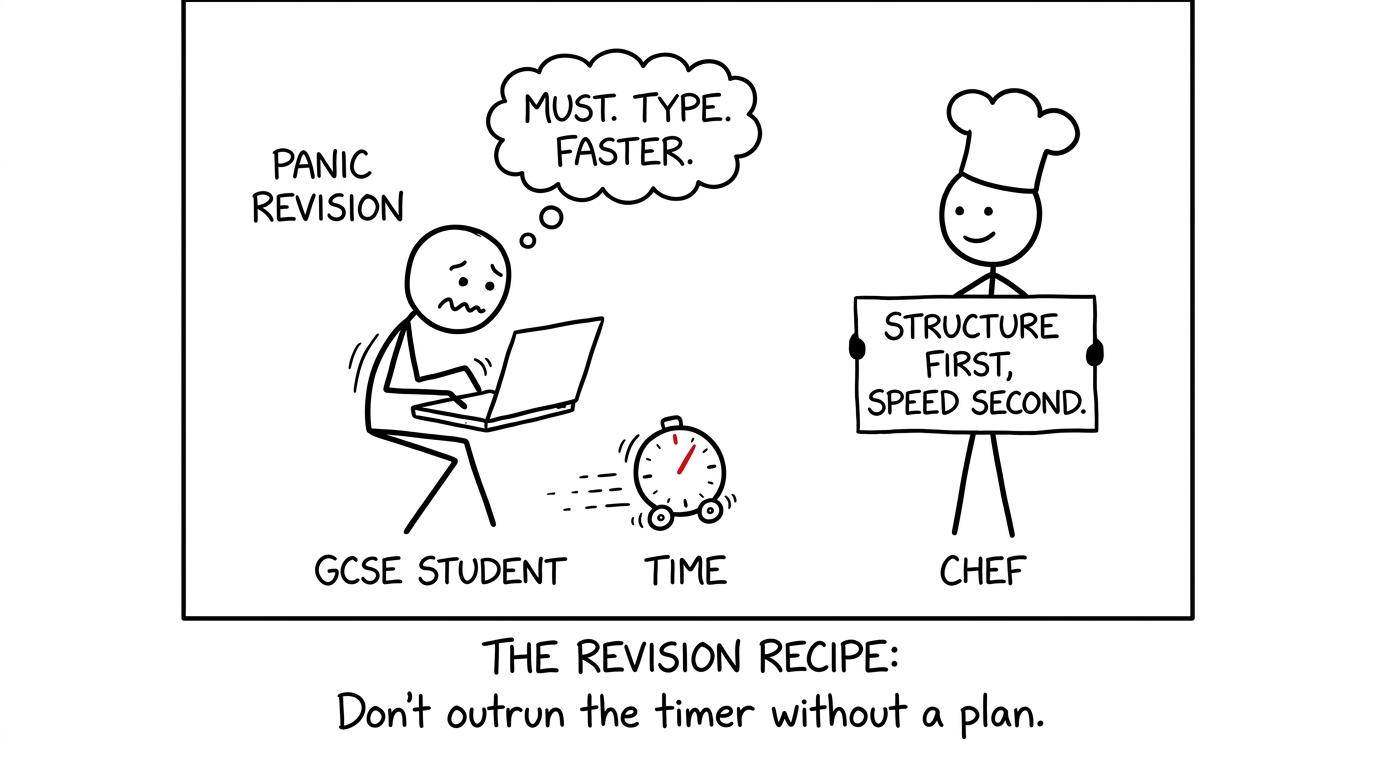 A student races a kitchen timer while a calm chef recommends structure before speed
Why typing can improve GCSE Food and Nutrition speed
A Food Preparation and Nutrition paper asks you to move between different kinds of thinking. You may need to recall a fact, apply nutritional knowledge, explain a process, analyse information or evaluate a choice. Slow answers are therefore not always caused by slow writing.
Sometimes the delay happens before the first word. The student is deciding what the command word means, searching their memory for relevant knowledge and trying to organise several ideas at once.
Timed typed practice can reduce that hesitation in three ways.
It makes retrieval more deliberate
Answering a question without notes forces you to retrieve knowledge. That is more demanding than rereading, but it also reveals whether you can produce the information when it is needed.
Typing allows many students to capture recalled ideas quickly. The benefit does not come from the keyboard itself; it comes from repeatedly retrieving accurate knowledge in response to unfamiliar wording.
It exposes inefficient structure
A long answer can still earn few marks if it repeats one idea. When you type under a timer, patterns become visible: oversized introductions, vague claims, repeated conclusions and paragraphs that never explain why something happens.
Food and Nutrition answers often improve when each relevant point is developed through a clear chain:
- make a precise point;
- add appropriate food-science or nutritional knowledge;
- connect that knowledge to the context in the question;
- explain the resulting effect or judgement.
This is not a script to force onto every question. It is a way to notice whether an answer has moved beyond assertion.
It builds familiarity with time pressure
A timer makes decisions visible. You discover whether planning takes too long, whether one difficult question consumes the session, and whether your checking routine is realistic.
That feedback matters. Speed is rarely built by telling yourself to hurry. It is built by identifying the stage where time disappears.
Typing speed is not the same as examination speed
Imagine two students producing the same number of words per minute. One identifies the command word, selects relevant facts and constructs a focused response. The other types immediately, changes direction halfway through and repeats the same point.
Their keyboard speed is identical. Their examination speed is not.
A useful way to think about total response time is:
Tresponse=Tread+Tplan+Twrite+TcheckT_{\text{response}} = T_{\text{read}} + T_{\text{plan}} + T_{\text{write}} + T_{\text{check}}Tresponse=Tread+Tplan+Twrite+TcheckTyping mainly reduces TwriteT_{\text{write}}Twrite. Effective practice also reduces unnecessary delay in reading and planning, while protecting enough time to check.
This is why unstructured typing drills have limited transfer. Being able to copy a paragraph quickly does not prove that you can interpret an unfamiliar question about nutrition, food provenance, functional properties or food safety.
Match practice to your real examination method
This is the most important condition.
If your school has approved a word processor for your examinations and typing is your established normal way of working, practising typed answers is specific and sensible. Ask your school or exams officer exactly how your examination will operate. Do not assume that practising on a laptop automatically gives you permission to type in the real paper; examination access arrangements and approved working methods are handled by the school under current rules.
If you will handwrite, use typing selectively. It can help you test knowledge, reorganise a response and compare structures, but regular timed handwriting remains essential. Handwriting involves different physical demands, and you need to know whether it remains legible when you are tired or rushed.
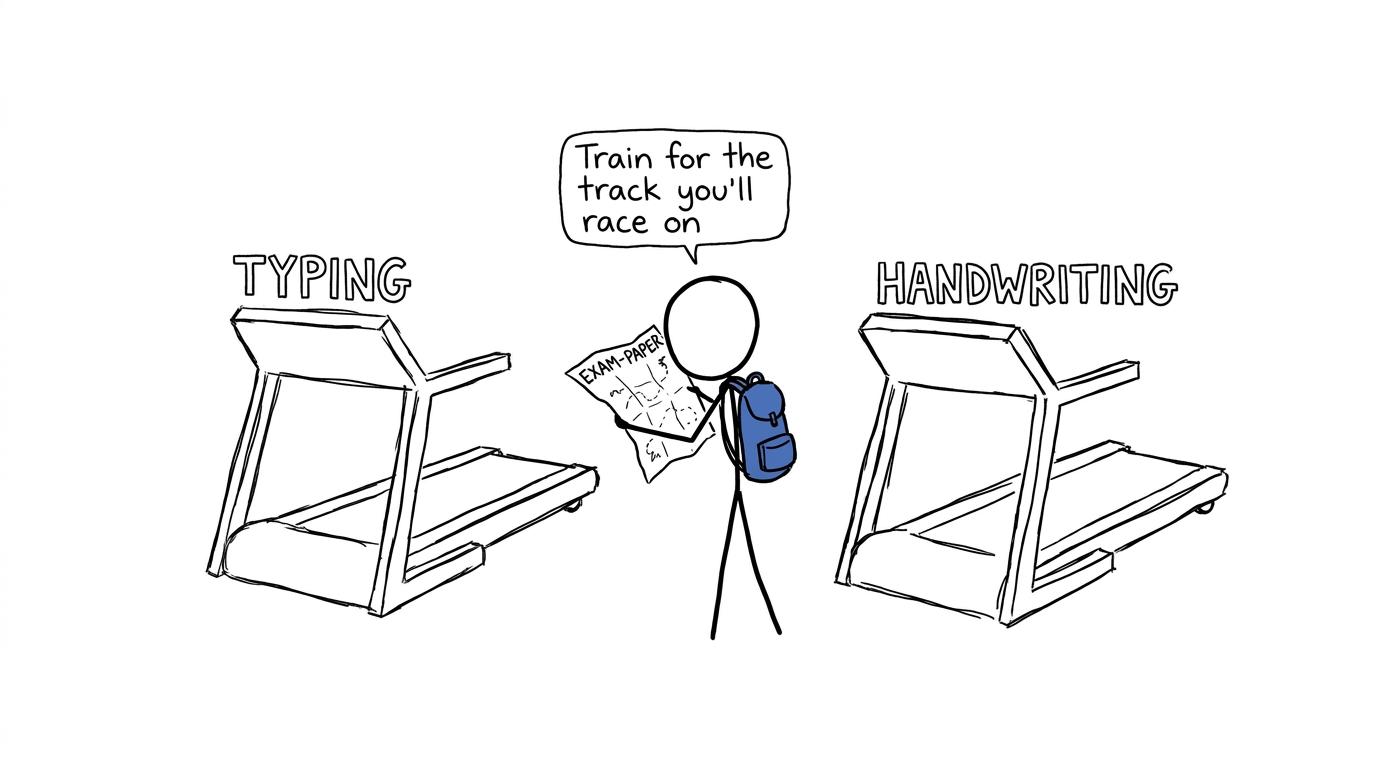 A student chooses between typing and handwriting after checking the examination route
The principle also applies to maths revision. Watching a solution and completing a paper yourself are different experiences. MathsGenie's GCSE maths revision lessons help rebuild knowledge, while its GCSE examination papers let you practise producing answers under pressure.
A practical timed-answer routine
A productive session can be short. What matters is that each stage has a purpose.
Choose a focused set of questions
Select questions from your own exam board and specification. Food Preparation and Nutrition qualifications are offered by boards including AQA, OCR and Eduqas, but paper structures and wording can differ. Check the current specification and materials supplied by your teacher rather than assuming that every board uses the same format.
Mix shorter recall questions with extended responses. If every question is familiar, you may be measuring memory of the mark scheme rather than flexible knowledge.
Set time from the task, not from impatience
Use the marks, command word and paper timing to establish a reasonable limit. A rough starting measure is:
time per mark=usable examination timetotal available marks\text{time per mark} = \frac{\text{usable examination time}}{\text{total available marks}}time per mark=total available marksusable examination timeTreat this as guidance, not a law. Reading data, analysing an unfamiliar context and planning an extended judgement may need different proportions of time. Reserve some of the paper for checking rather than allocating every second to writing.
Plan before typing
Spend a small, controlled part of the time identifying:
- the command word;
- the precise topic;
- the context that must appear in the answer;
- the number of distinct ideas required;
- the evidence or explanation supporting each idea.
Planning is not lost time if it prevents repetition. The aim is not to create a polished outline; it is to choose a route before accelerating.
Type without using hidden support
Close notes and disable tools that would not be available in the examination. Avoid copying prepared paragraphs. Predictive text, grammar suggestions or online searches can make practice feel fluent while concealing gaps in recall.
If you become stuck, mark the point and continue where possible. Learning to leave and return to a difficult item is part of managing a paper.
Review for marks and lost time
When the timer ends, stop. Then use the official mark scheme supplied with the question and ask:
- Which statements were accurate and relevant?
- Where did I explain rather than merely state?
- Did I respond to the command word?
- Which paragraph repeated an earlier point?
- Was time lost through missing knowledge, weak planning or physical typing?
- What single change should I test next time?
Keep a brief error log. Maths students can apply the same process with MathsGenie's GCSE predicted papers, GCSE mini tests and topic-based GCSE revision resources. The subject changes, but the feedback loop remains powerful: attempt, check, diagnose, practise again.
How to improve structure without writing more
Under time pressure, students often equate length with quality. Yet additional words only help when they add relevant knowledge, application, analysis or evaluation.
Before submitting a typed response, look for four things:
A direct opening
Answer the question rather than restating it. An extended introduction can consume time without demonstrating subject knowledge.
Distinct developed ideas
Each paragraph should contribute something new. If two paragraphs make the same nutritional claim using different wording, combine them and develop the reasoning.
Contextual links
Generic knowledge is not always enough. Where the question presents a person, product, dietary need or practical situation, connect the explanation to that context.
A justified judgement
For evaluative questions, a conclusion should follow from the evidence already discussed. Avoid adding a completely new argument in the final sentence.
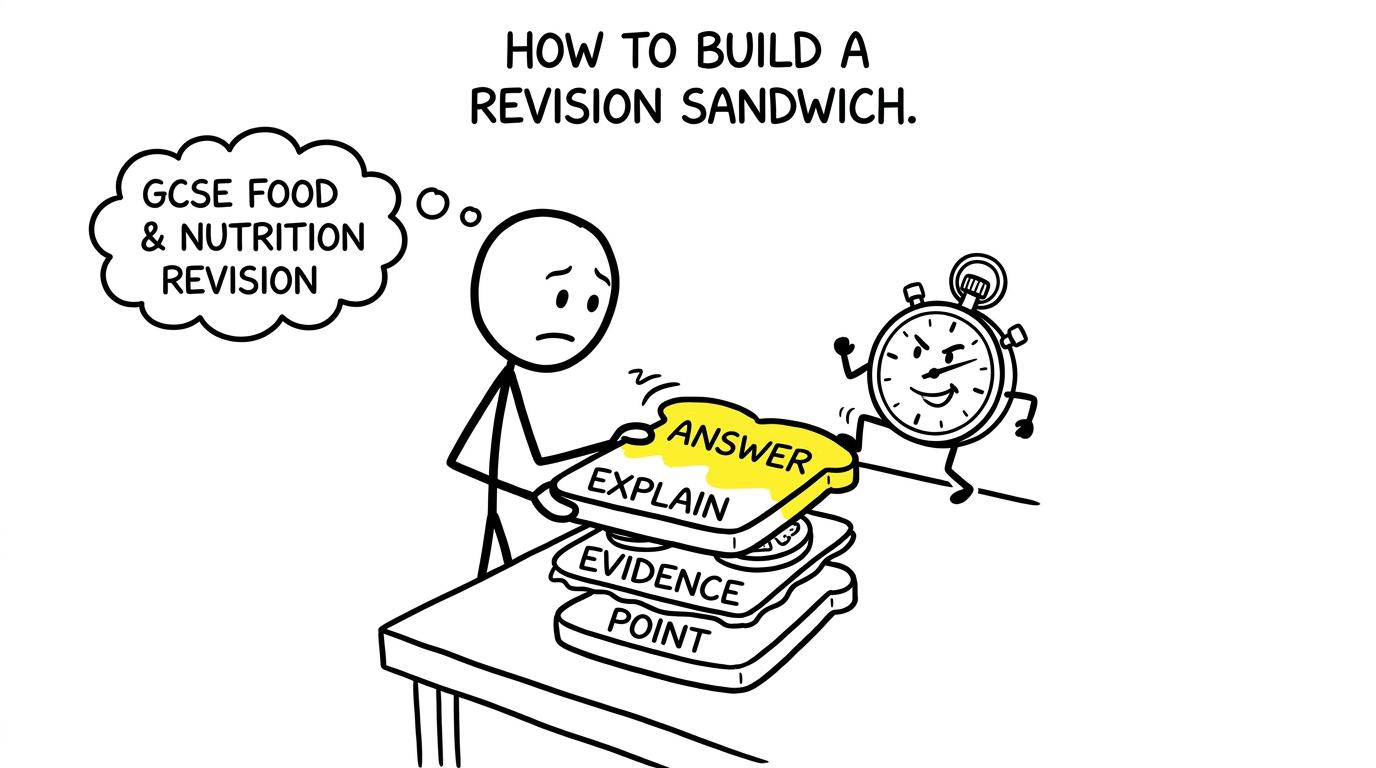 A stopwatch attempts to steal the final layer from a carefully structured answer sandwich
Measure improvement properly
Do not judge a session only by word count. A faster answer that earns fewer marks is not progress.
Track a small set of useful measures:
- marks achieved;
- completion within the chosen time;
- repeated or irrelevant ideas;
- missing technical vocabulary;
- typing or handwriting errors that affect meaning;
- time remaining for checking.
You can record an approximate mark rate as:
mark rate=marks earnedminutes used\text{mark rate} = \frac{\text{marks earned}}{\text{minutes used}}mark rate=minutes usedmarks earnedUse it cautiously because questions differ in difficulty. Compare similar tasks over several sessions rather than treating one result as proof. Improvement is more convincing when accuracy, completion and structure rise together.
MathsGenie's revision planner can help maths students space practice across a week instead of relying on one exhausting session. Its A Level maths revision hub also shows how topic teaching, questions and video support can be combined as students progress beyond GCSE.
Common mistakes with timed typed practice
Practising only typing speed
Copying text builds keyboard familiarity, not subject-specific decision-making. Type answers to real questions from your specification.
Using a laptop when the examination will be handwritten
This creates a mismatch between practice and performance. Keep some typed sessions for structure if they help, but make handwriting your main timed method.
Starting the timer too aggressively
An unrealistic limit encourages rushed reading and shallow answers. Begin with a defensible allocation, then improve efficiency through better knowledge and planning.
Ignoring mark schemes
Completion can feel successful even when the response misses the assessment demand. Marking is where practice becomes feedback.
Editing forever
Typing makes rewriting easy, but constant polishing can consume the time saved by faster production. Plan briefly, write clearly and make only purposeful corrections.
Confusing more words with more marks
Examiners reward relevant, accurate responses that meet the question's demands. Repetition increases length without increasing coverage.
Leaving practice until full papers
Full papers matter, but they are demanding. Build control with short question sets before attempting longer timed sections. The same progression works in maths: use lessons and practice questions first, then test endurance through MathsGenie past papers.
Build speed that survives examination day
Typing answers under a timer can improve GCSE Food and Nutrition speed and structure, particularly when a word processor is your approved examination method. But the timer is not the teacher. The improvement comes from retrieving knowledge, planning economically, responding to command words and learning from mark schemes.
Train in the format you will use. Measure marks as well as minutes. Keep your answers focused enough that speed does not erase precision.
For your GCSE maths preparation, begin with MathsGenie's free GCSE revision lessons and practice questions, then move into past papers, predicted papers, mini tests, mark schemes and video solutions. Choose one weak area, complete a timed attempt and review it while the decisions are still fresh. That small cycle, repeated calmly, is how examination speed becomes dependable.