

A Two-Week GCSE Maths Revision Plan That Fits Your Life
A two-week GCSE maths revision plan with daily tasks, past papers, rest days and catch-up time. Build a realistic timetable around your weakest topics.
Two weeks can feel awkwardly short: long enough to make progress, but short enough that every unfinished topic looks urgent. A two-week GCSE maths revision plan should prioritise your weakest useful topics, include past-paper practice and leave room for rest and catch-up. You do not need to cover everything equally.
Imagine a student opening their revision folder after a disappointing practice paper. Their first instinct might be to revise algebra all weekend. A better starting point is to find out which parts of algebra caused the lost marks, then build a manageable fortnight around those gaps.
Here is a plan you can follow, including what to change when schoolwork, tiredness or a difficult topic interrupts it.
Start with topic triage
Before writing your GCSE maths revision timetable, gather a recent marked paper, your topic list and your commitments for the next fortnight. Use materials for your exam board and foundation or higher tier. MathsGenie's GCSE maths revision resources provide a starting point for finding the right material.
Sort topics into three groups:
- Needs teaching: you cannot yet choose or explain a method.
- Needs practice: you understand the method but lose marks through slips or uncertainty.
- Needs checking: you usually answer correctly without help.
Choose three priorities from the first two groups. Prefer topics that repeatedly cost you marks or support other skills, such as fractions, rearranging equations or interpreting graphs. Keep the remaining gaps on a reserve list.
This is triage, not a prediction of what will appear. Your plan still needs mixed questions so that stronger topics stay accessible.
For the wider planning process, use the GCSE maths revision timetable guide alongside this fortnight structure.
Give each session a clear job
Start with around forty-five minutes on ordinary revision days, adjusting this around your other subjects and energy. A useful session has three parts:
- Recall a method or retry an earlier mistake without notes.
- Work on one priority topic, using a lesson if needed.
- Mark your answers and record what needs another attempt.
Write tasks such as “practise forming equations and check my errors”. “Revise algebra” is too broad to tell you when you have finished.
When you need an explanation, use MathsGenie's revision lessons and worksheets, then close the explanation before answering independently. Watching a solution can make a method feel familiar; attempting it reveals whether you can use it.
A two-week GCSE maths revision plan
The student in our example chooses three priorities and puts their busiest school evening aside for rest. You can move the days below to match your commitments, keeping the order of learning, practice and checking.
| Day | Main task | What to record |
|---|---|---|
| Monday, week one | Review a marked paper or attempt a mixed question set. Choose three priority topics. | Specific gaps and the reasons marks were lost. |
| Tuesday, week one | Relearn priority topic one, then attempt questions independently. | The method you need to remember. |
| Wednesday, week one | Practise priority topic two and briefly revisit Tuesday's work. | Any step you still cannot explain. |
| Thursday, week one | Take a rest day from planned maths revision. | Nothing to catch up unless you choose to move the rest day. |
| Friday, week one | Work on priority topic three, then mix questions from all three topics. | Which methods you can select without prompts. |
| Saturday, week one | Attempt a past paper under its stated conditions. Reserve time afterwards or on Sunday to mark it. | Questions to review, including uncertain correct answers. |
| Sunday, week one | Finish marking, correct selected errors and choose next week's priorities. | A short, updated task list. |
| Monday, week two | Repair the most useful gap exposed by the paper. | One clear explanation of the correction. |
| Tuesday, week two | Practise mixed questions, including previously corrected errors. | Whether the corrections have stuck. |
| Wednesday, week two | Use a catch-up slot or a short mini test if you are on schedule. | Any remaining uncertainty. |
| Thursday, week two | Take a rest day from planned maths revision. | Keep the evening free. |
| Friday, week two | Attempt another past paper, allowing for its full stated duration. | Questions that need marking and review. |
| Saturday, week two | Mark the paper and revisit the most useful remaining gaps. | A brief final checklist. |
| Sunday, week two | Use light recall and a few familiar questions, especially if your exam is close. | Practical preparations for your next paper. |
Build your version of this fortnight in the Revision Planner, using your exam date, topics and available revision time.
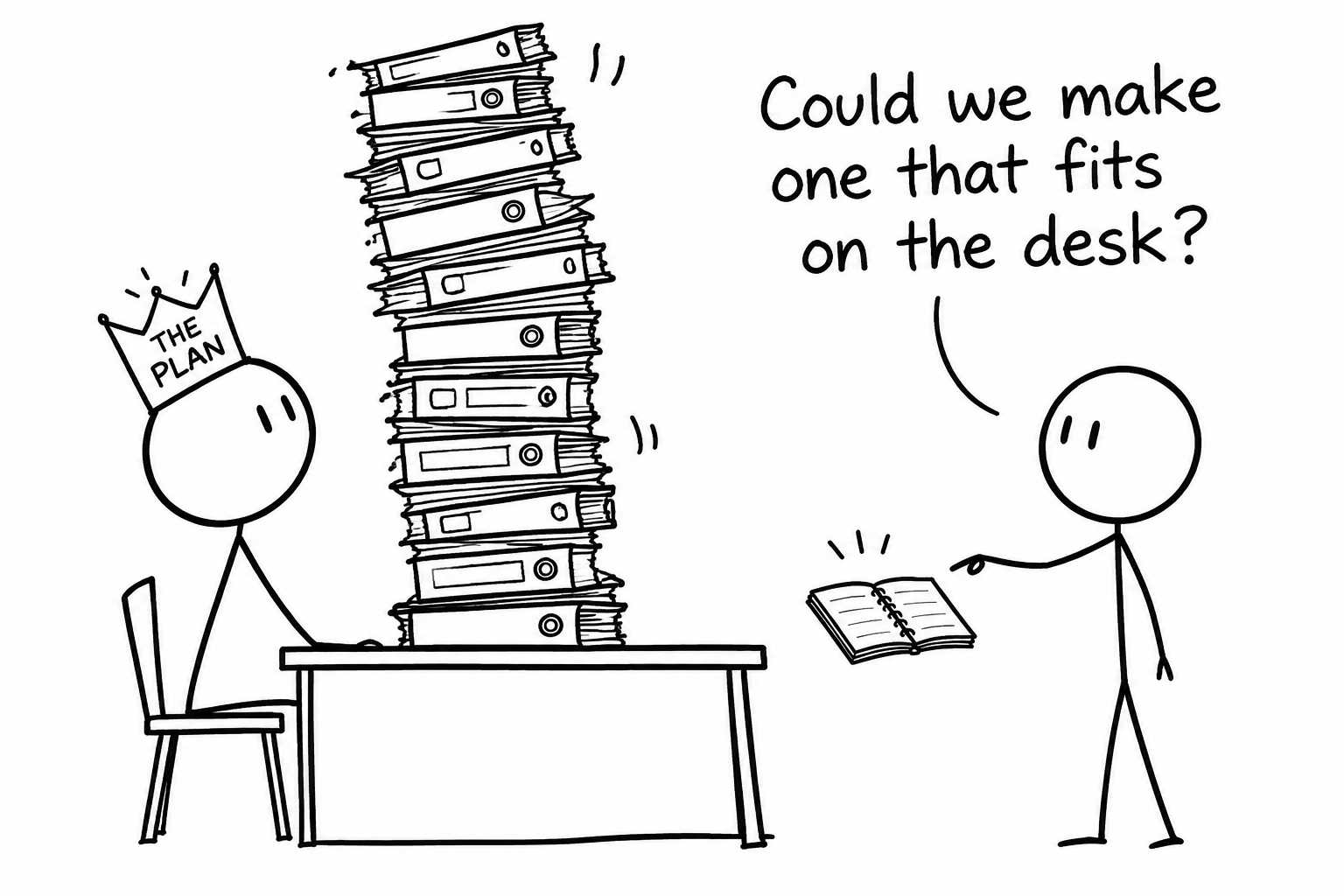 Stick-figure comic about a revision plan becoming an impractically large tower of folders
Make past papers change the plan
A paper gives you evidence for your next session. Once you have marked it, label each lost mark by its cause: missing knowledge, choosing the wrong method, a calculation slip or misreading the question.
Those causes need different responses. Missing knowledge may need a revision lesson. A misread instruction needs more careful question reading. Repeating an entire topic will not necessarily fix either problem efficiently.
For each important error, attempt the question again without the solution, then revisit a similar question later. Use mark schemes to understand the required working and video solutions when a written step remains unclear.
The guide to when to start GCSE past papers gives more context for fitting papers around topic practice. Predicted papers can offer additional practice, but should not determine which parts of the specification you leave out.
Adjust when you fall behind
If Tuesday's topic takes twice as long as expected, resist moving every unfinished task forward. That creates a timetable you already owe time to.
Instead, keep the next useful task, move one priority into the catch-up slot and shorten or remove a lower-priority task. Protect time for marking papers: an unreviewed score tells you much less than a corrected mistake.
Keep rest days too. If the plan repeatedly overruns, reduce its daily workload. A realistic GCSE revision plan should reflect the time you actually have, including other subjects, meals and sleep.
Common mistakes to avoid
Spending the fortnight planning. Choose your priorities and begin; adjust after you have evidence.
Only practising comfortable topics. Start with a manageable question, then tackle the gap you identified.
Looking at solutions too early. Make a serious attempt first, including any useful working.
Treating one score as a verdict. Use it to identify the next task, while recognising that papers vary in difficulty and topic mix.
Turn your fortnight into a schedule
You now have a structure that balances topic repair, exam practice and recovery. The next step is to fit it around your real commitments so that each revision session has a clear purpose. Build your two-week GCSE maths schedule in the Revision Planner.















