

A Two-Week A-Level Maths Revision Plan
A two-week A-Level Maths revision plan with topic triage, past papers, rest days and practical ways to recover when your revision timetable falls behind.

Two weeks before an A-Level Maths exam, the temptation is to revise everything. That usually creates a beautiful timetable and a tired student, but not enough useful practice. A realistic two-week A-Level Maths revision plan must make harder choices: diagnose what costs you marks, repair the most important gaps and practise complete papers under exam conditions.
Imagine a student looking at Pure, Statistics and Mechanics with fourteen days left. The list feels enormous because every topic appears equally urgent. It is not. Once the student uses evidence from questions rather than anxiety, the fortnight becomes manageable.
This plan gives you that structure. Adapt the topics and paper format to your exam board's specification, whether you take Edexcel, AQA, OCR or Eduqas.
Your two-week checklist
Before building the timetable, gather:
- your exam dates and exam-board specification
- one recent paper or mixed mini test for diagnosis
- a red, amber and green topic list
- practice questions for targeted repair
- complete past papers and mark schemes
- a notebook or document for recording mistakes
- protected rest periods and one flexible catch-up session
You can find board-specific materials through the A-Level Maths revision hub. Edexcel students can also go directly to the Edexcel A-Level Maths revision resources, which organise Pure Mathematics, Statistics, Mechanics and past papers.
Start with topic triage, not your favourite chapter
On the first day, complete a mixed mini test or part of a past paper without notes. Mark it honestly. The purpose is diagnosis, not reassurance.
Sort each topic into three groups:
- Red: you cannot start the question or repeatedly use the wrong method.
- Amber: you understand the method but lose marks through incomplete reasoning, algebra or interpretation.
- Green: you can answer standard and unfamiliar questions reliably.
Then choose a small number of priority topics. A red topic that appears throughout the course, such as algebraic manipulation, differentiation or integration, may deserve attention before an isolated weakness. These skills often reappear inside longer problems.
Do not ignore Statistics or Mechanics simply because Pure feels more substantial. The balance and organisation of content differ between exam boards, so use your specification and actual paper structure rather than copying another student's timetable.
For a broader look at planning principles, the maths revision timetable guide explains how topic work, practice and realistic weekly capacity fit together. It is written for GCSE students, but the scheduling principles transfer well to A Level.
A realistic A-Level Maths revision timetable
A productive session can follow this pattern:
- 101010 minutes retrieving formulas, definitions or methods from memory
- 202020 minutes reviewing a weak concept through a revision lesson or video solution
- 303030 to 454545 minutes answering questions without notes
- 101010 minutes marking, correcting and recording the error
On paper days, replace the structure with a timed paper followed by careful marking. Reviewing a paper is revision, not administration. A mark scheme tells you where marks were available; a video solution can show why your route became inefficient.
| Day | Main task | Purpose |
|---|---|---|
| One | Mixed diagnostic questions and topic triage | Identify red and amber areas |
| Two | Red Pure topic one | Relearn the method and complete practice questions |
| Three | Red Statistics or Mechanics topic | Repair a major applied weakness |
| Four | Red Pure topic two | Build accuracy in a connected skill |
| Five | Timed paper or substantial paper section | Test recall and exam timing |
| Six | Mark the paper and repair two recurring errors | Turn mistakes into targeted practice |
| Seven | Rest, with optional light formula recall | Recover and protect the second week |
| Eight | Amber Pure topics | Convert partial understanding into secure marks |
| Nine | Statistics and Mechanics mixed practice | Practise choosing methods independently |
| Ten | Timed full paper | Rehearse sustained exam performance |
| Eleven | Mark, analyse and revisit weak questions | Find patterns behind lost marks |
| Twelve | Final targeted topic session | Address the highest-value remaining gap |
| Thirteen | Final timed paper or selected paper sections | Check readiness without cramming |
| Fourteen | Light review and rest | Arrive rested with methods accessible |
If setting this up by hand feels like another revision task, build your two-week schedule in the Revision Planner using your exam date, topics and available time.
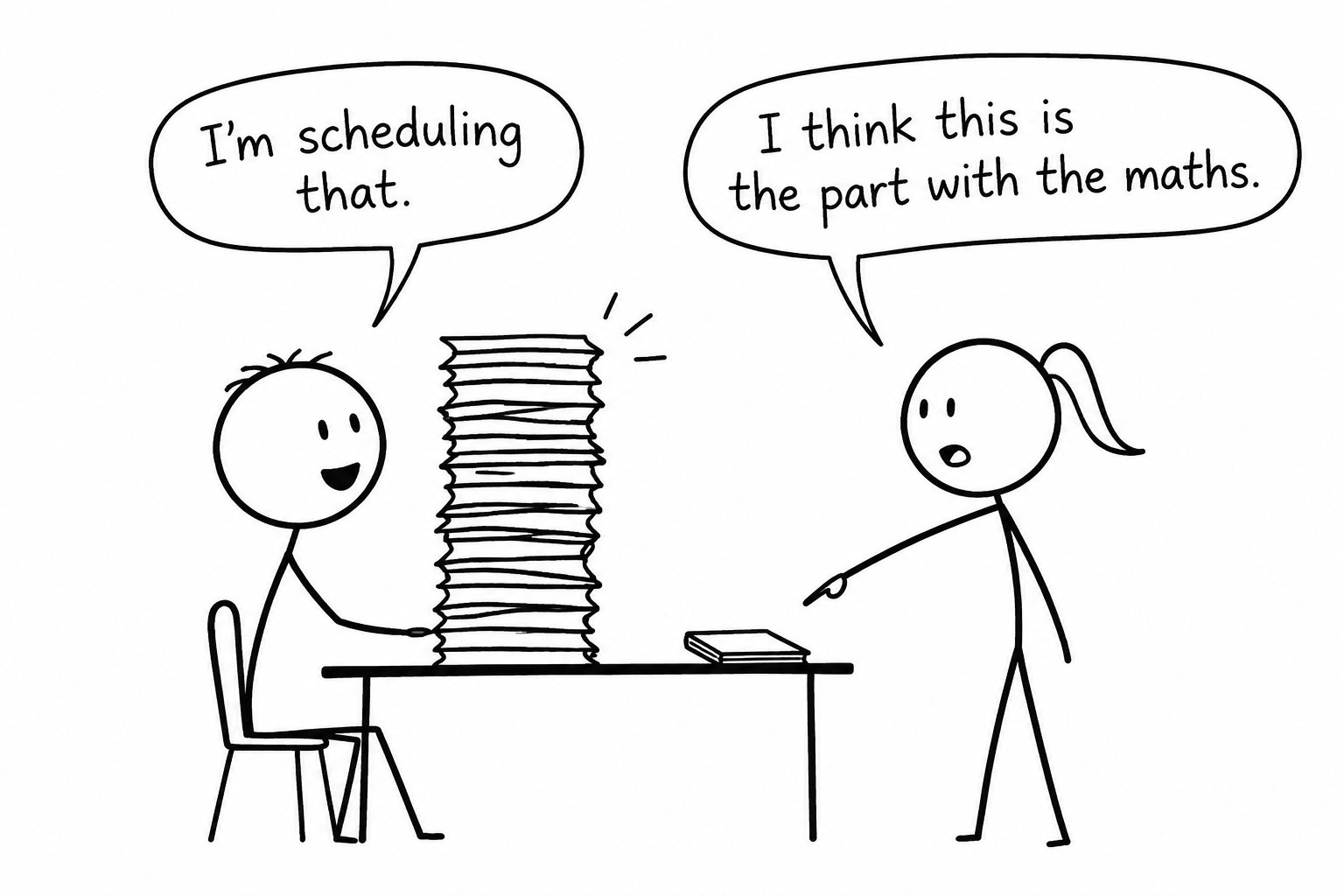 Two stick-figure students discover that making a revision timetable is not the same as doing the maths
How to use past papers properly
Past papers are most useful when they change what you do next. Completing paper after paper without reviewing mistakes can rehearse the same weaknesses.
Use a simple paper cycle:
Sit it
Work under timed conditions in a quiet space. Use only the equipment permitted for that paper. If a full paper is unrealistic early in the fortnight, complete a substantial section without notes.
Mark it
Use the official mark scheme where available. Record the mark, but also classify each lost mark:
- knowledge gap
- wrong method
- algebra or arithmetic error
- incomplete reasoning
- misread instruction
- poor time management
Repair it
Redo incorrect questions without copying the solution. Then answer one or two related questions to test whether the method has actually become independent.
Retest it
Return to selected mistakes after a few days. A corrected solution can look obvious while it is still on the page. Retrieval later tells you whether the learning lasted.
MathsGenie's resources combine A-Level past papers, mark schemes and revision materials, making it easier to move from diagnosis to repair. The comparison of MathsGenie and PMT past-paper resources also explains what to look for when selecting paper practice.
Why the rest day belongs in the plan
Rest is not a reward for finishing everything. Everything will not be finished.
The first week asks you to diagnose weaknesses, relearn methods and complete a timed assessment. A quieter seventh day creates separation between the two phases. It also gives the plan some resilience if schoolwork, illness or another exam disrupts a session.
Keep the rest day genuinely light. Optional formula recall is fine, but do not quietly turn it into a full paper because guilt appeared at lunchtime. Sustainable attention is more valuable than another exhausted set of questions.
The one-month maths revision plan offers a longer example of balancing diagnosis, targeted practice and paper work. Although its timetable is designed for GCSE, the principle remains relevant: different phases should serve different purposes.
What to do when you fall behind
By day five, our hypothetical student has missed a Mechanics session because another subject needed attention. The wrong response is to move every unfinished task forward. That creates a timetable with two days of work squeezed into each remaining day.
Instead, use this adjustment rule:
- Keep the next timed paper and the final rest period.
- Drop duplicated practice from topics that are already secure.
- Reduce a missed session to its essential method and a short set of questions.
- Move only the highest-priority unfinished task into the catch-up space.
- Reassess priorities using marks, not guilt.
If you miss two days, do not restart the entire plan. Continue from the current date. A revision timetable is a decision-making tool, not a contract with your past self.
Common mistakes to avoid
Giving every topic equal time
Your available time is limited, so your weakest and most connected topics deserve more attention than material you can already answer confidently.
Watching solutions without attempting questions
A clear explanation can create the feeling of understanding. Attempting a new question reveals whether you can select and apply the method yourself.
Saving all past papers for the end
An early paper provides evidence for topic triage. Later papers measure improvement and expose remaining weaknesses.
Counting hours instead of corrected errors
Time at a desk is an input. Better solutions are the goal. Track recurring errors, corrected questions and topics that have moved from red to amber or green.
Removing sleep and rest when behind
This usually protects the timetable on paper while weakening the quality of the work. Cut low-priority tasks before cutting recovery.
Turn the fortnight into a schedule you can follow
You now have the structure: diagnose, repair, test, review and rest. The remaining gap is turning those priorities into daily decisions while fixed exam dates keep moving closer. Our hypothetical student stopped repeatedly redrawing the timetable and used one schedule that could be adjusted when a session was missed.
Your turn: build your two-week schedule in the Revision Planner.















