

Tracking Revision Progress GCSE Economics: Does It Help?
Tracking revision progress GCSE Economics: learn when a spreadsheet improves recall and exam practice, when it wastes time, and what to record each week.
Revision spreadsheets have a peculiar power: colouring a topic green can feel almost as satisfying as learning it. Almost.
For students considering tracking revision progress GCSE Economics preparation, the short answer is yes, a spreadsheet or app can help, but only when it changes what you do next. It cannot improve recall by itself. Its value comes from identifying weak topics, scheduling further practice and recording evidence from questions or past papers.
A useful tracker is a compass, not the journey. If maintaining it takes longer than deciding your next task, it has become another form of procrastination.
The quick checklist
A GCSE Economics revision tracker is likely to be useful if it:
- lists topics from your current exam board specification;
- records performance rather than time alone;
- separates knowledge, application, analysis and evaluation;
- identifies one clear next action for each weak area;
- prompts you to revisit material after a delay;
- includes question practice and timed papers;
- takes only a few minutes to update.
It is less useful if you spend revision sessions choosing colours, building charts or repeatedly reorganising columns. The system should make revision easier to direct, not more impressive to look at.
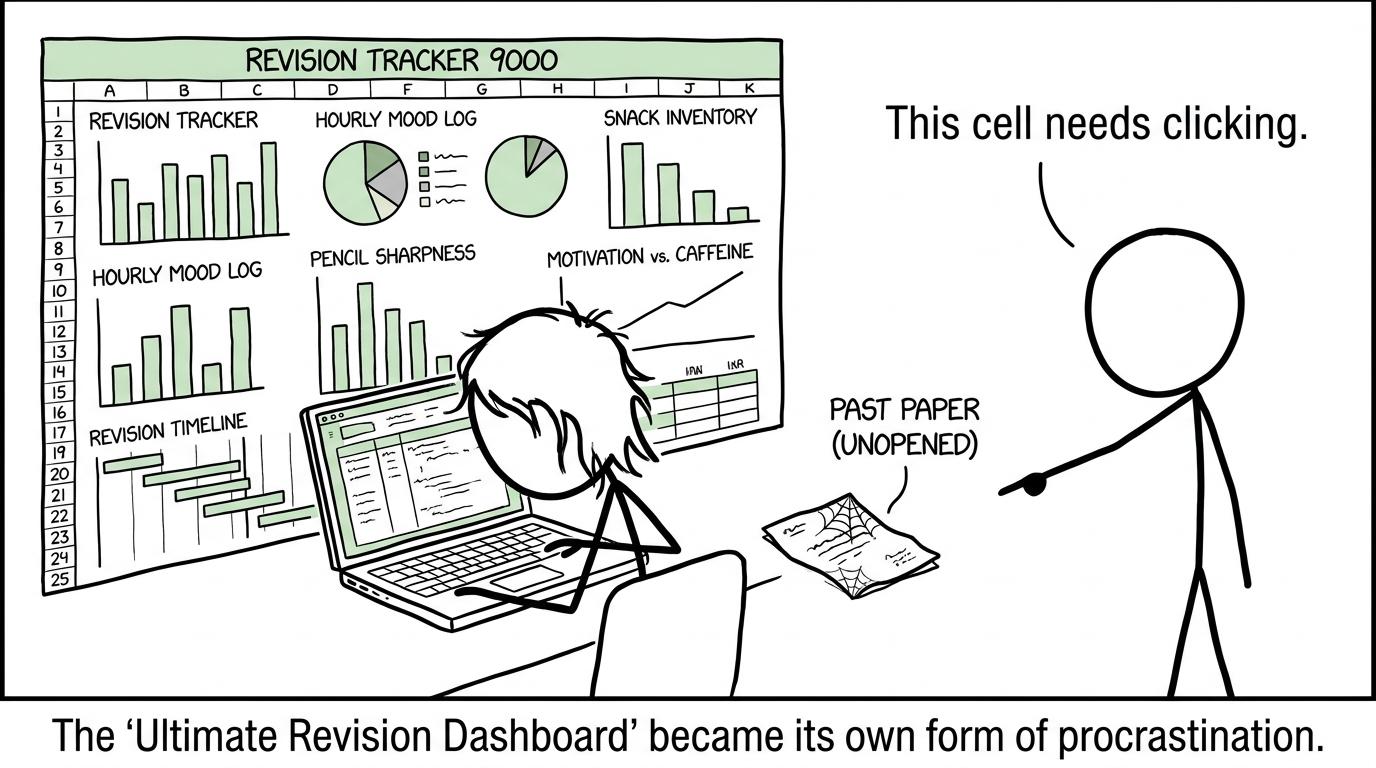 A student discovers that an unopened practice paper matters more than a complicated revision dashboard
Why tracking revision can genuinely help
The useful part of tracking is not the spreadsheet. It is the thinking the spreadsheet encourages.
Effective independent revision requires students to plan a task, monitor their understanding and adjust their approach. A tracker can support that cycle by turning a vague feeling, “I am not very good at macroeconomics”, into a specific decision: revisit inflation, test the key definitions and then answer an application question.
This matters because familiarity is not the same as recall. A page of notes can look reassuring when it is open. The real test is whether you can explain a concept, interpret information and construct an answer when the notes are closed.
A tracker also preserves information that memory tends to soften. After a difficult paper, it is tempting to remember the questions you nearly answered rather than the marks you actually earned. Recording the mark, the error and the required follow-up gives you better evidence.
The same principle applies to maths revision. MathsGenie's GCSE maths revision resources combine lessons, practice questions and video solutions, making it possible to record both the topic studied and the evidence produced afterwards.
What your GCSE Economics spreadsheet should record
Begin with the specification used by your school. GCSE Economics content and assessment structures vary between exam boards, so students following AQA, OCR or another available specification should use the headings in their own course documents rather than copying a generic online list.
Topic and subtopic
Broad headings are rarely diagnostic enough. “The economy” might cover several distinct ideas, each needing different revision. Break larger sections into the smallest useful units found in your specification.
Each row should represent something you could reasonably revise and test in one or two sessions. If a row is so broad that you cannot decide what to do next, divide it.
Last retrieval date
Record the most recent occasion on which you tried to recall or apply the material without relying on notes. This is more informative than recording when you last read it.
Revisiting topics over time is generally more valuable than compressing all practice into one long session. Your tracker should therefore bring older material back into view instead of allowing a green cell to disappear forever.
Evidence of performance
Hours can show effort, but they cannot prove understanding. Record evidence such as:
- marks from practice questions;
- marks from a timed paper;
- definitions recalled without prompts;
- diagrams produced accurately from memory;
- missing chains of analysis;
- feedback from a teacher or mark scheme.
You may calculate a simple completion rate with:
P=CT×100P = \frac{C}{T} \times 100P=TC×100where CCC is the number of completed topics and TTT is the total number listed. However, this percentage measures coverage, not mastery. Completing every row once does not mean you are ready for the exam.
Economics also involves quantitative information, so confidence with percentages, ratio and interpreting data can support both subjects. Those links lead to free MathsGenie lessons and questions for strengthening the underlying maths.
Confidence and evidence should be separate
Confidence remains useful, but it should not be the only measure. You might use a short rating scale for how secure a topic feels, then place an objective result beside it.
A confident student with a weak question score needs more practice. A nervous student who repeatedly earns strong marks may need timed experience and reassurance rather than another complete set of notes.
That gap between feeling and evidence is one of the most valuable things a revision tracker can reveal.
Your next action
Every weak topic should lead to an action small enough to begin. “Revise markets” is not an action. Better actions include learning selected definitions, checking a diagram, planning an extended response or completing a timed question.
Avoid recording only “review”. Write what reviewing will involve and how you will check whether it worked.
Spreadsheet or revision app: which is better?
Neither format has an automatic academic advantage. The best tool is the one that remains simple enough to use and specific enough to influence your next session.
A spreadsheet is particularly helpful when you want to:
- sort topics by confidence, mark or last-practised date;
- filter for overdue topics;
- compare predicted confidence with actual performance;
- customise columns around your specification;
- see several weeks of activity in one place.
An app may be better if reminders, quick mobile updates or ready-made scheduling reduce friction. A paper checklist can be equally effective for students who find screens distracting.
Choose one system and use it consistently for a short period before changing it. Constantly moving information between platforms creates the appearance of organisation while consuming the time meant for practice.
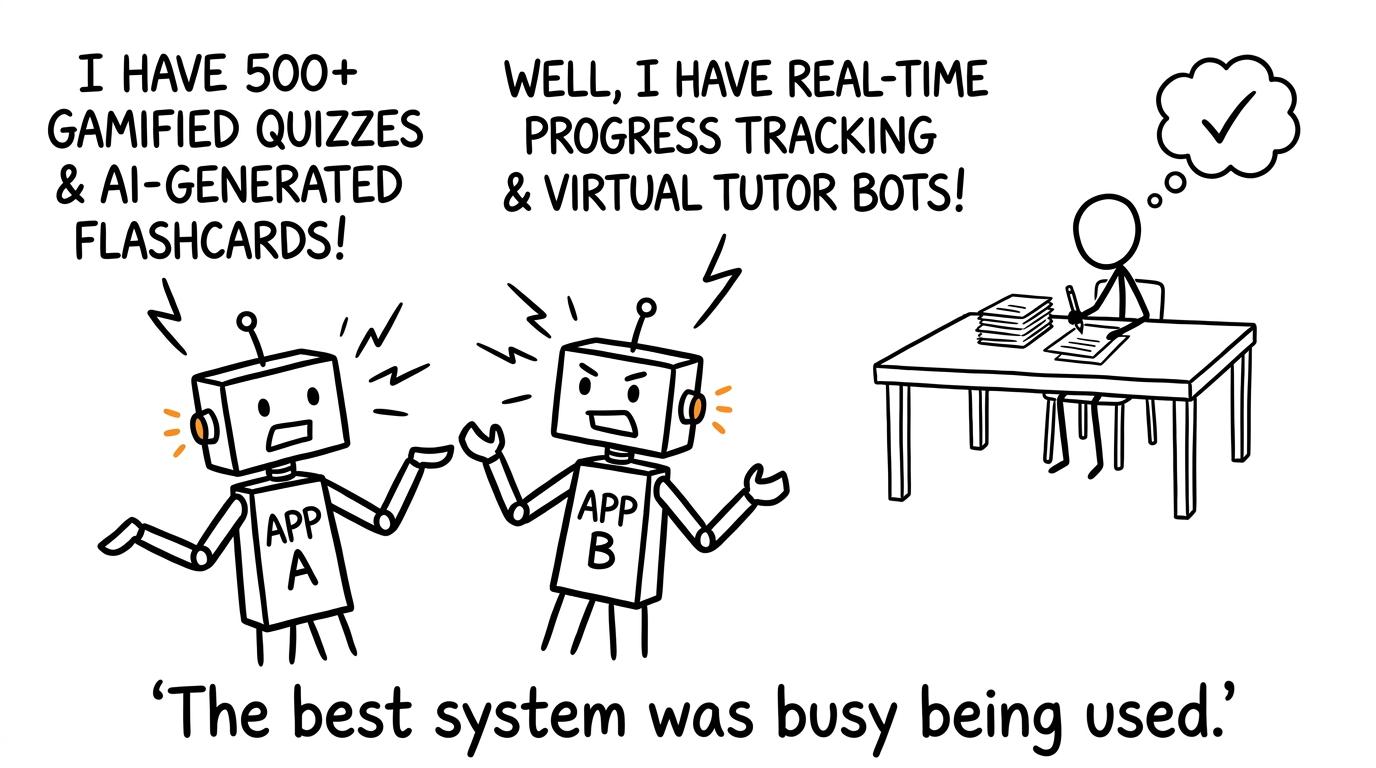 Two overcomplicated revision apps argue while a student quietly completes a practice paper
How to make tracking lead to better revision
Start each session from the tracker
Open the tracker only long enough to select a priority. A sensible choice usually combines importance, weakness and the time since your last attempt.
Then close it and revise. The tracker should reduce decision fatigue, not remain on screen throughout the session.
For maths, the free MathsGenie revision planner provides a similar bridge between knowing what needs attention and choosing purposeful practice.
Finish with a test, not a tick
A tick records attendance. A question records learning.
After revising an Economics topic, close your notes and retrieve the central ideas. You could then answer a relevant exam question, plan a longer response or explain how a piece of context changes the analysis. Check your work against the official guidance supplied by your exam board or ask your teacher to review it.
Only update the tracker after this evidence exists.
Record errors by cause
A raw mark tells you that something went wrong. An error category helps you repair it.
Useful categories might include:
- missing knowledge;
- inaccurate terminology;
- weak use of context;
- incomplete analysis;
- unsupported judgement;
- misread data;
- poor timing.
This approach also improves maths revision. When completing GCSE maths past papers, distinguish between a forgotten method, an arithmetic error and a misread question. Each needs a different response.
Review the system once a week
A brief weekly review is enough. Look for neglected topics, repeated errors and results that have not improved after several attempts. Then set a small number of priorities for the next week.
Do not redesign the tracker simply because revision feels difficult. Difficulty can be a sign that retrieval and exam practice are exposing what you still need to learn.
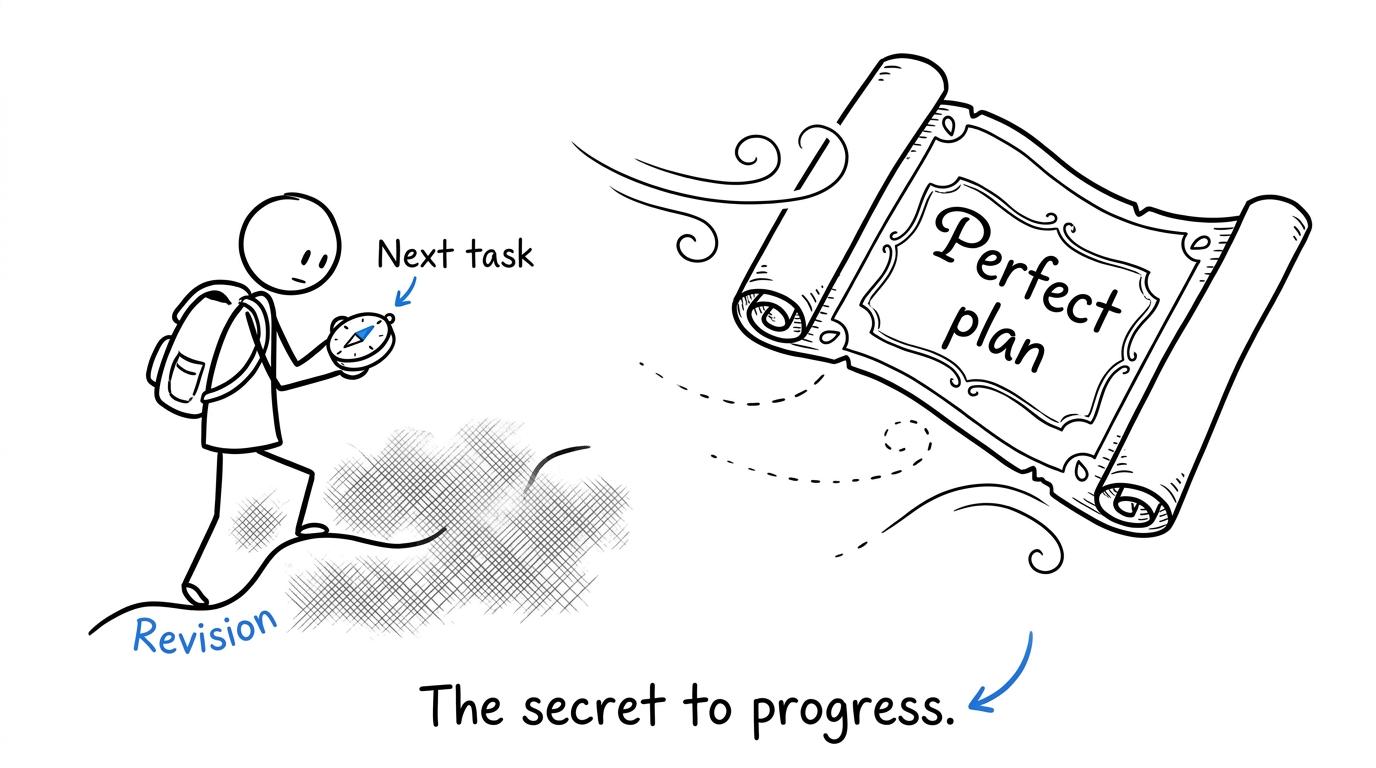 A small compass marked next task proves more useful than a perfect revision map
When tracking only feels productive
Revision tracking becomes performative when the record grows but your ability does not.
Warning signs include spending longer updating the system than answering questions, marking a topic complete after watching one video, recording every minute while recording no outcomes, or avoiding timed papers because they may lower your confidence score.
A useful test is simple: if the spreadsheet disappeared tomorrow, would its recent entries have changed what you revised today? If not, it is probably functioning as a diary rather than a decision tool.
Predicted papers can also provide useful practice near the appropriate stage of preparation, but they should complement broad specification coverage and authentic past-paper experience. Maths students can use MathsGenie's free predicted GCSE maths papers alongside topic revision and official-style questions.
Common mistakes when tracking revision progress
Tracking time instead of learning
Time matters, but “revised for an hour” says little about what you can now do. Pair time with a result, error note or next action.
Turning confidence green too early
Do not mark a topic secure because it made sense while reading. Wait until you can retrieve and apply it independently, preferably on more than one occasion.
Using one score for every exam skill
You may remember definitions accurately but struggle to apply them to context or evaluate competing arguments. Record these aspects separately where doing so affects your next task.
Ignoring forgotten topics
A completed topic still needs to return. Include a last-practised date or next-review date so earlier content remains visible.
Building an elaborate dashboard first
Begin with a plain list, evidence column, last-attempt date and next action. Add another column only when it helps you make a recurring decision.
Treating the tracker as the revision
Planning supports practice; it does not replace it. Most of the session should involve retrieval, questions, feedback and correction.
Build a system that produces action
Tracking revision progress can help with GCSE Economics, but the benefit comes from the behaviour around it. A good tracker reveals weak areas, schedules retrieval, captures meaningful evidence and tells you what to do next. A beautiful tracker that records only activity is simply tidy procrastination.
Keep the system small. Test yourself before changing a colour. Revisit topics that once felt secure. Let marks and errors challenge your first impression.
And apply the same discipline to your maths preparation. Start with MathsGenie's GCSE revision lessons and practice questions, organise your time with the free revision planner, then use past papers and mark schemes to produce honest evidence. Add predicted papers, mini tests and video solutions where they meet a clear need.
The spreadsheet does not earn the marks. It should quietly lead you towards the work that can.











