Too Late to Revise GCSE History? A Realistic Plan
Too late to revise GCSE History? Learn what late revision can achieve, how to prioritise topics and how to balance History with GCSE Maths calmly.
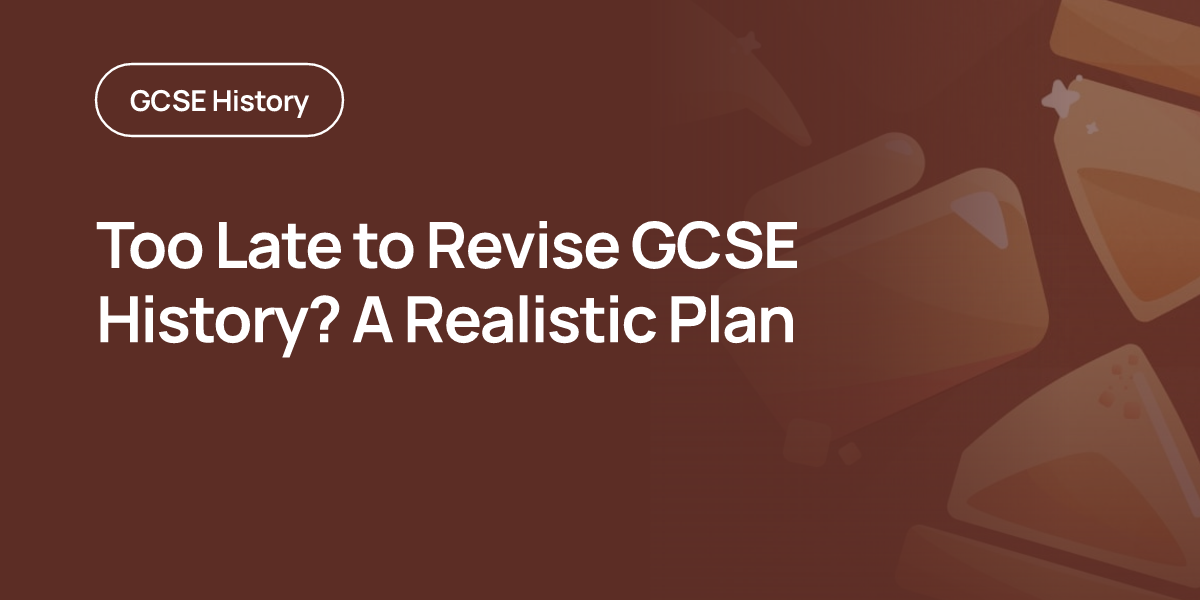
There is a particular kind of panic that arrives when you open your History folder and realise the exam is close. The course suddenly looks enormous: several periods, hundreds of names and dates, source questions, interpretations and essays.
If you are wondering whether it is too late to revise GCSE History, the honest answer is no. You may not have time to learn everything perfectly, but focused revision can still improve your knowledge, answer structure, timing and use of evidence. Even close to the exam, those improvements can turn unfinished or vague responses into answers that collect more marks.
The aim is no longer to create the perfect revision programme. It is to make the remaining time count, while protecting enough time for GCSE Maths and your other subjects.
Your late GCSE History revision checklist
Start with these priorities:
- Confirm your exam board, papers and exact options.
- Use the specification to identify what you actually need to know.
- Test yourself before choosing what to revise.
- Prioritise weak, frequently examined skills rather than rewriting everything.
- Combine factual recall with exam-question practice.
- Check answers against official mark schemes.
- Keep GCSE Maths revision active alongside History.
- Protect your sleep before each exam.
Late revision becomes useful when it is selective. The question is not, “Can I cover the entire course?” It is, “Which actions are most likely to improve my next answer?”
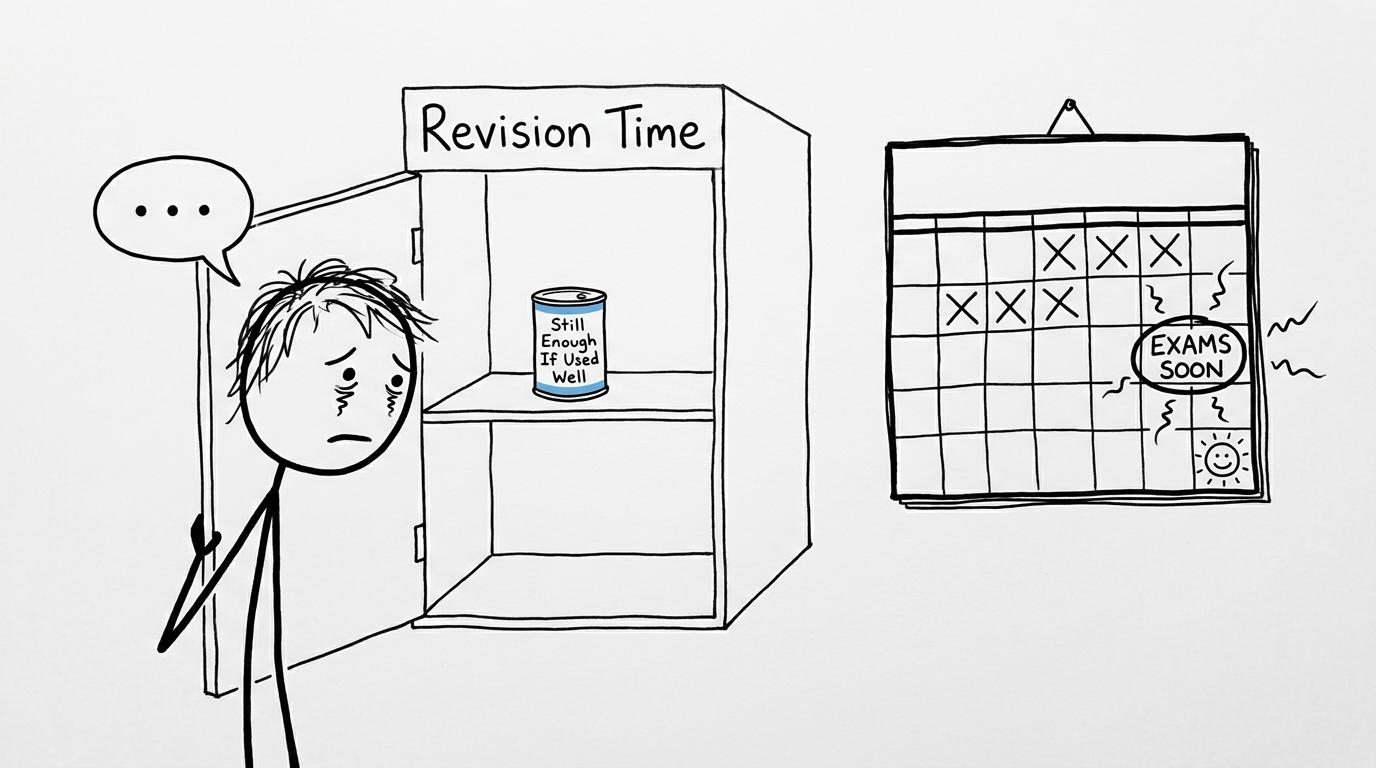 A student discovers that a small amount of revision time can still be useful
How much difference can late revision realistically make?
No responsible revision guide can promise a particular grade increase. Your result depends on your starting knowledge, the questions on your papers, the quality of your answers and the amount of focused time remaining. Grade boundaries also vary between exam series.
What late revision can do is reduce avoidable losses. GCSE History answers often weaken because a student cannot recall precise evidence, misreads a command word, writes description instead of explanation, or spends too long on one question. Each of those problems is trainable.
The official assessment objectives used by GCSE History exam boards reward four broad areas:
- AO1: knowledge and understanding of the periods studied.
- AO2: explanation and analysis using concepts such as cause, consequence, change, continuity, significance, similarity and difference.
- AO3: analysis, evaluation and use of contemporary sources.
- AO4: analysis and evaluation of historical interpretations.
Across current GCSE History qualifications in England, AO1 and AO2 are each worth approximately 35%35\%35% of the qualification, while AO3 and AO4 are each worth approximately 15%15\%15%. This matters because factual recall alone is not enough. Knowledge supplies the material, but explanation, analysis and judgement turn it into marks.
A few focused sessions can therefore help in two ways: they can restore missing knowledge and improve how you deploy the knowledge you already possess.
First establish what your exam actually covers
AQA, Pearson Edexcel, OCR and Eduqas do not arrange their History papers in exactly the same way. Schools also choose different options within each specification. Revising a popular topic that your class did not study is a particularly expensive mistake when time is short.
Check your exam-board specification, school checklist or teacher’s guidance. Write down:
- the topics included on each paper;
- the question types used on that paper;
- the marks available for each question;
- whether source or interpretation skills appear;
- any requirements concerning spelling, punctuation and grammar;
- the duration and date of each exam.
Unlike GCSE Maths, GCSE History is not divided into foundation and higher tiers. In Maths, tier and exam board directly shape the content you need. MathsGenie’s GCSE Maths topic list by board and tier can help you keep that separate plan accurate.
Choose revision by evidence, not anxiety
When time feels scarce, students often begin with whichever folder looks thickest. That feels industrious, but the size of a folder tells you little about where your next marks are hiding.
Instead, complete a short diagnostic check. Without notes, try to produce a basic timeline for each History unit and list the key individuals, events, causes, consequences and turning points. Then inspect past questions and decide whether you understand their command words.
Classify each area:
- Secure: you can recall precise evidence and use it in an answer.
- Partial: you recognise the material but struggle to retrieve or explain it.
- Weak: you cannot yet outline the topic or approach its questions.
Partial areas often offer the quickest gains. A topic you nearly know may require one concentrated session, whereas rebuilding a completely unfamiliar unit could consume several. Weak areas still matter, but begin with their essential chronology and major themes rather than every minor detail.
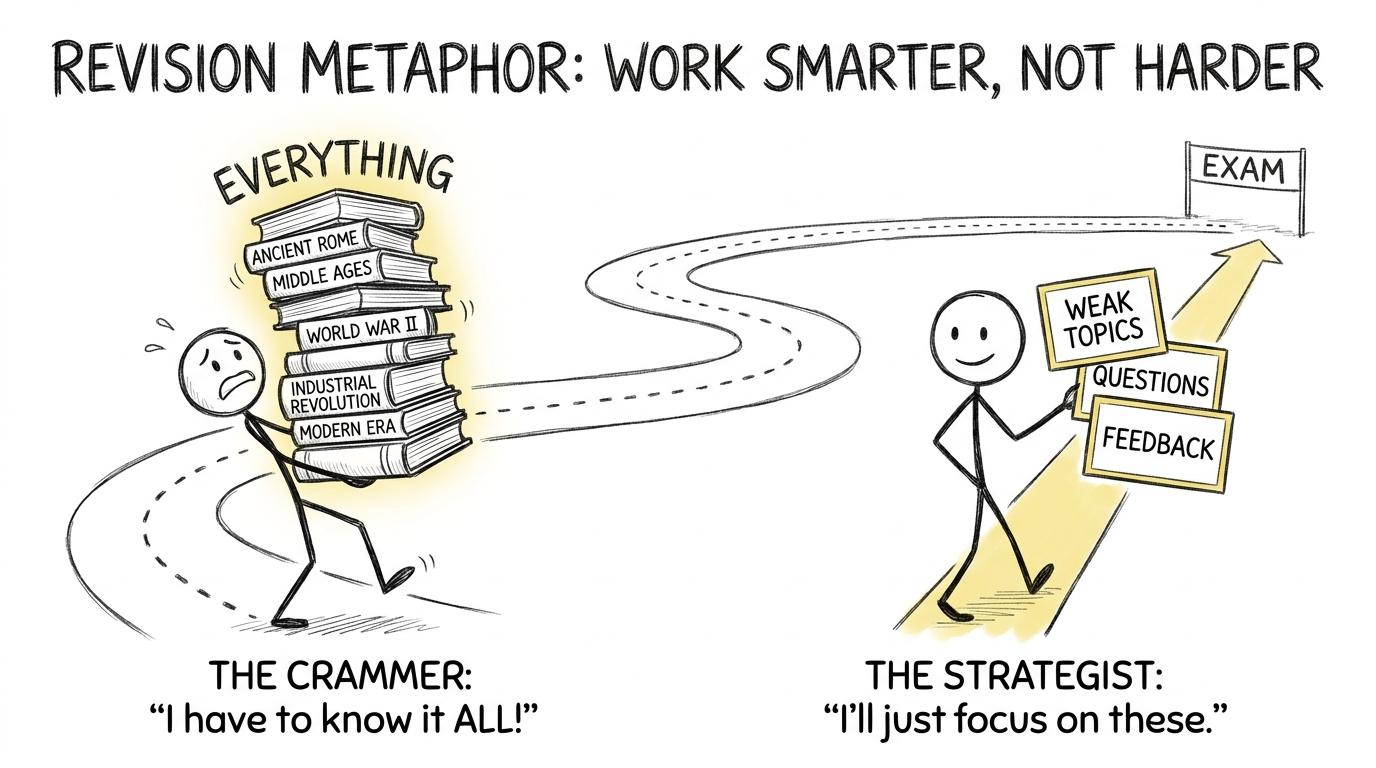 One student carries everything while another takes a focused revision shortcut
What to do when the History exam is weeks away
With several weeks remaining, you still have time to alternate content and application.
Create a one-page overview for each unit. Include the chronological spine, essential individuals, major causes and consequences, significant changes and a small bank of precise supporting evidence. Then close the page and reproduce as much as possible from memory. Check it, correct omissions and test it again later.
Every revision cycle should include an exam question. It does not always need to be a complete paper. One planned essay, one source evaluation or one timed explanation can reveal more than another hour of highlighting.
Use your teacher’s materials and official exam-board mark schemes to identify what a stronger response does. Look beyond the list of acceptable content. Pay attention to whether higher levels require developed explanation, sustained analysis, comparison, contextual knowledge or a substantiated judgement.
What to do when the exam is days away
When only days remain, breadth must become controlled. Do not attempt to manufacture beautiful notes for every lesson since Year 10.
Build a minimum-viable knowledge sheet for each topic containing:
- the sequence of major events;
- a short selection of accurate dates;
- key people and policies;
- two or three causes and consequences of major developments;
- important examples of change and continuity;
- evidence that could support competing sides of an argument.
Then practise retrieval. Cover the sheet, write what you remember and compare. Reading creates familiarity; retrieval reveals whether the knowledge will be available when the paper is closed and the clock is running.
You should also rehearse question selection, planning and timing. The precise question formats differ by exam board, so use papers and mark schemes from your own specification rather than relying on a generic essay formula.
What if the exam is tomorrow?
The night before an exam is a poor time to chase the whole specification. Narrow the task.
Review your key timelines, vulnerable topics and question requirements. Practise planning rather than writing several full essays. Check that you know how much time you intend to allocate to each section, pack what you need and stop at a sensible hour.
One exhausted extra session may leave you slower and less accurate the next morning. The purpose of final revision is to make useful knowledge accessible, not to prove how long you can remain at a desk.
 A student bargains with a clock for one focused revision session
Balance late History revision with GCSE Maths
History panic can quietly absorb every available evening. That is risky if you are also preparing for Maths, where methods and problem-solving fluency need regular practice.
A sensible plan keeps both subjects moving. You might alternate a History retrieval block with a Maths practice block, then finish by checking errors in each. The exact length matters less than having a specific output: a recalled timeline, an essay plan, a completed mini test or a marked set of questions.
Use the free GCSE Maths revision hub to choose lessons and questions based on weaknesses rather than browsing randomly. Students taking Pearson can use the Edexcel GCSE Maths resources, while separate collections are available for AQA GCSE Maths revision, OCR GCSE Maths revision and Eduqas GCSE Maths revision.
This is where a revision planner becomes valuable. Assign topics to limited slots, leave space for feedback and avoid scheduling every minute. A plan with no spare capacity usually collapses after one difficult day.
Revise History answers, not just History facts
Knowing that an event happened is different from explaining why it mattered. Before answering, identify the historical thinking demanded by the question.
A causation question needs developed reasons and links between them. A change question needs comparison across time. A significance question requires an explanation of importance, not merely a description of the event. A judgement question needs evidence on more than one side and a conclusion that answers the exact wording.
Source evaluation should be tied to the enquiry. Consider the source’s content, nature, origin and purpose, then use contextual knowledge to judge what it contributes. Avoid declaring that a source is simply “biased” and therefore useless. A source created to persuade may still be valuable evidence of the message its creator wanted an audience to accept.
Interpretations are later constructions of the past, not the same as contemporary sources. Questions may ask how interpretations differ, why they differ or how convincing they are. Always follow the wording and mark scheme used by your board.
Common mistakes in last-minute GCSE revision
Rewriting every note
Copying can look productive while demanding little retrieval. Make notes only when they create a concise resource you will actively test.
Memorising dates without relationships
Dates help establish chronology and precision, but isolated dates do not explain cause, consequence or significance. Connect each fact to the argument it can support.
Practising only favourite topics
Confidence is pleasant, but weak areas are usually where additional revision has greater value. Keep secure topics warm while directing more time towards partial knowledge.
Ignoring the mark scheme
Completing questions without reviewing them can reinforce weak habits. Compare your response with the level descriptors, indicative content and teacher feedback.
Using the wrong exam board’s paper
Question styles and paper structures differ. Confirm whether you take AQA, Edexcel, OCR or Eduqas and use the correct specification.
Abandoning Maths because History feels urgent
Urgency is not the same as importance. Keep practising Maths methods and mixed questions, especially if your Maths paper follows shortly afterwards.
It is late, but the next decision still matters
You cannot recover yesterday’s revision time. You can decide what the next focused session produces.
Begin with your specification and diagnose what you can retrieve. Repair partial topics, learn the chronological spine of weaker ones and practise the exact questions used by your exam board. Mark what you write. Repeat what you forget. Keep enough structure in your week for Maths and your other GCSEs.
For Maths, start at MathsGenie’s free revision homepage and move from a revision lesson to practice questions, mini tests and past papers. Use mark schemes and video solutions to understand errors, then build exam readiness with predicted papers. The clock may limit how much you can do, but it does not make the next useful step too late.