

Too Late to Revise GCSE English Language? Start Here
Too late to revise GCSE English Language? Learn what late revision can still change, what to prioritise and how to build a realistic plan for the exam.
The calendar can make revision feel more final than it really is. Perhaps the exam is a month away. Perhaps it is next week. You may be looking at everything you have not covered and wondering whether starting now would make any difference.
If you are asking whether it is too late to revise GCSE English Language, the useful answer is no. Late revision cannot guarantee a particular grade, but focused practice can still improve your timing, understanding of the questions, use of evidence and control of your writing. Even close to the exam, those are meaningful gains.
The aim is no longer to revise everything equally. It is to identify the skills that can still earn marks, practise them under realistic conditions and learn from each attempt.
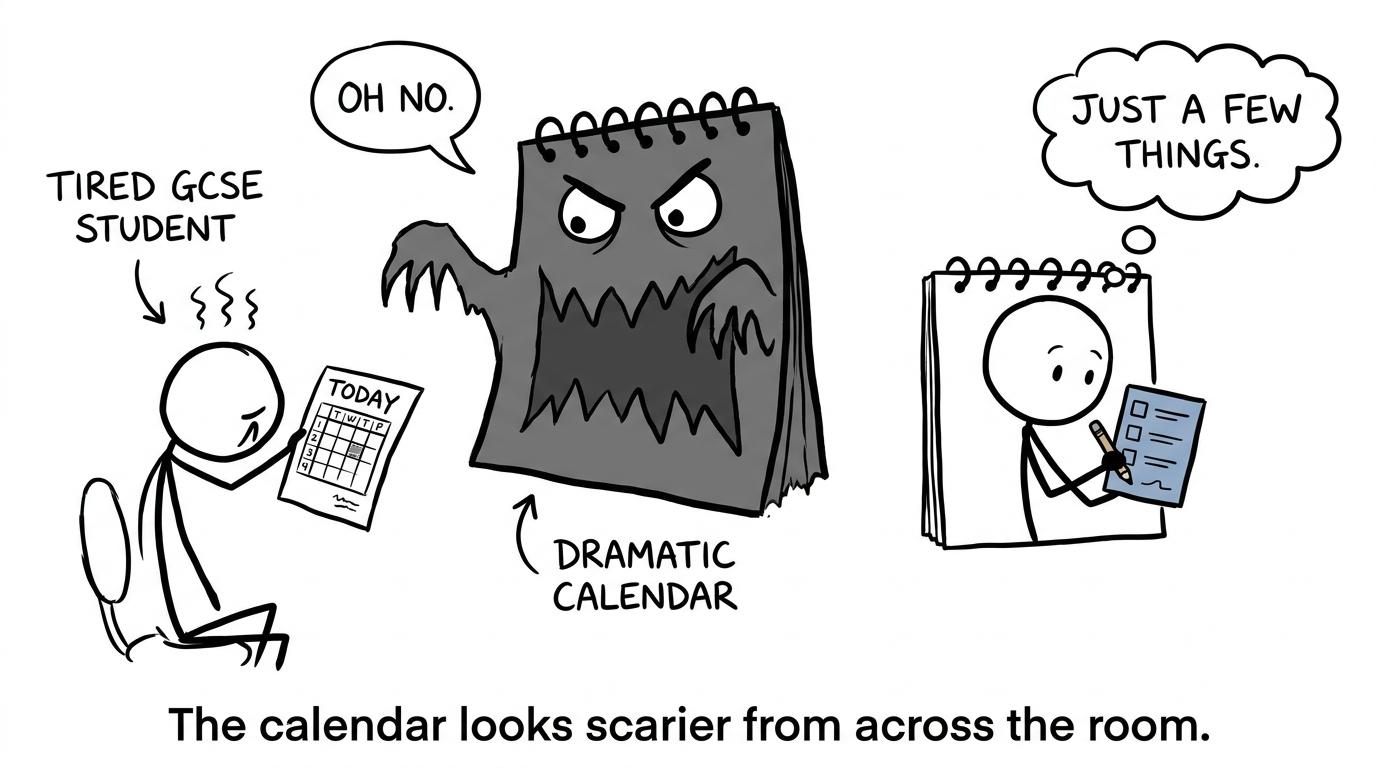 A student discovers that the frightening revision calendar is carrying a helpful checklist
A quick late-revision checklist
Before making a detailed timetable, establish what you are preparing for:
- Confirm your exam board: AQA, Pearson Edexcel, OCR or Eduqas.
- Find the current specification and the correct paper structure.
- List the reading and writing tasks that can appear.
- Complete one paper, or a manageable section, under timed conditions.
- Mark it using the official mark scheme and any teacher feedback available.
- Identify the two or three weaknesses costing you the most marks.
- Practise those weaknesses before attempting another timed task.
- Protect some revision time for maths and your other subjects.
GCSE English Language is not divided into foundation and higher tiers. However, exam boards organise and phrase their assessments differently. Advice for one board should not automatically be applied to another, so use papers and mark schemes that match your own specification.
How much difference can late revision make?
The honest answer depends on your starting point, the time remaining and how deliberately you practise. A student who already understands the texts but regularly runs out of time has a different problem from someone who does not yet recognise what each question requires.
Late revision is most effective when it addresses a specific obstacle. You might learn to select shorter, more precise quotations. You might stop spending too long on a low-mark question. You might plan writing before beginning or leave enough time to check sentence boundaries and paragraphing.
These improvements do not require you to become a completely different writer overnight. They require you to make better decisions during the exam.
If you have several weeks
You have time to build a short cycle of practice, feedback and repetition. Begin with a diagnostic paper, then divide your sessions between reading analysis, extended writing and timed sections. Complete at least some full papers so that concentration and pacing do not feel unfamiliar on exam day.
Several weeks also gives you room to revisit the same weakness. That matters because recognising advice is not the same as applying it independently.
If you have one to three weeks
Prioritise the structure of your own papers and the tasks that carry substantial marks. Practise planning and completing individual responses before combining them into longer timed sections.
Avoid producing large quantities of unmarked work. One response that you review carefully can teach you more than several responses placed in a folder and forgotten.
If you have only a few days
Do not attempt to relearn the entire course. Confirm the paper format, review the mark scheme language and practise the decisions you will need to make: reading the question precisely, selecting evidence, planning extended writing and moving on when the allocated time has passed.
Sleep and normal routines matter too. An exhausted final night is unlikely to repair months of uncertainty, while a rested student can still use the skills they already possess more effectively.
What to revise first for GCSE English Language
English Language revision can feel vague because there is no single list of facts to memorise. The subject rewards transferable reading and writing skills, but those skills can still be broken into practical priorities.
Know what every question is asking
Learn the command words, mark allocations and expected response style for your exam board. You should know where you are being asked to retrieve information, analyse language or structure, compare viewpoints, evaluate a statement or produce your own writing.
Do not rely on a generic social-media formula without checking whether it fits your paper. A reliable method begins with the actual question and the relevant assessment objective.
Practise selecting and explaining evidence
Many reading responses improve when the evidence becomes more precise. Long copied sections can hide the detail you intended to discuss. Practise choosing a relevant word, phrase or structural feature, then explain how it shapes meaning or affects the reader.
Technique spotting alone is rarely enough. Naming a metaphor does not complete the analysis. The valuable thinking lies in explaining what the writer suggests and how the evidence supports that interpretation.
Prepare for extended writing
You cannot predict every prompt, but you can practise the process. Generate ideas, choose a clear viewpoint or direction, plan a purposeful sequence and control your paragraphs. Accuracy matters alongside ambition: punctuation and vocabulary should make meaning clearer, not merely look impressive.
Review recurring errors in spelling, sentence construction and paragraphing. A short personal checklist is more useful than trying to remember every possible writing rule at once.
Train your timing
Timing is a skill, not a personality trait. Use the recommended timings supplied by your school or exam board as a starting point, then practise moving through the paper without allowing one answer to consume the rest of the exam.
A timed section can be useful when a full paper feels overwhelming. Build towards whole-paper practice when time allows.
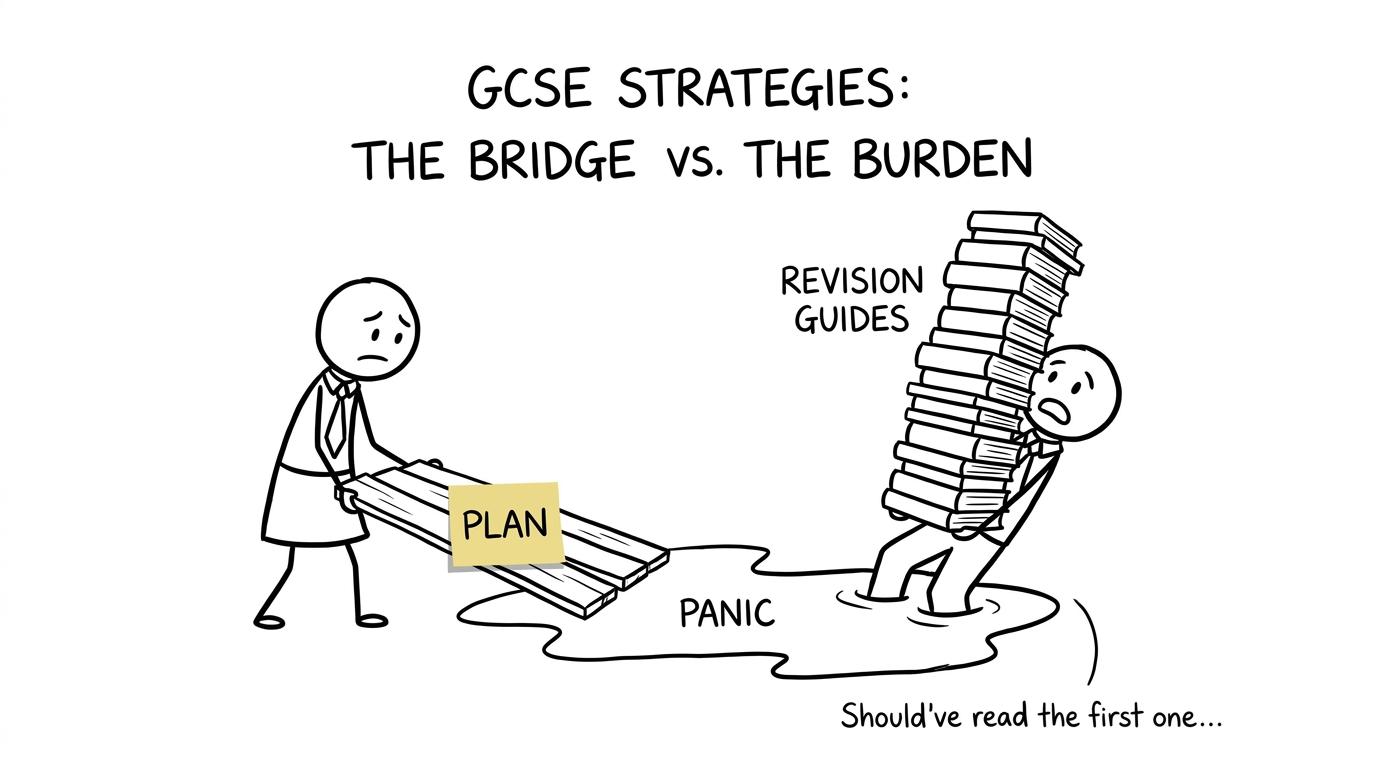 A simple plan forms a bridge over revision panic
Use the paper as feedback, not a verdict
A practice paper is valuable because it reveals what to do next. Treat it like an investigation rather than a prediction of your final grade.
After each attempt, ask:
- Did I answer the exact question?
- Was my evidence relevant and precise?
- Did I explain meaning rather than list techniques?
- Was my writing organised for the stated audience and purpose?
- Where did I lose time?
- Which error appeared more than once?
Use the mark scheme to understand what examiners reward, but do not expect it to contain one perfect model answer. For interpretive questions, different responses may be valid when they are supported convincingly by the text.
If possible, ask your English teacher to review a small number of carefully chosen responses. Focused feedback on a repeated weakness is particularly valuable when revision time is short.
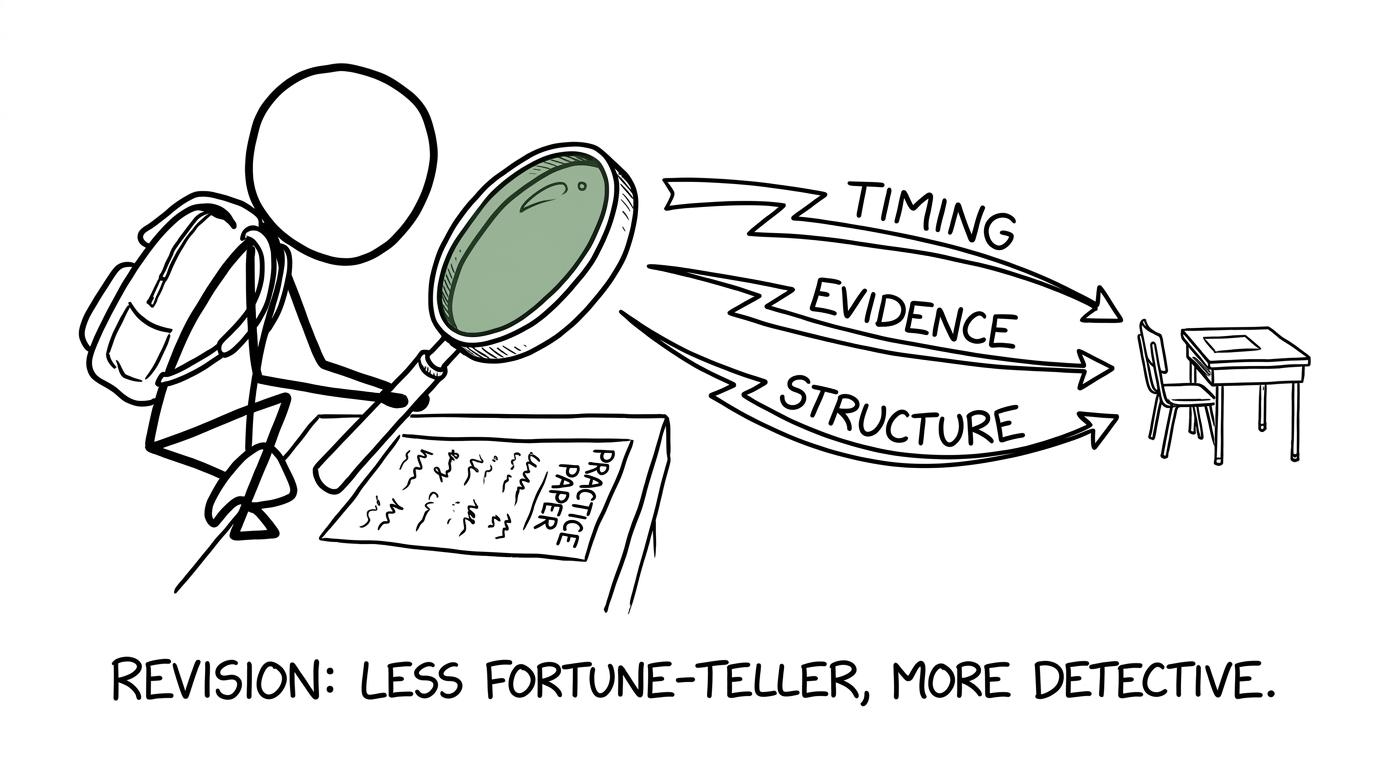 A student investigates a practice paper like a detective
Balance English revision with GCSE maths
Students preparing for GCSE English Language are usually balancing several exams. Panic often creates an all-or-nothing timetable: one subject receives an entire day, while another disappears completely.
A better approach is to give each session a defined outcome. You might complete one English reading task, review it and then switch to a selected maths topic. MathsGenie's free GCSE maths revision resources organise topics by grade and include videos, practice questions and solutions, making it easier to choose a specific task rather than losing time deciding what to revise.
If securing the standard pass is your immediate maths priority, concentrate on the skills listed within the grade four GCSE maths topics and grade five GCSE maths topics. Students aiming higher can use the grade six revision topics and grade seven revision topics to target gaps without revisiting everything.
You can then test broader exam readiness with GCSE maths past papers or use GCSE maths predicted papers for additional practice. Predicted papers are revision resources, not forecasts of the exact questions that will appear.
The principle is the same in both subjects: attempt, check, diagnose and return to the weakness.
Common late-revision mistakes
Revising methods instead of applying them
Watching explanations and reading model responses may help, but they can create false confidence. The exam asks you to produce your own response. Spend a meaningful proportion of each session writing, planning or annotating independently.
Memorising a response to force into any question
A prepared phrase or flexible structural habit may be useful. A memorised story, description or argument can become a problem when it does not suit the task, audience or purpose. Examiners reward relevance as well as technical control.
Ignoring the exact exam board
AQA, Edexcel, OCR and Eduqas papers are not interchangeable. Their question sequences, wording and assessment arrangements can differ. Check the current materials provided by your school and exam board before following online advice.
Completing papers without reviewing them
Practice is not simply evidence that you worked hard. Its purpose is to expose decisions that need changing. Mark the task, compare it with the assessment criteria and record one or two actions for the next attempt.
Sacrificing every other subject
English may be urgent, but maths also improves through regular retrieval and practice. A short, focused session on grade three GCSE maths topics, for example, can preserve essential skills while you place temporary emphasis on English.
Start with the next useful action
It may be late enough that the perfect revision plan is no longer available. That does not mean useful revision is unavailable.
Confirm your paper. Attempt a task. Check it carefully. Choose the weakness that matters most and practise it again. That sequence is simple, but it turns worry into evidence and evidence into a plan.
For the maths side of your timetable, start with MathsGenie's free revision lessons and topic-based practice questions, then move to past papers, predicted papers, mark schemes and video solutions. Use mini tests and a revision planner to keep the work manageable. You do not need to feel fully prepared before beginning; you become better prepared by beginning.










