Too Late to Revise GCSE Arabic? A Realistic Plan
Too late to revise GCSE Arabic? Learn what focused late revision can still change, how to prioritise four skills and protect your GCSE maths time calmly.
The calendar can turn revision into a judgement. A month becomes a week; a week becomes a handful of evenings. Suddenly, opening a vocabulary list feels like evidence that you should have started sooner.
If you are asking whether it is too late to revise GCSE Arabic, the honest answer is no. Focused revision can still improve vocabulary recall, response structure, translation accuracy, listening technique and confidence. What it cannot do is compress an entire course into one heroic night or guarantee a particular grade.
Your task now is not to recover lost time. It is to use the time that remains well, while protecting the revision needed for GCSE maths and your other subjects.
Your late GCSE Arabic revision checklist
Start with these decisions:
- Confirm your specification, tier and examination arrangements with your teacher.
- Check which assessment comes first, especially if speaking is scheduled before the written papers.
- Attempt material from all four skills: listening, speaking, reading and writing.
- Identify the two areas where focused practice could recover the most marks.
- Practise actively rather than repeatedly reading notes.
- Mark or review every task and record specific errors.
- Keep maths revision in your timetable instead of allowing Arabic to consume every evening.
- Protect sleep, particularly during the final days.
The current Pearson Edexcel GCSE Arabic qualification assesses listening, speaking, reading and writing. Each skill contributes 25%25\%25% of the qualification, and students take one tier, foundation or higher, across all four papers. Dictionaries are not permitted in the assessments. Check the latest official specification and instructions through your school, because arrangements can change between exam series.
How much can late revision realistically change?
Late revision is most useful when it converts partial knowledge into usable exam performance. You may already recognise more Arabic than you can retrieve quickly. You may know relevant vocabulary but lose marks because a writing response misses part of the prompt. You may understand a recording generally but struggle to capture a decisive detail.
Those are trainable problems.
Late revision is less likely to transform deeply insecure reading, grammar and vocabulary into effortless fluency. That is not pessimism. It is a reason to choose high-value actions instead of trying to relearn every page of the course.
If you have about a month
You still have time for a structured cycle: diagnose, practise, correct and revisit. Work across all four skills each week, but give extra sessions to your weakest areas. Complete longer timed tasks regularly and build a short vocabulary and grammar list from genuine errors.
The same principle works in maths. MathsGenie's one-month GCSE revision plan shows how diagnosis, retrieval and timed practice can turn several weeks into a purposeful sequence rather than a collection of anxious evenings.
If you have about a week
A week is enough to sharpen technique and secure familiar content. It is not enough to treat every topic equally.
Prioritise:
- common vocabulary from the specification themes;
- verbs and time frames you can use accurately;
- understanding every part of a writing or speaking prompt;
- short listening sessions with careful review;
- timed reading and translation practice;
- correction of repeated errors.
Use short blocks rather than one exhausting session. For example, three focused blocks of 252525 minutes provide
3×25=75 minutes 3 \times 25 = 75\text{ minutes} 3×25=75 minutesof active revision. The breaks matter because concentration matters. If several GCSE subjects are competing for attention, adapt the structure in the GCSE one-week revision plan rather than abandoning your timetable.
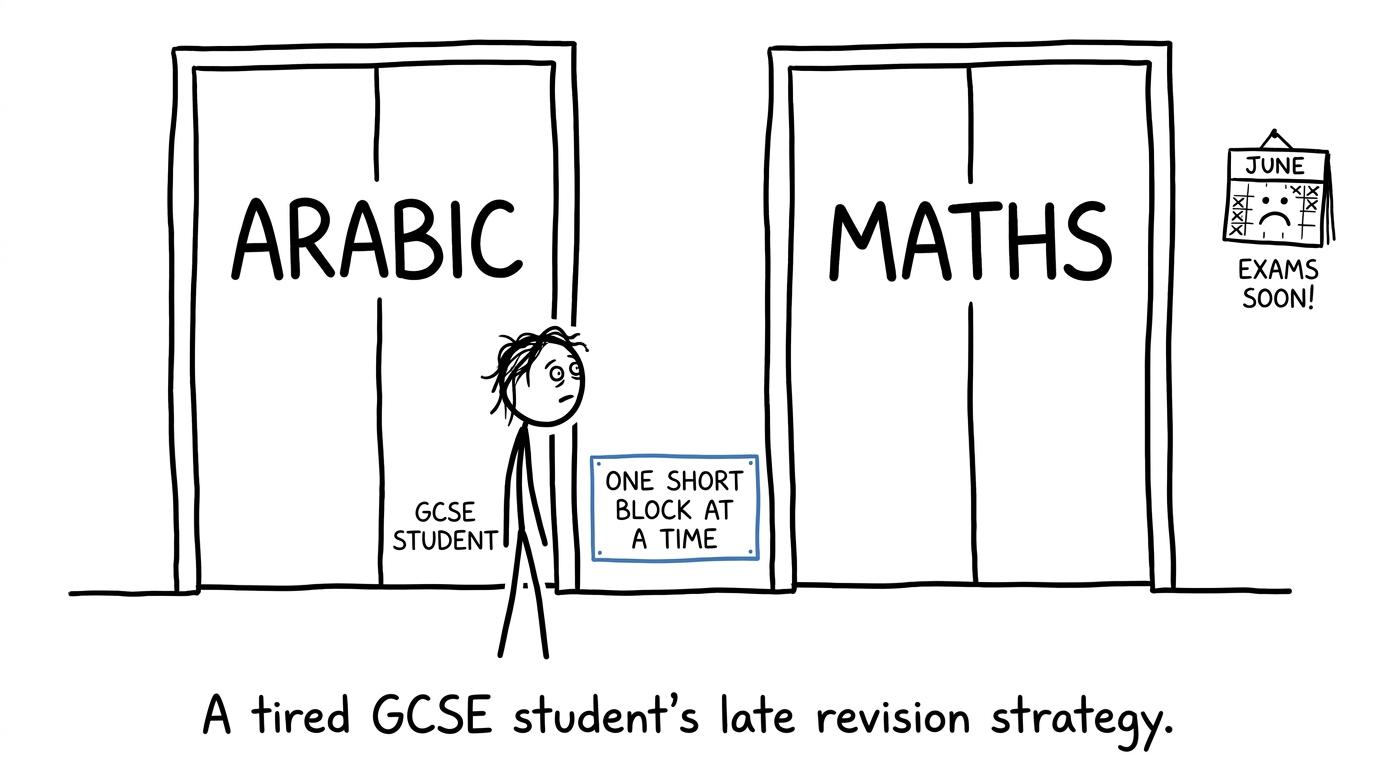 A student discovers that two intimidating GCSE subjects can be approached one short block at a time
If the exam is tomorrow
Do not attempt to learn the whole specification overnight. Review a compact set of dependable vocabulary, useful connectives, question words, common verbs and personal error notes. Complete one short task, check it carefully and stop at a sensible time.
For speaking, practise responding aloud without silently composing a perfect answer first. For writing, review how to address every bullet point and communicate clearly. For listening and reading, focus on instructions, negative expressions, time references, opinions and changes of speaker or viewpoint.
One calm final review can help. Sleep deprivation is not a revision strategy.
Prioritise the four GCSE Arabic skills
Because the Edexcel qualification gives equal weighting to the four skills, ignoring one entire paper is risky. Equal weighting does not mean that your remaining revision time must be divided equally, however. Your allocation should reflect evidence from practice.
A simple planning rule is
time for a skill=available revision time×priority share. \text{time for a skill}=\text{available revision time}\times\text{priority share}. time for a skill=available revision time×priority share.The priority share is a planning choice, not an examination weighting. Give more time to a weak skill where practice is producing clear corrections, while continuing short maintenance sessions elsewhere.
Listening
Listen with a purpose. Before the audio begins, read the question and identify what information is required. During review, separate vocabulary gaps from concentration errors and misread questions.
Repeatedly playing a recording without analysing the mistake can create familiarity without improvement. After checking an answer, note the exact word, contrast or detail you missed, then listen again.
Speaking
The current Edexcel speaking assessment includes a role play, a picture-based task and a conversation. Practise producing clear, relevant answers aloud. Retrieval speed matters: knowledge that remains trapped in a notebook cannot help during a live response.
Prepare flexible language rather than a rigid script that collapses when the question changes. Ask your teacher to confirm the assessment format, preparation rules and the areas you should practise.
Reading
Use timed passages and read the question before searching for evidence. Pay particular attention to whether the response must be given in English or Arabic. The Edexcel reading assessment also includes translation from Arabic into English.
When reviewing, classify errors: unknown vocabulary, grammar, inference, instruction or rushing. That classification tells you what tomorrow's session should contain.
Writing
Accuracy matters, but so does completing the task. Train yourself to identify every required element before writing. Use language that you can control, include justified ideas where appropriate and leave time to check verb forms, agreement, spelling and whether each prompt has been answered.
Do not spend late revision collecting impressive phrases you cannot adapt. A smaller bank of flexible, accurate language is usually more useful.
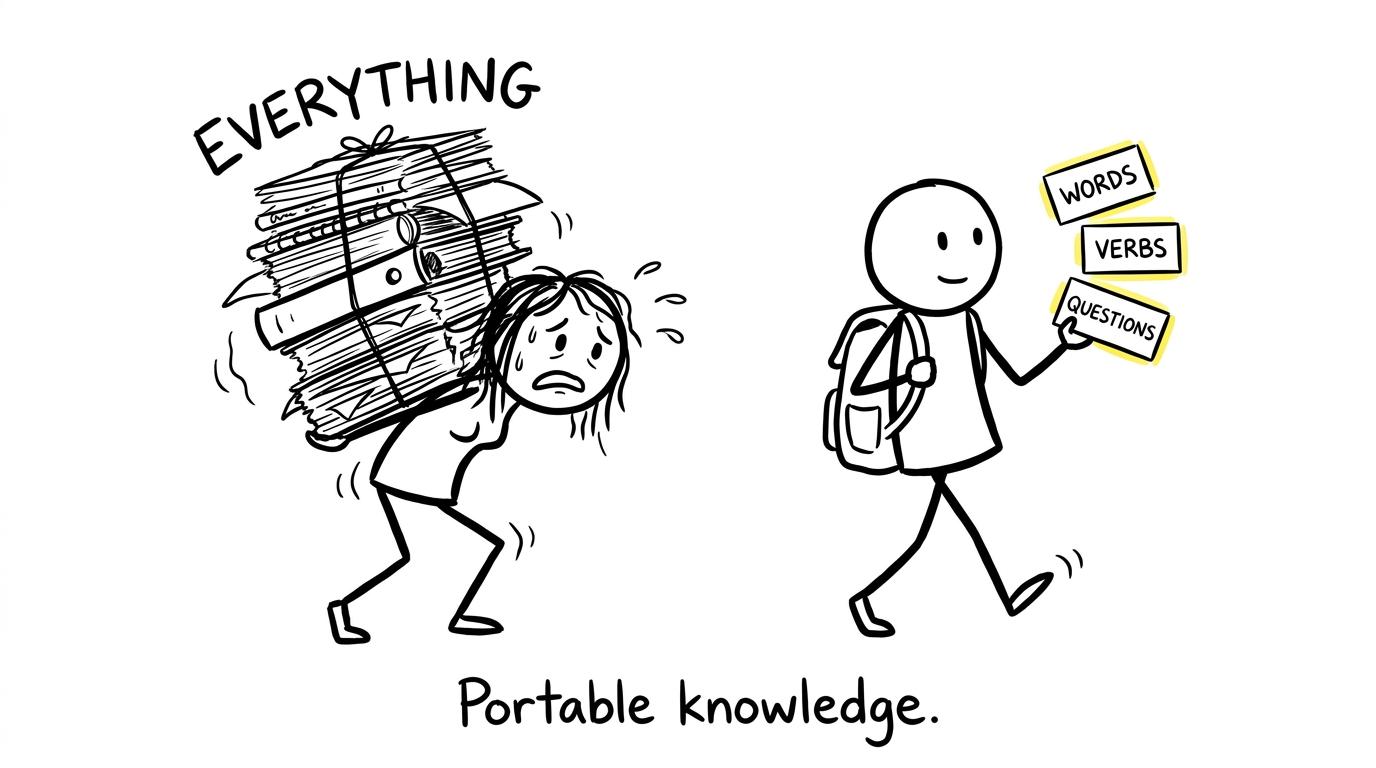 One student carries everything while another travels lightly with three focused revision cards
Use past papers as feedback, not decoration
A completed paper is only the beginning. The valuable part comes afterwards:
- mark the task carefully;
- identify why each mark was lost;
- correct the response;
- practise the underlying weakness;
- retest it later without notes.
MathsGenie's guide to using GCSE past papers properly explains this paper, mark, fix, retest cycle. Although the examples are designed for maths revision, the feedback principle transfers directly to Arabic.
Your error log should be specific. Write “missed the negative expression in listening” or “answered only two parts of the writing prompt”, not simply “bad at Arabic”. Specific problems create possible actions.
For Arabic papers, use material approved by your school or supplied by your examination board. For maths, choose your board and tier through the free GCSE maths revision hub. Edexcel students can also use organised GCSE maths past papers and mark schemes.
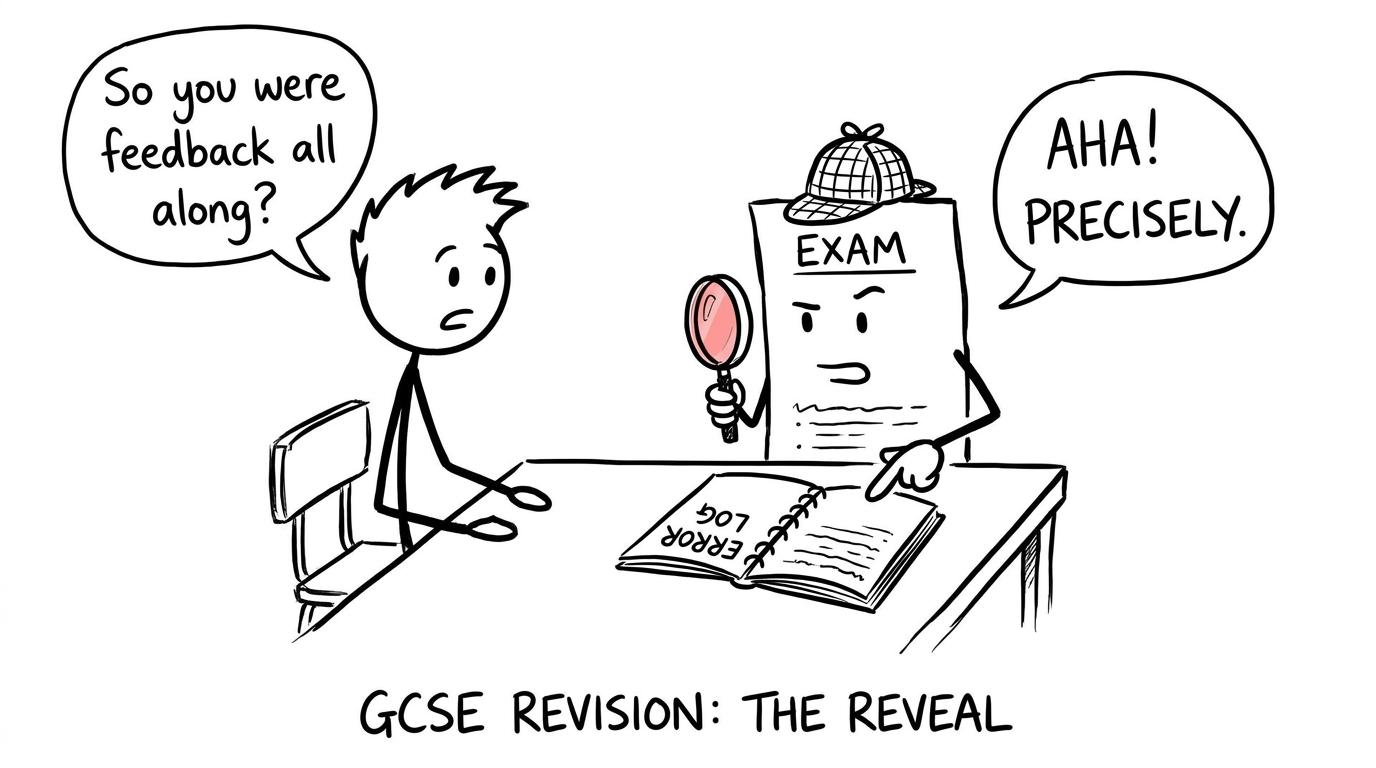 An exam paper reveals its secret identity as useful feedback
Balance Arabic with GCSE maths revision
Panic encourages extremes: an entire night on Arabic, followed by an entire night on maths. A repeatable timetable is more reliable.
Give each session one defined outcome. “Revise Arabic” is vague. “Complete and correct one listening task” is actionable. In maths, “do some algebra” is similarly weak; choose one lesson, a set of practice questions or a mini test instead.
On busy days, use a minimum session you can actually complete. The 20-minute GCSE revision routine offers a useful framework: recall, practise, mark and choose the next target. For longer maths sessions, the MathsGenie resources collection brings together mini tests, predicted papers and other revision material.
Late revision becomes manageable when decisions are made before the session begins. Decide the subject, skill, resource and stopping time. Then begin.
Common mistakes when starting GCSE Arabic revision late
Revising only comfortable topics
Familiar vocabulary feels productive because recognition is easy. Begin with evidence from a timed task and target what actually costs marks.
Copying vocabulary without retrieving it
Cover the answer, recall it and use it in context. Looking at a word repeatedly is not the same as being able to produce or recognise it under pressure.
Ignoring listening or speaking
Silent revision cannot fully prepare you for spoken language. Include short, frequent listening and speaking practice, even when written work feels safer.
Completing tasks without reviewing them
Unmarked practice can repeat the same mistake. Use teacher feedback, authorised mark schemes and model responses to understand what the assessment rewards. The principles in MathsGenie's guide to learning from GCSE mark schemes can help you turn feedback into a correction routine.
Sacrificing every other subject
Arabic matters, but so do your maths papers and other GCSEs. Allocate time according to examination dates, current weaknesses and realistic mark gains. Ask a teacher for help if priorities are unclear.
Start with the next useful action
It may be late enough that your original revision plan is no longer possible. That does not make today's work pointless. A focused listening review can prevent a repeated mistake. Speaking aloud can make familiar language easier to retrieve. One corrected writing task can expose the habit that has been leaking marks.
Choose one Arabic skill and complete one active task today. Then schedule the next revisit. For maths, open the free GCSE maths revision hub, identify a weak topic and use MathsGenie's revision lessons, practice questions, mini tests, past papers, predicted papers, mark schemes and video solutions to follow the same learn, practise, fix cycle.
You cannot revise yesterday. You can still make the next session count.