

Tell Your Teacher You're Struggling With GCSE Dance
Tell teacher struggling GCSE Dance: why speaking up early brings clearer support, protects maths revision time and creates a realistic plan for exams.
The hardest part of falling behind is often not the unfinished work. It is pretending that everything is under control while quietly calculating how many evenings it might take to recover.
If you are wondering whether to tell your teacher you're struggling with GCSE Dance, the short answer is yes. Tell them early, explain the specific difficulty and ask for one practical next step. Speaking up cannot guarantee changed deadlines or marks, but it gives your teacher a chance to clarify expectations, identify priorities and connect you with appropriate support.
This matters particularly when Dance is competing with maths and other GCSE subjects for limited revision time. Quietly trying to catch up can feel responsible. Often, it simply allows uncertainty to grow.
A quick checklist before you speak to your teacher
You do not need a polished speech. Before the conversation, note down:
- which part of GCSE Dance feels difficult;
- when the problem began;
- what you have already tried;
- any approaching assessment or rehearsal dates;
- how the situation is affecting other subjects, sleep or wellbeing;
- one thing you would like help with first.
A useful opening is: “I am struggling with the choreography section and I am not sure what to prioritise. Could we agree on the first two things I should work on?”
That is clearer than saying “I am bad at Dance”, which describes a feeling but gives the teacher little information to act upon.
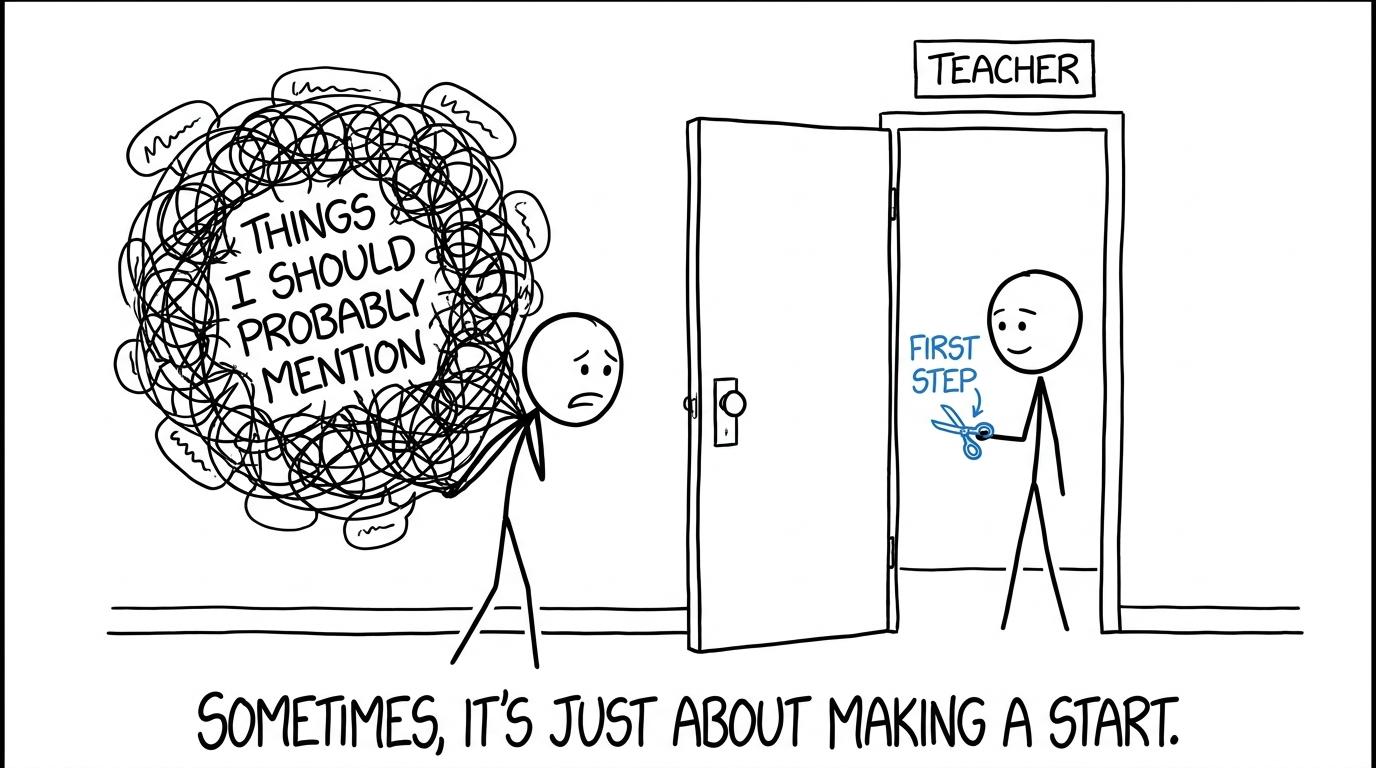 A student discovers that speaking to a teacher can untangle a large revision problem
Why raising the problem early tends to help
A difficulty hidden from your teacher is difficult for them to respond to. They may see an incomplete task or hesitant performance, but they cannot automatically know whether the cause is unclear feedback, missed lessons, confidence, injury, workload or something outside school.
An early conversation turns a vague problem into information. Your teacher may be able to:
- explain the assessment criteria in simpler language;
- identify which skill should come first;
- give more precise feedback on performance or choreography;
- direct you towards suitable rehearsal or theory resources;
- help you create a manageable catch-up sequence;
- involve pastoral or learning-support staff where appropriate;
- explain which deadlines are fixed and where flexibility may be possible.
None of those outcomes requires you to wait until the situation becomes serious. Asking early usually preserves more options.
There is another benefit. Once a teacher has helped you define the next action, your independent work becomes more efficient. Instead of spending an evening trying to “revise Dance”, you might have a focused task such as reviewing feedback on expressive skills or planning one section of choreography.
Work out what kind of GCSE Dance problem you have
Under the current AQA GCSE Dance specification, performance and choreography make up 60%60\%60% of the qualification, while the written Dance appreciation component makes up 40%40\%40%. The written paper lasts one hour and thirty minutes and is marked out of 808080.
This distinction matters because “struggling with Dance” can describe several different problems.
Performance difficulties
You might be finding accuracy, timing, spatial awareness, expressive skills, confidence or remembering movement material difficult. Practical problems benefit from observation. Ask your teacher to identify one visible feature to improve rather than requesting general reassurance.
If pain, illness or injury is affecting your movement, tell an adult promptly rather than trying to perform through it. A subject teacher can follow the school’s procedures and help you find the appropriate support, but should not be treated as a substitute for medical advice.
Choreography difficulties
Perhaps you have ideas but cannot develop them into a complete piece. Alternatively, you may be unsure about choreographic intention, structure, motifs, devices, aural setting or how feedback relates to the assessment criteria.
Ask where your current work is least secure. Your teacher may be able to distinguish between a shortage of movement material and a problem communicating the intended idea. Those are different difficulties and require different actions.
Written appreciation difficulties
The written component requires knowledge as well as analysis, interpretation and evaluation. If you understand a professional work but struggle to express your ideas under exam conditions, say so. Your teacher needs to know whether the gap is recall, terminology, written structure or understanding.
Workload and confidence difficulties
Sometimes the subject content is not the whole problem. Several deadlines may have arrived together, or one disappointing rehearsal may have made every subsequent task feel larger.
Be honest about this. A realistic plan has to account for your full timetable, including maths revision, other subjects and rest.
What to say to your GCSE Dance teacher
Choose a calm moment rather than trying to explain everything while the class is beginning. You could ask briefly after a lesson, request a meeting or send a concise email through your school’s approved system.
Keep the message factual:
I am struggling with GCSE Dance, particularly the written appreciation work. I have tried reviewing my notes, but I am still unsure how to use evidence when evaluating a work. Could we discuss what I should practise first?
You can also mention the effect on your wider revision:
I am spending a lot of time trying to catch up, and it is beginning to affect my maths revision. Could you help me identify the essential Dance tasks for this week?
Specificity is not about proving that you deserve help. It simply helps the teacher diagnose the difficulty.
If speaking face to face feels overwhelming, write down your main points and read from them. You can also ask whether a parent, carer, form tutor or trusted member of staff can help you start the conversation.
Turn the conversation into a small recovery plan
A helpful meeting should end with actions, not just encouragement. Try to leave knowing:
- the first task to complete;
- what a satisfactory attempt should include;
- where to find the relevant material;
- when you will receive feedback;
- when progress will be reviewed.
Do not attempt to repair every gap in one weekend. Divide the work into “now”, “next” and “later”. The purpose of a catch-up plan is not to make the workload disappear. It is to put tasks into a useful order.
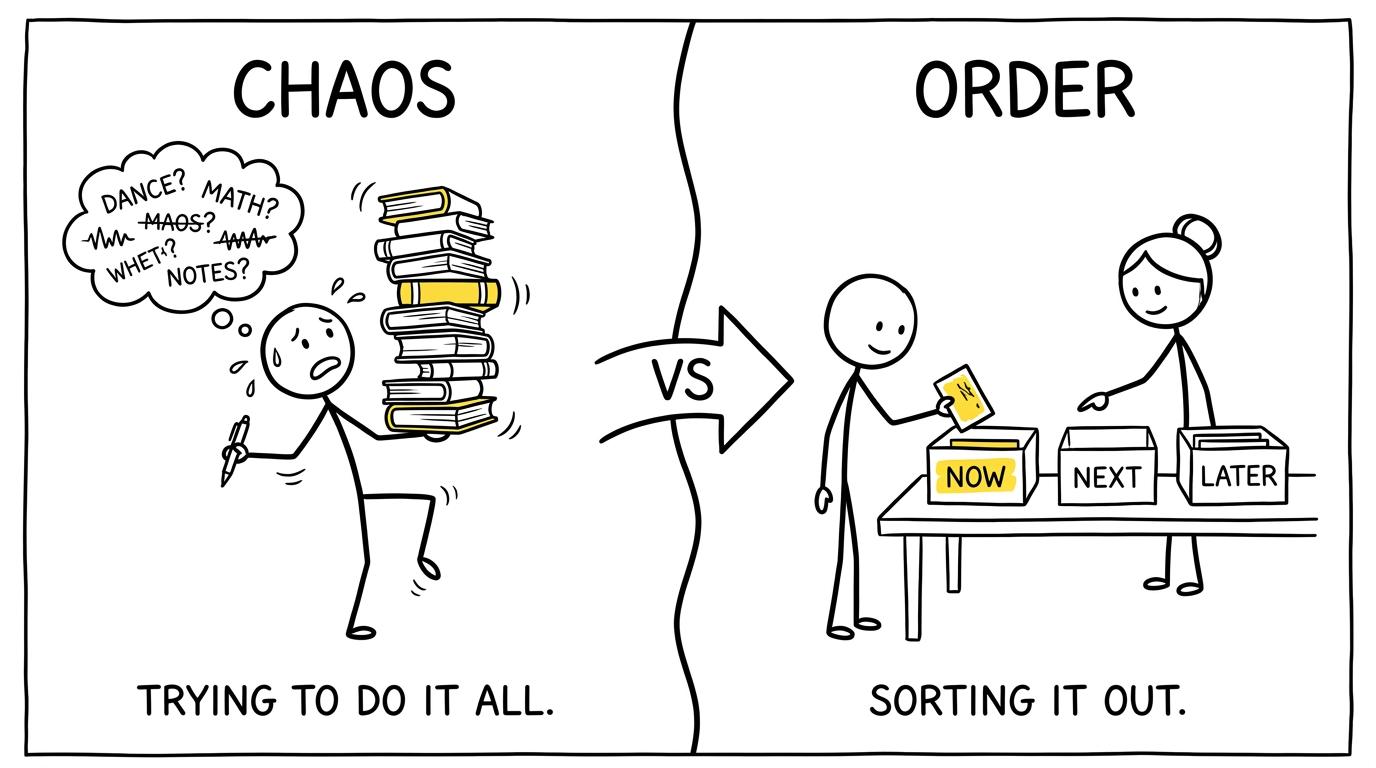 A chaotic workload becomes manageable when tasks are sorted into now, next and later
This same principle can protect your maths preparation. Use the GCSE maths revision hub to select resources for your exam board and tier instead of searching randomly. If your week is crowded with rehearsals, the twenty-minute GCSE maths revision routine gives you a repeatable minimum: recall, practise, mark and record the next target.
Short sessions are not a complete replacement for longer paper practice. They are a way to keep momentum when another subject temporarily needs more attention.
Protect your maths revision while catching up
Students preparing for Edexcel, AQA, OCR or Eduqas maths still need board-appropriate practice at the correct foundation or higher tier. The answer is not to ignore Dance until maths is finished, or abandon maths until the Dance task is complete. It is to give each session a defined job.
Start by creating one list for Dance and one for maths. For maths, use a mini test or paper section to identify the topics actually costing you marks. The guide to finding your weakest GCSE maths topics explains how to turn errors into precise revision targets.
Then build a sustainable week using the GCSE maths revision timetable guide. A balanced pattern might include:
- short topic sessions on busy rehearsal days;
- one longer maths session at the weekend;
- a fixed Dance catch-up block based on your teacher’s priorities;
- protected time for sleep and ordinary schoolwork.
When exams approach, use GCSE past paper timing guidance to introduce timed practice gradually. Edexcel students can also use GCSE maths predicted papers once core topic gaps have been addressed. Predicted papers are practice tools, not guarantees of what will appear.
What if the first conversation does not solve it?
A teacher may need time to review your work, and some assessment rules or deadlines may not be adjustable. Give the agreed action a fair attempt, then follow up with evidence: what you completed, what improved and what remains unclear.
If you feel dismissed or cannot approach the subject teacher, speak to another trusted adult in school. Depending on the issue, that might be your form tutor, head of year, head of department, pastoral team, school counsellor or special educational needs co-ordinator. A parent or carer can also help you explain the situation.
If stress is seriously affecting sleep, eating, attendance or daily life, tell a trusted adult rather than treating it as an ordinary revision problem. If you feel unsafe or at risk of harming yourself, seek urgent help from an adult or emergency service immediately. Academic catch-up can wait; safety cannot.
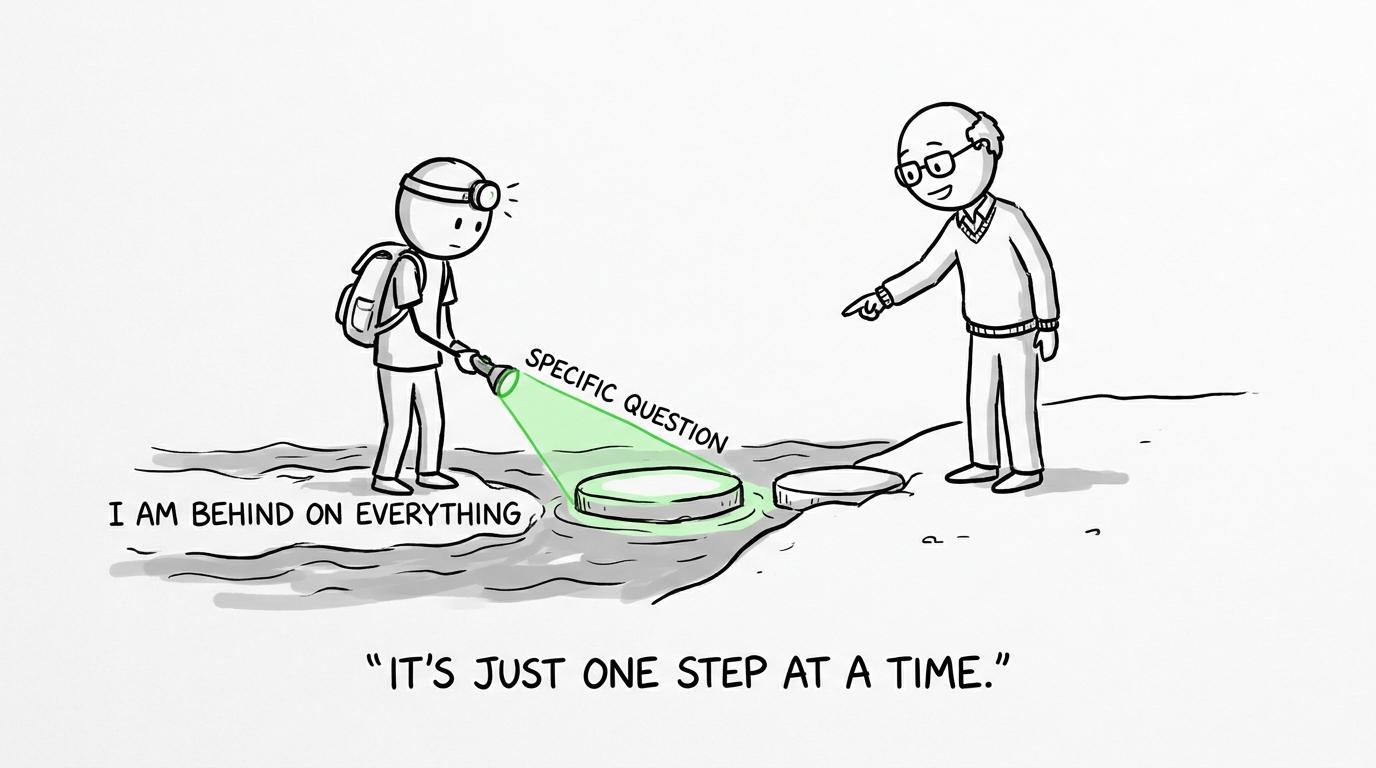 A specific question lights the next stepping stone through an overwhelming revision problem
Common mistakes when asking for help
Waiting until the final deadline
The later you speak, the fewer practical options may remain. You do not need to prove that you have exhausted every possible solution before asking for guidance.
Describing yourself instead of the problem
“I am useless at Dance” is neither accurate nor actionable. Identify the task, skill or situation that is difficult.
Expecting the teacher to remove every difficulty
Support may mean clearer feedback, better priorities or referral to another member of staff. It does not necessarily mean reduced assessment requirements or unlimited deadline changes.
Agreeing to an unrealistic catch-up plan
A plan that assumes several perfect evenings is fragile. Mention your maths workload and other commitments so the plan reflects the time you genuinely have.
Quietly stopping revision in another subject
Recovering in Dance should not create a hidden crisis in maths. Follow a clear sequence such as the best order for learning GCSE maths topics, and maintain a small revision minimum during unusually busy weeks.
Speaking up is part of taking responsibility
There is a common fear that asking for help looks like avoiding responsibility. Usually, the opposite is true. Responsibility means noticing when your current approach is not working, communicating the problem and acting on informed feedback.
Tell your GCSE Dance teacher early. Bring one or two specific concerns. Agree on the next task and a review point. Then protect the rest of your exam preparation with a timetable that is modest enough to follow.
For maths, let MathsGenie's free GCSE revision resources carry some of the organisational load. Use revision lessons and practice questions to repair individual topics, mini tests to check recall, and past papers or predicted papers to develop exam technique. Mark your work with the available mark schemes and use video solutions when the method remains unclear.
You do not need to solve the entire term tonight. You need one honest conversation and one useful next step.











