How to Tell Parents You're Struggling With GCSE RS
Tell parents you're struggling with GCSE Religious Studies calmly. Use this practical script to explain the problem, avoid a lecture and agree support.

Being behind in a subject is uncomfortable. Admitting it can feel worse, especially when you expect the conversation to become a lecture about effort, revision or screen time.
If your search was “tell parents struggling GCSE Religious Studies”, the immediate answer is this: choose a calm moment, describe the specific difficulty, explain what you have already tried and ask for one practical form of help. You do not need to defend your entire school record. You need to make the problem clear enough that you and your parents can decide what happens next.
This matters when GCSE Religious Studies is competing with maths, English, science and other subjects for limited revision time. Saying something early gives you more options. It can lead to a conversation with your teacher, a more realistic timetable or simply a quieter place to work.
A quick conversation checklist
Before speaking to your parents, prepare five things:
- The problem: identify exactly where you are falling behind.
- The evidence: bring a marked assessment, teacher comment or list of unfinished topics.
- What you have tried: mention revision, homework or questions you have already attempted.
- The help you want: ask for something specific and reasonable.
- The next check-in: agree when you will review whether the plan is working.
The goal is not to prove that everything is fine. It is to turn a vague worry into a manageable next step.
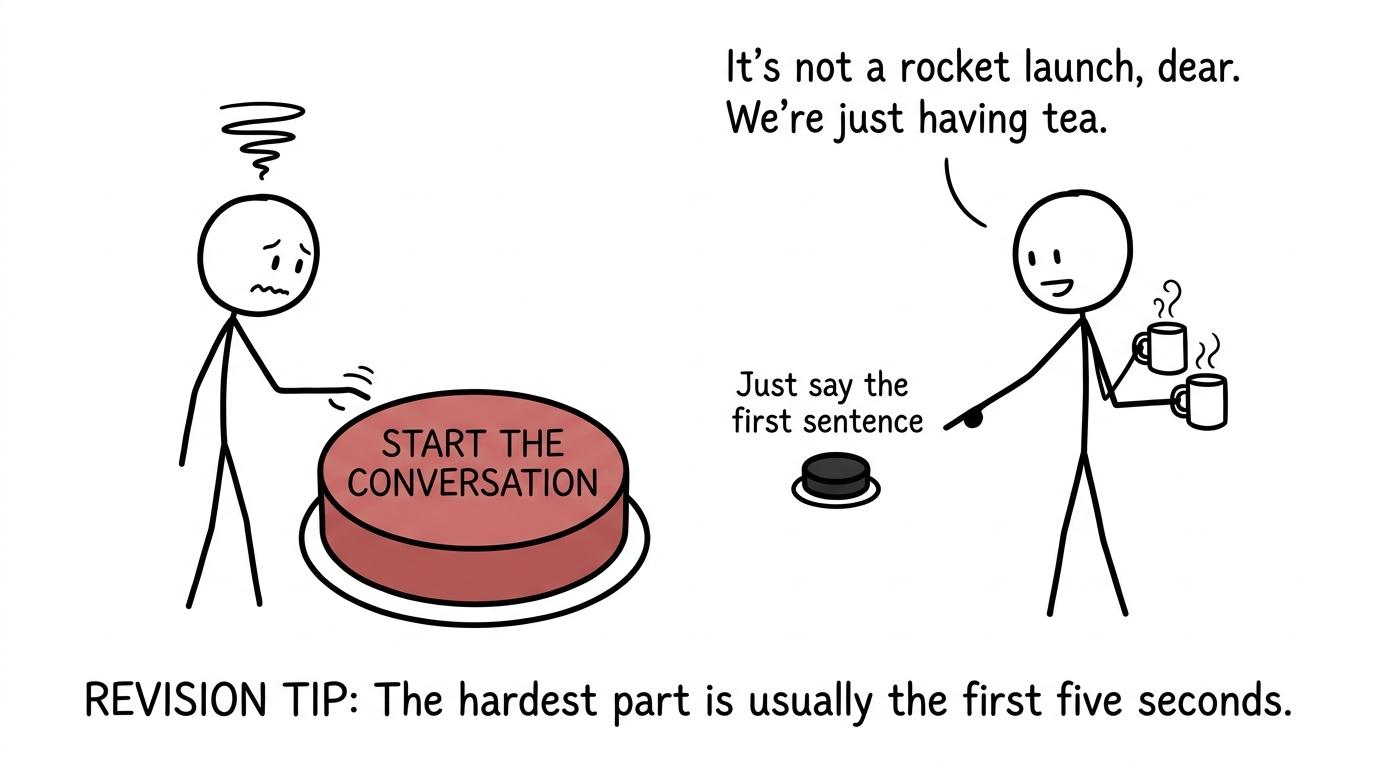 A student discovers that starting the conversation is smaller than it feels
Work out what “struggling” actually means
“I’m bad at Religious Studies” is a feeling, not a diagnosis. It gives your parents very little to work with and may invite an unhelpful response such as “just revise more”. A more precise explanation makes practical support possible.
Your difficulty might be that you:
- cannot recall beliefs, teachings or sources of authority;
- confuse different religious viewpoints;
- know the content but cannot structure extended answers;
- find analysis and evaluation harder than description;
- run out of time in assessments;
- have missed lessons or incomplete notes;
- do not understand what your exam board expects;
- are trying to revise too many subjects at once.
Official GCSE Religious Studies specifications assess both knowledge and understanding, commonly described through AO1, and analysis and evaluation through AO2. The exact papers, question formats and content depend on your specification and exam board, such as AQA, Edexcel, OCR or Eduqas. That is why “I lose marks on evaluation questions” is more useful than “I don’t get RS”.
Look at your latest marked work and write down three facts:
- the topic or question type causing difficulty;
- what your teacher or mark scheme says is missing;
- the next assessment or deadline you know about.
This is the same diagnostic habit that improves maths revision. The MathsGenie guide to finding your weakest topics explains why evidence is more useful than revising whichever topic happens to feel familiar.
Choose a moment that lowers the temperature
Timing cannot guarantee a perfect response, but poor timing can make a difficult conversation harder. Avoid starting just as someone is leaving for work, dealing with another problem or already annoyed.
Try asking for a short conversation first:
“Can we talk for ten minutes later? I’m falling behind in Religious Studies and I want help making a plan.”
That sentence does three useful things. It sets a time limit, names the subject and shows that you want a solution. It also gives your parent or carer a moment to switch into listening mode rather than reacting in surprise.
If talking face to face feels too difficult, send a message or write down your opening sentence. The aim is communication, not performance. You can also ask another trusted adult to help you begin the conversation.
Use a script that keeps the conversation practical
You do not have to improvise. A simple structure can stop nerves from turning your explanation into silence or an argument.
Start with the fact
“I’m struggling with GCSE Religious Studies, particularly remembering the content and using it in longer answers.”
Explain the impact
“I’m spending time on it, but my latest assessment showed that my answers are still missing the evaluation the questions need.”
Show what you have tried
“I’ve reread my notes and completed the homework, but I think I need clearer feedback on how to improve my answers.”
Ask for specific support
“Could you help me contact my teacher and protect two short revision slots each week until the next assessment?”
This is not a speech you must memorise word for word. Adapt it to the truth of your situation. If you have avoided revision, say so without turning the conversation into a confession:
“I left it too long because I felt overwhelmed. I want to fix that now, and I need help making the plan realistic.”
Honesty tends to be more productive when it is followed by a next action.
How to prevent the conversation becoming a lecture
You cannot control every parental reaction. You can, however, keep returning the discussion to the kind of help you need.
At the beginning, make the request explicit:
“Could you listen first, then help me decide on one or two next steps?”
If advice starts arriving before you have finished, respond calmly:
“I understand why you’re worried. Can I finish explaining what the problem is before we make the plan?”
If the discussion moves towards every missed homework or disappointing mark you have ever had, narrow it again:
“I know there are other things we may need to discuss. For tonight, can we focus on what I should do before the next RS assessment?”
A pause is also allowed. If voices rise, suggest returning to the conversation later that evening. Pausing is not avoiding the issue when you name a clear time to continue.
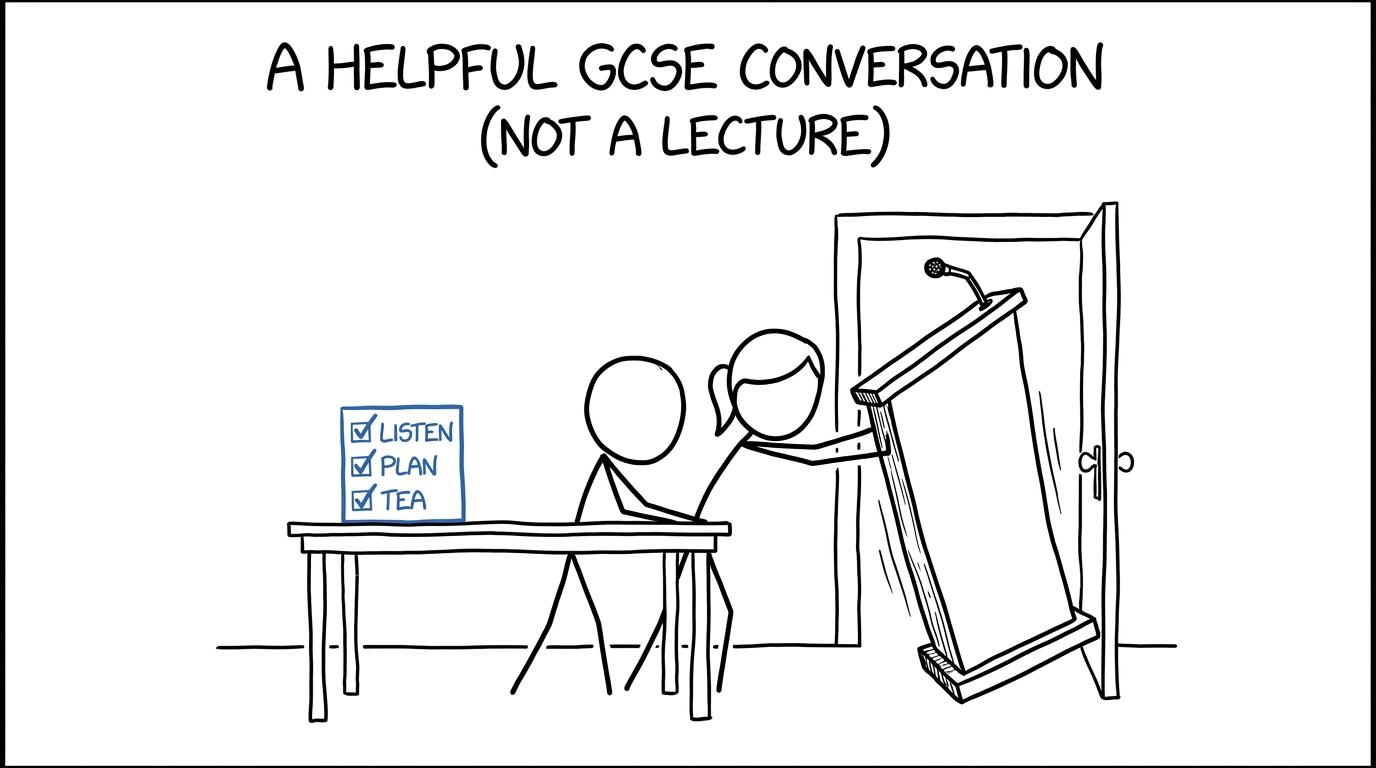 A student and parent remove the lecture podium before making a plan
Ask for help your parents can actually provide
Your parents do not need to know the difference between every belief, practice or ethical argument to help. They can support the conditions around revision.
Useful requests include:
- helping you email your RS teacher or arrange a meeting;
- asking your teacher which topics and question types need attention;
- helping you obtain missing notes or specification information;
- testing you with flashcards you have prepared;
- providing a quiet revision period without interruptions;
- helping you balance Religious Studies with maths and other GCSEs;
- checking in once a week rather than asking about revision every day.
The NHS advises that having someone to talk to can help students share worries and keep exam pressure in perspective. Its guidance also encourages practical support such as creating a revision schedule and using past papers. The important word is support: the plan should be created with you, not imposed without your input.
If your timetable is already crowded, use the principles in the GCSE maths revision timetable guide. Although the resources themselves focus on maths, the planning idea transfers: prioritise genuine weaknesses, use short repeatable sessions and leave room for rest and other subjects.
Turn the conversation into a small recovery plan
A useful conversation should end with actions rather than a promise to “work harder”. Keep the first plan short enough to follow.
For example, your plan might include:
- speak to your RS teacher this week;
- confirm your exam board, specification and assessed topics;
- identify two weak areas from marked work;
- complete two focused RS sessions each week;
- practise one extended response and ask for feedback;
- review progress with your parent after two weeks.
The revision method should match the weakness. Flashcards may help with definitions, beliefs and sources of authority, but they will not automatically teach evaluation. For longer answers, you need to practise planning and writing responses, then compare them with teacher feedback or the relevant mark scheme.
Avoid designing a heroic timetable that assumes you will suddenly revise every evening. A sustainable plan protects your maths preparation too. The 20-minute maths revision routine shows how a short session can still include recall, active practice and review. You can use the same shape for an RS topic while keeping subject content and exam techniques separate.
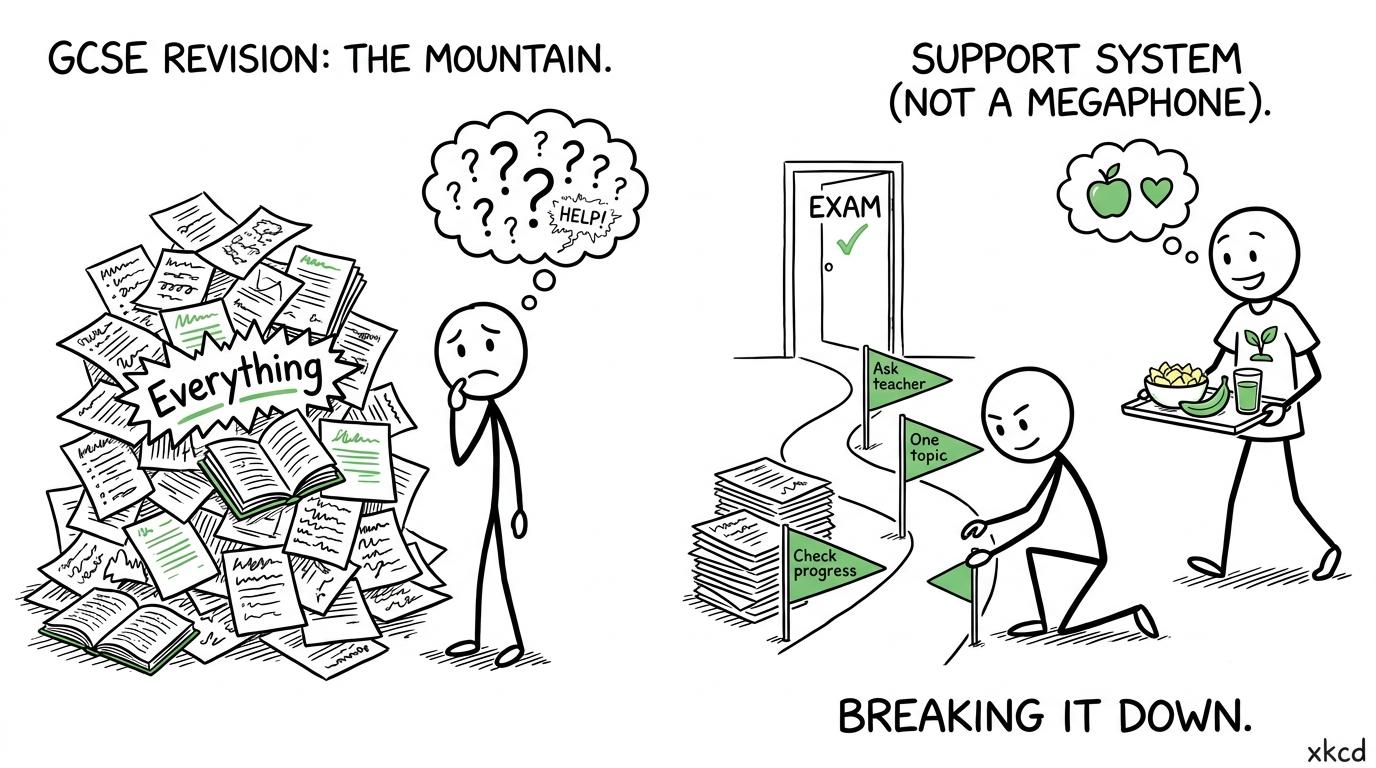 A student turns an impossible revision mountain into three manageable actions
Keep maths revision from disappearing
Students rarely struggle with only one demand on their time. Giving Religious Studies more attention must not mean abandoning maths until the next mock.
Keep a simple weekly balance:
- use short RS sessions for content recall and answer planning;
- reserve separate maths sessions for active question practice;
- mark work promptly so the next session targets a real weakness;
- schedule one catch-up space rather than filling every available hour.
For maths, the free GCSE Maths revision hub brings together revision lessons, exam questions, practice papers and solutions across exam boards. If you need a longer structure, the one-month GCSE maths revision plan helps organise diagnostic work, topic repair and timed practice.
Short tests can also make progress easier to see. The Edexcel GCSE Maths mini tests provide focused practice with mark schemes and solutions. Students following another board should select the matching board resources from the main GCSE hub.
Common mistakes when speaking to parents
Waiting until the night before an assessment
Late conversations leave fewer options and make panic more likely. Speak up when you notice a pattern, not only when the exam is hours away. If an assessment is already close, use a calm, limited plan rather than attempting to relearn the whole course. The GCSE maths night-before plan offers useful principles for protecting sleep and focusing on a few high-value actions.
Making the problem too vague
“I’m failing everything” can hide the problem you need to solve. Bring one marked answer, one topic list or one clear example of where you become stuck.
Promising an unrealistic amount of revision
A huge promise may end the conversation quickly, but it usually creates another disagreement later. Offer a plan you can repeat on an ordinary school week.
Treating concern as criticism immediately
A worried question can sound like an accusation when you already feel ashamed. Ask what your parent means before assuming the worst. Equally, you are allowed to say when a tone or comparison is making it harder to talk.
Asking parents to replace your teacher
Your parents can help organise support, but subject-specific feedback should usually come from your RS teacher. Ask what an improved response needs, which content has priority and where your current answers lose marks.
Hiding severe stress
If exam anxiety or low mood is persistent, severe or interfering with sleep, eating, school or everyday life, tell a trusted adult rather than carrying it alone. You can speak to a teacher, pastoral lead, school nurse or GP. Childline also provides confidential support for young people on 0800 1111.
Make the first sentence the next step
Falling behind feels private, but recovery usually begins with another person understanding the problem. You do not need a flawless explanation. You need one honest sentence, a little evidence and a request that your parents can act on.
Then keep the plan small: speak to your RS teacher, target the precise gap and check whether your approach is working. Protect time for your other GCSEs rather than allowing one difficult subject to consume every evening.
For maths, start with the MathsGenie GCSE revision hub. Use the free revision lessons and practice questions to rebuild weak topics, then test your progress with mini tests, past papers and predicted papers. Mark schemes and video solutions can show where marks are earned and what to change next time. The conversation with your parents opens the door; a calm, repeatable revision routine carries you through it.