

Tell Parents: Struggling With GCSE Biblical Hebrew
Tell parents you’re struggling with GCSE Biblical Hebrew using a calm script, clear evidence and a practical plan that protects your wider revision.
Falling behind can feel strangely private. You may be sitting at the same desk, attending the same lessons and carrying the same books, while quietly realising that the words make less sense each week. Then another worry appears: how do you explain it at home without triggering a lecture?
If you need to tell parents you are struggling with GCSE Biblical Hebrew, start with three things: choose a calm moment, describe the specific difficulty and ask for one practical form of help. You are not announcing failure. You are identifying a problem early enough to change what happens next.
That matters when Biblical Hebrew sits alongside GCSE maths and your other subjects. The aim is not to let one difficulty consume the whole revision timetable. It is to bring the problem into the open, involve the right teacher and agree on a manageable plan.
A quick conversation checklist
Before speaking to your parents or carers, prepare these points:
- What is going wrong: vocabulary recall, grammar, translation, set texts, lesson pace or exam technique.
- What evidence you have: teacher feedback, a recent assessment, unfinished homework or questions you could not answer.
- What you have already tried: revising notes, practising vocabulary or asking a classmate.
- What support you need: contacting your teacher, finding extra help, creating quiet revision time or reviewing your workload.
- When you will review the plan: agree on a short check-in rather than daily questioning.
Keep the first conversation focused. You do not have to explain the entire course or solve every problem that evening.
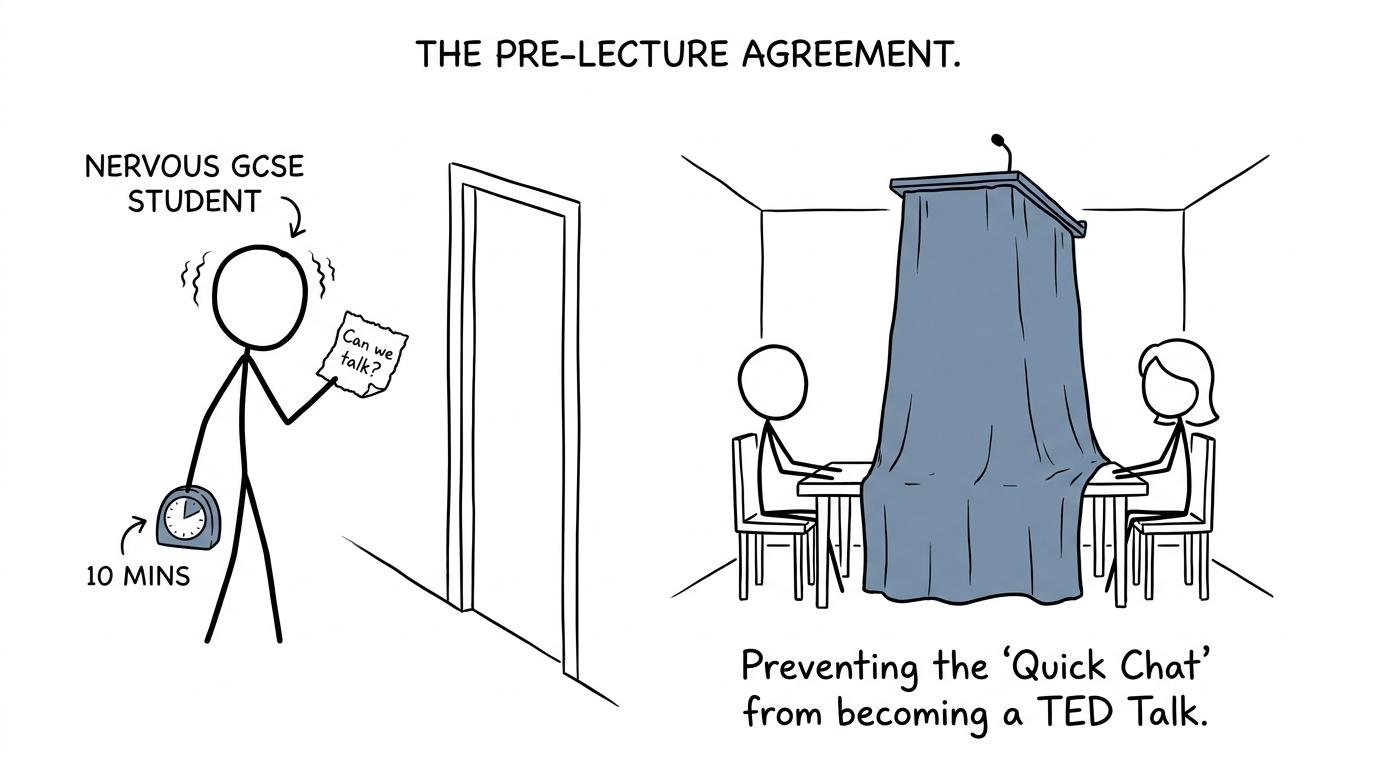 A student uses a ten-minute timer to stop a family conversation becoming an enormous lecture
Work out what “struggling” actually means
“I’m bad at Biblical Hebrew” is painful to say but difficult to act upon. A more precise description gives your parents something useful to understand.
Ask yourself where the difficulty begins. Can you recognise the vocabulary but not recall it independently? Do grammatical forms become confused? Can you translate individual words but lose the meaning of a complete passage? Are you comfortable in lessons but unable to reproduce that knowledge under timed conditions?
There may also be a workload problem rather than a single knowledge gap. Perhaps Biblical Hebrew takes so long that it crowds out foundation or higher tier maths revision. Perhaps you avoid the subject because starting feels uncomfortable, then feel guiltier as unfinished work accumulates.
Write down no more than three difficulties. For example:
- I cannot recall enough vocabulary without looking at my notes.
- I do not understand how to approach unseen translation questions.
- I am spending so long catching up that maths revision is being displaced.
Use only descriptions that are true for you. Also confirm the exact qualification title, specification and assessment structure with your school. GCSE Biblical Hebrew should not be confused with studying Judaism within GCSE Religious Studies, and your teacher is the best source for the requirements of your particular course.
Choose a moment that lowers the temperature
A useful conversation is partly about content and partly about timing. Avoid raising the issue while someone is leaving for work, dealing with another problem or asking why homework has not been completed.
Try a direct request:
“Could we talk for ten minutes after dinner? I’m falling behind in GCSE Biblical Hebrew and I want your help making a plan. I need you to listen first before we decide what to do.”
This sentence does several jobs. It says what the problem is, places a boundary around the conversation and shows that you want action rather than an argument.
If speaking face to face feels too difficult, send a short message asking for a conversation. The message does not need to contain the whole explanation. Its purpose is simply to open the door.
How to tell parents you are struggling with GCSE Biblical Hebrew
Begin with facts, then explain the effect, and finish with a request.
State the problem without exaggerating it
You might say:
“I’ve realised I’m behind on vocabulary and translation. My recent work shows that I’m not understanding some of the grammar, and revising for longer has not fixed it.”
Avoid predicting your final grade unless your teacher has given you reliable information. “I will definitely fail” may express how frightened you feel, but it can pull the conversation towards panic. Describe what is happening now instead.
Explain why you are raising it now
Parents sometimes hear “I’m struggling” as “I have given up”. Make the opposite clear:
“I’m telling you because I want to deal with it before the gap gets bigger. I think I need help from my teacher and a more realistic revision plan.”
Asking for support is evidence that you are taking responsibility. It is not evidence that you do not care.
Make one or two specific requests
Your parents may not know Biblical Hebrew, and they do not need to. Their role could be to:
- help you write an email to your teacher;
- arrange a meeting with school;
- protect a quiet revision period at home;
- help you reduce avoidable commitments temporarily;
- listen while you explain your plan;
- agree not to ask for progress reports every evening.
A specific request prevents the conversation drifting into general advice about “working harder”. Effort matters, but a precise learning gap usually needs precise support.
Stop the conversation becoming a lecture
You cannot completely control another person’s reaction, but you can give the discussion a structure.
Ask for listening time first. You could say, “Can I explain the whole situation before we discuss solutions?” Keep your notes nearby so that nerves do not make you forget the main point.
If the conversation turns into criticism, return calmly to your request:
“I understand that you’re worried. What would help most tonight is agreeing how I can speak to my teacher.”
If voices rise, suggest a pause. Pausing is not avoiding the issue. It can be the sensible choice when nobody is processing information well.
Some parents react strongly because they are frightened for you, even when that reaction is unhelpful. Concern explains a lecture, but it does not make every comment fair. You can acknowledge their concern without accepting labels such as lazy or careless.
Turn the conversation into a school-supported plan
Parents can support you, but your subject teacher is the person who can identify what the course requires and where your understanding has broken down. Ask for specific feedback:
- Which areas should I prioritise?
- Is the main problem knowledge, translation technique or exam timing?
- Which class materials should I revisit first?
- Can I complete a shorter diagnostic task?
- When can we check whether I am improving?
If stress, a disability, a learning difficulty or a medical condition affects how you access lessons or examinations, speak to your school’s SENCo or examinations officer. Access arrangements are decided by schools under JCQ rules and must reflect evidence of need and a student’s normal way of working. They are not simply granted because an examination feels difficult, so raise concerns early rather than waiting until the exam period.
For ordinary subject gaps, the likely answer is targeted teaching and practice. The important change is that you are no longer guessing alone.
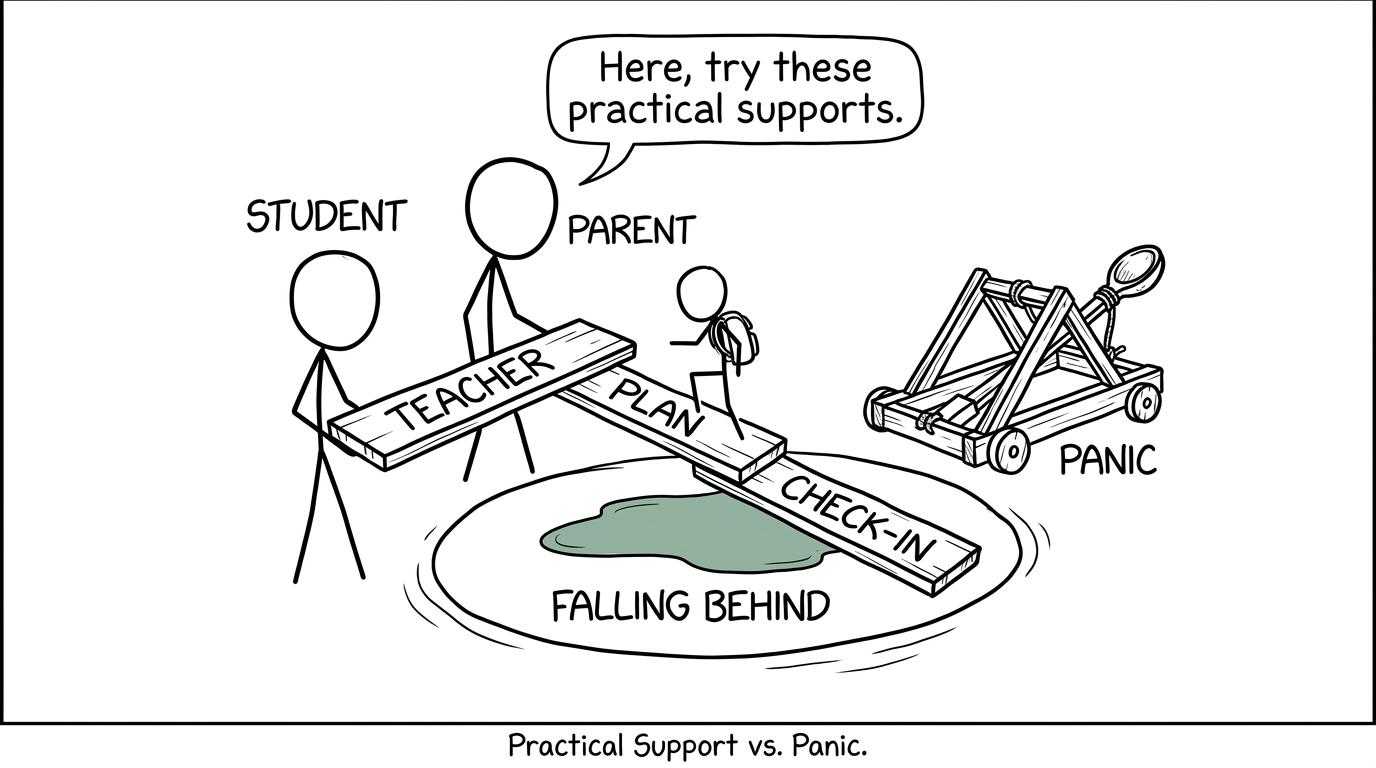 A student and parent build a practical bridge while leaving the panic catapult unused
Protect your GCSE maths revision as well
One struggling subject can distort the rest of your timetable. Students often respond by giving it every available hour or avoiding it completely. Neither response is sustainable.
Use a weekly plan that keeps Biblical Hebrew visible without allowing it to erase maths. MathsGenie’s guide to building a GCSE maths revision timetable can help you organise focused sessions, rest and paper practice. Start with the GCSE maths revision hub to select your exam board, including Edexcel, AQA, OCR or Eduqas, and make sure you are using the correct foundation or higher tier material.
For both subjects, replace vague revision with a repeatable cycle:
- identify one weak area;
- review the relevant teaching;
- complete focused practice;
- check the result;
- record the precise mistake;
- revisit it on another day.
In maths, the weakest-topic diagnostic approach helps turn lost marks into a shortlist of next actions. If the order of topics feels confusing, follow the best order for learning GCSE maths topics rather than jumping randomly between difficult questions.
Do not use full papers as punishment for feeling behind. Build towards them. The guide to when to start GCSE past papers explains how mini tests and timed sections can lead into complete papers. Nearer the exams, Edexcel GCSE maths predicted papers can provide fresh exam-style practice when used alongside mark schemes and video solutions.
Your parents can support this plan by asking, “What is your next task?” rather than, “How many hours have you done?” Progress is easier to see when the task is specific.
If your parents do not respond well
Sometimes the first conversation does not produce the calm response you hoped for. That does not mean asking for help was a mistake.
Try again later with written notes, or ask another trusted adult to join the conversation. This could be a relative, form tutor, head of year, subject teacher, school counsellor or pastoral lead. If you do not feel safe discussing the issue at home, speak to a trusted member of school staff instead.
Exam stress can affect sleep, appetite, mood and everyday life. The NHS advises involving a supportive adult and seeking further help when anxiety or low mood is severe, persistent or interferes with daily life. A teacher, school pastoral team or GP can help you decide what support is appropriate. Childline also offers free, confidential support on 0800 1111.
You deserve help before the situation becomes a crisis.
Common mistakes when asking for help
Waiting for the perfect moment
There may never be a completely comfortable time. Choose a reasonably calm moment and begin with a short request to talk.
Presenting a verdict instead of evidence
“I’m hopeless” closes possibilities. Teacher feedback, unfinished tasks and named weak areas create a problem that can be investigated.
Promising an impossible timetable
A plan built on late nights and hours of daily revision may reassure everyone briefly, but it is unlikely to last. Use a manageable routine and protect sleep. For especially pressured evenings, MathsGenie’s GCSE maths night-before plan keeps revision focused without encouraging panic.
Asking parents to teach the whole subject
Parents do not need subject expertise to help. Ask them to support communication, routine and access to the right teacher.
Hiding your other GCSE pressures
Explain if Biblical Hebrew is affecting maths or other subjects. Your plan must work across your complete timetable, not rescue one subject by quietly damaging another.
Move from secrecy to a next step
Falling behind feels larger when it remains unnamed. Once you can say, “This is the area I do not understand, this is the evidence, and this is the help I need,” the situation becomes more manageable.
Ask your parents for a short conversation. Agree on one school contact, one immediate revision action and one date to review progress. Then return to the next task rather than replaying the whole problem in your mind.
For maths, let MathsGenie’s free GCSE resources carry some of that planning load. Use revision lessons to rebuild weak topics, practice questions and mini tests to check understanding, then move to past papers and predicted papers. Mark schemes and video solutions show you what to correct. The goal is not a dramatic overnight transformation; it is a calmer conversation followed by useful, repeatable action.











