

Tell Parents You're Struggling With GCSE Arabic
Tell parents struggling GCSE Arabic feels difficult? Use this calm conversation plan to explain the problem, avoid a lecture and ask for useful support.

Sometimes the hardest sentence in a GCSE course is not in the specification. It is: “I need help.”
If you searched for tell parents struggling GCSE Arabic, the short answer is this: choose a calm moment, describe the exact skill causing trouble, show what you have already tried, and ask for one practical form of support. Do not wait until the conversation is forced by a report, mock result or missed deadline.
Your aim is not to prove that everything is fine. It is to turn a private worry into a shared plan, without letting the discussion become a lecture.
Your conversation checklist
Before speaking to your parents or carers:
- identify whether the main difficulty is listening, speaking, reading or writing;
- collect one or two pieces of evidence, such as teacher feedback or a recent assessment;
- choose a time when nobody is rushing or already upset;
- plan your opening sentence;
- ask to be heard before advice is offered;
- request one or two realistic actions;
- agree when you will review the plan;
- speak to a teacher or another trusted adult if talking at home feels unsafe.
The conversation does not need to solve the entire course. It only needs to make the next step clearer.
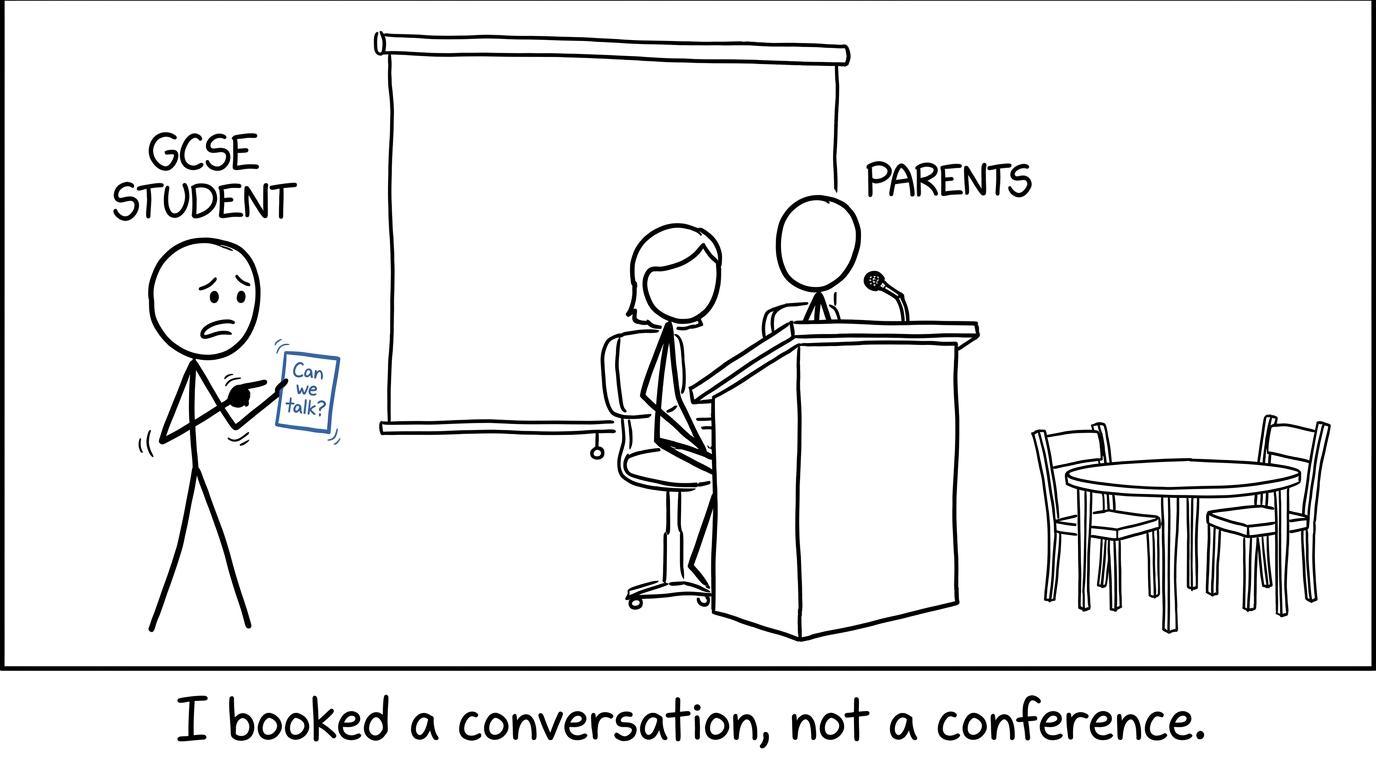 A student choosing a conversation rather than a conference
Work out what “struggling” actually means
“I am bad at Arabic” feels true when you are anxious, but it gives your parents very little useful information. A subject is rarely one solid block. It is a collection of separate skills, and one weak area can make the whole course feel unstable.
The current Pearson Edexcel GCSE Arabic qualification assesses listening, speaking, reading and writing in separate papers, with each skill contributing 25%25\%25% of the qualification. Students take either foundation or higher tier across all papers. Your school should confirm your specification, tier and assessment arrangements.
Ask yourself:
- Do recordings feel too fast to follow?
- Can I understand vocabulary on paper but not recognise it when spoken?
- Do I freeze during role-play or conversation practice?
- Is reading slow because I cannot retrieve vocabulary quickly?
- Do grammar, spelling or sentence construction reduce my writing marks?
- Am I behind because I missed lessons or avoided practice?
- Is Arabic itself the problem, or is my workload across GCSE subjects becoming unmanageable?
Write down one honest sentence. For example: “My reading is improving, but I cannot respond quickly enough in speaking tasks.” That is not an excuse. It is a diagnosis.
The same principle helps with maths. Rather than saying “I cannot do maths”, use a paper or GCSE maths mini test to identify the precise topic costing marks. Specific problems are easier to support than general panic.
Choose a moment that lowers the temperature
Timing changes the shape of a conversation. Raising the issue while everyone is leaving for work, immediately after an argument or late at night makes careful listening less likely.
Try asking in advance: “Could we talk about Arabic after dinner? I need your help making a plan.” This signals that the subject matters without surprising anyone halfway through another task.
If speaking face to face feels too difficult, send a short message first. You could also bring notes so that nerves do not erase what you meant to say. The notes are not a speech. They are a handrail.
Choose one parent or carer first if that feels easier. A trusted older sibling or relative might also help you prepare, but avoid turning the conversation into a large family meeting unless that would genuinely make you feel safer.
Open the conversation without inviting a lecture
Parents often move quickly into advice because they are worried and want to fix the problem. You can slow that process down by explaining what you need at the start.
A useful opening has four parts:
- The truth: “I am falling behind in GCSE Arabic.”
- The detail: “Speaking and listening are the main problems.”
- The effort: “I have been revising vocabulary, but it is not transferring into timed practice.”
- The request: “Could you listen first, then help me decide what to ask my teacher?”
You might say:
“I want to tell you before this gets worse. I am struggling with the speaking and listening parts of GCSE Arabic. I have tried revising vocabulary on my own, but I need a better plan. Could you let me explain everything before we discuss solutions?”
This wording does three useful things. It shows honesty, provides evidence and gives the conversation a boundary. It also replaces the question “Why did you not tell us?” with a more productive question: “What should we do next?”
Do not promise a particular grade to calm the room. Promise actions you can control: contacting your teacher, attending support, following a short timetable and reviewing progress.
Bring evidence, not a courtroom case
Evidence keeps the discussion grounded, but you do not need a folder containing every piece of work you have ever completed.
Bring two or three useful items:
- a recent assessment or mock result;
- written or verbal teacher feedback;
- a list of tasks you find difficult;
- your current revision timetable;
- the date when you can next speak to your Arabic teacher.
Describe what the evidence shows without attacking yourself. “I lost marks because I did not understand the recording” is more useful than “I am hopeless.” Equally, avoid blaming the teacher, your family or the exam board. There may be real problems to discuss, but blame usually makes people defend themselves rather than listen.
For maths, you can create equally clear evidence by completing an appropriate Edexcel GCSE Maths past paper, marking it and listing the topics behind lost marks. MathsGenie’s guide to finding your weakest GCSE topics explains how to turn a vague concern into a focused revision list.
Ask for practical support
“Please help” is an important beginning, but a specific request gives your parents something constructive to do.
Depending on your circumstances, you might ask them to:
- help you contact your Arabic teacher;
- arrange a quiet place and regular time for speaking practice;
- listen while you rehearse, without correcting every sentence immediately;
- help you find out whether school offers lunchtime or after-school support;
- reduce a non-essential commitment temporarily;
- check in once a week instead of asking about revision every evening;
- help you balance Arabic with maths and your other GCSE subjects.
A good plan should include your teacher. Ask which skill needs the most attention, what resources match your specification and whether your current tier remains appropriate. Tier decisions belong in a discussion with school staff who understand your assessment evidence, not in a panicked family debate.
The NHS advises that having someone to talk to can help students keep exam worries in perspective, while practical support from parents, tutors, study partners and school staff can be valuable. Support works best when it creates structure rather than surveillance.
Keep Arabic from swallowing the rest of revision
One struggling subject can consume every spare hour because it feels urgent. That can quietly damage maths revision and increase the sense that everything is slipping.
Build a weekly plan with small, named tasks. “Revise Arabic” is too broad. “Practise one speaking theme” or “review feedback from a listening task” gives the session an ending.
Do the same for maths. Use a realistic GCSE maths revision timetable and choose work that matches your board and tier, whether you sit Edexcel, AQA, OCR or Eduqas. MathsGenie’s GCSE maths topics by exam board and tier can help you decide what belongs in the plan.
Protect breaks and sleep as well. A timetable that assumes unlimited concentration will fail, and its failure may look like a lack of effort when the real problem was unrealistic planning.
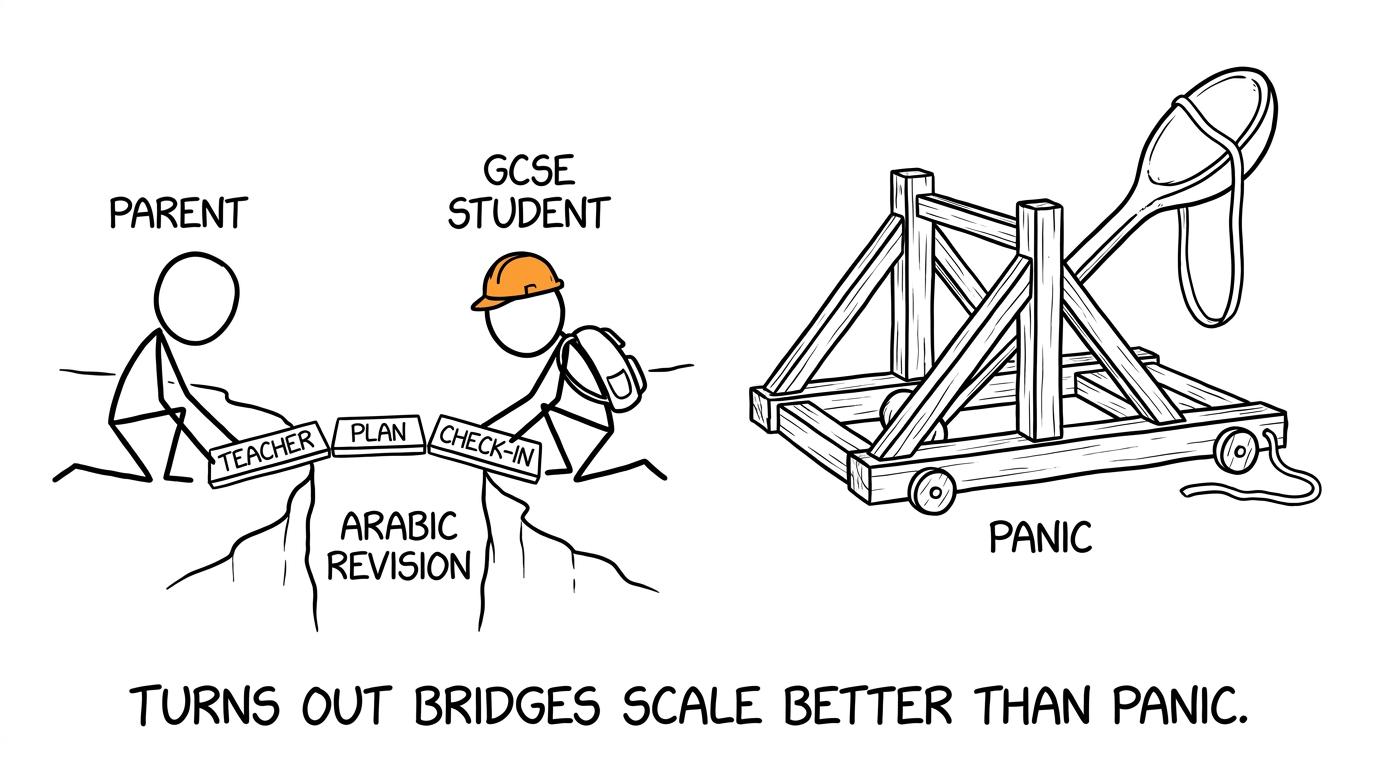 A student and parent building a bridge instead of using panic
What to do if the conversation becomes a lecture
You cannot control your parents' first reaction, but you can stop the conversation drifting further from its purpose.
Try one of these calm responses:
- “I understand that you are worried. Can I finish explaining the problem first?”
- “I am not asking you to ignore it. I am asking for help with the plan.”
- “Could we choose one action for this week rather than discuss every possible consequence?”
- “I want to continue this conversation, but I am getting overwhelmed. Can we pause and return to it later?”
Do not match rising volume with rising volume if you can safely step away. Pause, write down the agreed facts and try again when everyone is calmer. A teacher, form tutor, head of year or school pastoral member may be able to help organise a more constructive discussion.
If you expect punishment, intimidation or harm, do not manage the situation alone. Speak first to a trusted adult at school or another safe adult. If exam stress is seriously affecting sleep, mood, eating or everyday life, tell someone promptly and seek appropriate support through school, your GP or a confidential young-person support service.
Common mistakes when telling parents about GCSE Arabic
Waiting for proof that everything has gone wrong
You do not need to fail a mock before asking for support. Early conversations leave more time for teachers and families to respond.
Choosing the worst possible moment
A rushed or emotionally charged setting can turn a reasonable concern into an argument. Ask for a dedicated time.
Speaking only in labels
Words such as “terrible” and “hopeless” describe fear, not the skill gap. Name the paper, task or revision barrier.
Hiding what you have already tried
Parents may assume no work has happened if they cannot see it. Briefly explain your effort, then be honest about why it has not been enough.
Agreeing to an impossible timetable
Panic can produce plans with no rest and no room for other subjects. A smaller repeatable routine is more credible. If maths also needs attention, the GCSE one-month maths revision plan offers a manageable structure.
Treating the first reaction as the final answer
A surprised parent may respond badly and think more clearly later. Unless the situation is unsafe, allow time and return with one practical request.
Turn the conversation into a next step
The useful conversation is not the one where you explain everything perfectly. It is the one that ends with a next action: an email to your teacher, a speaking-practice slot, a revised timetable or a weekly check-in.
Then give your other subjects the same honest structure. For maths, start at the MathsGenie GCSE and A Level maths revision hub, use free revision lessons and practice questions to repair specific gaps, then check progress with mini tests. As exams approach, add past papers, Edexcel predicted papers, mark schemes and video solutions.
Telling your parents that you are struggling is not an admission that the story is over. It is the moment you stop carrying the problem alone, and begin replacing worry with evidence, support and a plan.










