

Teach Back Method GCSE Bengali: Does It Work?
Teach back method GCSE Bengali revision can expose hidden gaps. Learn how explaining aloud strengthens recall and supports smarter GCSE maths practice.
Revision can look productive without demanding very much from your memory. You read a Bengali passage, recognise the vocabulary and feel reassured. Then someone asks you to explain the tense, translate a sentence or justify a word choice. Suddenly, the knowledge feels less secure.
That is why the teach back method GCSE Bengali approach can be useful. Explaining a topic aloud forces you to retrieve it, organise it and notice what you cannot yet express clearly. It is not a replacement for listening, speaking, reading, writing or exam practice. It is a diagnostic tool: one that can also reveal why quiet revision sometimes lets gaps survive.
For students preparing for GCSE maths, the wider lesson matters too. If you cannot explain a mathematical method without leaning on notes, you may not yet be ready to select and apply it independently in an exam.
The short answer
Yes, teaching GCSE Bengali to someone else can be a good revision method when you:
- explain from memory rather than read from notes;
- choose a small, specific topic;
- ask the listener to interrupt with questions;
- check your explanation against reliable course material;
- record gaps instead of hiding them;
- follow the explanation with exam-style practice;
- return to the same content later.
The method is less effective if your listener simply agrees, if you repeat an inaccurate explanation or if talking replaces the actual tasks required by the assessment.
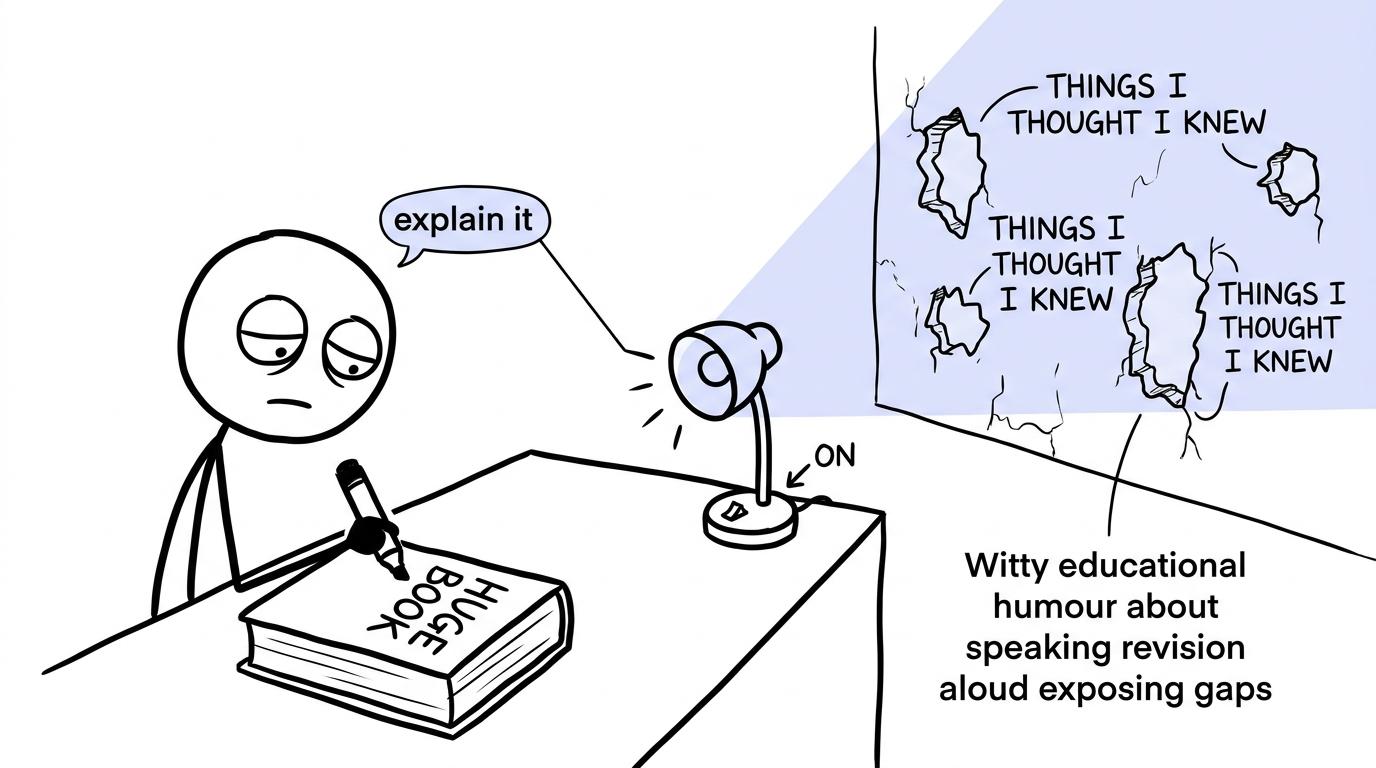 A student discovers that explaining a topic switches on the light and reveals gaps
Why explaining Bengali aloud exposes hidden gaps
Recognition and recall are different experiences. When a page is open, familiar words and examples provide cues. You may recognise an answer without being able to produce it independently. Close the book and those cues disappear.
Teaching changes the question from “Does this look familiar?” to “Can I reconstruct this clearly enough for another person?” That involves retrieval practice: bringing previously learnt material back from memory. Research reviewed by the Education Endowment Foundation supports retrieval practice as a useful learning approach, while also stressing the importance of suitable challenge, feedback and attention to misconceptions.
Explaining also encourages metacognition: thinking about your own learning. You have to monitor whether your explanation makes sense, identify uncertainty and decide what needs more revision. These habits are strongest when students plan, monitor and evaluate their work rather than simply completing an activity.
There is an important qualification. Research into learning by teaching does not prove that explaining to another person is always better than every other form of retrieval. Some of its value may come from the retrieval itself. The practical conclusion is simple: use teach-back as part of a revision system, not as a miracle technique.
What the method can reveal in GCSE Bengali
AQA is the current accredited exam board for GCSE Bengali in England. Its specification assesses listening, speaking, reading and writing, with each area contributing approximately 25%25\%25% of the qualification. Students enter foundation or higher tier and take all components at the same tier.
Teach-back can expose different weaknesses across those skills.
Vocabulary that is recognised but not retrievable
You might understand a word when it appears in a passage but struggle to produce it when explaining a theme. That gap matters in speaking and writing, where you must generate language rather than recognise it.
Grammar that has been memorised without understanding
A rule can feel secure until somebody asks why a form changes or when it should be used. If your explanation becomes a list of remembered examples, you may need to revisit the underlying pattern.
Pronunciation and fluency problems
Silent reading cannot show whether you hesitate, mispronounce a word or lose control of a sentence halfway through. Speaking aloud makes those difficulties audible.
Translation choices you cannot justify
Translation is rarely a mechanical exchange of isolated words. Explaining why a phrase works in context can reveal whether you understand meaning, register and sentence structure.
Topic knowledge that is too narrow
You may know one prepared response well but struggle when the listener changes the question. That is a warning that your knowledge is tied to a script rather than flexible enough for unfamiliar wording.
How to use the teach-back method properly
Choose one narrow objective. “Teach GCSE Bengali” is too broad. Explaining how to form a particular tense, how to approach a reading response or how to develop an answer on one specification theme creates a clearer test.
Spend a short period reviewing the material, then close the notes. Explain the idea to a classmate, family member, teacher or even an empty chair. Your listener does not need to be a Bengali expert. In some ways, a non-expert’s questions can be valuable because they force you to remove vague shortcuts.
Ask them to use prompts such as:
- “Why does that work?”
- “When would it not work?”
- “Can you say that more simply?”
- “How would you recognise this in an exam?”
- “What are you least certain about?”
Do not bluff when you get stuck. Mark the gap, reopen your material and check it. Then close the notes and explain that part again. Feedback is essential because fluent delivery can still contain an error.
Finally, complete a relevant listening, speaking, reading or writing task. Teaching can diagnose understanding, but exam practice tests whether you can use that understanding under the conditions in which marks are awarded.
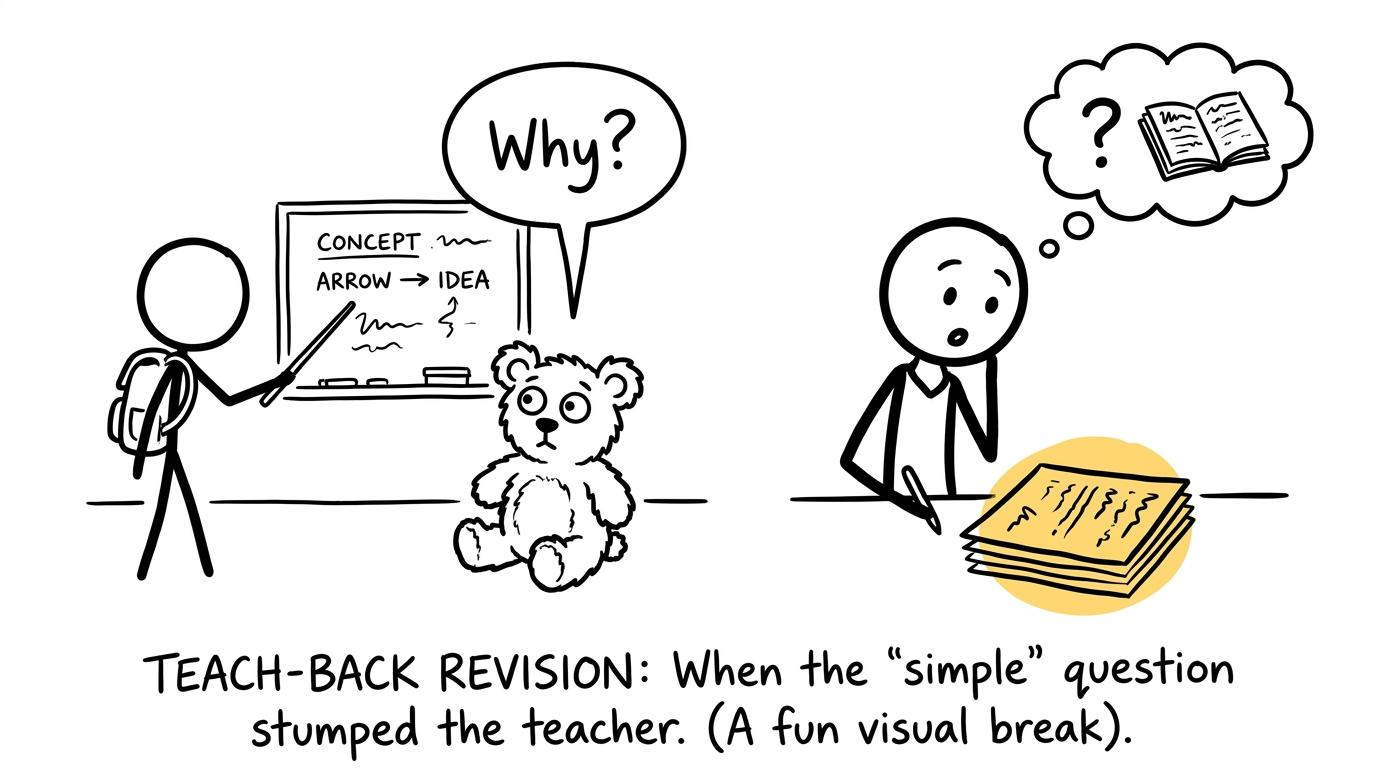 A teddy bear asks the awkward question that sends a student back to their notes
Why this matters for GCSE maths revision
The same distinction between recognition and recall appears constantly in maths. A video solution can seem obvious while it is playing. A completed calculation can look familiar. Yet an unfamiliar question may still leave you unsure how to begin.
Teach-back helps test whether you understand the decisions inside a method. Can you explain what information matters? Can you describe why a method is appropriate? Can you identify a condition under which it would fail? Can you state how you would check the result?
This is particularly useful before independent practice. Start with a topic from the GCSE maths revision hub, study the revision lesson, close it and explain the method aloud. Then answer practice questions without support. The explanation reveals what you think you know; the questions reveal what you can actually do.
If you do not know which topic to teach, use a paper or short test to diagnose the problem first. MathsGenie’s guide to finding your weakest GCSE topics shows how lost marks can become a focused revision list.
Teaching a maths method should never replace writing solutions. GCSE maths awards marks for correct reasoning, processes and answers. You need to practise selecting methods, showing working and maintaining accuracy across complete questions.
Build teach-back into a repeatable revision cycle
A useful cycle has five stages:
- Learn: use a concise lesson or reliable explanation.
- Retrieve: close the resource and teach the idea aloud.
- Question: invite interruptions and identify uncertainty.
- Practise: complete suitable exam-style questions.
- Review: mark the work, correct errors and revisit the topic later.
This cycle works because each stage has a different job. Learning introduces the content. Teach-back tests your mental model. Questions expose vagueness. Practice tests application. Review prevents the same mistake from becoming permanent.
Spacing also matters. One successful explanation immediately after reading may rely partly on short-term familiarity. Return later and explain the topic again without warning. Maths students can organise these revisits through a realistic one-month GCSE revision plan or a shorter one-week maths revision plan.
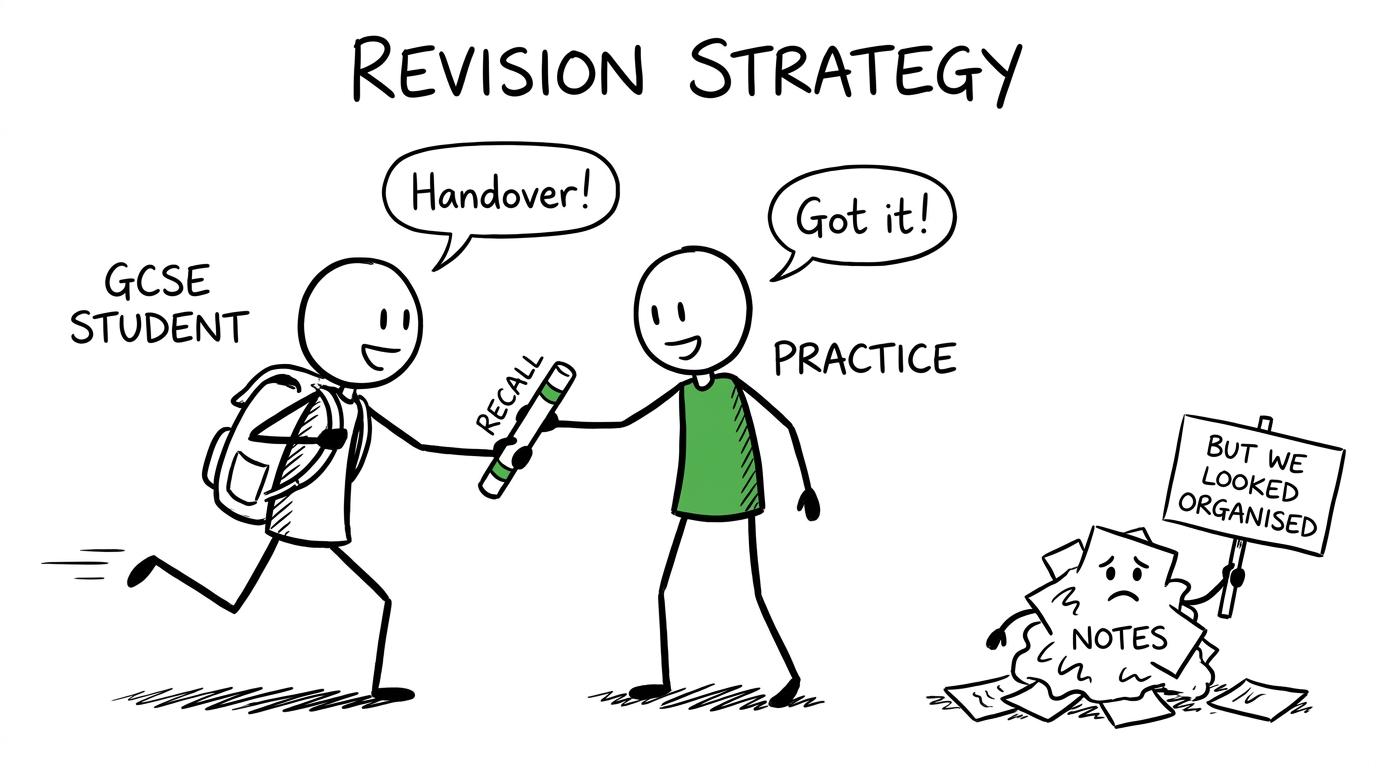 Recall and practice run the revision relay while beautiful untouched notes watch
When teach-back is not enough
Bengali is assessed through specific language skills. Explaining vocabulary in English does not automatically develop Bengali pronunciation. Describing how to answer a writing task does not prove that you can produce an accurate response. Talking about listening technique cannot replace listening to Bengali spoken at an appropriate pace.
Maths has the same boundary. You may explain a process elegantly and still make algebraic or arithmetic errors when applying it. Knowledge must survive contact with the question.
Move from explanation to increasingly realistic practice. Begin with topic questions, then use mini tests and mixed sets. Add timed papers once your core methods are more secure. The guidance on when to start GCSE past papers can help you choose the right stage.
When using a full paper, mark it carefully rather than treating the total as the only useful information. This guide to using Edexcel GCSE maths past papers properly explains how to diagnose errors, fix weak topics and reattempt difficult questions. The principle also applies to AQA, OCR and Eduqas papers: always use resources matching your board and tier when practising exam format.
Common teach-back mistakes
Reading notes aloud
Reading is not retrieval. Put the resource out of sight and reconstruct the explanation from memory. Check it afterwards, not during every sentence.
Choosing a topic that is too large
A broad explanation encourages shallow summaries. Teach one grammar feature, one assessment skill or one maths method at a time.
Mistaking confidence for accuracy
A smooth explanation can be wrong. Compare it with the specification, revision lesson or mark scheme and correct inaccuracies promptly.
Using a passive listener
A listener who only nods provides little challenge. Give them question prompts and permission to stop you whenever a step is unclear.
Avoiding uncomfortable gaps
The pause where you cannot continue is not failure. It is the most valuable information produced by the session. Write the gap down and make it your next action.
Stopping before exam practice
Teach-back checks explanation, not complete exam performance. Follow it with questions, mark them and retest the same skill. Students who feel stuck around a pass grade can use MathsGenie’s advice on targeted GCSE maths revision to turn gaps into manageable practice.
Make explanation a test, not a performance
The goal is not to sound like a teacher. It is to discover where your understanding becomes uncertain.
For GCSE Bengali, explaining aloud can reveal inaccessible vocabulary, fragile grammar, pronunciation issues and over-reliance on prepared scripts. For GCSE maths, it can uncover a method you recognise but cannot select or justify independently. In both subjects, the pause matters more than the performance.
Use teach-back briefly, check it carefully and follow it with real questions. Then let MathsGenie provide the maths side of the cycle: free revision lessons, practice questions, mini tests, mark schemes, video solutions, past papers and predicted papers. Start at the MathsGenie GCSE maths revision hub, choose one weak topic and try explaining it before you answer the first question. What you cannot yet say clearly is often exactly what you need to practise next.










