Switch GCSE Spanish to French Mid-Year: Can You?
Switch GCSE Spanish to French mid-year? Learn what schools consider, the catch-up required, exam-entry issues and how to protect your maths revision.
A subject choice can feel permanent until the lessons begin. Perhaps Spanish is no longer working for you, French feels like a better fit, or you have realised that your previous experience would make French more manageable. Then comes the practical question: can you switch GCSE Spanish to French after the course has started?
The short answer is possibly, but only with your school's agreement. There is no automatic national right to change GCSE options mid-year. Your school must decide whether the timetable works, whether the French class has space, how much content you have missed and whether you can realistically catch up without damaging your progress elsewhere.
The earlier you ask, the better. A change during the first term of Year 10 may be feasible in some schools. A move later in Year 10, or during Year 11, is considerably harder because of missed teaching, speaking preparation and examination-entry arrangements.
Your first switching checklist
Before assuming that the answer will be yes or no, establish the facts:
- Speak to your Spanish teacher, French teacher, form tutor or head of year.
- Ask whether French sits in the same timetable option block.
- Check whether the French class has capacity.
- Find out which exam board and specification the class follows.
- Request a list of everything already taught.
- Ask the French department to assess your current level.
- Agree a written catch-up plan with deadlines and support.
- Consider the effect on maths, English, science and your other GCSE subjects.
- Involve a parent or carer in the formal request.
- Do not stop attending Spanish until the school confirms a change.
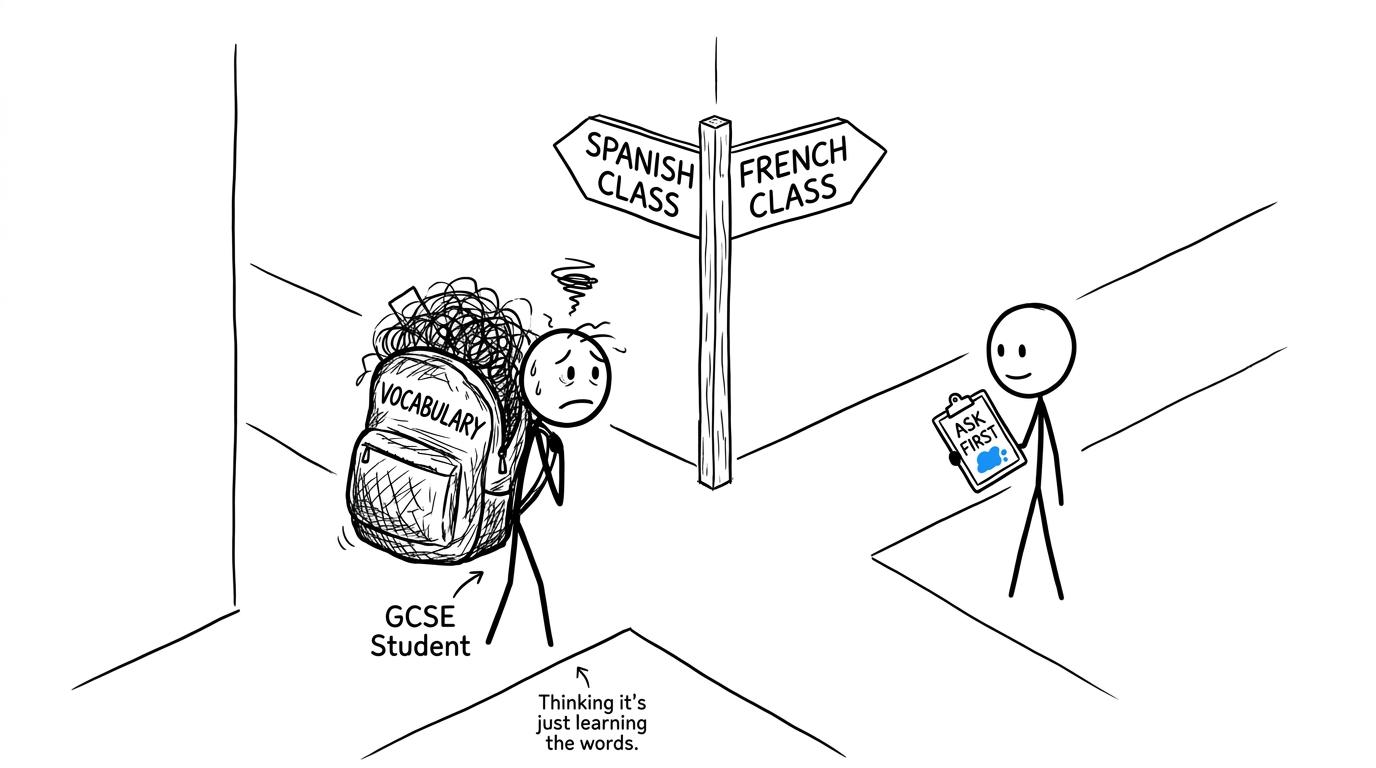 A student choosing between French and Spanish while a teacher advises asking first
Who decides whether you can switch?
GCSE subject changes are normally governed by individual school policy. The final decision may involve the heads of both language departments, your head of year, the timetable team, senior leadership and your parents or carers.
Published school policies vary significantly. Some schools permit changes only during the opening weeks of Year 10. Others allow requests until the first half-term if the option blocks fit and the receiving department believes the student can catch up. Some permit later changes only in exceptional circumstances.
That variation matters. A friend at another school being allowed to change does not establish what your school must do. Ask for your own school's GCSE options or curriculum-change policy and follow its process.
Timetabling and class capacity
A switch is easiest when Spanish and French occupy the same option block. Otherwise, changing language could create a clash with another subject. Even where the timetable fits, a French class may already be full or arranged around teaching resources that cannot easily be expanded.
These are not comments on your ability. They are structural limits. Schools build Key Stage 4 timetables around staffing, rooms, class sizes and the combinations selected by hundreds of students.
Evidence that the change is academically sensible
Your school may ask why you want to move and how you will recover the missed learning. Stronger reasons are specific and supported by evidence: previous French knowledge, a sustained difficulty that has already been discussed with teachers, or a clear mismatch identified through assessment.
Simply preferring the sound of French, wanting to join friends or having one disappointing Spanish test may not be enough. A school needs confidence that the move solves a genuine problem rather than relocating it.
What you would need to catch up in GCSE French
French and Spanish GCSEs share a broad assessment structure, but they are not interchangeable courses. Similar themes do not remove the need to learn different vocabulary, grammar, pronunciation and spelling conventions.
The reformed French and Spanish GCSE specifications were first taught from September 2024, with first examinations in summer 2026. Under the national subject content, students learn prescribed vocabulary and grammar. Foundation tier specifications contain 1,2001{,}2001,200 lexical items, while Higher tier adds a further 500500500, producing 1,7001{,}7001,700 in total.
That does not mean every missed word must be memorised before joining a class. It does mean that catch-up must be systematic rather than based on occasional app practice.
The four assessed areas
Current AQA and Pearson Edexcel French specifications assess listening, speaking, reading and writing. Each area contributes 25%25\%25% of the qualification, and students must take all assessments at the same tier.
A credible catch-up plan therefore needs to cover:
- Listening: recognising vocabulary at natural speaking speeds.
- Speaking: pronunciation, read-aloud work, role-play and conversation tasks.
- Reading: comprehension, grammatical recognition and translation into English.
- Writing: accurate sentences, extended responses and translation into French.
The most visible gap may be vocabulary, but speaking and listening often require the most teacher involvement. You need feedback on whether your pronunciation is comprehensible, not merely whether you recognise a word on a screen.
Grammar and themes already covered
Ask for the French department's scheme of work. You need to know which thematic contexts, verb forms, grammatical structures and speaking tasks have already been taught. Request the actual specification code too. Resources written for an old or different specification may not match your course.
A useful catch-up file would include:
- the specification vocabulary list;
- the department's knowledge organisers;
- missed classwork and assessments;
- model speaking materials;
- writing feedback criteria;
- a weekly list of priority grammar;
- dates for progress checks.
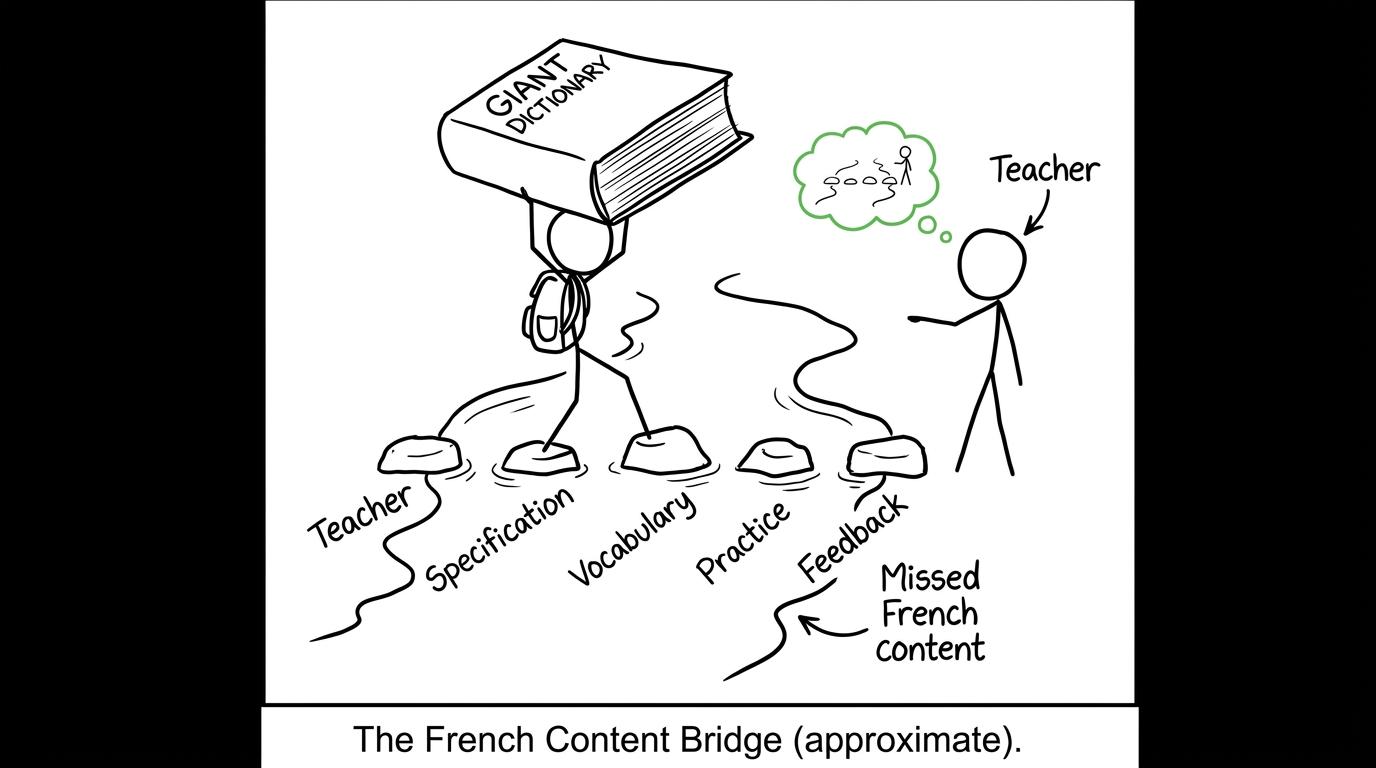 A student crossing the missed-content moat using sensible catch-up steps
When switching becomes less realistic
Time changes the nature of the decision. Early in Year 10, you may be recovering several weeks of work. By Year 11, you could be replacing much of a two-year course while examination preparation is already under way.
A late switch may be refused when:
- too much French content has been missed;
- there is no suitable class or timetable space;
- your current French level is too far behind;
- the school cannot provide catch-up teaching;
- speaking assessment preparation is already advanced;
- examination entries have been submitted;
- the extra workload could weaken your other GCSE results.
GCSE entries are submitted by schools to awarding organisations. The Joint Council for Qualifications coordinates common entry deadlines, while exam boards publish arrangements for amendments, late entries and withdrawals. Once those deadlines approach or pass, changing subjects becomes an examination-administration issue as well as a teaching decision. Exact dates vary by series, so your exams officer is the reliable source for your situation.
How to present a serious request
A calm, prepared request is more persuasive than announcing that you are giving up Spanish. Explain why you believe French is the better route, what evidence supports that view and what work you are prepared to complete.
Ask the French teacher three direct questions:
- What content have I missed?
- What standard must I demonstrate before joining?
- What catch-up timetable would make the switch realistic?
You might be asked to complete a diagnostic assessment, attend support sessions or work through missed units independently. Treat that process as useful evidence. If the diagnostic reveals that the gap is larger than expected, discovering this before changing is valuable.
A trial period can sometimes help, but only if the school offers one. Do not informally attend French or abandon Spanish lessons without permission, because that creates further gaps while leaving your official programme unchanged.
Protecting your maths revision during the change
Changing language can consume the time that was previously protecting your core subjects. The hidden risk is not French itself. It is allowing catch-up work to expand until maths revision becomes whatever is left over.
Start by opening the GCSE Maths Revision hub and identifying the small number of topics that currently need attention. If you study Edexcel, the Edexcel GCSE Maths revision area keeps lessons, questions and exam preparation together.
Use short, protected maths sessions rather than postponing the subject until the language gap closes. The 20-minute maths revision routine is particularly useful when your timetable suddenly feels crowded.
Your weekly pattern could include:
- fixed French catch-up sessions agreed with the department;
- two or three short maths topic sessions;
- one timed maths check using Edexcel GCSE Maths mini tests, where relevant;
- immediate marking and correction;
- one evening kept free from heavy catch-up work.
If you are unsure what to revise, use a diagnostic approach rather than guessing. MathsGenie's guide to finding your weakest GCSE topics explains how to turn lost marks into focused practice. When examinations are closer, follow the paper, mark, fix and retest process in the guide to using GCSE past papers properly.
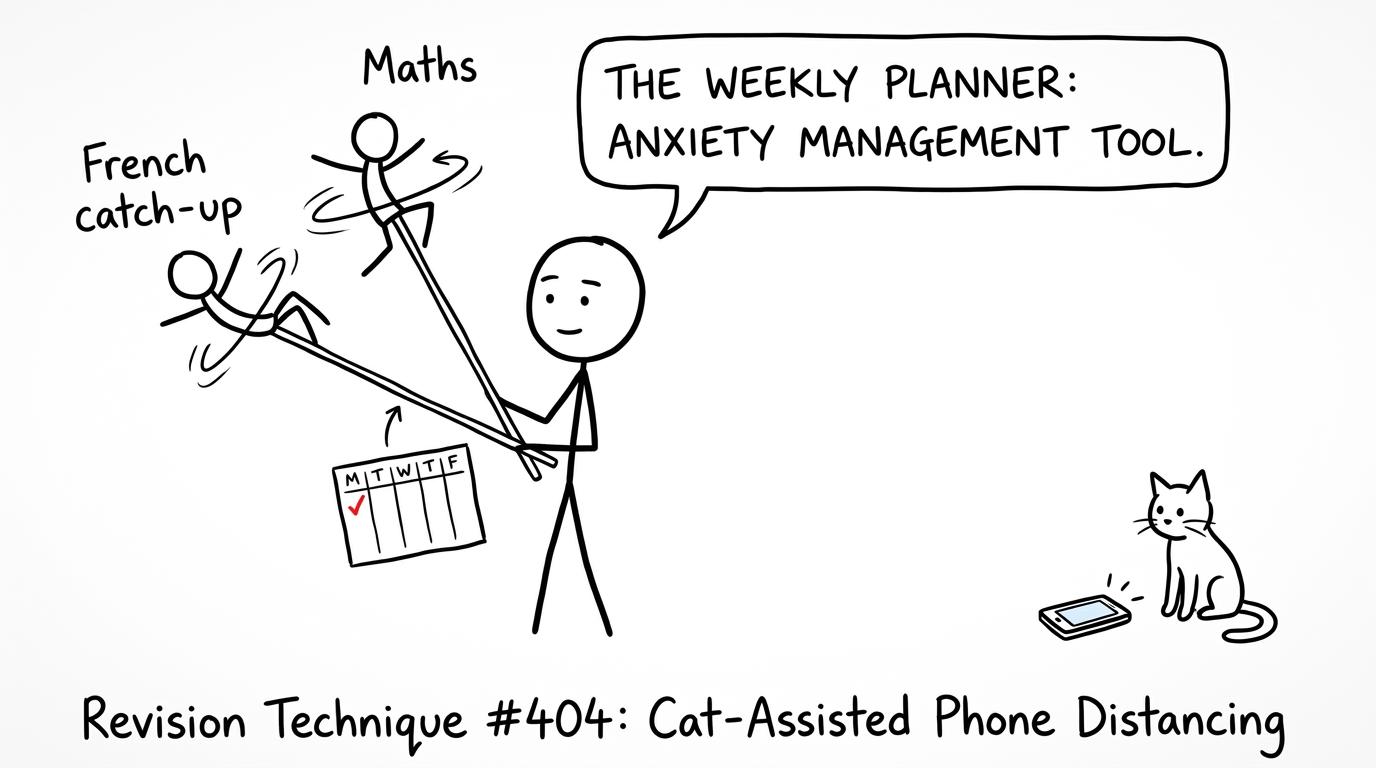 A student balancing French catch-up and maths with a weekly planner
Common mistakes when trying to switch
Waiting for the problem to resolve itself
Every extra week increases the amount of French you would need to recover. Ask promptly, even if you are not yet certain that you want to move.
Treating French as an easier version of Spanish
The assessment structure may be similar, but the language knowledge is different. Familiar themes are not a substitute for French vocabulary, grammar and pronunciation.
Making the request about friends
Class friendships can make lessons more comfortable, but they are rarely a strong academic reason for reorganising a GCSE programme.
Underestimating speaking preparation
Independent vocabulary learning helps, but it cannot replace regular spoken practice and corrective feedback from a teacher.
Ignoring your other subjects
A successful change should improve your overall programme, not rescue one subject while weakening maths, English and science. If exams are approaching, the one-month GCSE maths revision plan can help you preserve a clear routine.
Assuming permission before it is confirmed
Continue attending Spanish, completing work and meeting deadlines until the school gives you a formal decision and revised timetable.
A switch needs a plan, not just permission
It may be possible to switch GCSE Spanish to French mid-year, particularly early in Year 10, but feasibility depends on your school. Timetabling, class capacity, prior French knowledge, missed specification content, teacher support and exam-entry timing all matter.
The best next step is simple: speak to your school immediately and ask for a precise assessment of the gap. If the move is approved, turn the missed French content into a dated catch-up plan and protect fixed time for your other GCSEs.
MathsGenie can keep the maths side calm while you make that transition. Use the free revision lessons and practice questions to repair individual topics, mini tests to check recall, and past papers or predicted papers to build exam confidence. Mark your work with the available mark schemes and video solutions, then act on each lost mark. A subject change may complicate your timetable, but your revision system does not need to become complicated with it.