

Switch GCSE Economics to Business Mid-Year?
Switch GCSE economics to business mid-year with a clear checklist for school approval, course catch-up, exam entries and protecting your GCSE maths revision.
A subject can look right on an options form and feel wrong once lessons begin. Perhaps Economics seems too abstract, Business feels closer to your interests, or you have discovered that the two courses ask rather different questions.
If you want to switch GCSE Economics to Business mid-year, the short answer is: it may be possible, but there is no automatic right to change. Your school must decide whether the timetable, class capacity, exam-board specification and amount of missed work make the move realistic. Switching during Year 10 is usually more manageable than changing deep into Year 11, but the actual decision rests with your school.
The important question is not simply whether you prefer Business. It is whether you can complete the missing content without damaging your progress in maths, English, science and your other GCSEs.
Your mid-year switching checklist
Before making a final decision, confirm all of the following:
- Your school allows subject changes at this stage.
- Business fits your timetable and the class has space.
- You know the Business exam board and specification.
- A teacher has identified exactly what you have missed.
- You understand how Business differs from Economics.
- You have a realistic catch-up timetable.
- The extra work will not weaken your core GCSE revision.
- Your parent or carer has completed any required approval.
- The exams officer can make or amend the correct entry.
- You receive written confirmation before leaving Economics.
That last point matters. Keep attending your current lessons until the change is formally approved.
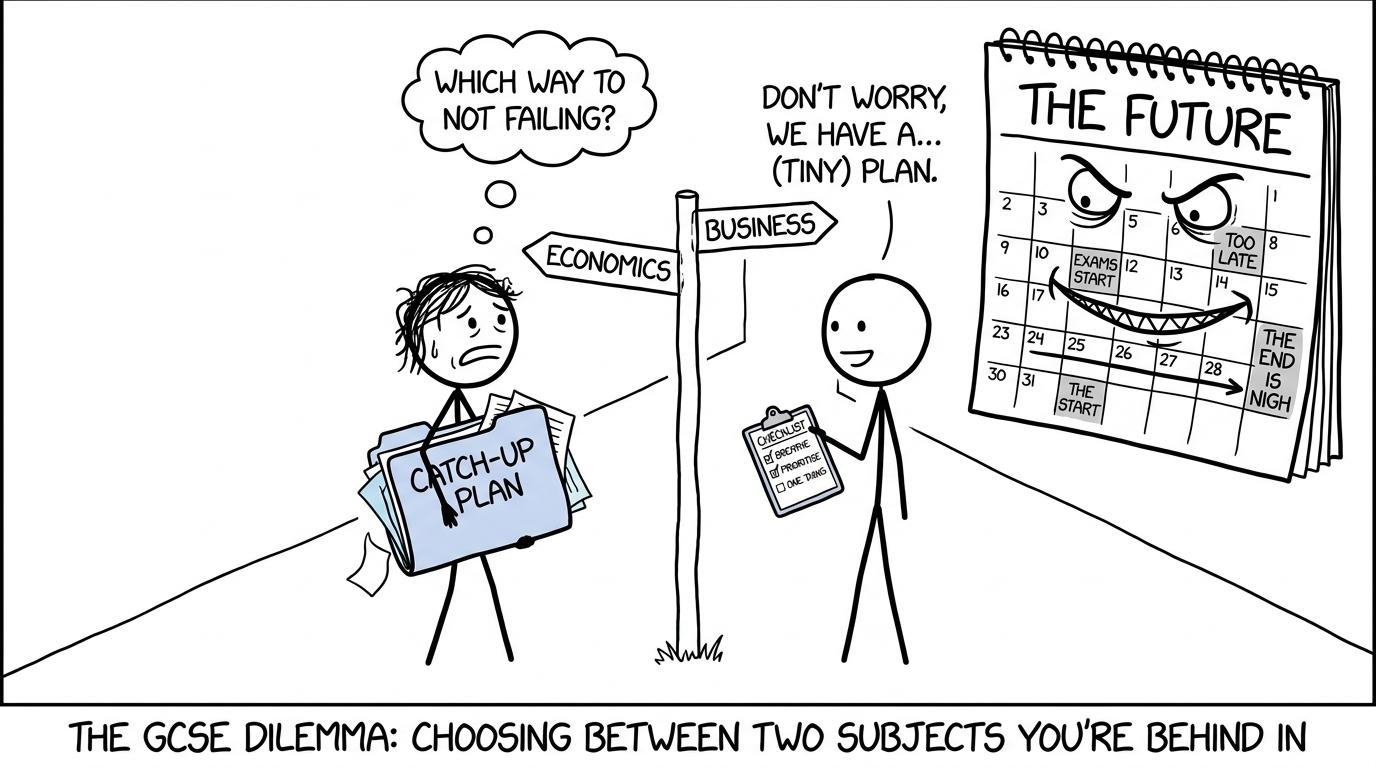 A student choosing between Economics and Business while a large calendar watches
Is switching actually allowed?
There is no single national rule guaranteeing a mid-year change between optional GCSE subjects. Schools organise their own option blocks, staffing and internal deadlines, so two students at different schools may receive different answers.
Your first conversation should normally be with your form tutor, head of year or options lead. They may also involve the Business teacher, Economics teacher, curriculum leader and exams officer.
A school will usually consider:
- Timing: how far the Business class has progressed.
- Timetabling: whether Business occupies the same option block.
- Capacity: whether another student can safely join the class.
- Prior attainment: whether your current work suggests that you can catch up.
- Workload: how the change would affect all your GCSE subjects.
- Assessment: whether missed internal tests can be completed.
- Exam administration: whether entries have been submitted and whether amendments remain possible.
Awarding organisations publish entry and amendment deadlines for each examination series. Changes after relevant deadlines may create fees or administrative restrictions, but a deadline does not itself decide whether your school will approve the academic change. Ask the exams officer for the current position rather than relying on a date found in an old forum post.
Economics and Business are related, not interchangeable
The names sound close because both subjects discuss firms, money and decision-making. Their centre of gravity is different.
GCSE Economics commonly examines how markets and the wider economy work. Depending on the specification, this can include resource allocation, supply and demand, competition, economic growth, inflation, unemployment, government policy and international trade.
GCSE Business focuses more directly on how businesses operate and make decisions. Common areas include enterprise, ownership, marketing, operations, human resources, finance and external influences.
There is useful overlap. Your Economics knowledge may help you understand competition, changing demand, interest rates or exchange rates. But overlap is not the same as coverage. You may still have missed Business-specific terminology, case-study techniques and substantial sections on operations, marketing or human resources.
Exam formats also vary among AQA, Edexcel, OCR and Eduqas. Do not assume that a revision guide for one board matches another. Before switching, ask for:
- the exact awarding organisation;
- the qualification and specification code;
- the topics already taught;
- the assessment structure;
- recent class resources and tests;
- the teacher's expected catch-up deadline.
Current GCSE specifications are generally designed as linear qualifications, with final examinations taken at the end of the course, but you must check the precise specification used by your school. Unlike GCSE Maths, Business and Economics do not normally involve choosing between foundation and higher tier.
What it actually takes to catch up
A successful change is not one signature followed by a fresh start. You join the new class at its current point while learning everything taught before you arrived.
Ask for a precise gap list
“Catch up on Business” is too vague to act upon. Ask the teacher to divide missed work into:
- essential knowledge;
- key vocabulary;
- calculations and quantitative skills;
- case-study application;
- extended-response technique;
- assessments that need completing.
Turn that list into small weekly tasks. The principle is similar to building a maths revision plan: diagnose first, repair specific gaps and then test them. MathsGenie's one-month GCSE revision plan shows how to make revision measurable rather than relying on long, unfocused sessions.
Learn Business question technique
Knowing a definition is only one part of many Business questions. You may need to apply an idea to a particular organisation, analyse consequences and reach a justified judgement.
That means catching up should include actual exam-style questions, not only copying notes. Ask your teacher to show you how command words are treated by your board and how the mark scheme rewards contextual application, linked analysis and evaluation.
Protect your maths timetable
Business includes quantitative skills, but it does not replace GCSE Maths revision. You may encounter revenue, costs, profit, percentages, averages, ratios, graphs and financial data. Core relationships can include:
revenue=selling price×quantity sold\text{revenue} = \text{selling price} \times \text{quantity sold}revenue=selling price×quantity sold profit=revenue−total costs\text{profit} = \text{revenue} - \text{total costs}profit=revenue−total costsand
percentage change=new value−original valueoriginal value×100%.\text{percentage change} = \frac{\text{new value} - \text{original value}}{\text{original value}} \times 100\%.percentage change=original valuenew value−original value×100%.These skills can reinforce your maths, but your GCSE Maths specification is much broader. Use the MathsGenie GCSE and A Level revision hub to keep your regular topic practice separate from the Business catch-up.
If interpreting data is a weakness, MathsGenie's Edexcel GCSE Statistics revision resources provide structured practice with data and statistical ideas. Students following another maths board should use resources matched to their own specification.
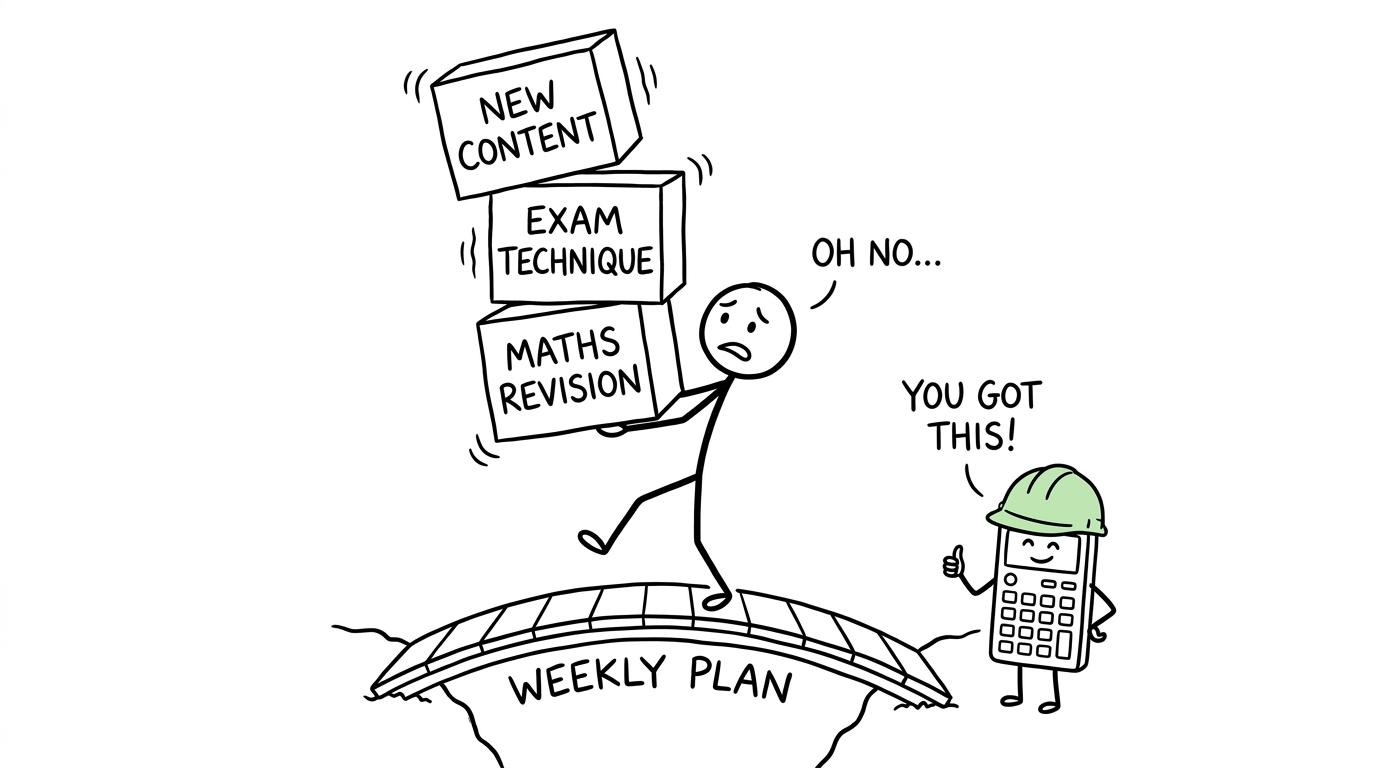 A student balancing new content, exam technique and maths revision
How to judge whether the switch is realistic
Try to separate a temporary difficulty from a genuine subject mismatch. One disappointing assessment does not necessarily mean that Economics is wrong for you. Equally, staying solely because changing feels awkward is not always sensible.
Ask yourself:
- Do I understand what Business lessons and examinations actually involve?
- Am I interested in the course, rather than only expecting it to be easier?
- How many topics have I missed?
- Can I access the notes, textbook chapters and teacher support needed?
- Where will the catch-up hours come from?
- Are my maths and English revision routines already secure?
- What evidence will show that I have caught up?
You could agree a short review period with the Business teacher. This might involve reading selected material, completing a baseline assessment or attempting an appropriate class task. That is not about proving that you deserve the subject. It gives everyone better evidence before an irreversible decision is made.
The later the proposed switch, the more demanding this test should be. In Year 11, mock examinations, unfinished content and final revision compete for the same limited weeks. A theoretically possible change may still be educationally unwise.
Build a catch-up plan that can survive a busy week
A useful plan should name the task, resource, deadline and method of checking it. Avoid promising several hours every evening. Plans fail when they assume that no other subject will set homework.
A sustainable pattern might include three short Business sessions each week: one for learning missed content, one for retrieval and one for an exam-style question. Keep your existing maths sessions in place.
For maths, follow a simple cycle:
- choose one weak topic;
- review the method;
- complete practice questions;
- mark the work;
- record the precise error;
- retest it later.
The best order for learning GCSE Maths topics can help if the subject change has disrupted your wider routine. When you are ready for mixed assessment, use GCSE predicted papers alongside official past papers rather than treating predictions as a replacement for specification coverage.
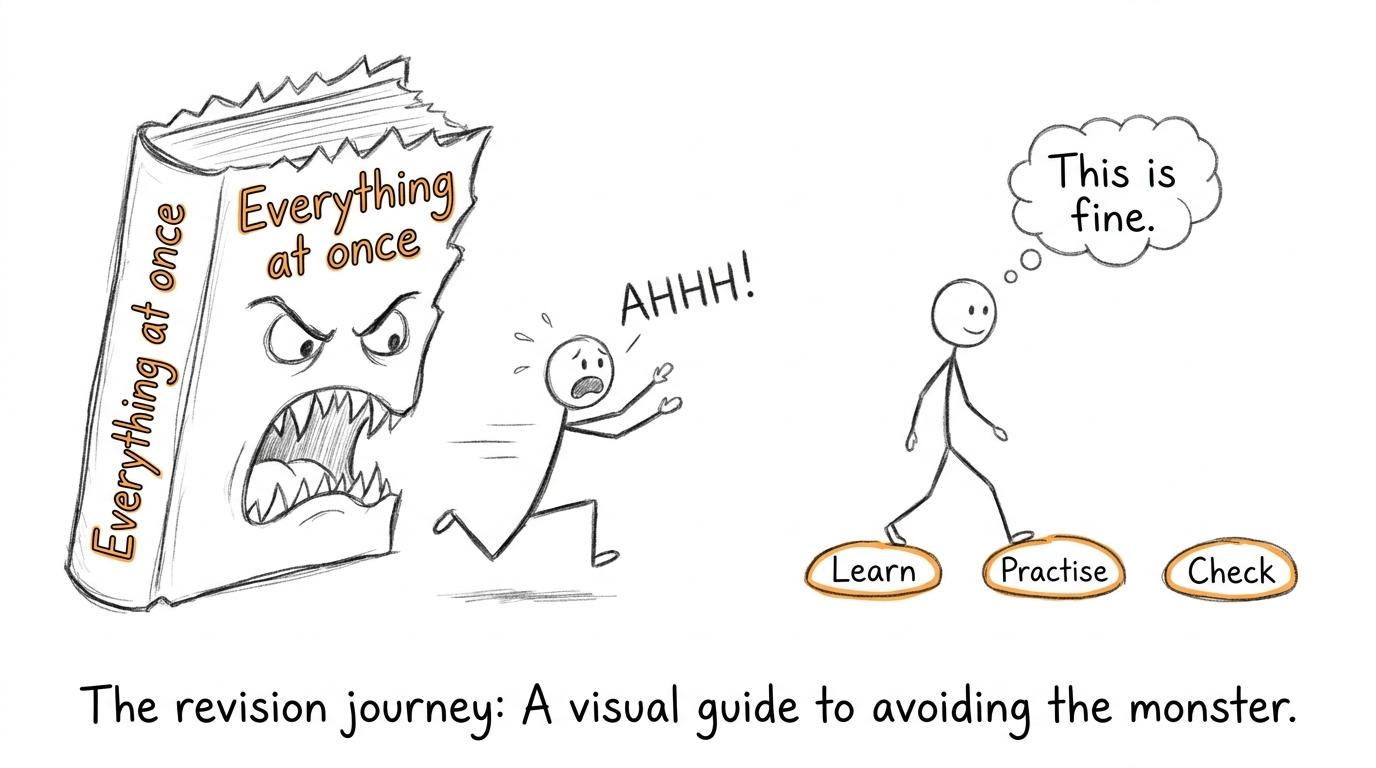 A textbook monster chasing unfocused revision while a calm student takes small steps
Common mistakes when changing GCSE subjects
Assuming Business will be easier
Business may feel more concrete, but it still requires accurate knowledge, calculations, careful application and developed written arguments. Choose it because its content and assessment suit you better, not because its title sounds less demanding.
Focusing only on overlapping topics
Economics knowledge is useful, but it does not remove the need to learn Business-specific content. Use the teacher's topic checklist, not your impression of what the courses have in common.
Leaving the exams officer out of the conversation
Teachers handle learning; exams officers manage formal entries. Both sides must be correct. Confirm the awarding organisation, specification and entry status in writing.
Abandoning other revision to catch up
A subject change should not consume every evening. Protect recurring sessions for maths, English and science. Maths students can use board and tier guidance to keep revision aligned with Edexcel, AQA, OCR or Eduqas requirements.
Doing full papers before learning the course
Past papers reveal gaps, but they do not efficiently teach an entire missed unit. Start with topic learning and focused questions. Then introduce timed work. The MathsGenie guide to when GCSE students should start past papers explains this phased approach, while Edexcel GCSE Maths past papers provide papers, mark schemes and solutions for students on that board.
Make the decision with evidence, not panic
Switching from GCSE Economics to GCSE Business mid-year is possible in some schools. It requires approval, timetable space, a manageable content gap and a formal examination entry. Most importantly, it requires an honest plan for doing two things at once: joining the current Business course and recovering the work already missed.
Ask for the specification, gap list and deadlines before agreeing to anything. Then protect the subjects you are already taking. A change that improves one option but quietly damages GCSE Maths is not a good trade.
MathsGenie can keep the maths side of that plan steady. Use free revision lessons to rebuild understanding, practice questions and mini tests to check individual skills, mark schemes and video solutions to correct mistakes, and past papers or predicted papers to develop exam readiness. Start with one weak topic today, keep the routine small enough to repeat, and let consistent evidence guide your next decision.











