

Switch GCSE Business to Economics Mid-Year
Switch GCSE Business to Economics mid-year with a realistic plan. Learn what your school must approve, what you need to catch up and how maths helps.
A subject can feel right on paper and wrong once lessons begin. Perhaps Business is not answering the questions you expected, while Economics seems closer to how you think about prices, choices, markets and government decisions.
So, can you switch GCSE Business to Economics after the course has started? Possibly, but it is not an automatic entitlement or a simple change of label. Your school must offer Economics, approve the move, fit it into your timetable and decide that you can catch up safely. The later you ask, the harder that becomes.
The practical answer is to speak to your subject teacher, head of year and examinations officer as soon as possible. Before agreeing, they are likely to consider the specification, missed teaching, assessment record, class capacity and effect on your other GCSEs.
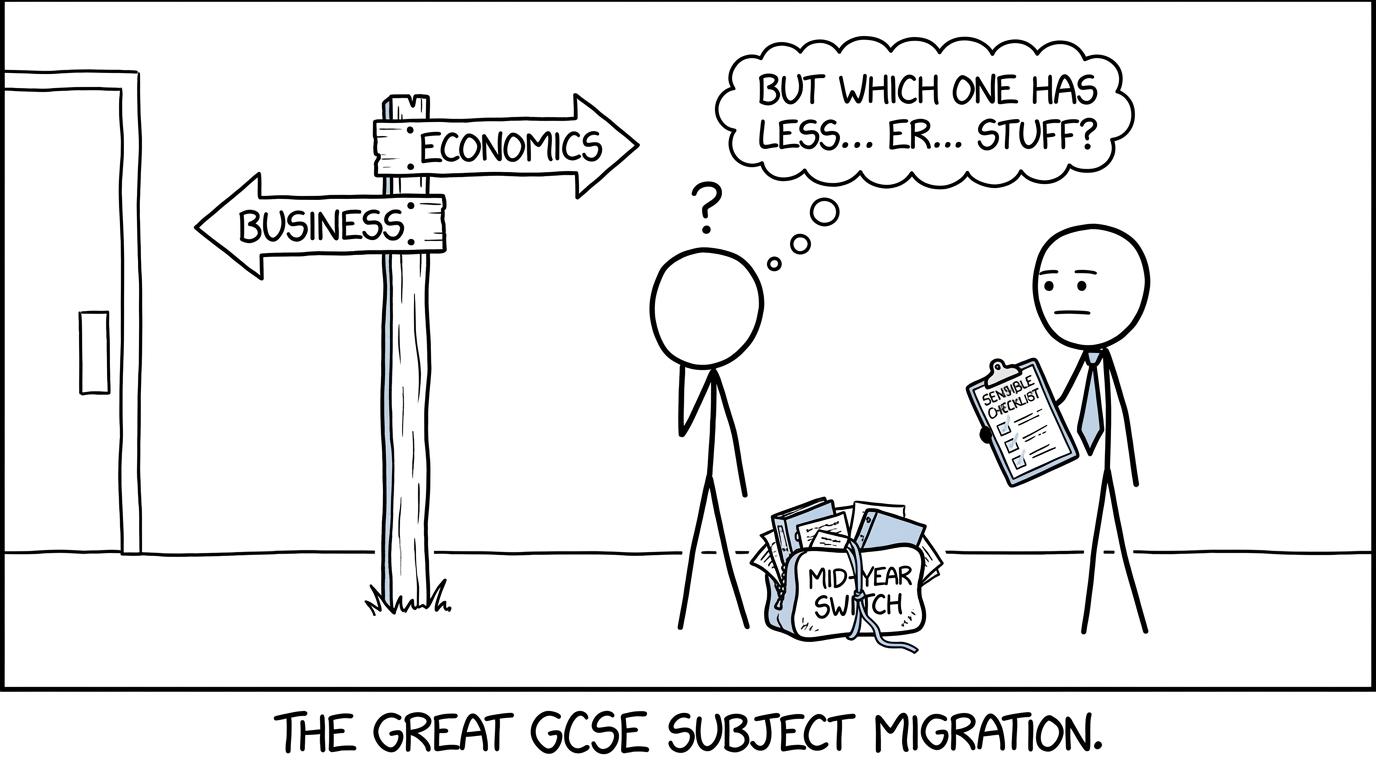 A GCSE student choosing between Business and Economics while carrying an overpacked mid-year suitcase
Your mid-year switching checklist
Before making a decision, establish the following:
- whether your school actually teaches GCSE Economics;
- which exam board and specification the Economics class follows;
- whether Economics occupies the same timetable block as Business;
- how much Economics content has already been taught;
- whether there is space in the class;
- which assessments you have missed;
- whether the examinations officer can amend your planned entry;
- how you will catch up without damaging maths, English or other subjects;
- whether you prefer Economics itself, rather than simply disliking one Business topic.
A successful switch needs more than enthusiasm. It needs an agreed catch-up plan with specific topics, resources, deadlines and review points.
Who decides whether you can switch?
GCSE subject changes are normally managed by the school. There is no single national rule guaranteeing that a student can change an option subject halfway through a course.
Your school must consider staffing, class size, safeguarding of curriculum time and examination administration. It may also have its own deadline for option changes. A switch that is manageable early in Year 10 could be judged too risky later in Year 11, even when the student is highly motivated.
Several people may be involved:
- Your Business teacher can explain whether the difficulty is temporary or fundamental.
- The Economics teacher or subject leader can assess the knowledge you have missed.
- Your head of year or options lead can check the timetable and wider academic effect.
- The examinations officer can confirm how a change affects exam-board entry arrangements.
- A parent or carer may need to support or formally request the change under school policy.
Exam-entry procedures and deadlines can change between examination series. Your examinations officer, rather than an online forum or another student, is the reliable source for your own entry.
Business and Economics are related, but not interchangeable
The names sound close because both subjects discuss organisations, money and decision-making. Their central questions, however, are different.
GCSE Business commonly examines how businesses operate and make decisions. Topics may include ownership, marketing, finance, operations, human resources, growth and external influences.
GCSE Economics looks more broadly at how scarce resources are allocated. Depending on the specification, students may study markets, demand and supply, competition, labour, economic growth, inflation, unemployment, government policy and international trade.
That distinction matters. Knowledge of revenue, costs and business objectives may help, but it will not automatically replace missed teaching about economic systems or macroeconomic policy. You also need to learn the vocabulary and response style expected by your new exam board.
At the time of switching, ask for the exact specification rather than relying on a generic online topic list. Schools offering the subject may follow specifications from boards such as AQA or OCR, while the Business course you are leaving may come from a different board. Assessment structures and terminology are not necessarily the same.
What it actually takes to catch up
The real cost of changing is measured in time and attention. Every hour spent recovering Economics content is an hour unavailable for another subject.
Audit the missed content
Ask the Economics teacher for a list of everything already taught. Divide it into three groups:
- content you understand from Business or general knowledge;
- content you recognise but cannot yet explain accurately;
- content that is completely new.
This prevents a common trap: revising familiar material because it feels comfortable while ignoring the largest gaps.
Agree evidence of progress
A vague promise to “catch up” is difficult for teachers to approve. A credible plan might include reading specified chapters, completing class assessments, learning key definitions and submitting exam questions by agreed dates.
The teacher may reasonably want evidence that you can manage the transition. Treat an initial assessment as information, not as a judgement on your potential.
Protect your other subjects
Switching should not turn every evening into emergency revision. Check your workload alongside homework, mock examinations and existing gaps. If maths also needs attention, begin with the structured GCSE maths revision programme rather than choosing disconnected questions at random.
A short weekly review can answer three useful questions: What have I caught up? What remains unclear? Is the plan still realistic?
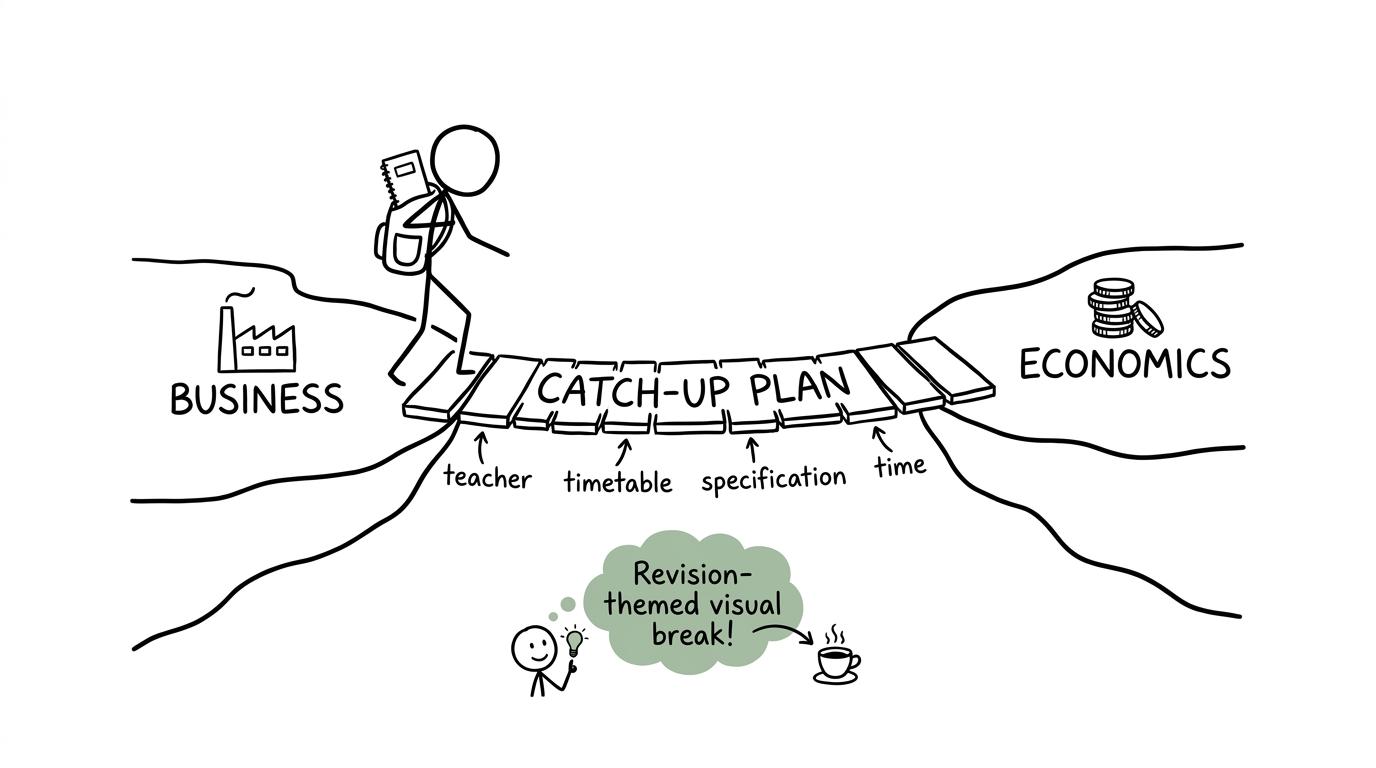 A student crossing a catch-up bridge supported by timetable, teacher and specification planks
How maths supports GCSE Economics
GCSE Economics is not GCSE Maths, but confident numeracy helps you interpret evidence and communicate conclusions. Depending on the specification and question, useful skills can include percentages, percentage change, ratios, averages, graphs and calculations involving economic data.
For instance, percentage change is represented by:
Percentage change=new value−original valueoriginal value×100\text{Percentage change}=\frac{\text{new value}-\text{original value}}{\text{original value}}\times 100Percentage change=original valuenew value−original value×100That relationship may appear when considering changes in prices, output, employment or other data. The calculation alone is rarely the whole economic answer. You must also explain what the result means in context and recognise that one figure may not prove a complete argument.
If numerical fluency is a concern, use MathsGenie by current level. The grade 333 revision topics can strengthen core arithmetic, while the grade 444 revision resources and grade 555 revision topics develop the skills many GCSE students need to handle data confidently.
Students working towards higher grades can move into grade 666 maths revision and grade 777 topic practice. The purpose is not to learn advanced maths for its own sake. It is to make routine calculations quick enough that your attention remains on economic interpretation.
When switching is more likely to be realistic
A move is more plausible when Economics is in the same option block, the class has capacity and relatively little unique content has been missed. It also helps when you have a strong attendance record, a manageable workload and a clear reason for changing.
The decision becomes harder when:
- the timetable would require changes to several subjects;
- the Economics class is full;
- substantial specification content has already been completed;
- mock examinations or final entries are close;
- your current workload is already unmanageable;
- the school does not offer GCSE Economics at all.
If the answer is no, that does not close the subject forever. GCSE Economics is not universally required for later study, although sixth forms and colleges set their own entry requirements. Ask prospective providers directly about their current criteria for A Level Economics and whether GCSE Maths grades are particularly important.
How to make the request well
Approach the conversation as a proposal, not a demand. Explain why Economics fits your interests, what you understand about the missed work and how you intend to catch up.
Useful questions include:
- “Which units has the class completed?”
- “Could I see the specification and current assessment plan?”
- “What evidence would show that I can make the change successfully?”
- “How many catch-up hours would be realistic each week?”
- “When would we review whether the switch is working?”
Avoid saying only that Business is boring or that Economics sounds easier. Neither subject is automatically easier. Grades depend on knowledge, application, analysis, evaluation and accurate responses to the particular mark scheme.
Common mistakes when changing GCSE subjects
Assuming the subjects contain the same material
There is overlap, but Economics introduces distinct concepts, chains of reasoning and terminology. Begin with a specification audit rather than assuming your Business notes cover the gap.
Waiting for the “right moment” to ask
Delay usually increases the amount of missed teaching. Asking promptly does not commit you to moving; it gives the school enough information to consider the request properly.
Ignoring exam technique
Knowing the content does not guarantee full marks. Command words, question structure and the balance between analysis and evaluation matter. Use your new teacher's model answers and official mark schemes to understand what the board rewards.
Creating an impossible catch-up timetable
A plan requiring several hours every night is unlikely to last. Build a routine around small, named tasks and leave space for your other GCSEs.
Neglecting maths revision
Economics can expose weaknesses in percentages, proportional reasoning and graph interpretation. Use grade 888 maths resources or grade 999 revision topics only when they match your current maths goals; start lower if foundational skills need attention.
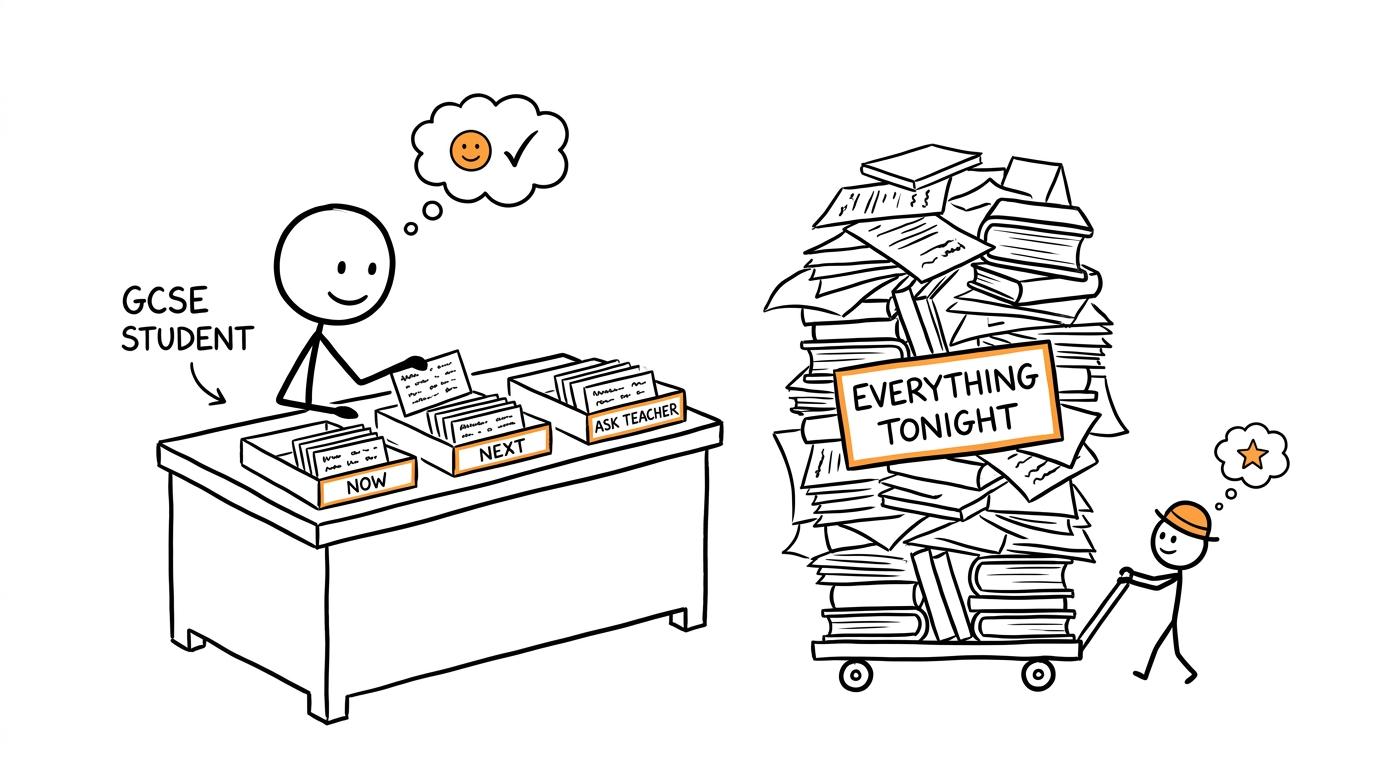 A calm student sorting revision into Now, Next and Ask Teacher while an impossible pile is removed
Make the decision from evidence, not panic
Changing course can be sensible, but the best decision is rarely made from one difficult lesson or one disappointing assessment. First identify whether the problem is the subject, the current topic, exam technique or a temporary loss of confidence.
If the school approves the move, leave the first meeting with the specification, a missed-topic list, assessment dates and a written catch-up timetable. If it refuses, ask for the reason and what support is available in Business. A clear answer is more useful than weeks of uncertainty.
Whichever subject you take, protect the GCSE that strengthens almost every data-based course: maths. MathsGenie offers free revision lessons, videos, practice questions, mini tests and mark schemes, alongside GCSE past papers for realistic exam practice. Use the revision planner to organise weak topics, then add predicted papers closer to the examination period.
A mid-year switch is not merely about entering a different classroom. It is a decision about time, fit and what you are prepared to do next. Speak to your school early, make the workload visible and let a realistic plan, not the appeal of a new subject name, guide you.











