Switch Exam Board GCSE Food and Nutrition Guide
Switch exam board GCSE Food and Nutrition with confidence. Learn what happens to NEA work, specification content and revision after a school changes board.
A change of exam board can make a familiar course suddenly feel uncertain. The folder is the same. The kitchen is the same. Yet the specification, assessment language and past papers may all look different.
If your school plans to switch exam board GCSE Food and Nutrition partway through the course, the short answer is that it can be possible. However, it is a decision for the school, not usually an individual student, and it requires careful handling of exam entries, specification gaps and non-exam assessment (NEA). Completed NEA should never be assumed to transfer automatically between awarding organisations.
The most important step is to ask your teacher and exams officer for a written transition plan. You need to know the new board, the specification code, which content must be caught up and whether any assessed work must be restarted or adapted.
Your exam-board switch checklist
Use this checklist as soon as the change is announced:
- Confirm the full name and specification code of the new qualification.
- Ask when the school will make the new exam entry.
- Compare the old and new specifications topic by topic.
- Find out whether either NEA task has formally begun.
- Ask which annual task or brief applies to your examination cohort.
- Confirm whether existing practical evidence can support the new course.
- Obtain the new assessment criteria and approved task instructions.
- Start using past papers and mark schemes from the new board.
- Keep copies of permitted notes, photographs and teacher feedback.
- Protect the rest of your GCSE timetable, including maths revision.
The final point matters. A board change can absorb attention because it feels urgent, but it should not quietly displace preparation for your other subjects. The MathsGenie GCSE Maths revision hub keeps lessons, questions and board-specific paper resources together when you need a stable revision routine.
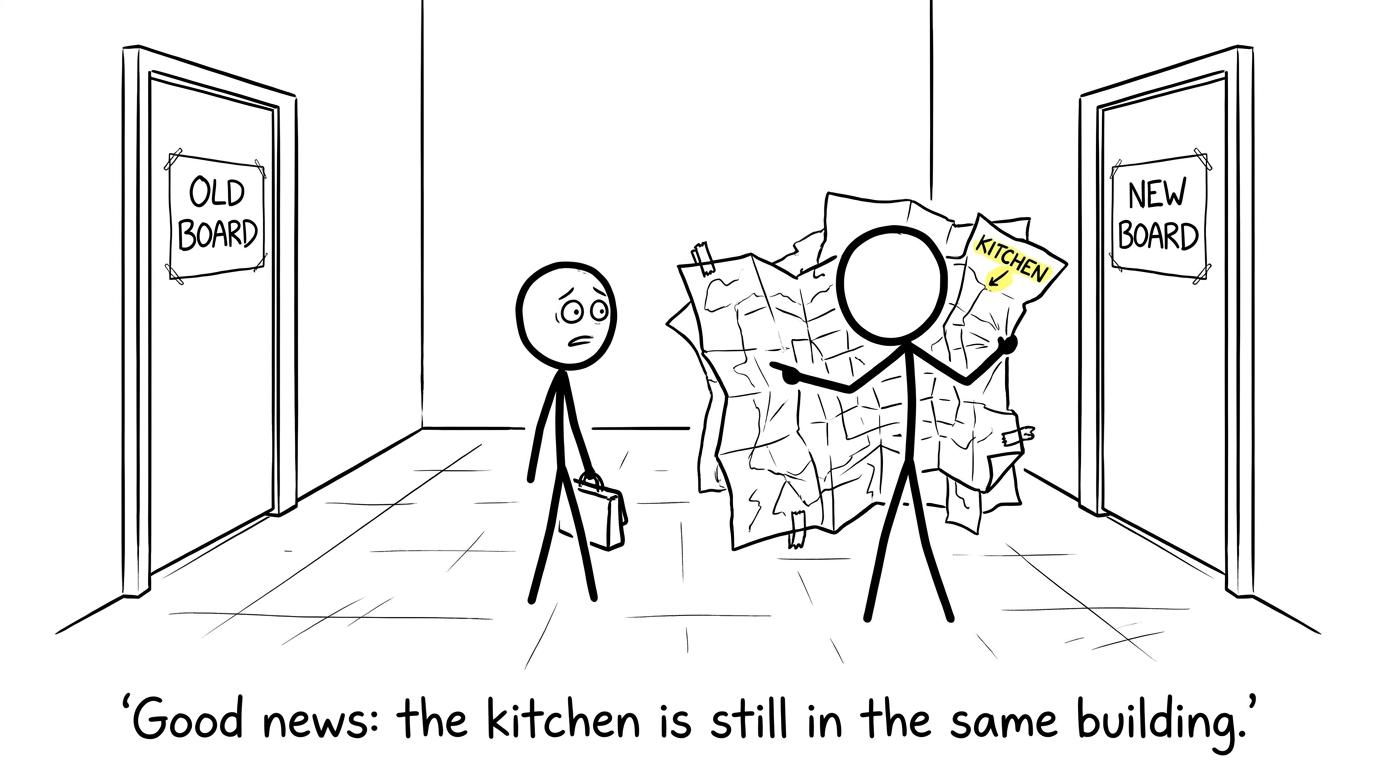 Student facing old and new exam-board doors while a teacher unfolds a specification map
Why switching is possible but not simple
GCSE Food Preparation and Nutrition qualifications in England are built around common subject requirements. Ofqual requires half of the available marks to come from an examination and half from non-exam assessment:
| Assessment area | Qualification weighting |
|---|---|
| Written examination | 50%50\%50% |
| Food investigation NEA | 15%15\%15% |
| Food preparation NEA | 35%35\%35% |
The regulated assessment objectives are also shared. Broadly, they cover knowledge, application, practical planning and preparation, and analysis and evaluation. This common structure means that much of what you have learnt remains useful after a switch.
But common structure does not mean identical courses. AQA, OCR and Eduqas organise content differently, use their own wording and issue their own NEA tasks. Their written papers can differ in length, question structure and command language. Marks may also be presented differently even where the qualification weightings are equivalent.
That distinction explains why a switch is manageable early in the course but potentially disruptive once live NEA has started.
What happens when your school changes board?
The school must first make the administrative change. Its exams officer needs to confirm that the centre can enter candidates with the new awarding organisation, use the correct entry code and meet the relevant submission arrangements.
Students should not try to organise this directly or assume that attending a different examination centre changes the board. An exam-centre transfer and a qualification change are separate matters.
Your teachers then need to map what has already been taught against the new specification. The overlap is likely to include nutrition, food science, food safety, food choice or provenance, practical techniques and healthy eating. What changes is often the grouping, depth, terminology or assessment emphasis.
A useful transition document has three columns:
- content already covered adequately;
- familiar content requiring new-board practice;
- content not yet covered or requiring additional depth.
This turns a vague fear into a finite list. The same principle works in maths: the quickest improvement often begins by identifying precise gaps rather than revising everything again. MathsGenie's guide to finding your weakest GCSE topics explains how to build that kind of evidence-led checklist.
What happens to completed NEA work?
This is the most important question to resolve.
The NEA consists of a food investigation worth 15%15\%15% and a food preparation task worth 35%35\%35%. Awarding organisations release their own tasks, set their own administrative instructions and apply their own marking criteria. A report written in response to one board's live task cannot simply be treated as though it answered another board's task.
Carry-forward rules sometimes allow an NEA mark to be retained when a student resits the same specification. That is not the same as moving unfinished or completed coursework from one awarding organisation to another. Do not assume that a cross-board transfer is available merely because both courses assess similar skills.
If live NEA has begun, your school should obtain case-specific guidance from both awarding organisations. Possible outcomes include:
- beginning the new board's task under its required conditions;
- using earlier practical learning only as preparation, not submitted evidence;
- completing additional work to meet the new criteria;
- delaying the switch if changing would create an unreasonable assessment risk.
Only your school and the awarding organisation can confirm which option is valid. Students should not rewrite controlled work independently at home, reuse restricted material or add evidence without teacher authorisation. NEA authenticity and supervision rules still apply during a transition.
How to adjust your revision
Learn the new specification language
Start with the new specification rather than a revision guide. Highlight unfamiliar headings, command words and practical expectations. Create a one-page map showing where your existing notes belong.
Do not throw away old notes simply because their headings differ. Knowledge of nutrients, food safety, ingredient functions and preparation techniques remains valuable when it matches the new content. Relabel useful material, then add only what is missing.
Change your question practice immediately
Past papers reveal how an awarding organisation turns content into questions. Move to the new board's papers as soon as the change is confirmed, even if you initially complete only short sections.
When marking, record whether each lost mark came from:
- missing knowledge;
- weak application to the scenario;
- an incomplete explanation;
- poor interpretation of data;
- unfamiliar command language;
- timing.
The mark scheme is not merely a score sheet. It shows the precision expected. Maths students can use the same approach through GCSE past-paper practice, where every lost mark becomes a clue about the next revision task.
Rehearse the quantitative skills
Food Preparation and Nutrition can require calculations and data handling. Depending on the specification and question, you may need to interpret tables and graphs, compare nutritional values, work with proportions, scale quantities or express changes as percentages.
These skills do not change simply because the logo on the paper changes. If number work is slowing you down, use MathsGenie's free revision lessons and practice questions to strengthen the underlying method. The overview of recurring GCSE maths topics is a useful place to identify high-value number, ratio and statistics skills.
Build a timetable that protects every subject
A board switch creates extra work, but it does not create extra hours. Ask your teacher to distinguish essential catch-up from optional enrichment. Then place the essential tasks into short weekly blocks.
A calm plan might include one specification-gap session, one new-board question session and one review of teacher feedback each week. Keep your normal maths practice running alongside it. If exams are approaching, the GCSE one-month maths revision plan offers a repeatable structure based on diagnosis, targeted practice and papers.
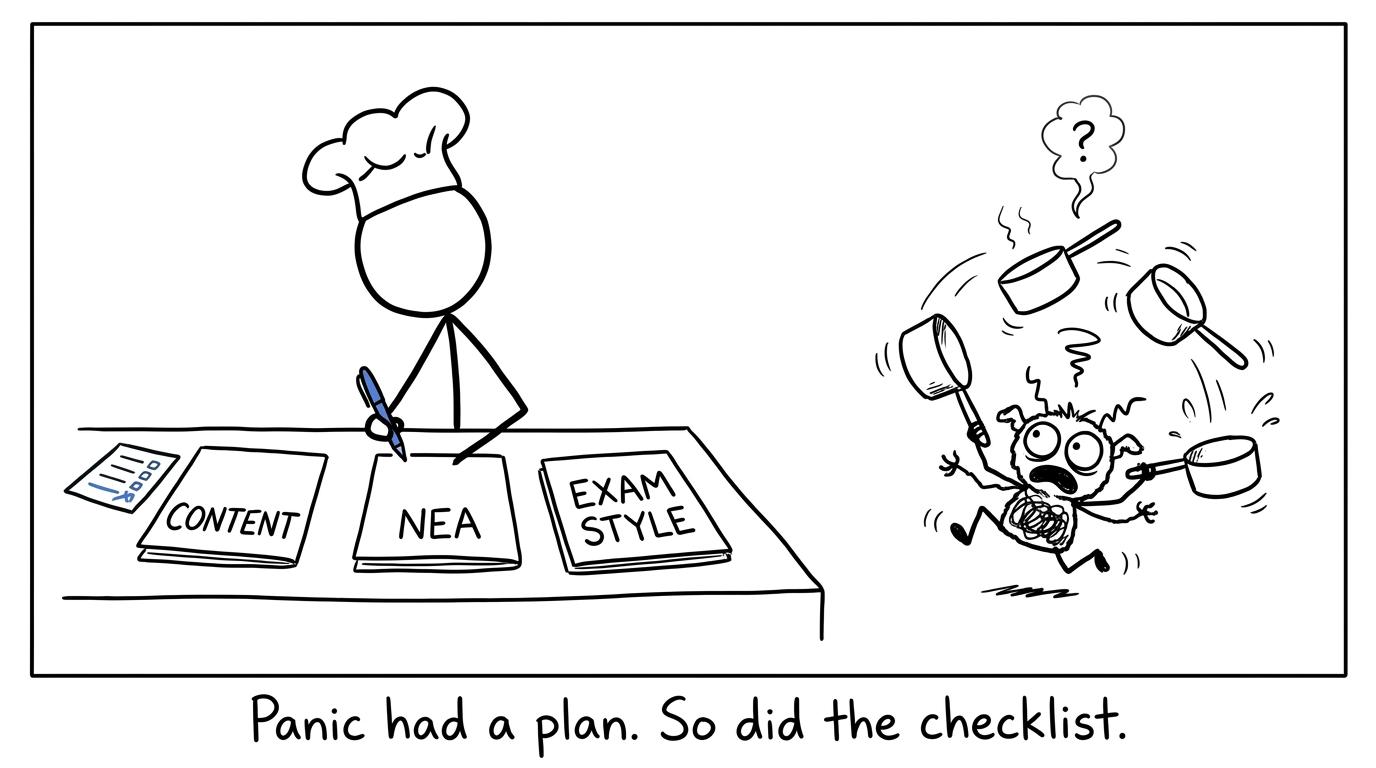 Student organising content, NEA and exam-style folders while a panic monster juggles saucepans
Questions to ask your teacher and exams officer
A useful conversation is specific. Ask:
- Which board and specification code are we leaving?
- Which board and specification code are we joining?
- Has the change been confirmed or is it still being considered?
- Which topics are genuinely new or differently emphasised?
- Have we started live NEA under the old board?
- Has the new awarding organisation confirmed what happens to that work?
- Which task release applies to our cohort?
- Will catch-up time be provided in lessons?
- Where can we find the new paper, mark scheme and assessment criteria?
- Who should students contact inside school if instructions conflict?
Write down the answers. A decision involving NEA, entries and deadlines is too important to leave as a half-remembered corridor conversation.
Common mistakes after an exam-board change
Assuming all specifications are identical
The nationally regulated content creates substantial overlap, but topic organisation, paper style and NEA instructions can differ. Revise from the new specification and assessment materials.
Treating old NEA as automatically transferable
Similar assessment weightings do not create an automatic right to move work across boards. Wait for formal instructions from your school.
Starting the new task without supervision
NEA work must follow the board's conditions. Independent work completed outside those conditions may be unusable and could create authenticity concerns.
Revising only the missing content
Knowing the content is not enough. You must also become familiar with the new board's command words, question structures and mark scheme expectations.
Letting one change derail every subject
Keep a minimum routine for maths and your other GCSEs. Short practice is easier to sustain than a late recovery. If maths is the subject being squeezed, revise GCSE Maths without wasting time by moving directly from a diagnosed weakness to focused questions and feedback.
Using the wrong board or tier resources
GCSE Food Preparation and Nutrition is not divided into foundation and higher tiers, but GCSE Maths is. Check the logo, board and tier on every maths paper. The GCSE maths night-before plan also explains how to avoid last-minute resource mix-ups.
A change of board does not erase your progress
A specification is a route through a subject, not the subject itself. Your practical skills, scientific understanding and knowledge of nutrition do not disappear when the route changes. What matters is identifying where the new route diverges and dealing with those differences before they become surprises.
Get the board and specification code in writing. Ask for a topic map. Insist on a clear answer about NEA before doing new assessed work. Then practise with the correct papers and mark schemes.
While your school manages the Food Preparation and Nutrition transition, let MathsGenie keep your maths revision steady. Start at the free MathsGenie GCSE revision hub, choose your exam board and tier, and use revision lessons, practice questions, mini tests, past papers, predicted papers, mark schemes and video solutions to keep moving towards the grades you want.