

Switch Exam Board GCSE Biology: What Happens?
Switch exam board GCSE Biology with less stress. Learn what changes, what stays, and how to close content gaps while protecting practical and maths marks.
The unsettling part of an exam-board change is rarely the new logo on the textbook. It is the thought that months of work might suddenly count for less.
If your school decides to switch exam board GCSE Biology partway through the course, the short answer is: yes, it is generally possible. Your school must manage the qualification entry, teaching plan and practical requirements. You do not need to relearn the whole subject, but you do need to identify differences between the old and new specifications.
Most core biological ideas remain familiar because regulated GCSE qualifications must cover defined subject content. The details can still move around: topic depth, required practical activities, terminology, paper structure and question style may differ. A calm specification comparison is therefore much more useful than restarting every revision folder.
Your immediate checklist
Ask your biology teacher or exams officer for:
- the full name and qualification code of the new GCSE;
- confirmation of whether you study separate Biology or Combined Science;
- your foundation or higher tier entry, where applicable;
- the first examination series affected by the change;
- a list of content already covered under both specifications;
- any new or different practical activities you must complete;
- the new assessment structure and permitted equipment;
- access to specimen papers, past papers and official mark schemes.
Do not rely on a textbook cover or a revision video title to identify the course. AQA, Pearson Edexcel, OCR and Eduqas offer different qualifications, and each specification has its own code.
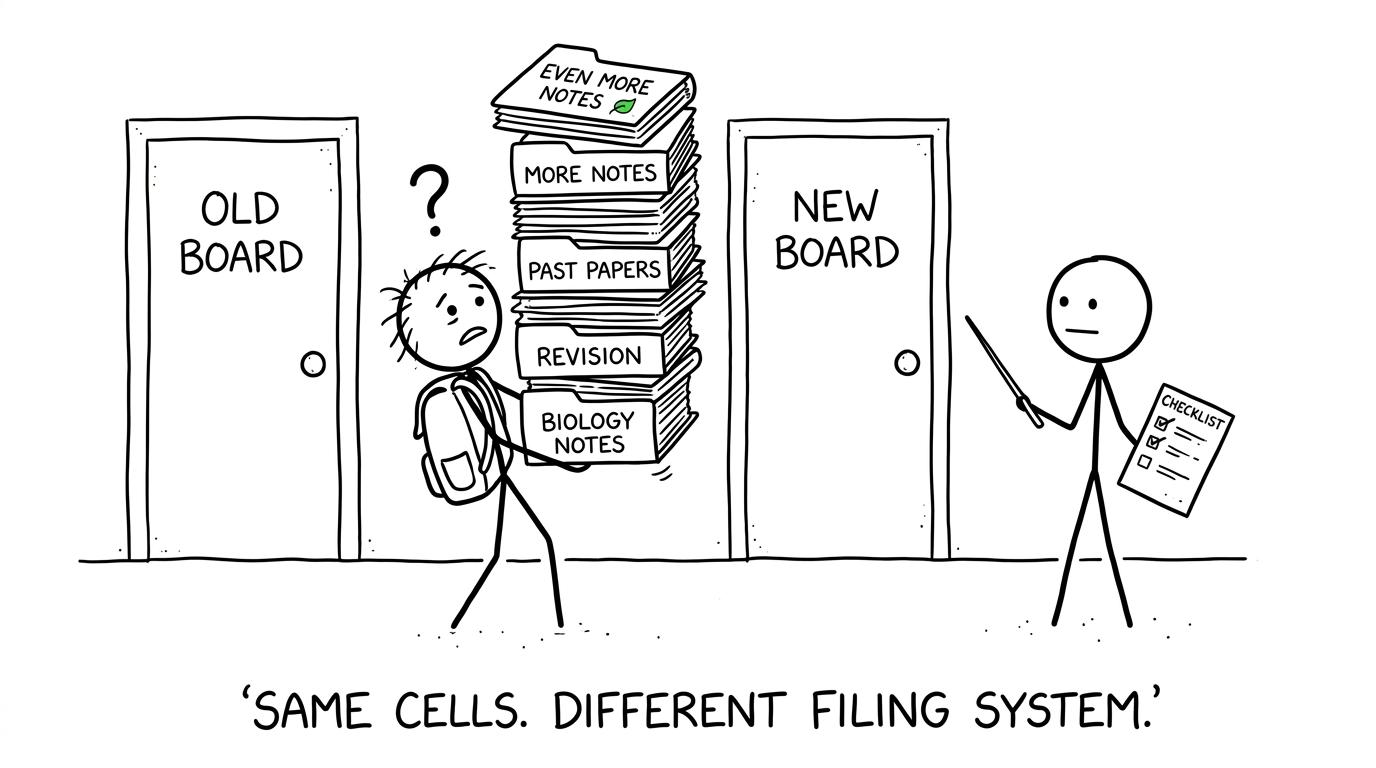 A student choosing between old and new exam-board folders
Is switching GCSE Biology exam board actually allowed?
There is no general rule forcing a school to remain with the same awarding organisation from the beginning of Year 10 to the end of Year 11. Schools are responsible for choosing qualifications and making examination entries through their centre. A change may be made because of teaching resources, assessment preferences, staffing decisions or a wider departmental review.
That does not make a late change effortless. The school must ensure that students are taught the new specification and prepared for its assessment requirements. Examination-entry deadlines, practical arrangements and access arrangements also need to be managed by the centre.
For most students, GCSE Biology is a linear qualification. The final result is based on the assessments belonging to the board for which the student is entered, rather than marks accumulated from lessons completed under a previous board. Your old classwork remains valuable evidence of learning, but it does not become a bank of transferable examination marks.
If the change happens because you move school, the practical outcome is similar. The new school normally enters you for the qualification it teaches. Ask for a transition meeting early, because an apparently familiar topic may have been taught in a different sequence or to a different depth.
What stays the same and what may change?
A cell does not alter because the name on the examination paper changes. Concepts such as inheritance, ecosystems, infection, homeostasis and cell biology appear across GCSE specifications. Scientific reasoning, data interpretation and mathematical skills remain important too.
The differences usually sit around that shared core.
| Likely to remain familiar | Must be checked carefully |
|---|---|
| Major biological concepts | Exact specification statements |
| Planning and evaluating investigations | Required or specified practical work |
| Interpreting tables and graphs | Paper structure and topic distribution |
| Using units and numerical data | Command words and mark-scheme language |
| Applying knowledge to unfamiliar contexts | Depth, terminology and named examples |
| Revision and retrieval methods | Tiering and qualification-specific rules |
A topic heading alone is not enough. Two specifications might both mention genetics, yet expect different detail, vocabulary or applications. Compare individual specification statements rather than simply ticking off chapter titles.
Build a specification gap map
The safest response to an exam-board change is a three-column audit. List each section of the new specification and label it:
- Secure: taught and confidently retrievable;
- Review: taught, but the new board expects different detail or presentation;
- New: not yet taught or linked to a different practical activity.
Your teacher should lead decisions about coverage, but making your own copy gives you a clear revision route. Begin with genuinely new material, then address differences in depth. Do not spend the first week rewriting notes on content you already understand.
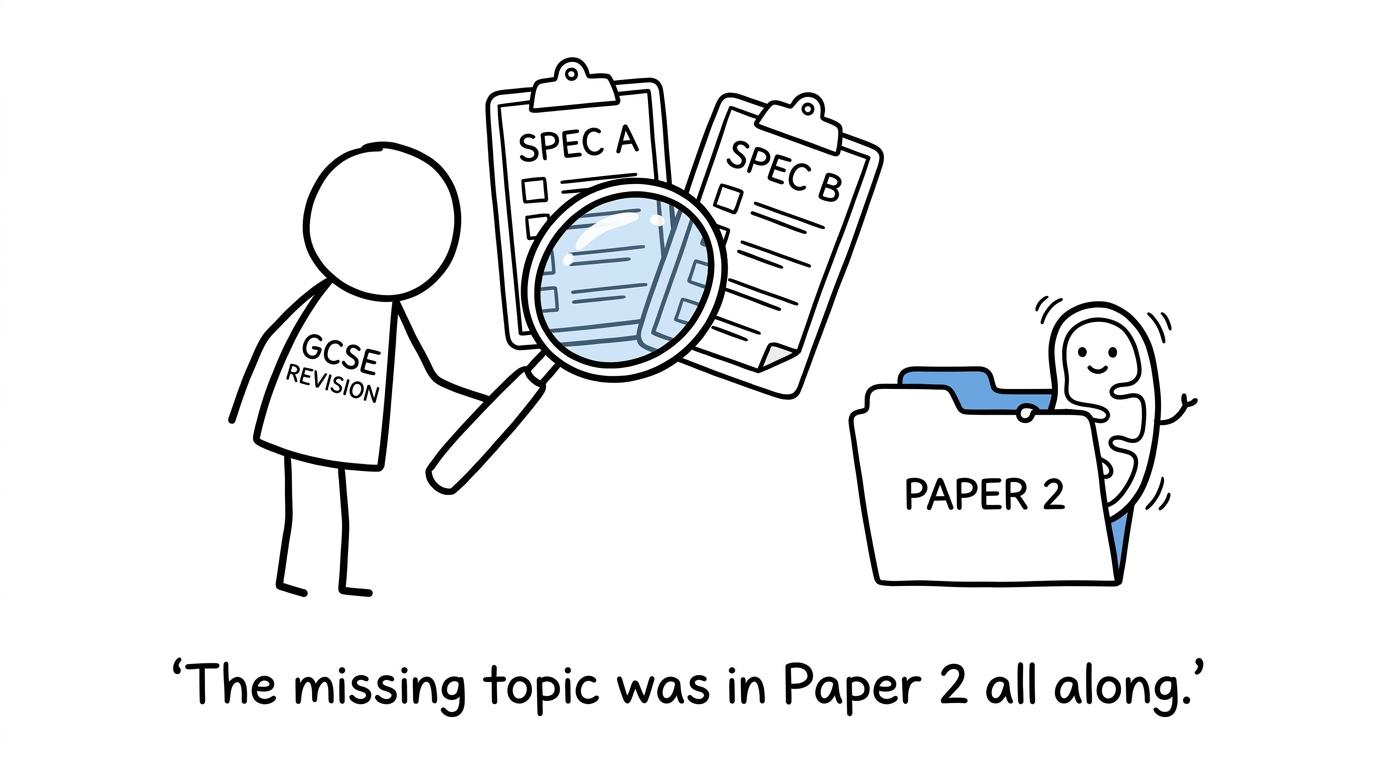 A revision detective comparing two specifications
Check practical work separately
Practical science deserves its own audit. GCSE Biology examinations can test understanding of experimental methods, variables, accuracy, uncertainty, conclusions and evaluation. The relevant practical activities and the language used for them depend on the qualification.
Ask your teacher which activities from the previous course satisfy the new specification and which must be taught or repeated. Your school, rather than an individual student, should confirm this with the relevant awarding organisation when necessary.
When revising a practical, know more than the sequence of instructions. Be ready to explain:
- the independent, dependent and control variables;
- how measurements are taken;
- why repeats may improve reliability;
- likely hazards and suitable precautions;
- how results should be presented;
- whether the evidence supports the conclusion;
- limitations and realistic improvements.
Protect the maths marks in GCSE Biology
An exam-board switch can make question layouts look unfamiliar, but the underlying numerical skills are portable. Biology may require calculations involving percentages, ratios, means, rates, magnification, areas, sampling and graphs.
For instance, percentage change uses:
percentage change=new value−original valueoriginal value×100\text{percentage change}=\frac{\text{new value}-\text{original value}}{\text{original value}}\times 100percentage change=original valuenew value−original value×100Magnification is based on:
magnification=image sizeactual size\text{magnification}=\frac{\text{image size}}{\text{actual size}}magnification=actual sizeimage sizeThe important habit is not memorising an isolated triangle. It is checking units, rearranging accurately and giving an answer with sensible precision.
MathsGenie's free GCSE maths revision lessons can strengthen those transferable skills. In particular, revisit percentages revision and standard form practice if calculations involving very small cells, populations or percentage changes slow you down.
Graphs are another common bridge between the subjects. Check the scale before plotting, label axes with quantities and units, and distinguish interpolation from predictions beyond the observed data. Revising graphs and coordinates can make biological data questions feel less dependent on the wording used by a particular board.
Adjust your revision resources
Old resources are not suddenly useless. They simply need labels.
Keep notes that match the new specification, but mark sections that are no longer required or need extra detail. From the date of the switch, make the new specification your master checklist. Use board-specific resources for question practice, especially near the examination.
A sensible weekly cycle is:
- learn or revisit one specification section;
- retrieve key ideas without looking at notes;
- answer questions written for the new board;
- mark them using the corresponding mark scheme;
- record missing knowledge and weak exam technique;
- revisit those weaknesses several days later.
Official specimen material is particularly useful when few past papers exist for the exact qualification or assessment format. Past papers reveal recurring command words, the amount of working expected and how extended responses are credited. Never combine a paper from one board with another board's mark scheme.
The same feedback cycle supports your maths preparation. MathsGenie's GCSE past papers provide board-specific practice, while predicted papers offer additional preparation alongside, not instead of, official past papers. Video solutions can help you identify the precise step where an otherwise sound method went wrong.
Questions to ask your school
A vague announcement creates unnecessary uncertainty. Ask precise questions and write down the answers:
- Which awarding organisation and specification code are we moving to?
- Will our examination tier change?
- Which topics have not yet been covered?
- Which topics require extra depth?
- Are there practical activities we still need to complete?
- Will the school provide replacement textbooks or digital materials?
- When will we attempt a complete paper from the new board?
- Who should families contact about examination entries or access arrangements?
If you have an access arrangement, such as extra time, changing board does not mean you should organise it alone. Speak to the school's special educational needs co-ordinator or exams officer so that the centre can manage the required process.
Common mistakes after an exam-board change
Restarting the entire course
This feels thorough but wastes time. Audit the new specification first, preserving secure knowledge and targeting genuine gaps.
Assuming identical topic names mean identical content
Headings can conceal differences in depth, examples and terminology. Read the detailed statements beneath each heading.
Revising from mixed-board questions without labels
Cross-board questions can develop broad understanding, but they may also test content outside your course. Label every resource and prioritise material written for your final qualification.
Ignoring practical methods
Knowing the biological theory is not enough if a question asks you to identify variables, evaluate a method or interpret experimental evidence.
Treating the mark scheme as a list of magic words
Precise vocabulary matters, but marks reward a correct answer in context. Understand the causal chain rather than collecting disconnected phrases.
Letting biology displace every other subject
A board change can make one subject feel urgent enough to consume the week. Protect a balanced timetable. MathsGenie's free revision resources and mini tests help you maintain regular maths practice while biology gaps are being addressed.
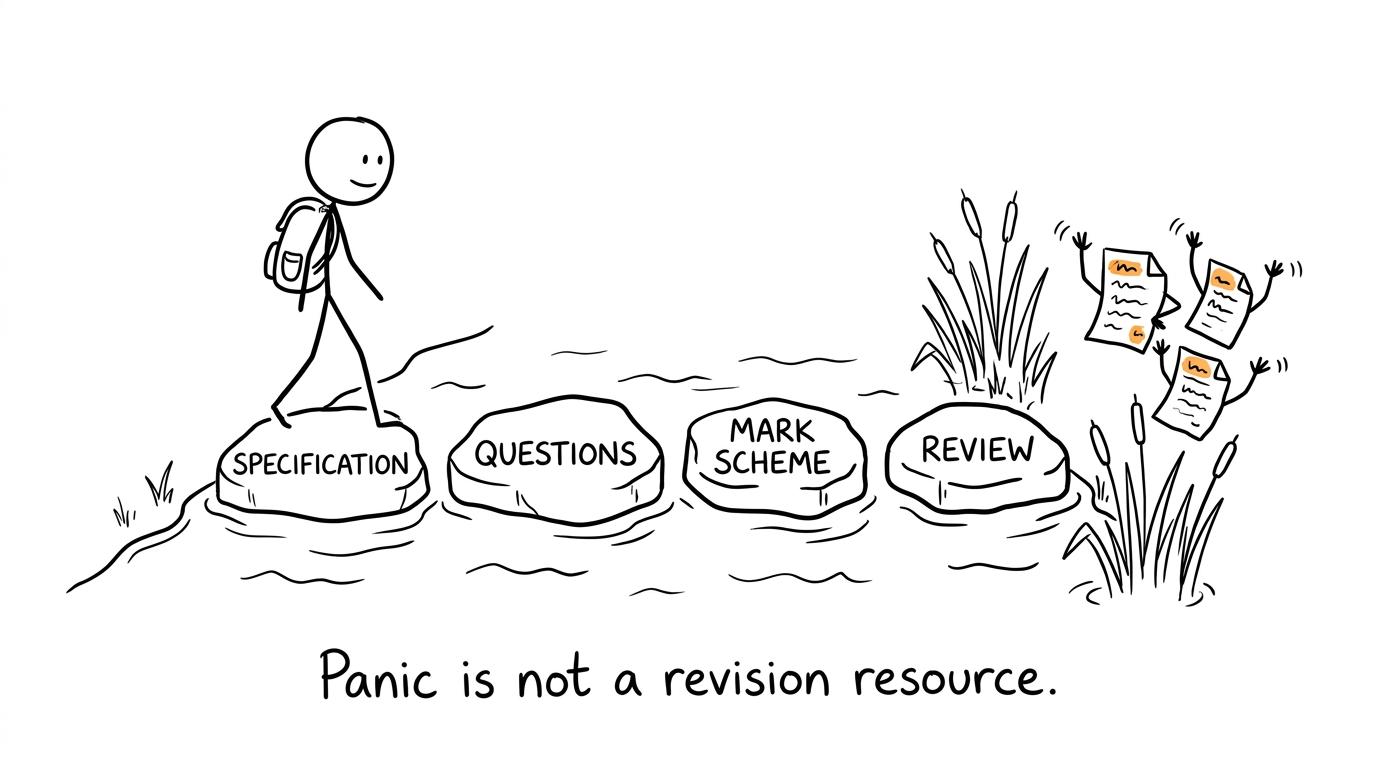 A student crossing from an old course to a new specification
Turn the change into a controlled plan
Switching exam board is disruptive because it introduces uncertainty, not because everything you learnt has vanished. Once the new qualification code, content gaps, practical requirements and assessment structure are clear, the problem becomes finite.
Ask your school for authoritative information. Build a specification map. Practise questions from the correct board and use mark schemes to refine your responses. Keep strengthening the numerical skills that travel between science and maths.
Then return to consistency. Use MathsGenie's free revision lessons, practice questions, mini tests and video solutions to protect your maths progress. Add GCSE past-paper practice and carefully chosen predicted papers to your timetable. An exam-board change may alter the route, but a clear revision system still moves you towards the same destination: confident answers and the marks your understanding deserves.










