Study Playlists for GCSE English Literature Focus
Study playlists GCSE English Literature focus: discover when music may help, when lyrics distract, and how to test your best revision setup before exams.
Revision can look productive before it becomes productive. You clear the desk, find your notes, put on headphones and spend ten minutes choosing the perfect soundtrack. The question behind searches for study playlists GCSE English Literature focus is simple: does that playlist genuinely help you concentrate, or is it mostly a comforting ritual?
The honest answer is that playlists can help some students begin and persist with revision, but there is little reason to assume that music improves the demanding language work itself. Research generally finds that songs with lyrics can interfere with reading comprehension and verbal memory. Instrumental music appears less disruptive, but it has not consistently improved performance compared with silence.
That matters for English Literature, where you must read closely, retrieve quotations and construct an argument. It also matters to MathsGenie students preparing for GCSE maths: the soundtrack that feels harmless during routine questions may become distracting when you meet an unfamiliar problem.
The short answer: playlist, ritual or distraction?
Use this checklist before pressing play:
- Silence is the safest default for close reading, quotation recall and timed writing.
- Instrumental music is the safer musical option if silence makes it difficult to settle.
- Songs with lyrics are more likely to interfere with language-heavy tasks.
- Low volume and familiar tracks reduce novelty, although they do not guarantee better focus.
- A playlist may help as a starting ritual without improving comprehension.
- Your results matter more than your impression, so compare completed work under different conditions.
- Practise some work in exam-like silence, because the examination will not come with headphones.
A playlist is therefore best treated as an environment-setting tool, not a revision method. It cannot replace retrieval practice, essay planning, timed answers or careful marking.
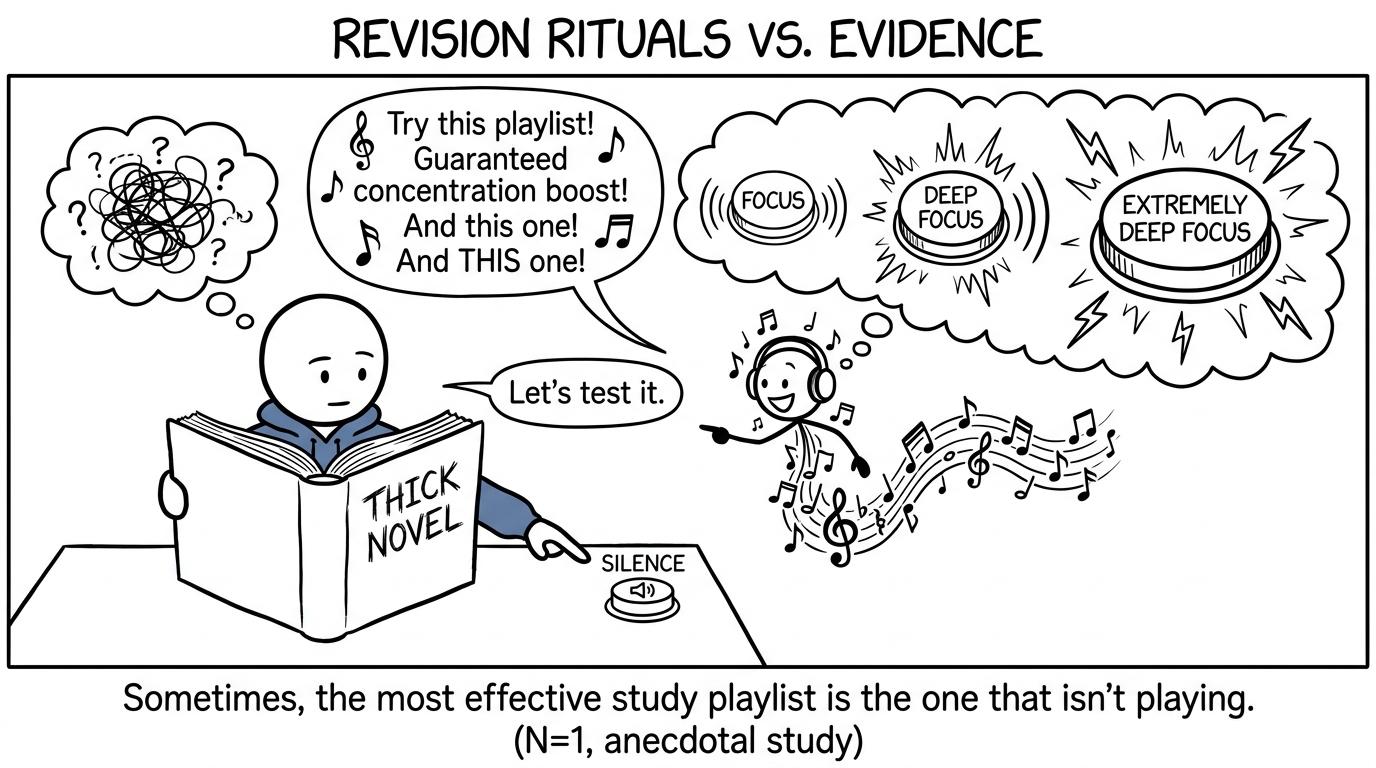 A student tests silence against increasingly dramatic focus playlists
What the research actually suggests
Research into background music and cognitive performance is mixed because studies use different participants, tasks and types of music. That makes sweeping claims such as “classical music makes you cleverer” difficult to justify.
A systematic review covering memory, language, attention and reasoning tasks found that background music did not produce one universal effect. However, negative effects appeared more often in memory and language-based work, particularly when the music contained lyrics. Reading could also become slower.
A controlled study published in 202320232023 compared silence, instrumental lo-fi music and music with lyrics. The participants were university students rather than GCSE pupils, so the findings should not be applied to teenagers without qualification. Even so, the pattern is useful: music with lyrics harmed verbal and visual memory and reading comprehension, while instrumental music produced no credible overall improvement over silence.
Research published in 202420242024 also found poorer reading comprehension with lyrical pop music than with no music. The interference was strongest when the language of the lyrics matched the language being read. Again, the participants were college students, not GCSE candidates.
Taken together, the evidence supports a cautious conclusion: lyrics are a meaningful risk during verbal revision, while instrumental music is usually neutral rather than magical. Individual responses vary, but personal preference alone is not proof of improved learning.
Why English Literature is especially vulnerable to lyrics
GCSE English Literature is not passive reading. Across AQA, Edexcel, OCR and Eduqas, students must understand texts, develop interpretations, select textual evidence and analyse how writers use language, form and structure. The exact paper structure differs by board, but these core assessment demands are shared.
Your attention may need to hold several things at once:
- the wording of the question;
- a relevant quotation or textual reference;
- the writer's method;
- an interpretation;
- contextual understanding where relevant;
- the logical direction of your paragraph.
A song with words introduces another stream of language. Even when you believe you are ignoring it, the lyrics can compete with the language you are reading or composing. This is why a favourite vocal track may be fine while organising folders but unhelpful while analysing a soliloquy or comparing poems.
The distinction is not simply “music is bad”. It is task versus sound. Revision requiring verbal memory and semantic analysis leaves less room for competing words.
When a study playlist can still be useful
A ritual is not worthless merely because it does not directly raise comprehension. Rituals reduce decisions. If putting on the same quiet instrumental playlist signals that revision has begun, it may help you move from avoidance to action.
Starting a revision session
The hardest part of revision is sometimes opening the book. A short, predetermined playlist can remove the temptation to browse endlessly. Start the music, put your phone out of reach and begin the first task immediately.
This works particularly well when the task is clearly defined. Maths students could open the GCSE Maths revision hub, select one topic and move directly from a revision lesson to practice questions. English students might retrieve quotations for one character before checking the text.
Completing routine or organisational work
Instrumental music may be acceptable while creating a revision timetable, sorting quotation cards or marking straightforward answers. It is less likely to compete when the task has become familiar and requires little new interpretation.
The same principle applies in maths. A familiar set of arithmetic questions may tolerate background music better than a multi-stage reasoning problem. The Edexcel GCSE Maths mini tests can help you notice whether music affects your speed and accuracy on focused tasks.
Making an unpleasant environment manageable
Silence is not always available. In a busy household, steady instrumental sound may mask unpredictable conversations, doors and televisions. The playlist is not necessarily enhancing cognition; it may simply be replacing a more disruptive soundscape with a stable one.
That is a practical benefit. The important thing is to describe it accurately.
Match the soundtrack to the revision task
Different tasks place different demands on attention. A sensible rule is to reduce sound as cognitive difficulty rises.
| Revision task | Sensible audio choice |
|---|---|
| Organising notes or planning the week | Quiet instrumental music may be suitable |
| Reviewing familiar flashcards | Test silence and instrumental music |
| Learning quotations | Silence is usually the safer choice |
| Closely analysing an extract | Prefer silence |
| Writing a timed essay | Use exam-like silence |
| Completing unfamiliar maths problems | Prefer silence or very unobtrusive sound |
| Sitting a past paper | Recreate examination conditions |
For maths revision, a structured process matters more than the soundtrack. The best order for learning GCSE maths topics moves from core knowledge towards exam technique. Music should never interrupt that sequence of learning, practising, marking and retesting.
Test whether your playlist actually helps
The best playlist is not the one with the most convincing title. It is the one that survives a fair comparison.
Choose two similar revision tasks. For English Literature, these could be two extract-analysis plans from the same text or two comparable quotation-retrieval sets. Complete one in silence and one with your usual playlist. Keep the time, difficulty, workspace and access to notes as similar as possible.
Then record:
- how much work you completed;
- how many accurate quotations or ideas you retrieved;
- how often you reread a sentence;
- how often you touched your phone or changed tracks;
- the quality of the finished response after checking it;
- how well you remembered the material the following day.
Repeat the comparison more than once and alternate which condition comes first. Otherwise, tiredness or task difficulty may distort the result.
The key is to measure output rather than mood. Feeling calm is valuable, but calmness and learning are not identical. A playlist can make revision feel smoother while quietly slowing your reading.
Maths students can run the same test with comparable question sets, then use a mark scheme rather than intuition to judge performance. The GCSE past papers library provides real papers organised by exam board, while the guide to finding your weakest GCSE topics explains how to turn lost marks into focused practice.
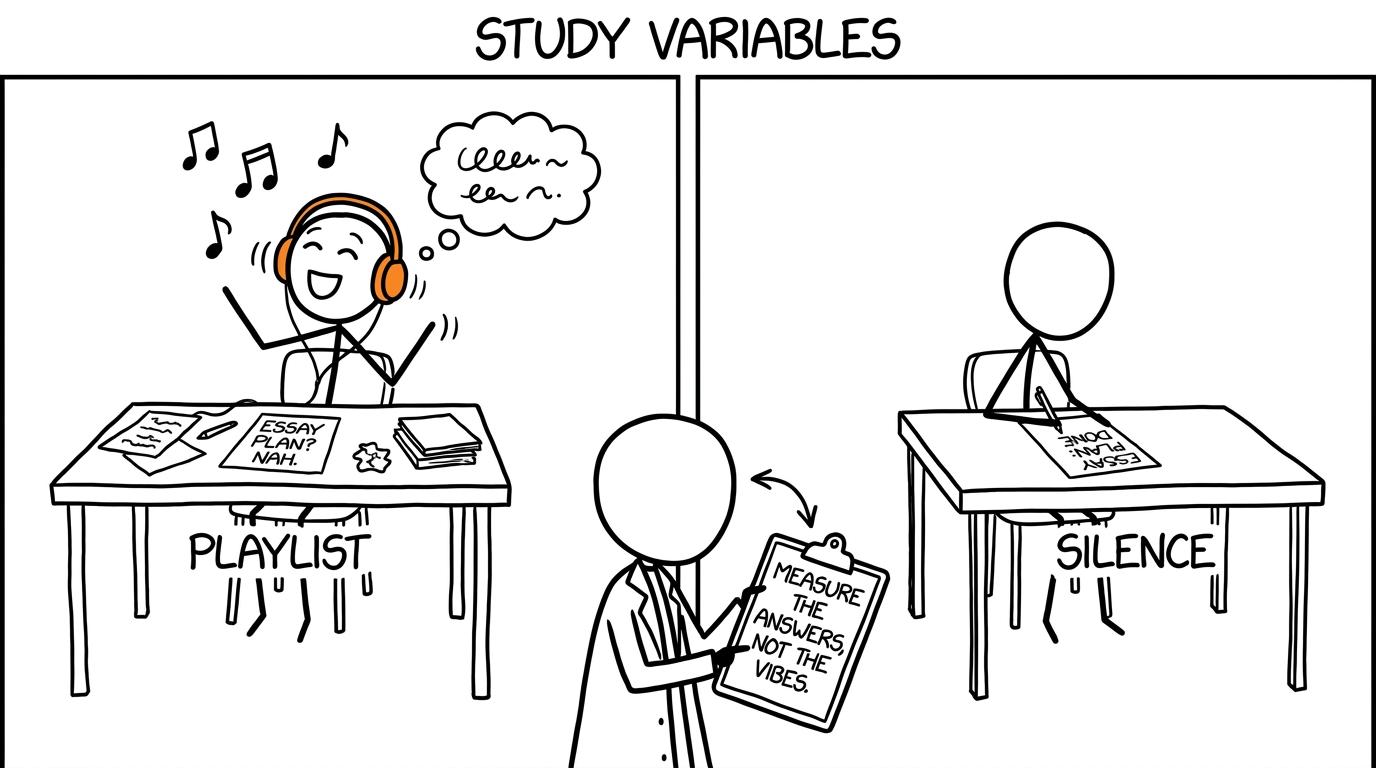 A revision experiment measures completed answers rather than playlist vibes
Build a playlist that minimises distraction
If your own testing shows that music helps you remain at the desk without reducing performance, keep the playlist deliberately uninteresting.
Choose tracks that are:
- instrumental rather than lyrical;
- familiar enough not to demand attention;
- quiet and relatively consistent;
- free from adverts and spoken introductions;
- long enough to avoid repeated track selection;
- downloaded or queued before revision begins.
Avoid dramatic changes in tempo, tracks strongly linked to memories and songs that invite you to sing. Film and game soundtracks can still become distracting if they are emotionally intense, so “instrumental” should not automatically mean “suitable”.
Set the playlist once. Do not keep refining it during the session. If selecting music becomes the main activity, the ritual has replaced the work.
Practise the conditions you will face in the exam
GCSE English Literature examinations require sustained independent reading and writing without personal music. Many specifications are closed book, although the precise stimulus material and question format depend on the exam board. Your preparation should reflect your own current specification.
Regular silent practice teaches you to manage attention without an audio cue. It also reveals whether your quotations, analytical vocabulary and essay structures can be retrieved under realistic pressure.
The same principle is essential in maths. Use the past paper practice features to work with a timer and mark scheme, and follow the guide to using GCSE past papers properly. Predicted papers can sharpen final preparation, but they should still be completed under controlled conditions.
A practical compromise is to use quiet instrumental music for the opening learning block, then turn it off for retrieval and timed practice. That preserves the starting ritual while training the performance conditions that matter.
Common mistakes with revision playlists
Assuming enjoyment proves effectiveness
Enjoyable revision may improve persistence, but it does not automatically improve memory or comprehension. Check the finished work and test recall later.
Choosing familiar songs with lyrics
Familiarity can make distraction less noticeable, not necessarily less real. English lyrics are particularly risky when you are reading and writing in English.
Spending longer curating than revising
A playlist should reduce decisions. If you search for tracks during every break, it has become another form of procrastination.
Using music during every task
Quotation learning, close analysis, unfamiliar problem solving and timed papers place different demands on attention. One audio rule does not fit every task.
Never practising in silence
Headphones can become a dependency. Include silent sessions so that exam conditions feel normal rather than strangely empty.
Treating music as the revision strategy
The soundtrack does not retrieve knowledge, answer questions or expose misconceptions. For maths, use the 20-minute GCSE revision routine: choose a topic, practise actively, mark the work and record the next step. The same underlying cycle works in English when questions and quotations replace calculations.
Make the work, not the playlist, the main event
Study playlists are neither a guaranteed concentration tool nor a complete waste of time. Their most believable benefit is behavioural: they can signal the start of revision, mask worse background noise and make a session easier to continue. Their main risk is cognitive, especially when lyrics compete with reading, verbal memory and writing.
Start with silence for demanding English Literature work. If that makes revision difficult to sustain, try low-volume instrumental music and test it honestly. Then turn the music off for timed answers and past papers.
For your maths exams, let MathsGenie provide the structure. Build a plan with the revision planner, learn through free revision lessons, practise with topic questions and mini tests, and check your decisions against mark schemes and video solutions. When the foundations are secure, move to past papers and predicted papers. Students continuing beyond GCSE can follow the same evidence-led approach through the A Level Maths revision hub.
Pressing play may begin the session. What you retrieve, practise and correct is what moves it forward.