Study Playlists GCSE Engineering Focus: Do They Help?
Study playlists GCSE engineering focus: learn when music may aid revision, when lyrics distract, and how to test what improves your exam work in practice.
There is a familiar revision trap: you sit down to work, open a music app and spend longer choosing the soundtrack than answering questions. If you are searching for study playlists GCSE engineering focus, the honest answer is simple. A carefully chosen playlist may make revision feel easier to begin, but there is little evidence that music reliably improves learning or accuracy. Lyrics are particularly likely to interfere with reading and memory, while quiet instrumental music is often neutral rather than genuinely helpful.
That does not make every playlist useless. It means the playlist should support the work, not become the work.
The quick checklist
Before pressing play, ask:
- Does the task involve reading, remembering definitions or interpreting a long question? Start with silence.
- Are you completing familiar calculations or organising notes? Quiet instrumental music may be acceptable.
- Do you keep changing tracks? Use a fixed playlist or turn it off.
- Can you complete the same work more accurately in silence? Trust the result, not the atmosphere.
- Are you preparing under timed conditions? Recreate the quiet conditions of the exam.
The most useful test is not whether a playlist feels productive. It is whether you complete accurate, demanding work while it plays.
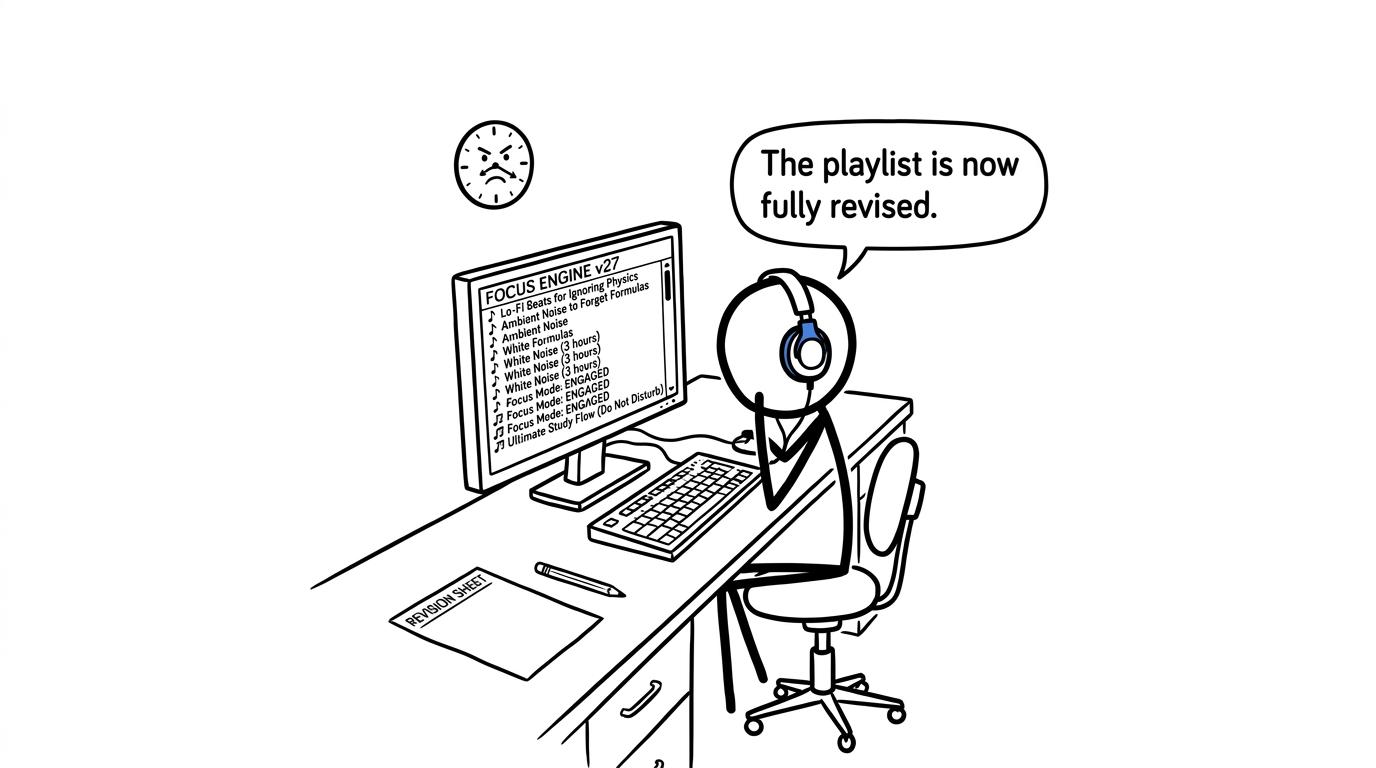 A student perfects a revision playlist while the revision sheet waits
What research says about music and concentration
Research into background music is mixed because concentration is not a single skill. Reading, calculation, memory and visual reasoning place different demands on attention.
A systematic review published in 202220222022 examined 959595 articles containing 154154154 experiments. It found a generally negative effect of background music on memory and language tasks. Music with lyrics tended to be more disruptive than instrumental music, while many other conditions produced no clear effect at all. Difficult tasks were also more vulnerable to distraction than easy ones.
A controlled study published in 202320232023 compared silence, instrumental lo-fi music and music with lyrics. Lyrics reduced performance in verbal memory, visual memory and reading comprehension. Instrumental music did not provide a credible improvement over silence. Arithmetic performance was less clearly affected, but that does not prove that music makes mathematical work better.
More recent research continues to show that the outcome depends on the task, the listener and the music. Instrumental music may sometimes reduce the feeling of mental fatigue or make repetitive activity more pleasant. Feeling less tired, however, is not automatically the same as remembering more or earning more marks.
There is also an important limit to the evidence: these studies do not directly prove what will happen to every GCSE Engineering student. Much of the research uses adults or university students and laboratory tasks. The sensible conclusion is therefore cautious. Lyrics are a known risk, instrumental music may be neutral, and silence remains the safest default for demanding revision.
Why GCSE Engineering focus changes with the task
GCSE Engineering revision combines several kinds of thinking. Depending on your specification, you may need to recall processes, interpret technical information, analyse data and apply mathematical concepts in engineering contexts. AQA's specification, for example, expects students to apply mathematical knowledge within engineering rather than treating it as an isolated exercise.
The best listening choice can therefore change from one revision block to another.
| Revision task | Sensible starting condition |
|---|---|
| Reading technical explanations | Silence |
| Learning terminology or process sequences | Silence |
| Interpreting an unfamiliar exam question | Silence |
| Completing familiar calculations | Silence or quiet instrumental music |
| Drawing, filing notes or organising resources | Quiet instrumental music may be suitable |
| Sitting a timed paper | Exam-style silence |
Reading and remembering
Words in a song compete with words on a page. This matters when you are learning properties of materials, manufacturing processes, quality-control terminology or the stages of an engineering system.
Even if you believe you can ignore the lyrics, your attention may still be switching between two verbal streams. That small interruption can make a dense paragraph harder to understand and a definition harder to retrieve later.
Mathematical engineering questions
Engineering calculations may involve ratio, percentages, standard form, units, graphs, areas, volumes and substituting into formulae. You can strengthen these foundations through the free GCSE Maths revision hub, which organises lessons and questions by topic and exam board.
Music may be less disruptive during a familiar calculation than during technical reading. But unfamiliar questions require you to decide what information matters, select a method and check units. That is complex problem-solving, so silence is still a strong first choice.
Repetitive and administrative work
A playlist is most defensible when the mental demand is low. Instrumental music might help you settle while organising notes, labelling folders or copying corrections into an error log.
The danger is carrying the same soundtrack into harder work without noticing. A song that is harmless while sorting paper may become distracting when you must decode a multi-step question.
Are playlists useful, or mostly a revision ritual?
Often, they are both.
A ritual can have value. Using the same short instrumental playlist may signal that revision is beginning. It can mask unpredictable household noise and reduce the temptation to browse for entertainment. If pressing play helps you open the question paper immediately, the playlist has performed a useful job.
But rituals become expensive when preparation replaces practice. Naming playlists, searching for the perfect lo-fi mix and changing tracks are not revision activities. They produce the feeling of control without testing any knowledge.
A reliable session has visible output: attempted questions, marks checked, mistakes classified and weak topics revisited. The twenty-minute GCSE maths revision routine provides a compact structure when starting feels difficult. Choose the resource before choosing the soundtrack.
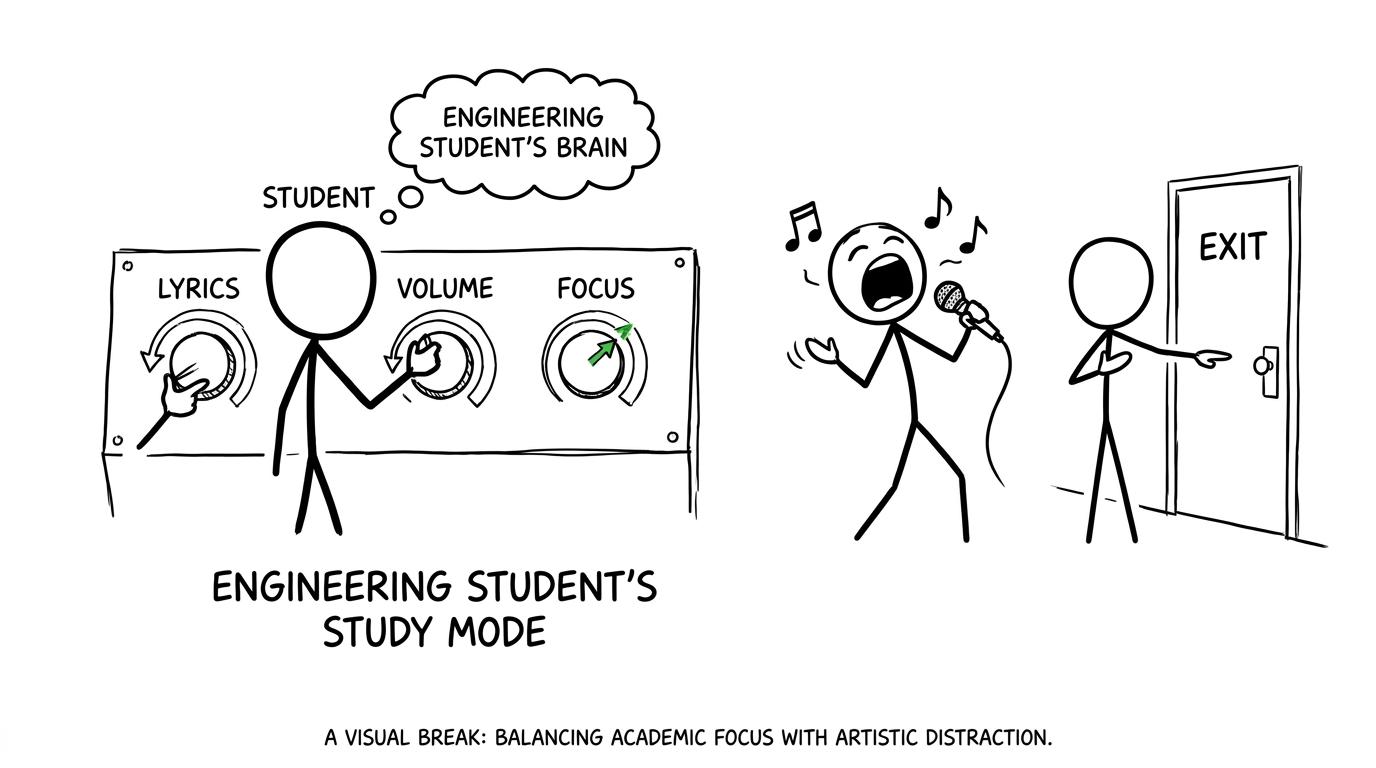 A focus control panel turns lyrics and volume down
How to build a playlist that creates less distraction
If silence feels uncomfortable or your surroundings are noisy, use music deliberately.
Remove lyrics
Choose instrumental tracks, ambient sound or unobtrusive background audio. Avoid songs you know so well that you anticipate every line. Familiarity can make music feel comfortable while still pulling attention towards it.
Keep the volume low
The music should remain in the background. If it covers your internal reading voice or makes you miss details in a question, it is too prominent.
Use a fixed queue
Select the playlist before the session. Turn off notifications, autoplay surprises and track recommendations where possible. Every decision about the next song is attention taken away from revision.
Match its length to one work block
A short, fixed playlist can act as a boundary for a focused session. When it ends, stop briefly, mark the work and decide what to fix. The GCSE revision guide for reluctant starters explains how small loops of learning, questions and immediate marking can replace vague hours at a desk.
Practise silence before the exam
Edexcel, AQA, OCR and Eduqas exams do not come with personal soundtracks. Complete regular timed work without music so quiet does not feel unfamiliar. Use the advice in how to use GCSE past papers properly: sit the correct paper, mark it carefully, log errors, relearn weak topics and retest them.
Run your own fair focus test
Personal preference matters, but preference should not be the only measurement. Compare silence with one low-volume instrumental playlist over several similar sessions.
Keep the conditions as consistent as practical:
- use question sets of similar difficulty;
- work for the same length of time;
- keep your phone out of reach;
- record questions attempted, marks earned and careless errors;
- note how often you pause, skip tracks or reread instructions;
- repeat each condition rather than judging one unusually good day.
Do not compare an easy worksheet with music against a difficult paper in silence. The tasks must be reasonably similar. The winning condition is the one that supports accurate work and sustained attention, not the one that creates the best mood.
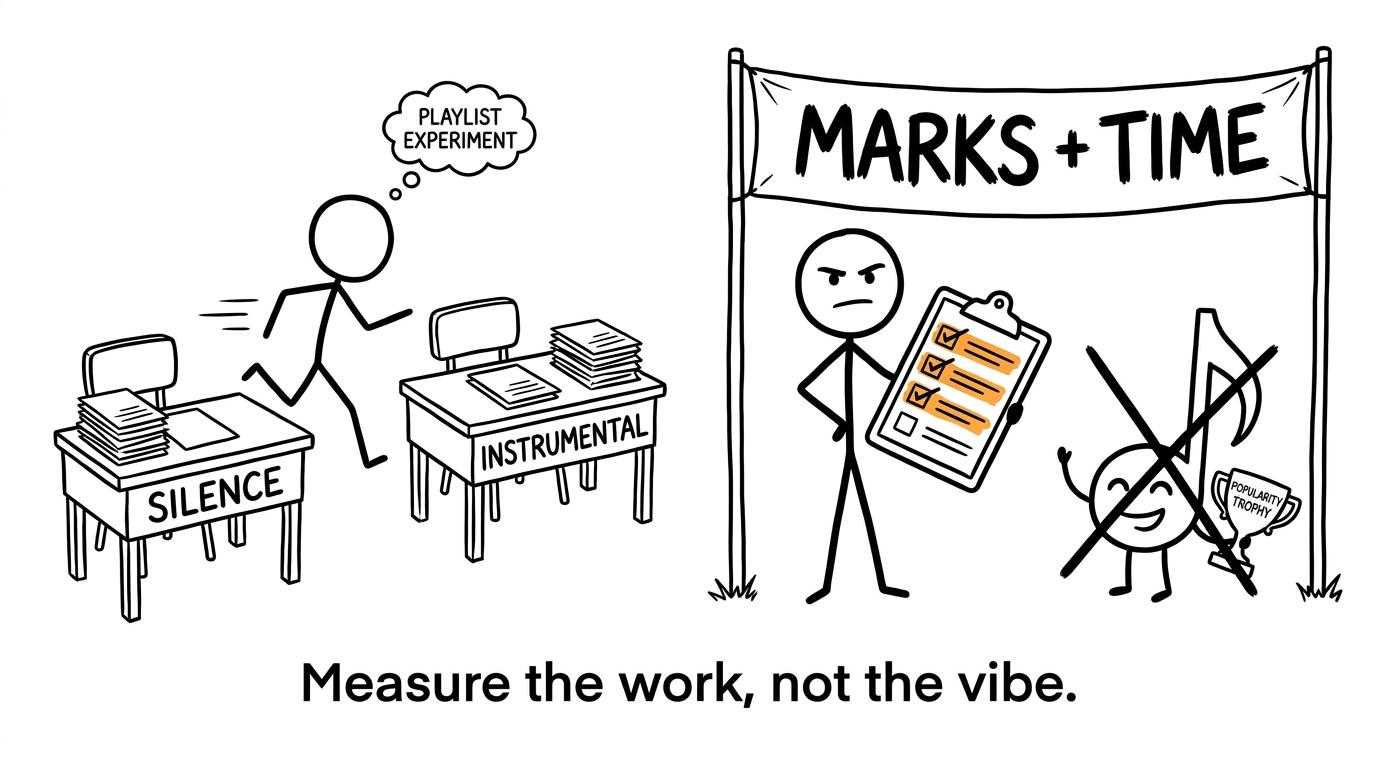 A fair playlist experiment measures marks and time rather than vibes
Common mistakes with study playlists
Assuming enjoyment means improvement
Music can make revision more pleasant without improving memory or accuracy. Enjoyment matters if it helps you begin, but check completed work before declaring the playlist effective.
Revising definitions with lyrical music
This creates direct competition for verbal attention. Use silence when learning terminology, reading mark schemes or recalling process sequences.
Constantly changing tracks
Skipping, searching and checking notifications fragment the session. Use one fixed queue or remove music completely.
Using music for every type of work
A soundtrack that suits simple questions may fail during unfamiliar reasoning. Change the environment when the cognitive demand changes.
Never rehearsing exam conditions
If every practice paper includes music, the real exam may feel strangely quiet. MathsGenie's GCSE maths exam-week checklist can help you build calmer, realistic paper practice.
Spending more time curating than practising
A polished playlist earns no marks by itself. Once the music is decided, move quickly into revision lessons, practice questions or a timed test.
Make the work the main event
Study playlists can be a useful doorway into GCSE Engineering revision, especially when quiet instrumental music masks background noise or creates a consistent starting ritual. They are not a proven shortcut to deeper concentration. For reading, memory and difficult problem-solving, silence is usually the safer option. Lyrics carry the greatest risk.
Begin with one real task. Use a MathsGenie revision lesson to repair the underlying maths, answer practice questions, then mark the work immediately. Progress to mini tests, past papers and predicted papers, using mark schemes and video solutions to understand every lost mark. The revision planner can keep those sessions balanced across the week.
A playlist may help you sit down. What improves your grade is what happens after you do.